

Key Takeaways
Why the Finance Office Exists to Sell You More Than a Car
You've shaken hands on a price you're happy with. The salesperson walks you to a back office, introduces you to the finance manager, and asks you to wait for paperwork. What happens next is one of the most profitable fifteen minutes in retail America.
The finance and insurance (F&I) office is where new car dealerships make a significant chunk of their total profit. Salespeople are coached to get you to a number you'll agree to, then hand you off to someone whose entire job is to add revenue through products you didn't ask for. According to the National Automobile Dealers Association, the average F&I gross profit per new vehicle sale sits above $1,500 — and that figure has been climbing.
This isn't inherently corrupt. Some of what they sell is genuinely useful. But the process is designed to soften resistance: you're already excited about the car, you've spent hours at the dealership, and you want to go home with keys in hand. The finance manager knows this. They're trained to use it.

Understanding the mechanics of that room is the first step to not losing money in it. See our guide to dealer negotiation for strategies that apply before you ever sit down with finance.
$1,500+
Average F&I profit per new vehicle sale
According to NADA data, average dealership F&I gross profit per new vehicle has exceeded $1,500 and continues to climb as product menus expand.
15–20%
New car depreciation in year one
Industry data consistently shows new vehicles lose 15–20% of their value in the first 12 months, creating significant GAP insurance exposure for low-down-payment buyers.
$300–$1,500
Dealer charge for paint protection
Dealer paint sealants and polymer coatings are typically priced between $300 and $1,500, while comparable aftermarket ceramic coatings from detailers cost similar amounts but with far superior durability.
78%
Nitrogen already in regular air
Earth's atmosphere is approximately 78% nitrogen, making the premium charged for 'nitrogen tire inflation' at dealerships — often $150–$300 — largely indefensible on scientific grounds.
The Most Common Add-Ons — and What They Actually Cost You
Every dealership has its own menu, but these items appear across virtually every F&I office in the country. Knowing what they are, what they cost to produce, and what alternatives exist strips the mystique right out of the pitch.
Paint Protection Film or Sealant
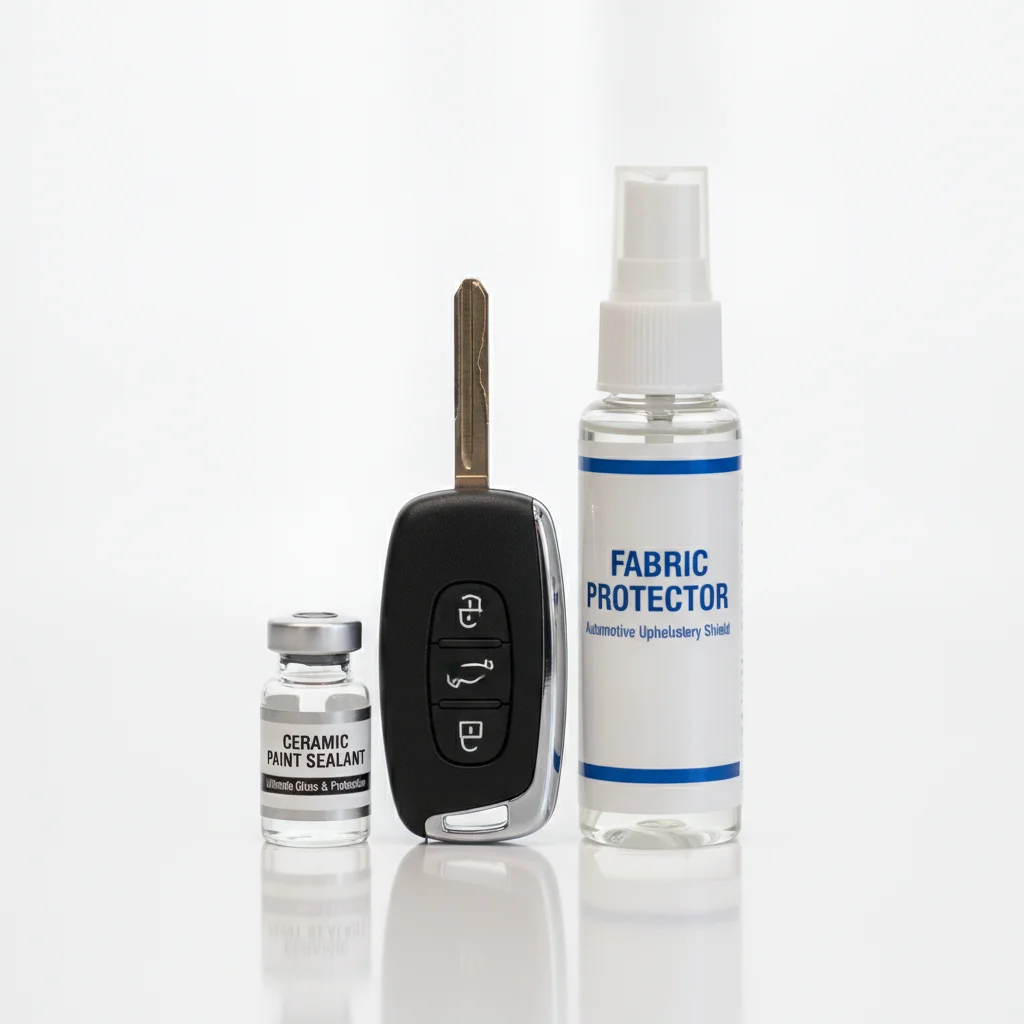
Dealers charge $300–$1,500 for paint sealant or polymer coatings applied in-house. The actual product often costs under $30 and takes a technician less than an hour to apply. A quality ceramic coating from a reputable detailer runs $500–$1,200 and outperforms anything a dealer applies on a sales lot. If paint protection matters to you, source it independently after purchase.
Fabric and Carpet Protection
This is usually Scotchgard-equivalent spray applied to seats and carpet — retail cost under $20 for a can, dealer charge $200–$400. You can apply comparable protection yourself in an afternoon. Worth noting: many new vehicles already arrive with factory-treated upholstery.
VIN Etching
The idea is that etching your VIN into windows deters theft and may support an insurance claim. Dealers charge $100–$400 for this. DIY kits cost less than $30, and many states run free VIN etching programs. Some insurers don't discount premiums for it at all. It's not worthless, but paying dealer prices for it is.
Nitrogen Tire Inflation
Nitrogen is presented as a premium alternative to regular air. The reality: the atmosphere is already 78% nitrogen. The marginal benefit of pure nitrogen — slightly more stable pressure in extreme temperature swings — is not detectable in normal driving. Dealers charge $150–$300 for this. Pass entirely.
Key Fob Replacement Insurance
Modern key fobs can cost $200–$500 to replace, so the pitch sounds reasonable. But check your existing insurance policy and credit card benefits before buying a separate plan. Many comprehensive auto policies already cover key replacement, and some premium credit cards include it as a perk. Paying $300–$500 for duplicate coverage you already own is a common and avoidable mistake.
For a deeper breakdown of which extras have genuine value versus which exist purely to pad the deal, see which dealer add-ons to decline.
Agreeing to add-ons presented as monthly payment increases rather than total costs.
Why it happens: After hours of negotiating, buyers focus on monthly affordability rather than total loan cost. A $20/month add-on sounds trivial but adds hundreds in interest over a 72-month loan.
Paying dealer prices for GAP insurance when the same product is available at a fraction of the cost elsewhere.
Why it happens: Buyers assume GAP must be purchased at the dealership, often because the finance manager presents it that way. The urgency of closing the deal discourages comparison shopping.
Accepting pre-installed dealer accessories without negotiating their cost off the purchase price.
Why it happens: Items like mud flaps, cargo mats, or paint film are installed before you arrive and presented as part of the vehicle. Many buyers assume they're mandatory once physically on the car.
Buying key fob replacement insurance, roadside assistance, or rental coverage the buyer already has.
Why it happens: Few buyers know exactly what their auto insurance policy and credit cards cover. Finance managers rely on this gap to sell duplicate coverage.
Treating the F&I office as separate from the price negotiation, allowing gains made on the floor to be erased.
Why it happens: Buyers mentally close the price deal before entering the F&I room, then evaluate add-ons in isolation without connecting them to total vehicle cost.
Agreeing to an extended warranty without comparing price and coverage terms to outside sources.
Why it happens: Extended warranties are pitched at a moment of high emotional investment and time pressure. Buyers rarely know what comparable coverage costs from a credit union, manufacturer, or third-party provider.
When an Add-On Might Actually Make Sense
Not everything from the F&I menu is a bad deal by definition — it depends on your situation and what you're paying. Two products in particular warrant careful evaluation rather than automatic rejection.
GAP Insurance
Guaranteed Asset Protection covers the difference between what you owe on your loan and what your car is worth if it's totaled or stolen. New cars depreciate roughly 15–20% in their first year, so if you put down less than 20% or financed over 60 months, you can easily end up owing more than the car is worth. GAP from a dealer typically costs $400–$900. The same product through your own insurer or credit union often runs $20–$40 per year — a fraction of the dealer price. If you need GAP, buy it cheap, not from the F&I desk.
Don't Roll Add-Ons Into a Long Loan
Financing add-ons over 60 or 72 months means you pay interest on products that depreciate immediately — or have no resale value at all. A $900 GAP insurance product rolled into a 72-month loan at 7% APR costs you closer to $1,100 by payoff. If you want a product, ask to pay for it separately or remove it from the contract.
Pre-Installed Extras Are Not Mandatory
Some dealers install accessories before delivery and present them as part of the vehicle's configuration. Window tinting, door edge guards, cargo liners, and paint film are common examples. These items are not required for the sale to proceed. Insist they be removed from the price or removed from the car — your choice, not theirs.
Extended Warranties (Vehicle Service Contracts)
Dealer-sold extended warranties, technically called vehicle service contracts, can have value — but only if you're keeping the car well past the manufacturer warranty, and only if the price is competitive. A dealer will quote $2,500–$4,500 for coverage you might find at $1,200–$1,800 from a third-party provider or the manufacturer directly. Always get the exact contract terms in writing and compare before agreeing. Our full analysis of extended warranties on new cars walks through exactly when they're worth the money.
You Can Say No to Every Single Add-On
No dealer add-on is legally required to complete a new car purchase. Finance managers are trained to present some items — particularly GAP insurance — as quasi-mandatory for financed purchases. This is false. Your signature is required; their product menu is not. If you feel pressured, ask to see the contract with all optional products removed before you review it.
Read Every Line Before You Sign
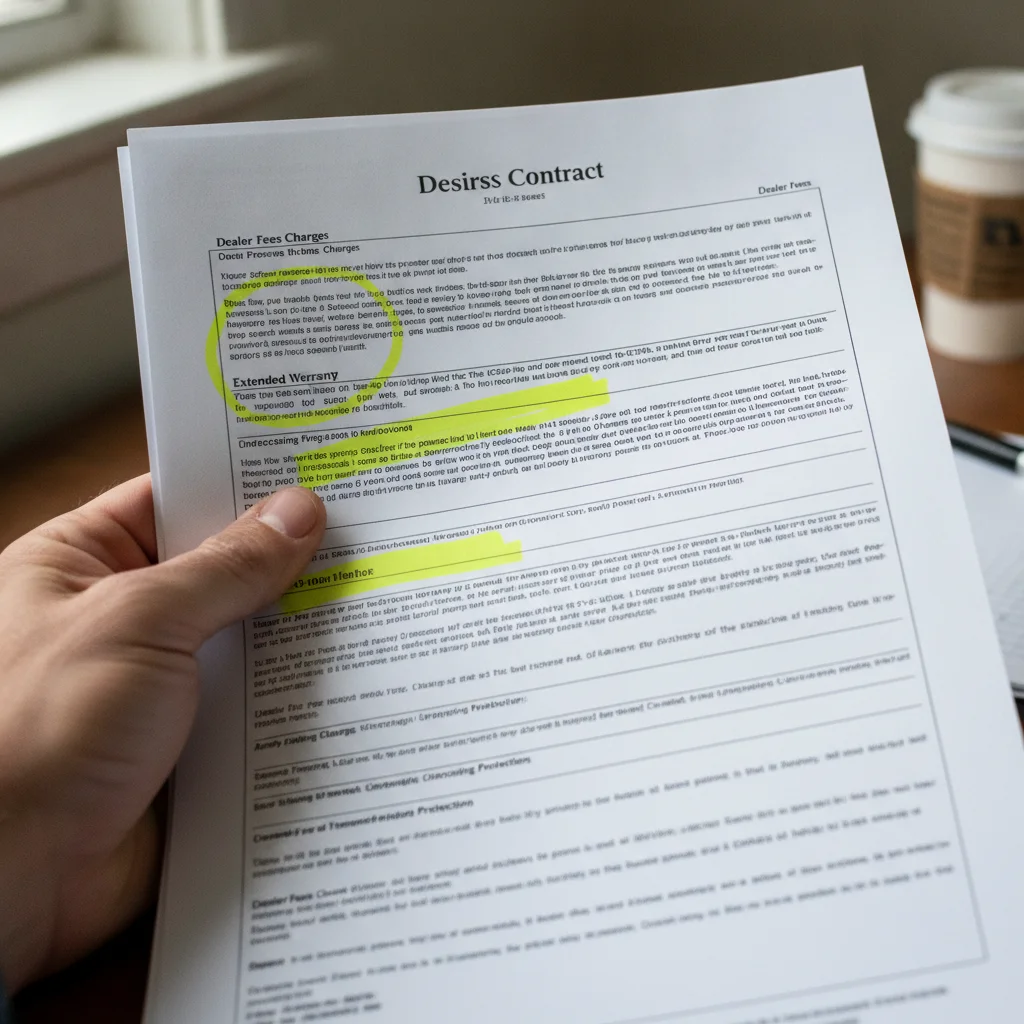
Digital signing tablets can make it easy to tap through screens without reviewing each item. Always ask for a printed or full-screen view of the complete contract before signing anything. Look specifically for line items you didn't agree to verbally — 'appearance package,' 'protection pkg,' or 'dealer installed options' are common labels for add-ons you didn't request. Removing them after signing is significantly harder than declining them before.
The broader lesson: the question isn't always whether a product has value, it's whether you're paying a fair price for it and whether you actually need it. The F&I office relies on you not knowing the difference.
How Add-Ons Get Buried in Your Contract
One of the most reliable tactics in the F&I playbook is monthly payment blending. Instead of presenting add-ons as lump-sum charges, the finance manager rolls them into your loan and shows you the impact on your monthly payment. A $1,200 paint protection package sounds steep. But "it's only $18 more a month" sounds manageable — especially after hours of negotiating.
Here's the math they're not emphasizing: $18 more a month on a 72-month loan at 7% APR costs you roughly $1,550 total. You paid $1,200 in product for $1,550 out of pocket, and you'd have paid interest on it for six years.
Add-ons can also appear as pre-checked boxes on digital signing tablets, line items with vague descriptions like "dealer protection package" or "appearance pkg," or bundled products presented as a single charge. You are legally entitled to an itemized breakdown of every line item. Ask for it. If the finance manager hesitates to provide one, that tells you everything you need to know.
For a complete list of how charges get embedded in the paperwork, see how add-ons are hidden in car contracts before you sign anything.
Your Step-by-Step Defense at the F&I Desk
Walking in prepared is the single biggest advantage a buyer can have. Here's what that looks like in practice.
- Request an out-the-door price before the F&I room. Before you ever sit down with finance, ask for the full purchase price including all fees, taxes, and any dealer-added items already on the vehicle. If there are pre-installed extras you didn't ask for, negotiate them off the price or walk.
- Know your financing rate before you arrive. Get pre-approved by your bank or credit union. The dealer can try to beat it, but you'll know the floor. Finance managers make money on rate markup — without your own quote, you have no leverage.
- Say "I'd like to review the menu separately." Don't let the finance manager bundle and present everything at once. Ask to see each product individually, with the cost as a lump sum (not monthly).
- Apply a 24-hour rule to expensive add-ons. For anything over $500, tell them you want to think about it and do your own research. A high-pressure insistence that you decide now is a red flag, not a buying signal.
- Know your current coverage. Before the appointment, spend 20 minutes reviewing your existing auto insurance policy and any credit card benefits. You may already have roadside assistance, rental reimbursement, or key replacement coverage.
- Decline politely but firmly. You don't owe an explanation. "No thank you, I'm not interested in that" is a complete sentence. Finance managers are trained to handle objections — don't get pulled into a debate about product value.
Understanding where dealers have room to negotiate also helps. Dealer holdback and hidden profit margins reveal that the sticker price conversation is rarely the last word on dealer profit.

Also worth reviewing before your visit: how to distinguish dealer fees from government-mandated fees. Not every line item is negotiable, and knowing which ones are gives you a cleaner conversation.
You Can Say No to Every Single Add-On
No dealer add-on is legally required to complete a new car purchase. Finance managers are trained to present some items — particularly GAP insurance — as quasi-mandatory for financed purchases. This is false. Your signature is required; their product menu is not. If you feel pressured, ask to see the contract with all optional products removed before you review it.
Read Every Line Before You Sign
Digital signing tablets can make it easy to tap through screens without reviewing each item. Always ask for a printed or full-screen view of the complete contract before signing anything. Look specifically for line items you didn't agree to verbally — 'appearance package,' 'protection pkg,' or 'dealer installed options' are common labels for add-ons you didn't request. Removing them after signing is significantly harder than declining them before.
The Bottom Line: Every Dollar Added Here Is a Dollar You Didn't Negotiate Back
Buyers who spend weeks researching the right vehicle and negotiating hard on price sometimes walk out of the F&I office having given back $1,500–$3,000 in unnecessary add-ons. The room is designed to recapture margin, and it works on smart, prepared people every day — not because they're gullible, but because the process is expertly engineered.
The antidote is simple: decide before you walk in which products you want at what price, and treat everything else as a firm no. Don't let fatigue or excitement make decisions for you. The car will still be there tomorrow. The deal you agreed to on the floor won't change because you didn't buy paint sealant.
If you're also evaluating the true total cost of your purchase, the hidden taxes buried in your car's sticker price is worth a read before you finalize anything. And if you want an honest look at which optional insurance coverages genuinely pay off versus which are mostly insurer profit, see which add-ons rarely pay off.
The best version of the F&I conversation is a short one. Go in knowing your answers, and leave with only what you decided you wanted — not what they decided to sell you.
All claims are backed by peer-reviewed research. Sources on request.