
Key Takeaways
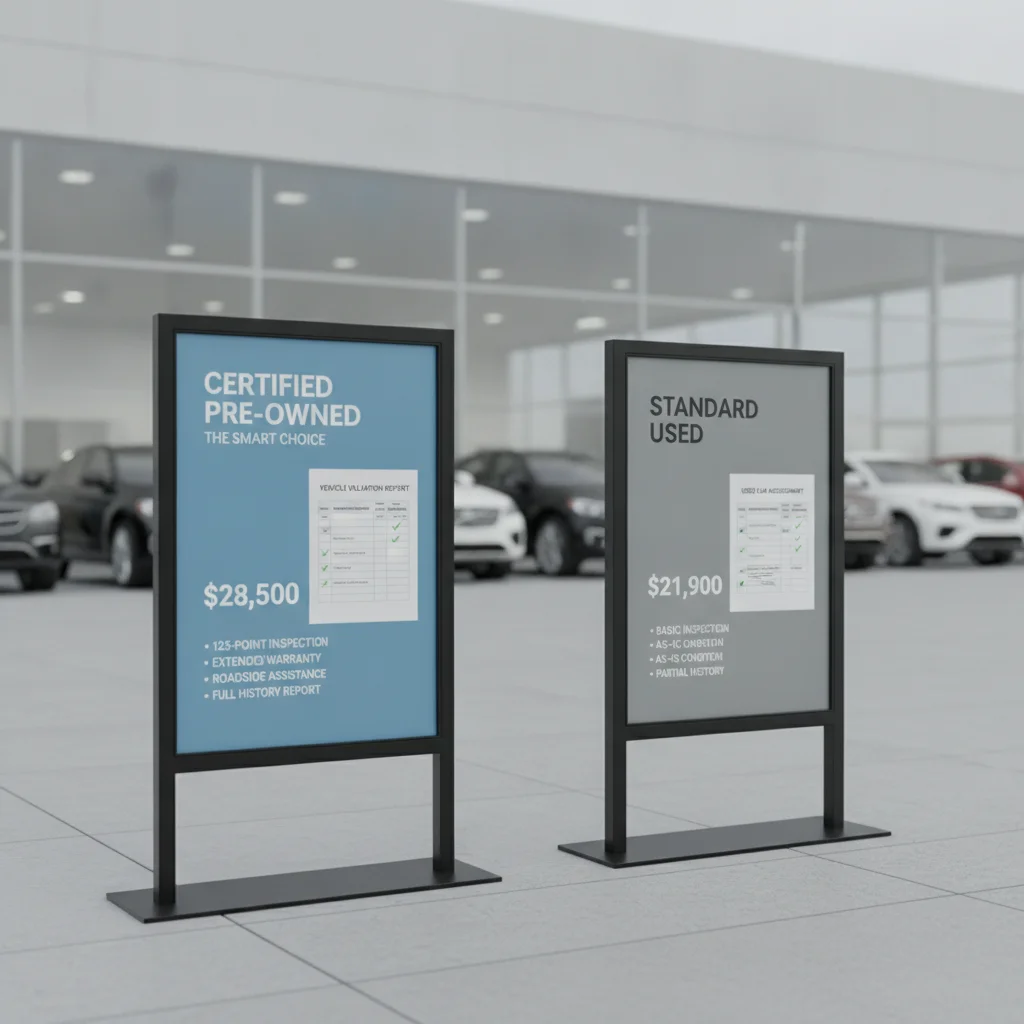
Option A
Certified Pre-Owned (CPO)
The dealer-backed, warranty-included option.
Best for: Buyers who want near-new peace of mind without paying new-car prices, especially for vehicles they plan to finance and keep for several years.
Option B
Standard Used Car
The flexible, lower-cost alternative.
Best for: Budget-conscious buyers comfortable doing their own due diligence — or those purchasing an older, high-mileage vehicle outside CPO eligibility windows.
If you want warranty coverage and a vehicle history guarantee
Certified Pre-Owned (CPO)
CPO programs bundle inspection, warranty, and often roadside assistance into one package, reducing the financial risk of unexpected repairs in the first few years.
If you're working with a tight budget or buying an older vehicle
Standard Used Car
CPO eligibility cuts off around 5–6 years or 80,000 miles for most brands, so older vehicles are only available as standard used — and the lower price can be a genuine advantage.
If you plan to finance over 48–72 months
Certified Pre-Owned (CPO)
Many manufacturers offer promotional APR on CPO vehicles, and the included warranty means you're less likely to face large repair bills while you're still paying off the loan.
If you're buying privately or from an independent lot
Standard Used Car
CPO programs are only available through franchised dealerships, so private-party and independent-lot purchases are always standard used — budget for a pre-purchase inspection instead.
If you're comfortable evaluating a car yourself or hiring a mechanic
Standard Used Car
A thorough independent inspection can surface most of the same issues a CPO inspection would catch, letting you pocket the CPO premium as savings.
What Separates a CPO from a Regular Used Car
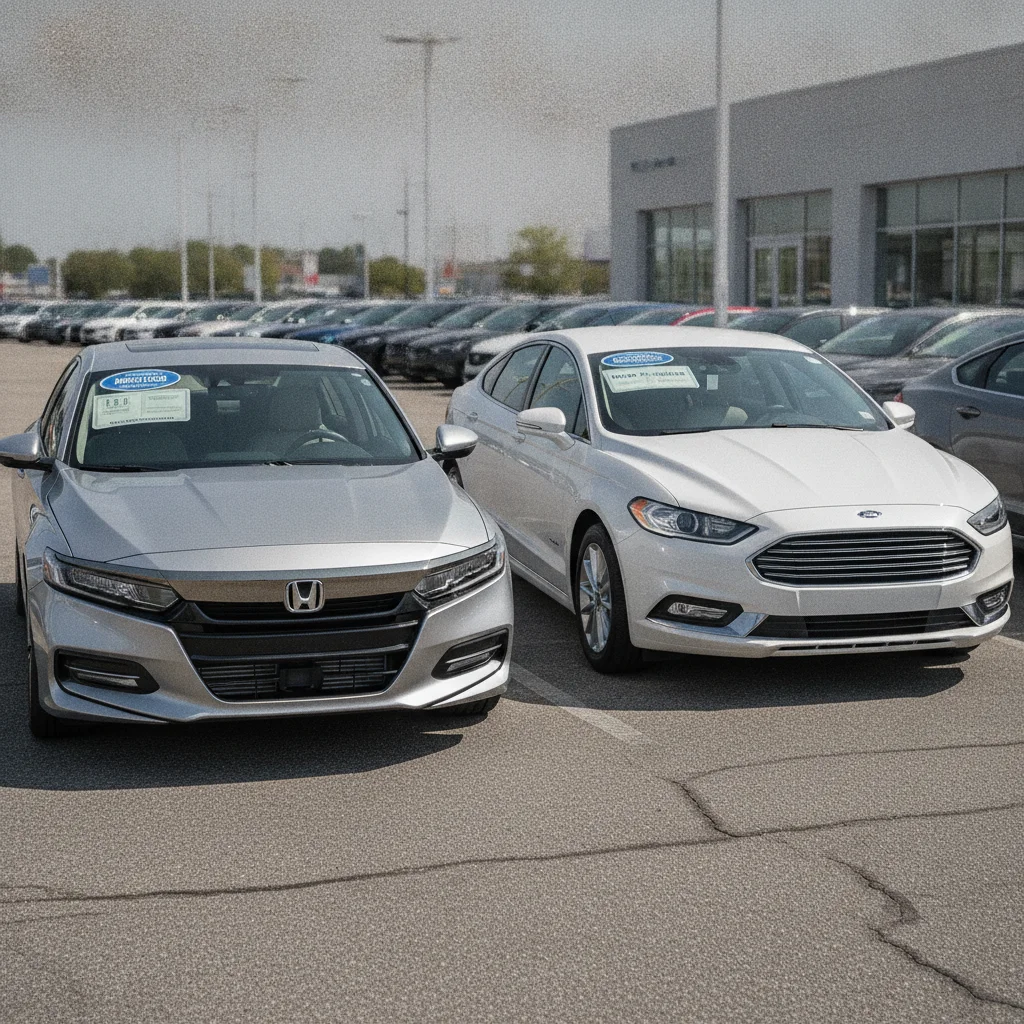
Walk into any franchised dealership and you'll see two categories of pre-owned vehicles: those wearing a Certified Pre-Owned badge and those without one. From the parking lot, they can look identical. The distinction lives in a stack of documents and a set of programmatic requirements that dealers must satisfy before slapping on that badge.
A standard used car is simply a vehicle someone previously owned that a dealership (or private seller) is now reselling. There is no minimum condition standard, no inspection requirement, and — unless negotiated separately — no warranty. The car is sold in whatever condition it happens to be in. That can be excellent, mediocre, or genuinely problematic, and the burden is largely on the buyer to figure out which.
A certified pre-owned vehicle, by contrast, has to clear a series of manufacturer-defined hurdles before it earns the label. The exact standards differ by brand, but every legitimate manufacturer CPO program requires:
- An age and mileage ceiling — typically no more than 5–6 model years old and under 80,000 miles
- A multi-point inspection — usually 100 to 200 checkpoints covering mechanical, electrical, and cosmetic condition
- Reconditioning to pass — failed inspection points must be repaired, not just noted
- A clean title — vehicles with salvage, flood, or lemon-law titles are disqualified
- A manufacturer-backed warranty extension — added on top of any remaining factory coverage
To understand exactly what those inspections do and don't cover, see how CPO inspections work and their limits. The short version: they're real, but they vary significantly by brand, and they aren't a substitute for an independent mechanic's review.
One distinction worth flagging early: manufacturer-certified and dealer-certified are not the same thing. A manufacturer CPO program is administered by the automaker — Honda, Toyota, BMW — with uniform national standards and a warranty backed by the company itself. A dealer-certified program is created by the dealership, with standards set however the dealer chooses and a warranty that's only as solid as the dealer's service contract. Manufacturer CPO programs vs. dealer-certified explains the gap in detail — it matters because consumers often confuse the two.
The Real Cost Difference — And What You Get for It
The CPO premium is real and measurable. On average, a CPO vehicle costs $1,000 to $3,500 more than a comparable standard used car of the same make, model, year, and mileage. For luxury brands like Mercedes-Benz or BMW, that gap can stretch to $4,000–$5,000. The question is what you're actually buying with that extra money.
| Criterion | Certified Pre-Owned | Standard Used Car |
|---|---|---|
| Inspection requirement | 100–200 point manufacturer checklist | None required |
| Warranty included | Manufacturer-backed extension | As-is (or limited dealer warranty) |
| Typical price premium | $1,000–$3,500 above comparable used | Baseline market price |
| Eligibility limits | Usually ≤6 years, ≤80,000 miles | Any age or mileage |
| Where you can buy | Franchised brand dealerships only | Dealers, private sellers, auctions |
| Vehicle history report | Required for certification | Optional; buyer must request |
| Financing rates | Often promotional manufacturer APR | Standard bank/credit union rates |
| Title requirement | Clean title only | Any title (buyer beware) |
| Negotiation flexibility | Limited (margin already compressed) | Higher (varies by seller) |
Breaking it down, you're effectively paying for three things:
- The warranty: A CPO warranty extension typically adds 1–2 years or 12,000–24,000 miles of powertrain coverage beyond the original factory warranty. Some programs, like Toyota's, include a 7-year/100,000-mile powertrain warranty from the original sale date. If a major repair — say, a transmission rebuild at $3,500 — would otherwise come out of your pocket, the warranty has already paid for itself.
- The inspection and reconditioning: Before certification, the vehicle has been inspected and any flagged items repaired. You're buying a car that a manufacturer-trained technician has already put through its paces. That said, the inspection is not unlimited: cosmetic imperfections and wear-and-tear items are often excluded.
- Financing access: Many manufacturers offer promotional APR rates — sometimes as low as 0.9%–2.9% — exclusively on CPO vehicles. On a $25,000 loan over 60 months, the difference between a 2.9% CPO rate and a 7.5% standard used rate works out to roughly $2,100 in interest savings. That can meaningfully offset the higher sticker price.
For a deeper look at how CPO pricing is structured relative to standard used car valuations, CPO pricing vs. standard used car valuations walks through how tools like Kelley Blue Book and Edmunds handle — and sometimes mishandle — the CPO premium.
$1,000–$3,500
Typical CPO price premium over comparable used
Based on Edmunds and iSeeCars market analyses of CPO vs. non-CPO listings for the same make, model, and year.
3.1M+
CPO vehicles sold in the U.S. annually
According to Autodata Corp, certified pre-owned sales have consistently exceeded 3 million units per year in recent market cycles.
~$2,100
Interest savings from CPO promotional rate vs. market rate
Estimated on a $25,000 loan over 60 months comparing a 2.9% manufacturer CPO rate to a 7.5% standard used car loan rate.
100–200
Inspection checkpoints in a typical CPO program
The exact count varies by manufacturer; Toyota's program uses 160+ points, while BMW's covers over 200 items.
The honest framing is this: if you're the kind of buyer who would purchase an extended warranty on a standard used car anyway, the CPO premium is often competitive or even cheaper for equivalent protection — plus you get manufacturer backing rather than a third-party contract. If you'd skip the extended warranty and self-insure against repairs, the standard used car's lower price makes more sense.
Warranty and Coverage: The Mechanics Behind the Badge
Warranty terms are the backbone of the CPO value proposition, so it's worth understanding exactly how they work — not just that they exist.
Every new car comes with a factory warranty, typically structured in layers:
- Bumper-to-bumper (comprehensive): Covers almost everything except normal wear items. Usually 3 years/36,000 miles.
- Powertrain: Covers engine, transmission, and drivetrain. Usually 5 years/60,000 miles.
When a car enters a CPO program, the manufacturer adds coverage on top of whatever factory warranty remains. If a two-year-old Toyota with 22,000 miles enters Toyota's CPO program, it still has one year of bumper-to-bumper coverage left. Toyota then adds a powertrain warranty that runs to 7 years/100,000 miles from the original in-service date — whichever comes first.
A standard used car has none of this. If the factory warranty has expired (common on vehicles over 3 years old), you own the repair bills outright from day one. Dealers sometimes offer their own limited warranties on used cars — 30 to 90 days — but these typically cover only powertrain issues and are far narrower than manufacturer CPO terms.

One subtlety that catches buyers off guard: CPO warranties are not the same as extended warranties or vehicle service contracts sold in the finance office. Those are third-party products with their own terms, exclusions, and claims processes. A CPO warranty is administered directly by the manufacturer and honored at any franchised dealer of that brand nationwide — a meaningfully stronger promise.
What certified pre-owned actually means covers warranty mechanics in more detail, including how to verify that a vehicle's CPO status is legitimate before you sign. This matters because fraud does exist — some dealers falsely represent standard used vehicles as CPO to justify higher prices.
CPO Warranty Transferability Matters
Many manufacturer CPO warranties are fully transferable to a subsequent buyer at no extra cost — a genuine resale advantage. If you sell a CPO vehicle before the warranty expires, the remaining coverage often transfers automatically, making your car more attractive to the next buyer. Check the specific program terms at the time of purchase to confirm whether your brand's warranty includes this feature.
Dealer-Certified Is Not Manufacturer-Certified
Some independent dealers advertise 'certified' vehicles without any manufacturer program backing them. These dealer-certified programs set their own standards and their own warranty terms, which can be far weaker than manufacturer CPO. Always confirm which type of certification applies before using the label to justify a higher purchase price.
Online 'Certified' Labels Vary Widely
When shopping for used cars online, the word 'certified' can appear with very different meanings depending on the platform. A manufacturer CPO listing on a franchised dealer's site is meaningfully different from a third-party platform's 'certified' badge, which may reflect only a basic inspection. See <a href="/buying-a-car/car-buying-process/online-car-buying/what-certified-actually-means-when-youre-buying-a-car-online">what certified actually means when buying a car online</a> for how to evaluate online certification claims.
Eligibility, Availability, and Where You Can Buy
One of the most practical constraints on CPO vehicles is simple: not every used car can be certified. Programs have strict eligibility gates that immediately narrow the pool.
Typical eligibility requirements across major manufacturer CPO programs:
| Brand | Max Age | Max Mileage | Title Restriction |
|---|---|---|---|
| Toyota | 6 years | 85,000 miles | Clean title only |
| Honda | 6 years | 80,000 miles | Clean title only |
| BMW | 5 years | 60,000 miles | Clean title only |
| Ford | 6 years | 80,000 miles | Clean title only |
| Chevrolet | 5 years | 75,000 miles | Clean title only |
This means the entire market of older, higher-mileage, or title-compromised vehicles is only available as standard used. If you're looking at a 2016 Honda Civic with 95,000 miles, CPO simply isn't an option — it's a standard used purchase by definition.
Geography matters too. CPO vehicles are exclusively sold through franchised dealerships of the corresponding brand. You cannot buy a Toyota CPO vehicle from an independent used car lot, from a private seller, or from a multi-brand used car retailer like CarMax (which runs its own inspection program but is not manufacturer-certified). Buying used cars covers the full landscape of where pre-owned vehicles are sold and what to watch for at each channel.
For buyers considering EVs specifically, the eligibility equation gets more complicated. Battery health, charging history, and range degradation add layers that traditional CPO frameworks don't fully address. Electric vehicle CPO programs explains what's different about certifying a used EV and why it matters more than it does for gas-powered vehicles.
Negotiation, Paperwork, and the Buying Process
The buying experience for a CPO vehicle and a standard used car follows the same broad steps — test drive, offer, financing, signing — but the details diverge in important ways.
Negotiation room
Standard used cars often have more negotiation flexibility. Dealers acquire them at auction or as trade-ins at variable prices, and margins vary widely. CPO vehicles, by contrast, tend to be priced with less wiggle room. Because the dealer has invested in reconditioning and the manufacturer has set program standards, the asking price is often closer to a real floor. That doesn't mean you can't negotiate — you can — but don't expect the same percentage discounts you might get on a private-party or independent-lot used car.
For a systematic approach to negotiating both types, negotiating a CPO vs. a new car outlines where the leverage actually sits and how dealers price CPO inventory differently from new stock.
Paperwork differences
CPO purchases add a layer of documentation. On top of the standard purchase agreement, you'll receive:
- A CPO warranty certificate specifying coverage terms, deductibles, and transferability
- A vehicle history report (Carfax or equivalent), which is required for certification
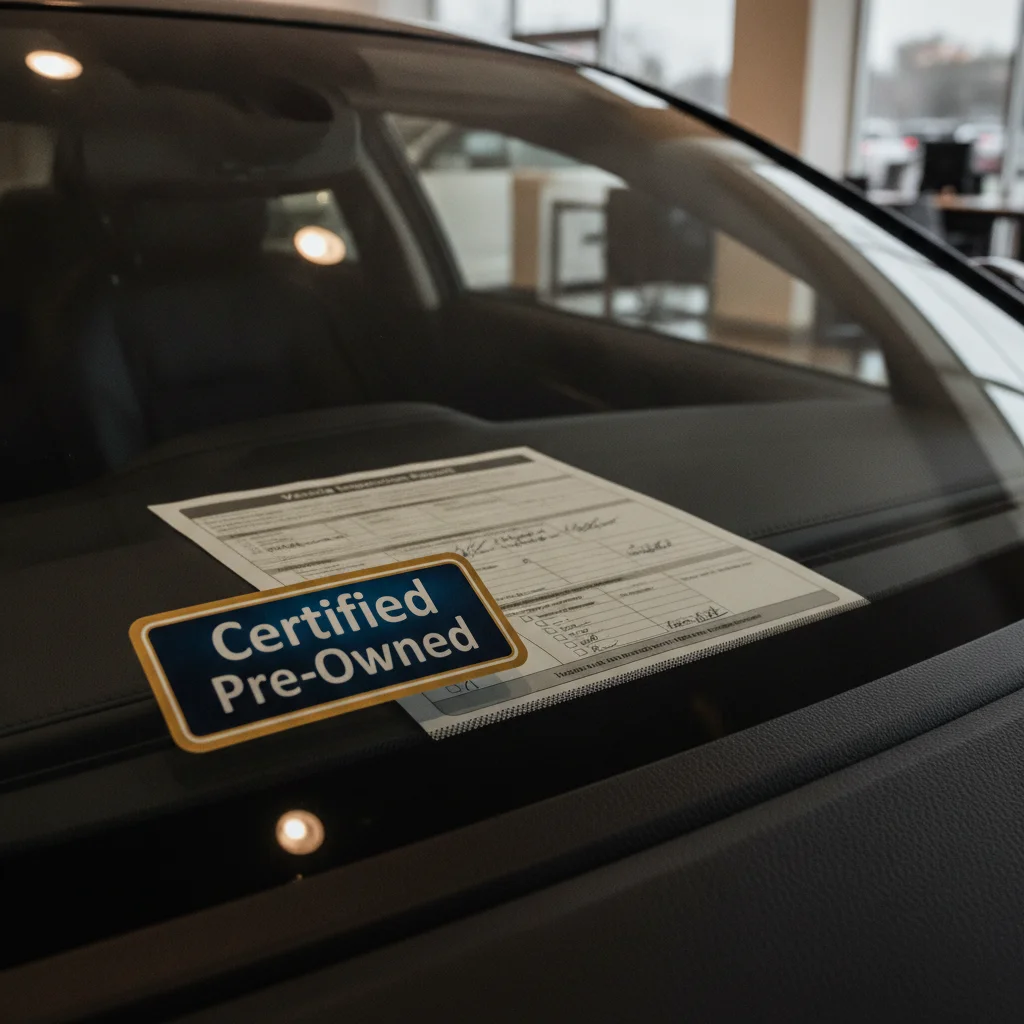
- An inspection checklist documenting what was checked and what was repaired
CPO contracts and extra paperwork walks through each document and what to verify before you leave the dealership. One key item: confirm that the CPO warranty is transferable if you sell the car before it expires — that's a genuine resale advantage.

Financing differences
As noted earlier, CPO vehicles often qualify for manufacturer-subsidized financing rates that standard used cars do not. Check the manufacturer's current promotional rates before walking in — these are posted on brand websites and change monthly. If you're pre-approved through a credit union or bank, compare that rate to the manufacturer's CPO promotional rate; take whichever is lower.
One more thing: the finance office will almost certainly offer you an extended warranty on a CPO vehicle. Politely decline unless you've done the math. The CPO warranty already provides substantial coverage; adding another layer is usually redundant and almost always overpriced.
When the CPO Premium Is Worth It — and When It Isn't
The CPO premium is not universally a good or bad deal. It depends on your specific situation: the vehicle's age and reliability record, your financial cushion, how long you plan to keep the car, and whether you'd be financing.
The CPO premium tends to pay off when:
- You're buying a high-repair-cost brand (German luxury vehicles, in particular) where a single out-of-warranty repair can run $2,000–$5,000
- You're financing over 48+ months and the manufacturer's promotional APR saves you real money
- You have limited mechanical knowledge and want a baseline guarantee of condition
- You're buying a vehicle that's still within its factory warranty window, meaning CPO adds meaningful extension on top of existing coverage
The CPO premium is harder to justify when:
- You're buying a highly reliable model (certain Toyota, Honda, and Mazda vehicles) with strong ownership records — the warranty has less expected value because the car rarely needs it
- You're paying cash and don't need the promotional financing
- The CPO vehicle is near the top of its mileage eligibility (say, 78,000 miles), leaving limited warranty runway before you're paying out of pocket anyway
- A comparable standard used car of the same model is available at a significantly lower price and passes an independent pre-purchase inspection
Is the CPO premium worth paying? runs a more detailed cost-benefit analysis with specific scenarios. And if you're comparing CPO to buying from a private party — where the discount can be steeper — CPO vs. private party used cars on the depreciation curve breaks down where each option sits in a vehicle's value lifecycle.
The simplest test: price out the CPO vehicle, then find the closest comparable standard used car and get an independent inspection quote (usually $100–$150). If the inspection comes back clean and the price gap exceeds the value of the warranty coverage you'd get, the standard used car wins. If the gap is narrow, or if the inspection flags anything significant, the CPO vehicle's built-in protections start looking more attractive.

All claims are backed by peer-reviewed research. Sources on request.