Key Takeaways
Our Verdict
CPO makes the most sense if you want a near-new experience, low-mileage vehicle, and manufacturer backing without paying new-car prices. Private-party buying wins on raw price if you're comfortable doing your own due diligence and can handle a pre-purchase inspection. Neither is universally better — the right answer comes down to how much risk you can absorb and how far down the depreciation curve you're willing to go.
| Best for | Recommended |
|---|---|
| Buyers who want warranty coverage and a structured purchase process | Certified Pre-Owned |
| Budget-focused buyers comfortable with independent inspections | Private Party |
| Luxury vehicle shoppers maximizing depreciation savings | Certified Pre-Owned |
| Buyers targeting older, higher-mileage vehicles for maximum value | Private Party |
Where Each Option Sits on the Depreciation Curve
Before you can compare CPO and private-party used cars, you need to understand that both options represent entirely different points on the same depreciation timeline. A car doesn't lose value evenly over its life — it drops fast early and then levels off. Knowing where each buying route lands on that curve is the whole ballgame.
New cars typically shed 15–25% of their value in year one alone. By year three, total depreciation often hits 40–50% of the original MSRP. That's the drop that CPO vehicles have already taken. A private-party car sitting in someone's driveway at year five or six has absorbed even more of that hit — which means less depreciation risk left for the next owner.
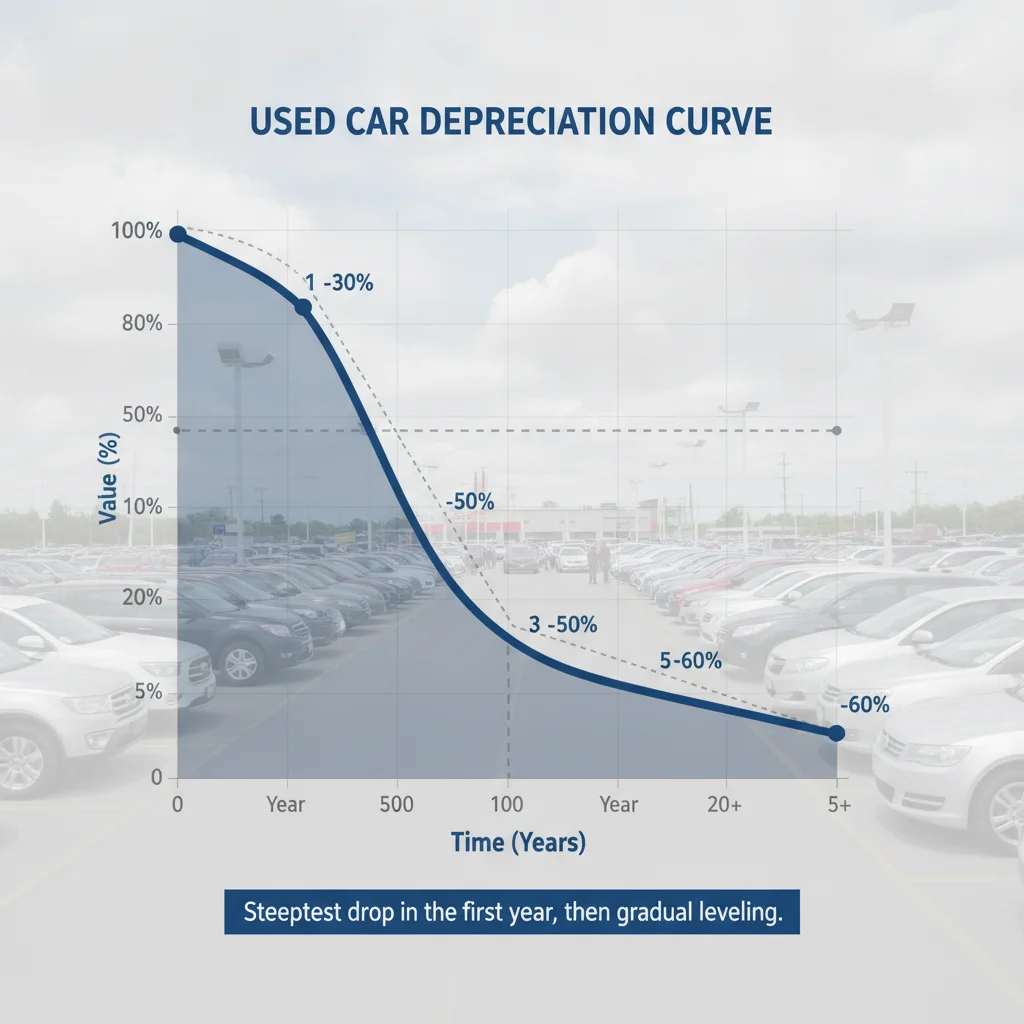
Here's the practical breakdown:
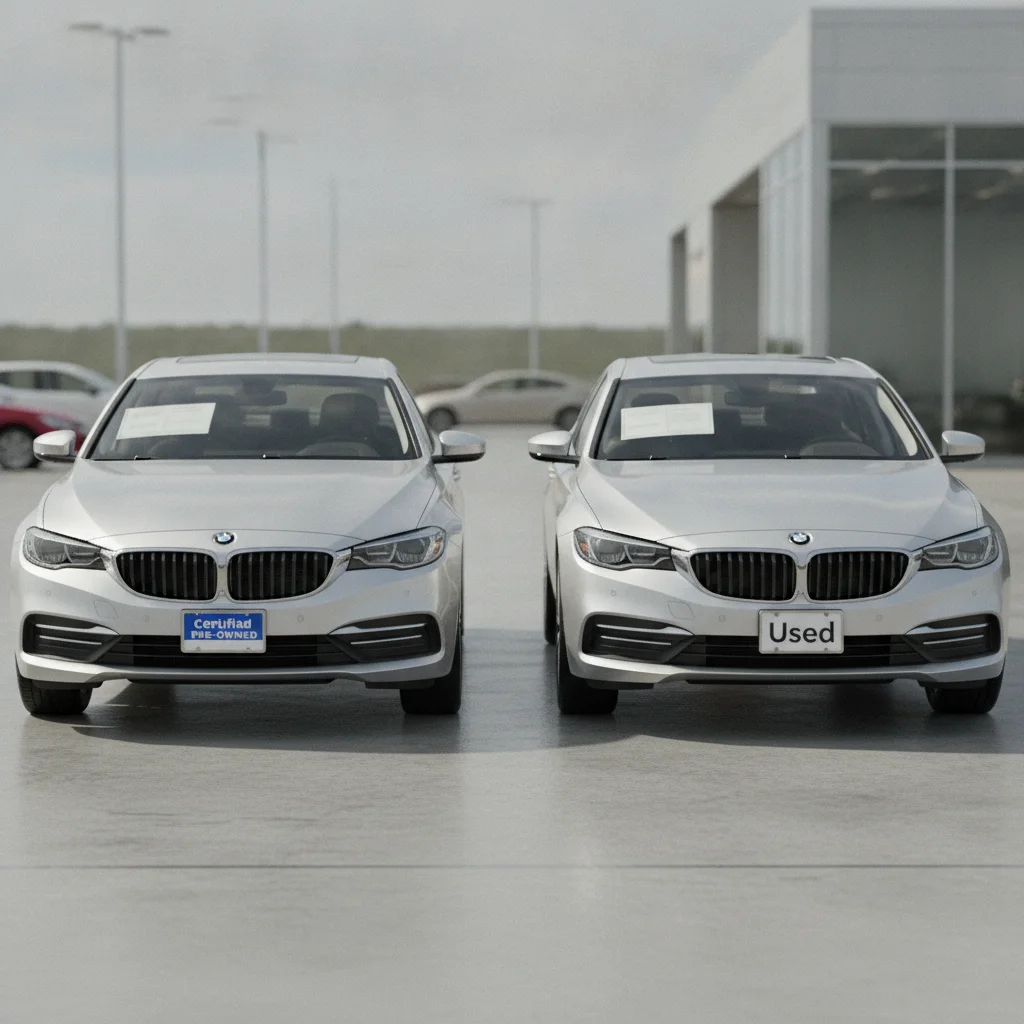
- CPO vehicles are typically 1–4 years old, under 60,000–80,000 miles, and have cleared a manufacturer inspection. They sit in the steeper part of the depreciation curve but have already cleared the worst of it.
- Private-party vehicles span a wider age and mileage range. The best value plays are usually 4–7 years old with 50,000–90,000 miles — far enough down the curve that depreciation has slowed significantly.
For a deeper look at how age and mileage interact with value loss, the Depreciation Basics hub breaks it down comprehensively. The point is: CPO isn't the same as "used" in the traditional sense — it's a specific slice of the used market with its own pricing logic.
CPO Pricing: What the Certification Actually Costs You
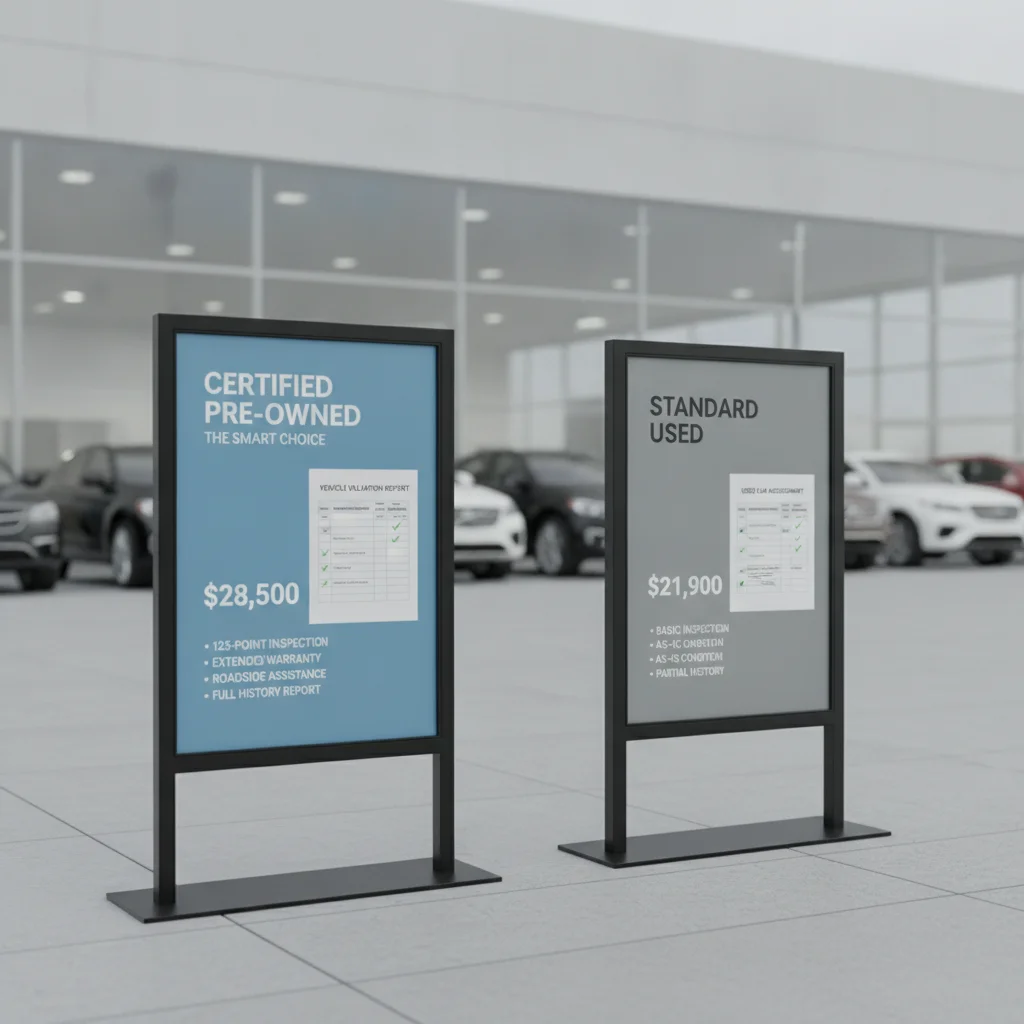
A CPO badge isn't free. Dealers typically price CPO vehicles 5–15% above comparable non-certified used cars. On a $25,000 vehicle, that's $1,250 to $3,750 more out of pocket before you even start negotiating. The question is whether what you get justifies that premium.
15–25%
First-year depreciation on new cars
Industry data consistently shows new vehicles lose this share of value in the first 12 months, which CPO buyers avoid entirely.
10–15%
Private-party discount vs. dealer retail
According to Kelley Blue Book and Edmunds valuation data, private-party prices typically run this much below equivalent dealer listings.
$100–$200
Cost of a pre-purchase inspection
An independent mechanic PPI is the single most important due-diligence step for private-party buyers and costs a fraction of what it can save.
40–50%
Typical 3-year depreciation off MSRP
Vehicles that enter CPO programs have typically shed this much of their original value, giving buyers a substantial built-in savings over new.
What's bundled into that CPO premium:
- Manufacturer-backed warranty extension — usually adding 1–4 years or 50,000–100,000 miles on top of any remaining factory coverage
- Multi-point inspection — vehicles that don't pass get repaired or rejected outright
- Vehicle history verification — most programs require a clean title, no flood damage, and no major structural repairs
- Roadside assistance — typically matched to the extended warranty period
- Special financing rates — manufacturer CPO programs sometimes offer sub-market APRs, which can offset the sticker premium
The warranty math matters most on vehicles with expensive failure points. A CPO BMW or Mercedes with a 1-year powertrain extension could easily save you $3,000–$8,000 on a transmission or transfer case repair. On a Toyota Camry or Honda Civic, where the drivetrains are famously durable, the warranty has less financial leverage.
What CPO actually gets you vs. standard used is worth reading if you're still unclear on what's included in most programs — the differences vary more by brand than most buyers realize.
Always Get a Pre-Purchase Inspection
For any private-party vehicle over $5,000, paying an independent mechanic $100–$200 for a pre-purchase inspection is the single best money you'll spend. Ask the seller to meet you at a shop of your choosing — if they refuse, treat that as a red flag. A good PPI will surface deferred maintenance, hidden repairs, and fluid issues that wouldn't be obvious on a test drive.
Compare CPO Financing to Outside Offers
Don't assume the manufacturer's CPO financing rate is automatically the best deal. Get a pre-approval from your credit union or bank before visiting the dealership. If the CPO rate beats your outside offer, great — take it. If not, you have leverage to negotiate. Either way, walking in with a competing rate protects you from dealer finance markup.
Check Insurance Costs Before You Commit
Get an insurance quote on the specific vehicle before you finalize any purchase — CPO or private-party. The difference in annual premiums between a 3-year-old and a 6-year-old version of the same model can be $300–$700 per year, which adds up meaningfully over a 5-year holding period. Factor that into your true cost of ownership calculation.
Private-Party Pricing: The Raw Depreciation Advantage
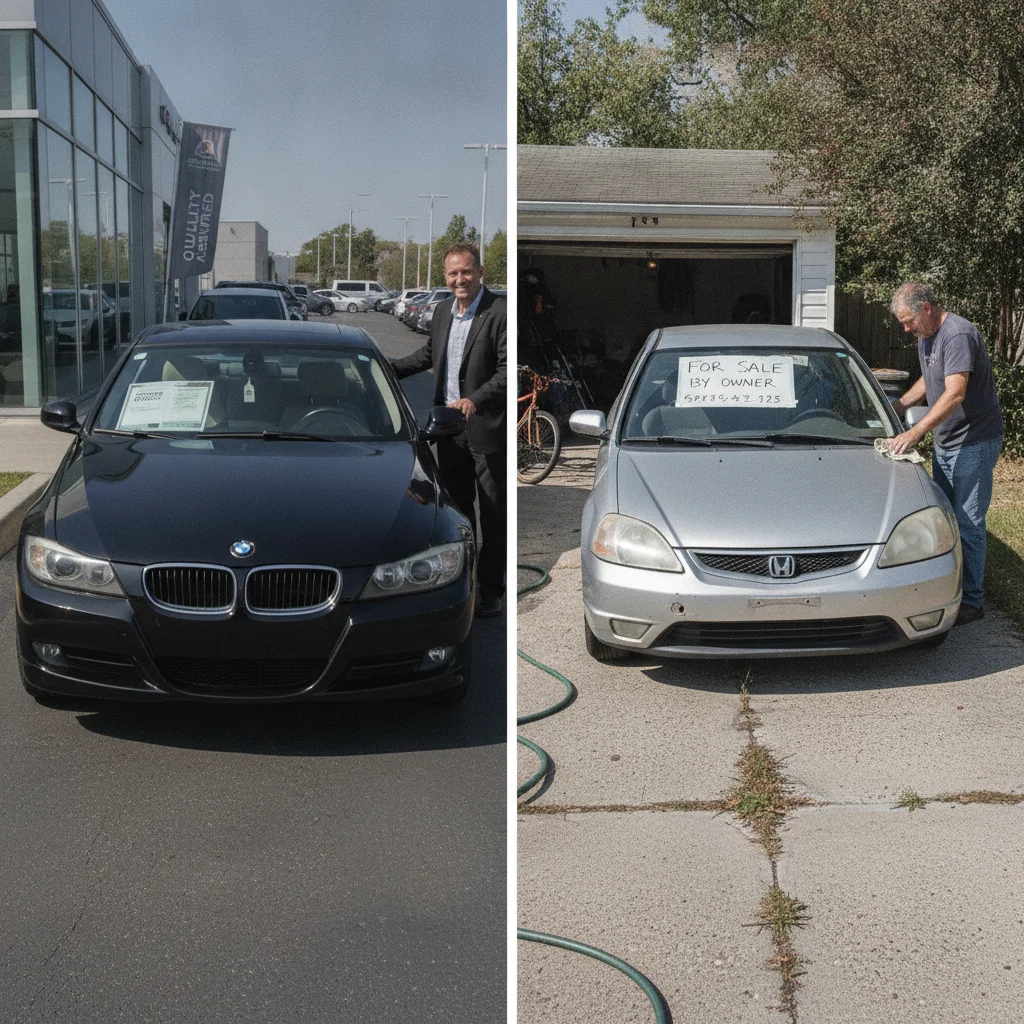
When someone lists a car in their driveway or on a platform like Facebook Marketplace or Craigslist, they're not paying dealer overhead, reconditioning costs, or CPO program fees. That savings gets passed on — at least partially — to you. Private-party prices typically run 10–15% below dealer retail on equivalent vehicles, and sometimes more on older or higher-mileage cars.
The depreciation math here works in two directions. First, you're buying from a seller who has no financial stake in inflating the price beyond market value (unlike a dealer who needs margin). Second, you can target vehicles that have aged past the steepest part of the depreciation curve, where year-over-year value loss has slowed to 3–7% annually instead of the 15–20% you see in years one and two.
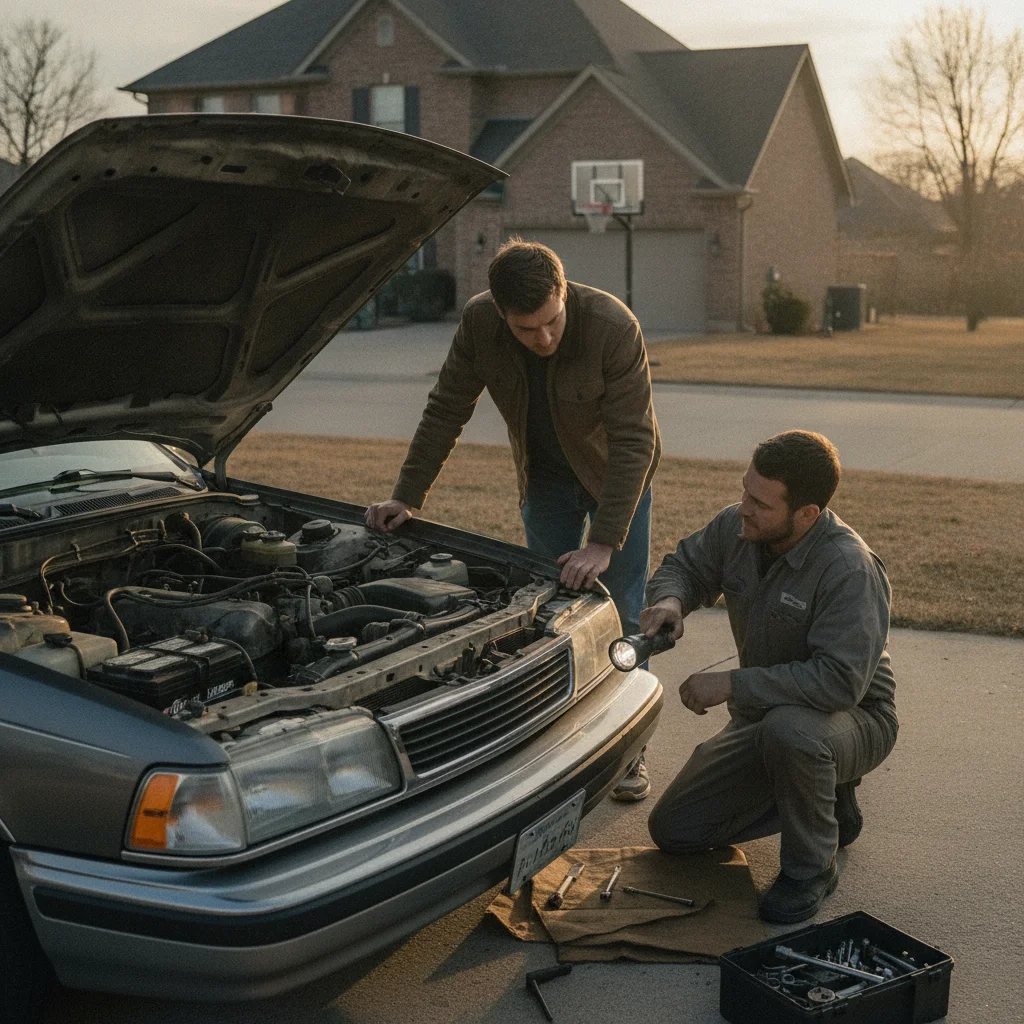
The practical risks of private-party buying are real though:
- No warranty unless the factory coverage is still active and transferable
- No guaranteed inspection history — you have to arrange your own pre-purchase inspection (PPI)
- Title issues — you need to run the VIN yourself through a paid service and check for liens
- Financing is harder — most banks will lend on private-party purchases, but rates are typically higher than dealer or CPO financing
- No recourse if problems emerge — "as is" is the default in private sales
A solid pre-purchase inspection from an independent mechanic typically costs $100–$200 and is non-negotiable for any private-party purchase above $5,000. Skip it and you're gambling. Budget it as a fixed cost of private-party buying and the math still usually works in your favor.
Never Skip the VIN Check on Private-Party Cars
A clean-looking car can have a salvage title, open recalls, or an outstanding lien you'd inherit at purchase. Run the VIN through Carfax, AutoCheck, or the NHTSA recall database before you hand over a deposit. Lien checks vary by state, but most DMVs or title search services can confirm the title is clear for under $30. This is not optional.
CPO Programs Vary Widely by Brand
Not all CPO programs are created equal. Toyota's Certified Used Vehicle program and Honda's CPO program are among the most comprehensive — others offer narrower coverage with more exclusions. Read the actual warranty documentation, not just the dealer's pitch. Pay attention to what's explicitly excluded, deductible amounts, and whether the warranty is transferable if you sell the car before it expires.
Side-by-Side: CPO vs. Private Party Across Key Factors
Let's put both options on the same scorecard. The "right" answer shifts depending on your priorities, but here's how they stack up across the factors that actually move the needle on total cost of ownership.
| Factor | CPO | Private Party | |
|---|---|---|---|
| Typical vehicle age | 1–4 years old | 2–10+ years old | |
| Price vs. market | 5–15% above private-party | 10–15% below dealer retail | |
| Warranty coverage | Manufacturer-backed, 1–4 years added | None (unless factory still active) | |
| Inspection history | Multi-point inspection required | Buyer arranges own PPI | |
| Financing rates | Often promotional APR available | Bank/CU rates, typically higher | |
| Title risk | Low — dealers verify clean title | Higher — buyer must verify | |
| Negotiation flexibility | Moderate — dealer has margin | High — motivated sellers flexible | |
| Depreciation absorbed | 35–50% of original MSRP | 45–70% of original MSRP | |
| Best for | Near-new, low-risk buyers | Budget-savvy, hands-on buyers |
One factor that doesn't show up cleanly in any table: the psychological cost of uncertainty. Some buyers genuinely aren't comfortable buying a car without knowing its recent service history, and that's legitimate. A CPO inspection and warranty buys peace of mind — and peace of mind has real value, even if it's hard to quantify in a spreadsheet.
On the flip side, experienced buyers who've owned multiple cars and know how to read a vehicle's condition often find private-party buying straightforward. If you can spot signs of deferred maintenance, assess tire wear honestly, and aren't intimidated by having a mechanic look things over, the private market rewards that knowledge with real savings.
The Depreciation Sweet Spot for Each Route
Timing matters as much as the buying channel. Not every CPO car is a great value, and not every private-party car is a bargain. Here's where each route tends to offer the best depreciation math.
CPO Sweet Spot: 2–3 Year Old, Off-Lease Vehicles
The best CPO values are typically 2–3 year old vehicles coming off lease. They've absorbed the worst of the depreciation curve (often 35–45% off MSRP), they're still within the manufacturer's original warranty window or just past it, and they've been through a structured inspection process. Off-lease vehicles also tend to have predictable mileage — usually 10,000–15,000 miles per year under the lease terms.
Luxury brands are where CPO often makes the most financial sense. The depreciation on a 3-year-old luxury SUV can be staggering — sometimes 40–50% off original MSRP — and the CPO warranty covers the repair costs that would otherwise make ownership risky. Luxury CPO programs and whether they beat buying new gets into this in more detail.
Private-Party Sweet Spot: 4–6 Year Old, 50K–90K Miles
For private-party buying, the sweet spot is further down the curve. Vehicles in the 4–6 year old range with 50,000–90,000 miles have shed most of their depreciation but still have substantial life remaining — especially on reliable brands like Toyota, Honda, Mazda, and Subaru. The seller has absorbed the painful value loss; you're buying into the flat part of the curve.
At this age, you're past any manufacturer warranty on most vehicles. That's the tradeoff. But you're also paying substantially less, and if you've done your pre-purchase inspection homework, you know what you're getting into. A vehicle with documented service records and a clean PPI at 75,000 miles is a known quantity.
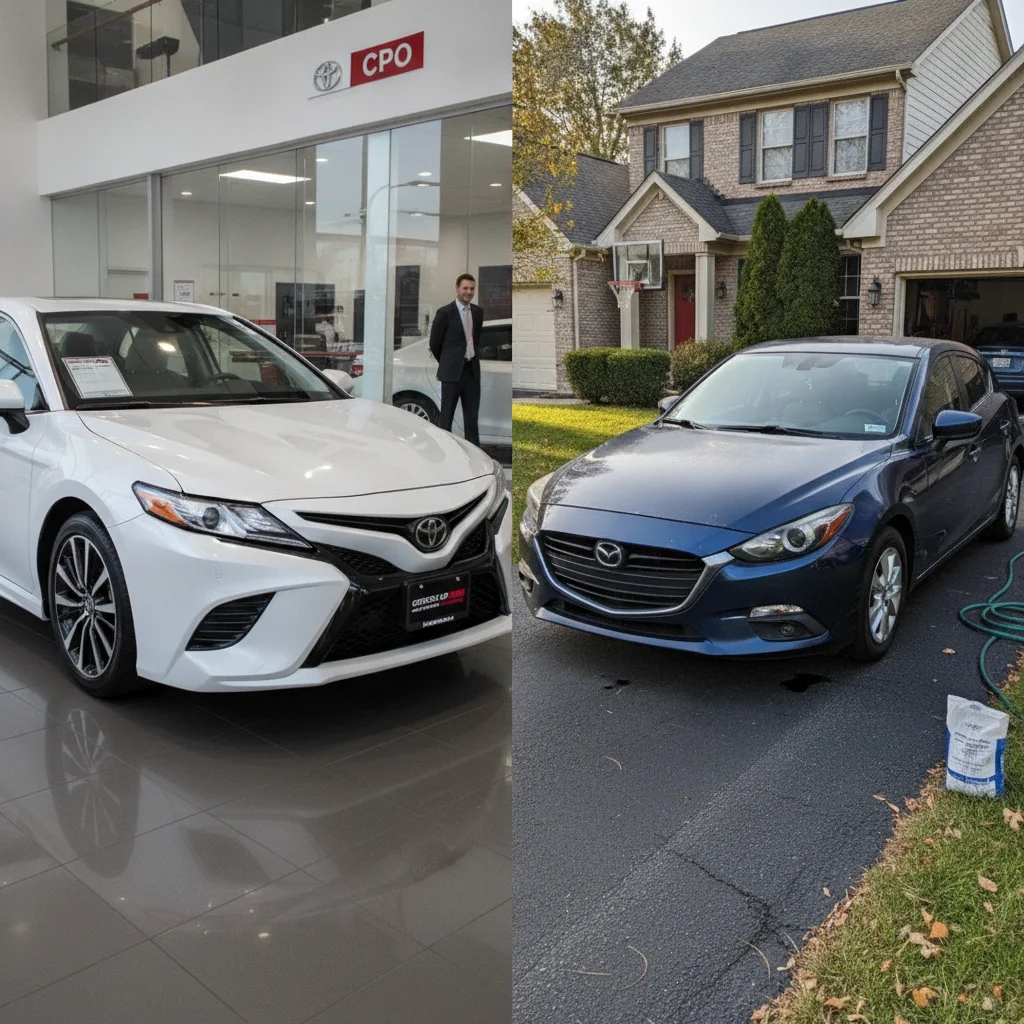
One more timing consideration: if you plan to sell the vehicle within 3–4 years, CPO vehicles can hold their value slightly better at resale because their service history is more verifiable. If you're buying to keep for 8–10 years, that resale advantage largely disappears — and the private-party savings at purchase look much better over the full holding period.
Financing, Insurance, and True Cost of Ownership
The sticker price gap between CPO and private-party isn't the only number that matters. Financing and insurance costs can shift the math meaningfully — in both directions.
Financing
Manufacturer CPO programs sometimes offer promotional APR rates — 1.9%, 2.9%, or similar — that are hard to beat through an outside lender. If you're financing a significant portion of the purchase price, a 2–3% rate advantage on a $20,000 loan saves you real money over a 4–5 year loan term. Run the numbers for your specific situation, because promotional rates can close part of the price gap between CPO and private-party.
Private-party financing through a bank or credit union is straightforward but typically carries rates 0.5–2% higher than dealer rates, and some lenders won't finance vehicles over a certain age or mileage threshold. If you're targeting a 6-year-old vehicle with 85,000 miles, confirm your financing before you commit to the sale.
Insurance
Insurance costs don't differ based on CPO status — they're driven by the vehicle's make, model, year, and your driving profile. A 3-year-old CPO vehicle will cost more to insure than a 6-year-old private-party equivalent simply because the replacement cost is higher. Factor that annual difference into your total cost of ownership calculation.
If you're financing either purchase, your lender will require comprehensive and collision coverage. On an older private-party vehicle with a lower ACV (actual cash value), it may make financial sense to carry liability only once you own it outright — something you can't realistically do while financing.
Always Get a Pre-Purchase Inspection
For any private-party vehicle over $5,000, paying an independent mechanic $100–$200 for a pre-purchase inspection is the single best money you'll spend. Ask the seller to meet you at a shop of your choosing — if they refuse, treat that as a red flag. A good PPI will surface deferred maintenance, hidden repairs, and fluid issues that wouldn't be obvious on a test drive.
Compare CPO Financing to Outside Offers
Don't assume the manufacturer's CPO financing rate is automatically the best deal. Get a pre-approval from your credit union or bank before visiting the dealership. If the CPO rate beats your outside offer, great — take it. If not, you have leverage to negotiate. Either way, walking in with a competing rate protects you from dealer finance markup.
Check Insurance Costs Before You Commit
Get an insurance quote on the specific vehicle before you finalize any purchase — CPO or private-party. The difference in annual premiums between a 3-year-old and a 6-year-old version of the same model can be $300–$700 per year, which adds up meaningfully over a 5-year holding period. Factor that into your true cost of ownership calculation.
For a clear look at how CPO status affects valuation estimates — and why standard tools sometimes undercount or overcount the premium — CPO pricing vs. standard used car valuations is worth a read before you make any offer.
How to Decide: A Practical Framework
Here's the honest version: neither route is universally better. The right answer depends on four questions you need to answer about your own situation.
- What's your risk tolerance? If an unexpected $3,000 repair in year one would seriously hurt you financially, CPO's warranty has real value. If you have an emergency fund and can absorb a repair, private-party savings make more sense.
- What vehicle are you buying? On a reliable non-luxury vehicle, the CPO warranty has less financial leverage. On a German luxury car, European SUV, or any vehicle with expensive electronics or complex drivetrains, CPO coverage is worth more.
- How long are you keeping it? Short hold period (3–4 years): CPO's verifiable history can help at resale. Long hold period (7+ years): the purchase price savings from private-party compound over time.
- Are you willing to do the work? Private-party buying requires running a VIN check, arranging a PPI, verifying the title, and handling your own financing. It's not hard, but it takes a few hours. If you'd rather hand that work to a dealer, CPO is a reasonable tradeoff.
CPO vs. standard used — what the label actually includes gives you a clear breakdown of what's in the typical certified program if you want to verify whether a specific manufacturer's CPO coverage is worth the premium you're being asked to pay.

And if you're comparing CPO to buying new rather than to private-party, the depreciation math works differently again — CPO vs. new car depreciation math walks through that calculation. The bottom line across all of these comparisons is the same: understand the curve, know where you're buying on it, and price the risk honestly.

All claims are backed by peer-reviewed research. Sources on request.