Key Takeaways
Why CPO Status Matters to Your Insurance Company
When most buyers think about the advantages of a certified pre-owned vehicle, they focus on the warranty — the multi-point inspection, the extended powertrain coverage, the roadside assistance. What they often overlook is that CPO status also has a quiet but meaningful effect on the auto insurance side of the equation.
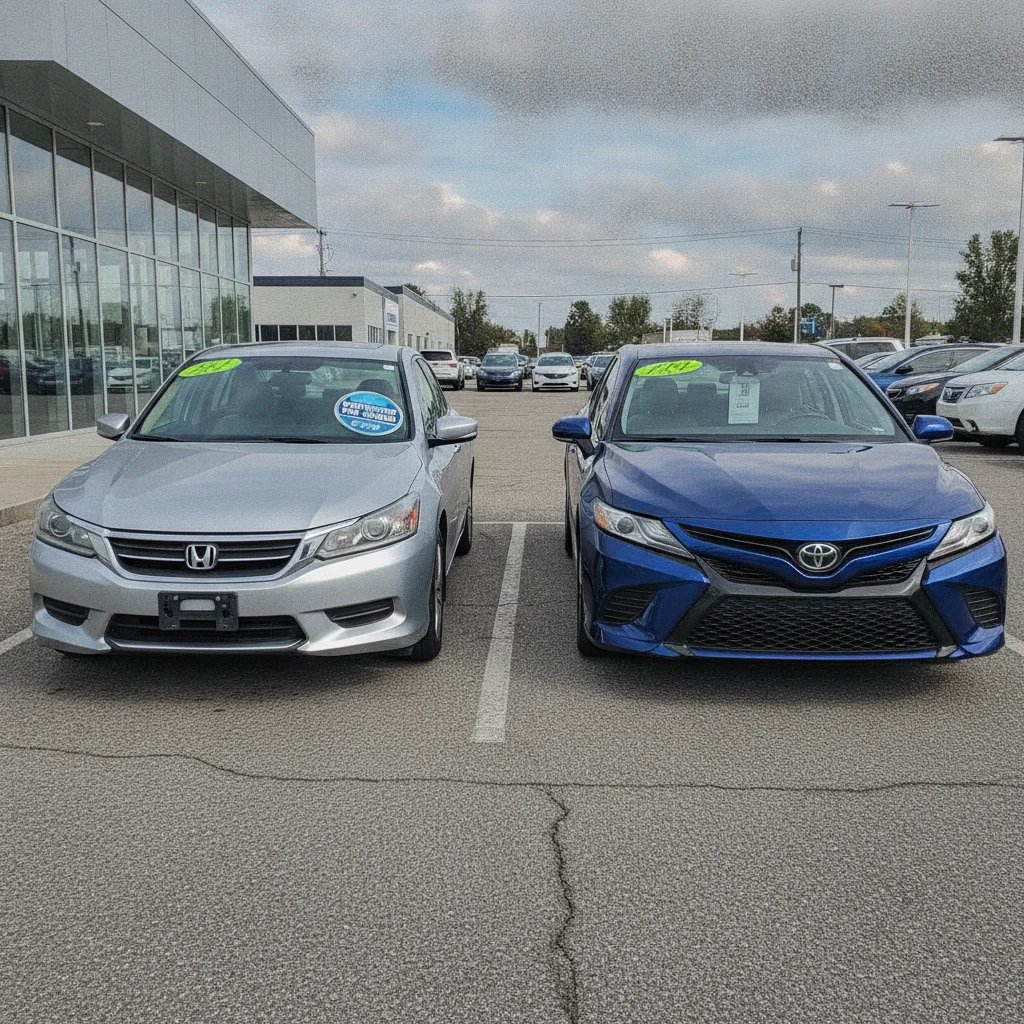
Here's the core reason: insurance premiums and payout calculations are anchored to market value. A CPO vehicle commands a measurable premium over an equivalent non-certified used car. According to data from several major valuation services, CPO-certified vehicles can sell for anywhere from $1,000 to $3,500 more than the same year, make, model, and trim in standard used condition. That gap exists because of the inspection, the warranty backing, and the manufacturer's implicit quality guarantee.
When your insurer calculates your car's actual cash value (ACV) — the figure they use to settle a total loss claim — they are supposed to reflect that premium. In practice, not all insurers automatically account for CPO status unless you tell them. This is one of the most commonly overlooked conversations in the car-buying process.
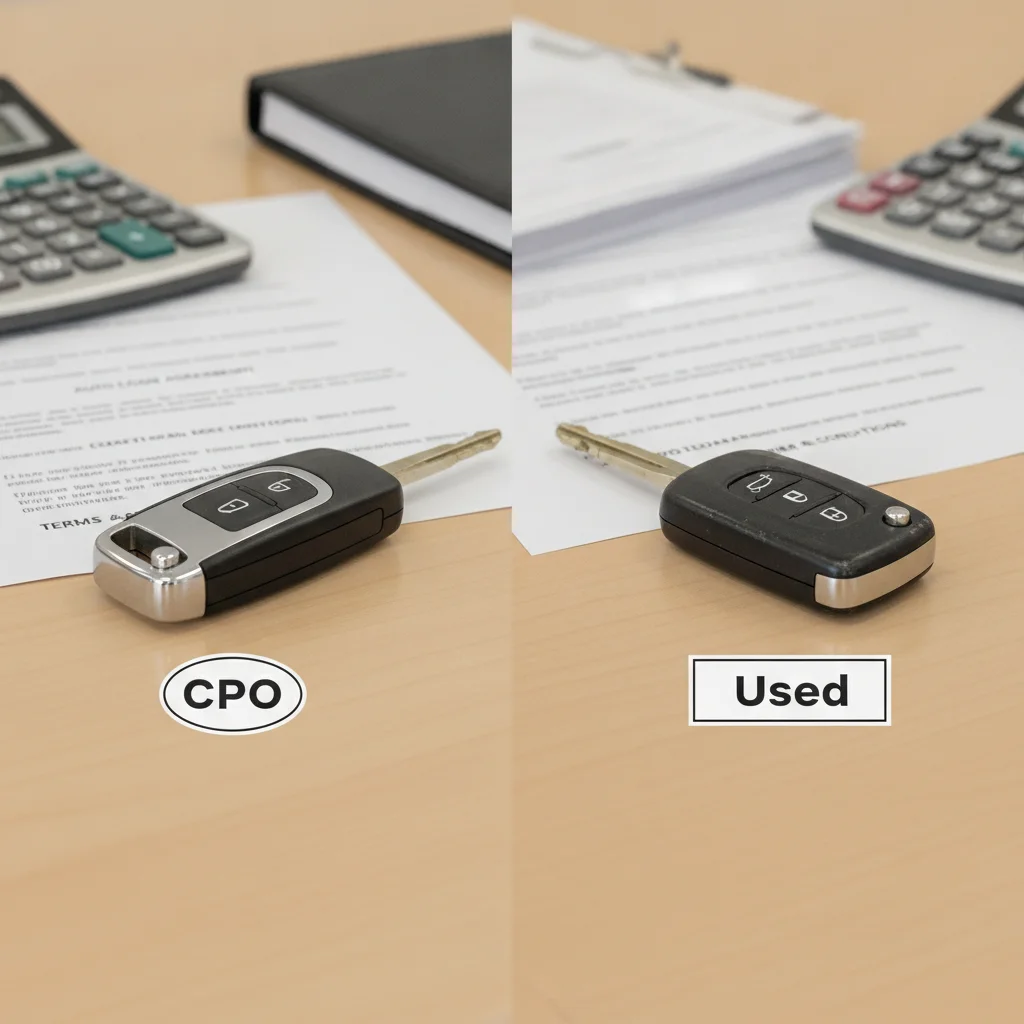
Before signing any insurance binder on a CPO purchase, it's worth understanding what the CPO label actually gets you versus a standard used vehicle — because that delta is exactly what you need to communicate to your insurer to make sure your coverage is calibrated correctly.
What You Need Before You Call Your Insurer
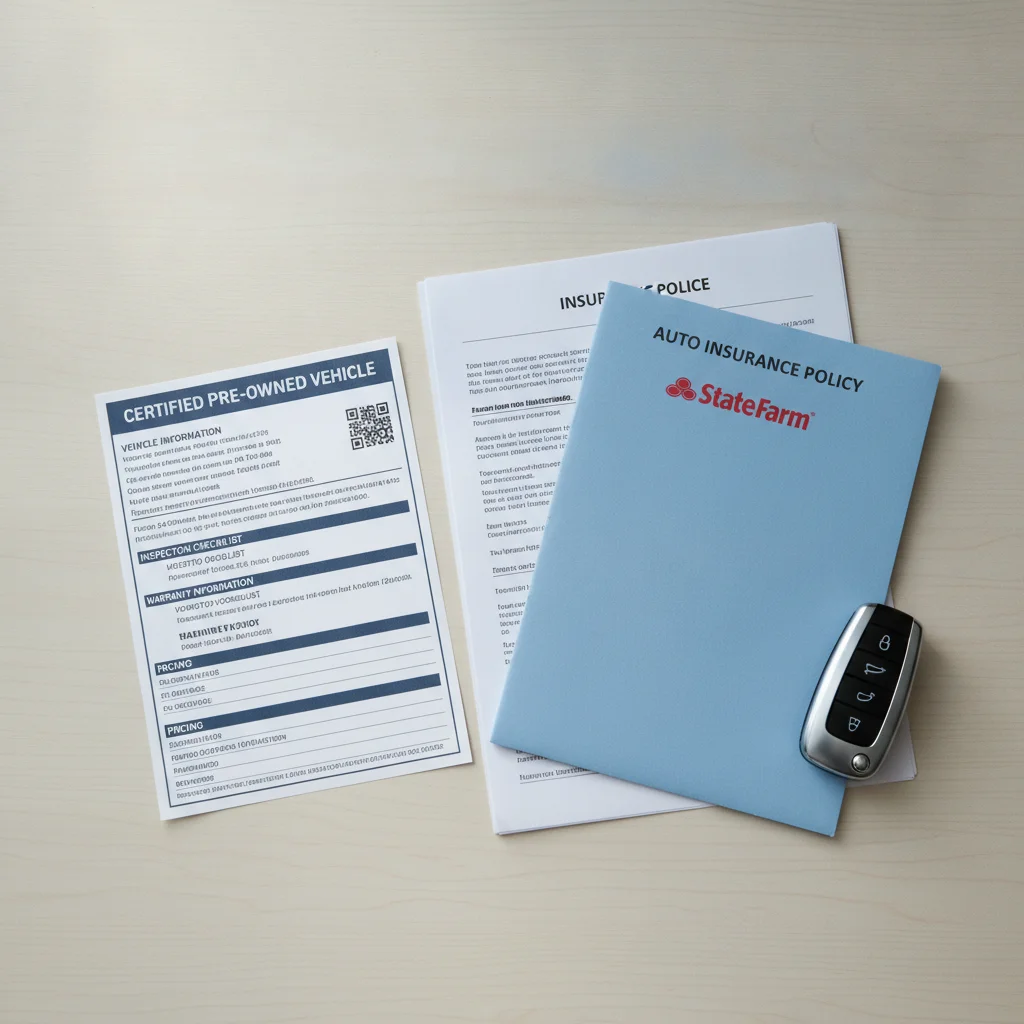
Getting the right insurance on a CPO vehicle requires a bit of preparation. You'll want to walk into that conversation with specific documents and information in hand — not just the car's VIN.
What you will need
Having this information ready serves two purposes. First, it allows your insurer to look up the exact vehicle history and confirm its CPO eligibility. Second, it gives you the documentation to push back if an adjuster later undervalues a total-loss claim by ignoring the CPO premium. Keep copies of the CPO certification paperwork and warranty booklet in a safe place — separate from the glovebox.
CPO Certification Documentation
Provides the exact warranty terms, covered components, and included benefits you need to compare against your insurance policy.
Kelley Blue Book or Edmunds Valuation Tool
Generates a market value estimate for your specific vehicle in CPO or dealer-retail condition, which you'll use to calibrate your insurance coverage amounts.
Loan Agreement or Payoff Quote
Tells you your exact remaining loan balance so you can calculate your loan-to-value ratio and determine whether gap insurance is necessary.
Auto Insurance Quote Comparison Tool
Lets you compare premiums across multiple insurers to find the best rate for the specific coverage configuration a CPO vehicle requires.
Spreadsheet or Note-Taking App
Used to document coverage decisions, deductible rationale, and CPO warranty dates for your annual policy review.
Step-by-Step: Structuring the Right Insurance Policy for a CPO Car
Follow these steps in order. Skipping ahead — for example, committing to a lender before confirming your coverage requirements — can leave you underinsured or paying for duplicate protections.
Confirm the exact CPO program details before contacting your insurer
Not all CPO programs are the same. A Toyota Certified Used Vehicle program has different coverage terms than a BMW Certified Pre-Owned program. Before calling your insurance agent, pull out the CPO certification paperwork and note the following:
- Which manufacturer's program applies (dealer-affiliated vs. manufacturer-backed)
- Warranty duration remaining — both years and mileage
- What components are covered and any exclusions
- Whether the warranty includes roadside assistance and rental reimbursement
- The per-visit deductible, if any
This information tells you which coverage elements might overlap with your insurance policy, allowing you to make intelligent decisions about riders and add-ons.
Get the vehicle's actual cash value estimate from multiple sources
Before finalizing coverage, you need a realistic sense of what your CPO car is worth as a CPO vehicle — not just as a generic used car. Run the VIN through at least two valuation tools and specifically select "certified pre-owned" or "dealer retail" condition where the option is available.
Common valuation sources worth checking:
- Kelley Blue Book (kbb.com) — look for the CPO/certified category
- Edmunds True Market Value
- NADA Guides dealer retail value
Document the estimated values from each source. If there's a significant gap between the CPO value and the standard used value, that gap is what you want your insurer to account for when setting up your coverage.
Contact your insurer and explicitly disclose CPO status
Call your insurance agent or use your insurer's online portal to add or update the vehicle. During this conversation, explicitly state that the car is CPO-certified and name the program. Ask the agent directly:
- Does your company account for CPO status when calculating ACV for a total-loss claim?
- Is there a specific condition code or designation I should have on file to reflect CPO certification?
- How does your ACV methodology work — do you use book value, comparable sales, or another method?
Their answers will tell you whether you need to push for additional documentation or whether the insurer already has a clean process for handling CPO vehicles.
Decide whether gap insurance is necessary for your loan situation
Pull up your loan agreement and calculate your current loan-to-value (LTV) ratio. Divide your loan balance by the CPO market value you found in Step 2.
- LTV above 100%: You're already underwater. Gap insurance is strongly advisable.
- LTV between 90%–100%: You're close to break-even. Gap insurance is still a low-cost way to protect against an early total-loss scenario.
- LTV below 80%: Your equity cushion is meaningful. Gap insurance may be unnecessary, but review annually as values shift.
Gap insurance purchased through your lender at the dealership is almost always more expensive than the same coverage added to your auto insurance policy. Get the price from your insurer before agreeing to the dealership version.
Set your deductibles based on your CPO warranty's mechanical coverage
With your CPO warranty terms in hand, review your collision and comprehensive deductible options. The warranty handles covered mechanical failures — which means your insurance deductible decisions are really about collision and non-mechanical comprehensive events (theft, hail, flooding).
General guidance on deductible selection for CPO vehicles:
- If your emergency fund can absorb $1,000 comfortably, a $1,000 deductible on collision can meaningfully reduce your annual premium.
- Comprehensive deductibles can often be set slightly higher than collision, since comprehensive claims tend to be less frequent for properly garaged vehicles.
- If you're financing, confirm with your lender whether they have a maximum deductible requirement — some lenders cap it at $500 or $1,000.
Eliminate duplicate coverage between your CPO program and your policy
Compare your CPO program's included benefits directly against your insurance policy's optional riders. Look specifically for overlap in these areas:
| Benefit | CPO Program Includes? | Insurance Policy Includes? | Recommendation |
|---|---|---|---|
| Roadside assistance | Often yes | Optional rider | Remove from policy if CPO version is adequate |
| Rental reimbursement | Sometimes yes | Optional rider | Compare daily limits; keep the better one |
| Trip interruption coverage | Some programs | Rare on standard policies | Note which applies and for how long |
Eliminating genuine duplicates isn't about cutting corners — it's about allocating your insurance budget toward coverage that actually adds protection.
Document everything and set a calendar reminder to review coverage annually
Once your policy is configured, create a simple reference document that captures:
- Your insurer's acknowledgment (written or email) of the car's CPO status
- The ACV methodology your insurer uses
- Whether gap/loan payoff coverage is active and through which provider
- The CPO warranty expiration date (both years and mileage)
- Your deductible amounts and rationale
Set a calendar reminder 30 days before your policy renewal each year to revisit these decisions. As the CPO warranty approaches expiration, you may want to adjust your coverage — and you should also reassess gap coverage as your loan balance decreases and your equity grows.
Gap Insurance on a CPO Vehicle: Still Necessary?
This is the question I hear most often from buyers who've just signed the CPO paperwork: "Do I still need gap insurance? The car already has a warranty."
The short answer is yes — for most buyers, gap coverage is still relevant on a CPO purchase. Here's why.
Gap insurance covers the difference between what you owe on your loan and what your insurance company pays out if the car is totaled or stolen. The CPO warranty covers mechanical failures. Those are two entirely different categories of risk. A warranty won't pay off your loan if a tree falls on the car in month three.
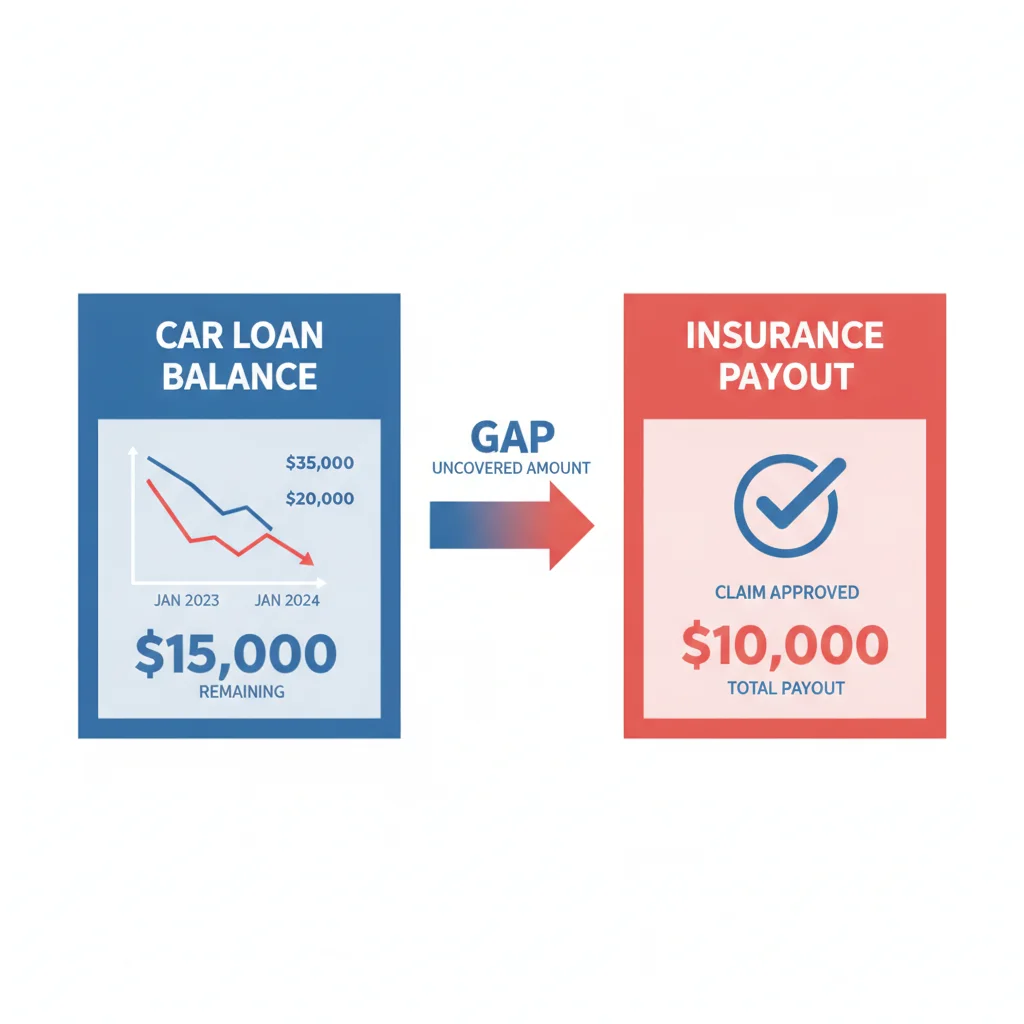
The gap risk on a CPO vehicle is actually slightly more complex than on a new car. A new car depreciates fastest in the first year — the infamous "drive it off the lot" effect. A CPO car has already absorbed that initial depreciation hit, which is one of its financial advantages. However, if you financed a CPO vehicle at a high loan-to-value ratio — meaning you put little or no money down — you can still end up "upside down" on the loan, particularly in the early months.
Consider this example: You purchase a 2-year-old CPO sedan for $28,000 with $1,000 down and a 72-month loan at 6.5%. In month 6, the car is totaled. Your insurer pays ACV — let's say $25,500 after depreciation. Your loan balance at that point might be $26,800. Gap insurance covers that $1,300 difference. Without it, you pay out of pocket.
CPO Warranties Do Not Cover Total-Loss Gaps
A CPO warranty protects you against covered mechanical failures during the warranty period. It provides zero protection if your car is totaled in an accident or stolen. These are separate and distinct risks that require separate and distinct financial products. Do not reduce your gap coverage or insurance limits based on the presence of a CPO warranty.
Dealer-Sold Gap Insurance Is Usually Overpriced
Dealers routinely mark up gap insurance significantly — sometimes charging $600 to $900 for coverage your insurer would add to your policy for $50 to $100 per year. Always get a quote from your insurer before agreeing to the dealership's version. If you've already signed for dealer gap coverage, check your contract — many states require a cancellation option within a set window.
CPO financing sometimes comes with promotional rates that are genuinely competitive. See how those deals stack up in our breakdown of CPO financing vs. used car financing rates. The lower your rate, the faster you build equity — which reduces the window where gap insurance is critical.
How CPO Warranty Coverage and Insurance Work Together
A common point of confusion: buyers sometimes assume that because their CPO car has a powertrain warranty covering major mechanical components, they can safely reduce their insurance coverage. This reasoning is flawed, and it can be expensive.
Think of the CPO warranty and your insurance policy as covering two completely separate categories of loss:
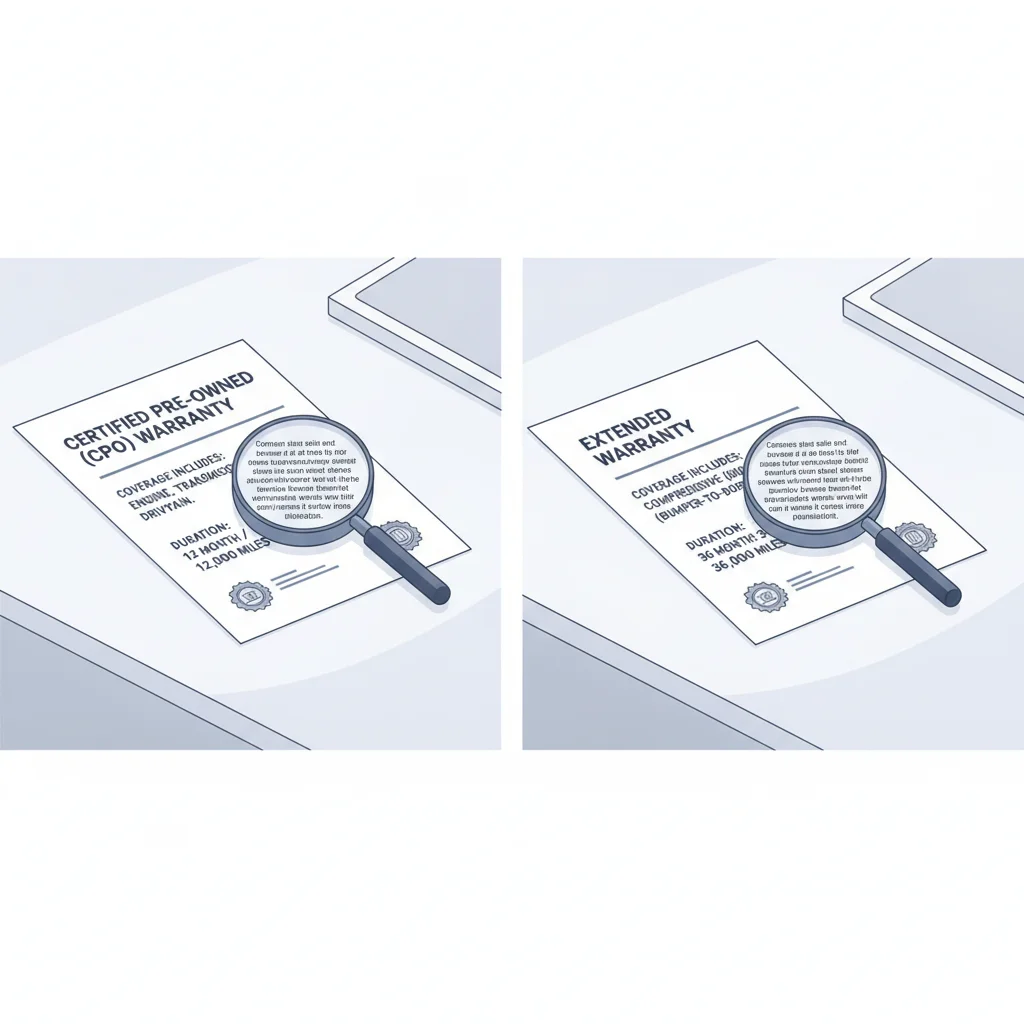
- CPO Warranty: Covers manufacturer-defect mechanical failures — engine, transmission, drivetrain, and sometimes electrical components depending on the program. It does not cover collision damage, theft, weather events, or your liability to other drivers.
- Auto Insurance: Covers collision damage, comprehensive losses (theft, weather, vandalism), and your legal liability if you cause an accident. It does not fix a blown head gasket.
Where they can interact is in a gray area around rental reimbursement and roadside assistance. Many CPO programs include these benefits. If your insurance policy also includes rental reimbursement coverage, you're doubling up on that specific benefit. It's worth checking whether you can remove that rider from your policy to save a few dollars monthly — but only if your CPO program's version is actually comprehensive enough to replace it.
Check Rental Coverage Before Removing It
Many CPO programs offer rental car reimbursement during covered warranty repairs, but limits vary significantly — some programs cap it at $35/day for up to 5 days. If your insurance policy's rental rider offers $50/day for 30 days, they're not equivalent. Compare the daily rates and maximum duration before dropping the insurance version to save a few dollars per month.
Disclose CPO Status Every Policy Renewal
Don't assume your insurer has CPO status permanently noted on file. At each renewal, confirm it's still documented — staff changes and system updates can occasionally cause this detail to drop off. A two-minute confirmation call can prevent a dispute later if you ever need to file a total-loss claim.
For a deeper look at how warranty layers work together, CPO warranties vs. extended warranties explains when stacking coverage makes sense and when it's redundant spending.
One more nuance worth flagging: some CPO programs include a deductible — typically $0 to $200 per covered repair visit. Your insurance policy has its own collision and comprehensive deductibles. These operate independently. Choosing a higher insurance deductible (say, $1,000 instead of $500) can lower your premium, and for a CPO vehicle in good mechanical condition, that tradeoff may be reasonable. Just make sure your emergency fund can absorb the difference if you need to file a claim.
The long-term insurance cost of a CPO vehicle is also tied to how well the car holds its value. Some CPO cars hold value significantly better than others based on brand reliability and parts availability — and a car that retains value tends to carry a higher ACV for a longer period, which affects your coverage needs year over year.
Common Mistakes to Avoid When Insuring a CPO Car
Even careful buyers make predictable errors at this stage. Here are the ones worth guarding against explicitly:
Mistake 1: Treating it exactly like a standard used car
Because a CPO vehicle is technically a used car, some buyers (and some agents) reflexively apply the same coverage logic they'd use for a $12,000 private-party purchase. That's a mistake when you're paying a CPO premium and financing a $30,000 vehicle. The coverage amounts and deductible choices should reflect the actual value and loan exposure — not the used-car category in the abstract.
Mistake 2: Not disclosing CPO status to the insurer
Some insurers ask specifically whether a vehicle is CPO-certified. Others don't. Either way, proactively disclose it. If you're ever in a total-loss dispute, having documented that you disclosed CPO status gives you a stronger position when arguing for a higher ACV settlement. CPO pricing behaves differently from standard used car valuations — and your insurer should know which category your car falls into.
Mistake 3: Dropping comprehensive coverage to save money
On a financed CPO vehicle, your lender will almost certainly require both comprehensive and collision coverage. But even if you own the car outright, dropping comprehensive on a $25,000-plus CPO vehicle to save $15 a month is usually a poor tradeoff. Comprehensive covers theft and weather events — two risks that don't care what warranty your car has.
Mistake 4: Ignoring the transferable warranty impact on future resale
This isn't strictly an insurance issue, but it affects the car's value throughout your ownership period. If the CPO warranty is transferable to a future buyer, that feature increases resale value — which in turn affects how long you'll want to maintain higher coverage levels. What happens to your CPO warranty when you sell explains how transferability works in practice.
Never Assume CPO Status Protects You From Insurance Gaps
The CPO label is a warranty and quality-assurance designation — not an insurance product. It will not pay out if your car is stolen, totaled in a collision, or damaged by a flood. Buyers sometimes reduce their insurance coverage after purchasing a CPO vehicle under the assumption that the warranty "covers" the car. This is a costly misunderstanding. Maintain appropriate comprehensive and collision coverage for the full value of the vehicle throughout the life of your loan.
Insuring a CPO car isn't dramatically more complicated than insuring any other vehicle — but the details matter more, because the financial stakes are higher. A CPO purchase typically represents a larger investment than a standard used car, and the warranty protection, while valuable, does not substitute for proper insurance coverage. Getting this right from the start protects both your car and your loan position.
For a fuller picture of costs that often catch CPO buyers off guard, see the hidden costs nobody mentions when buying CPO — insurance configuration is just one piece of a broader financial puzzle worth mapping out before you drive home.

All claims are backed by peer-reviewed research. Sources on request.