
Key Takeaways
Summary
22 items · 30–60 minutes
Why You Need to Verify Before You Sign
The federal EV tax credit sounds straightforward: buy a qualifying electric vehicle, get up to $7,500 back at tax time. In practice, there are at least a dozen independent requirements — applied to both the vehicle and the buyer — that must all be satisfied simultaneously. Miss one and the credit evaporates, regardless of how confident the salesperson seemed.
The Inflation Reduction Act of 2022 rewrote the rules entirely, adding North American assembly mandates, battery sourcing thresholds, MSRP price caps, and income limits that didn't exist under the old credit structure. Since then, the eligible vehicle list has changed multiple times. Models that qualified in early 2023 lost eligibility later that year. New models have been added. The rules are not static.
This checklist is designed to be worked through methodically — ideally a week or two before you plan to visit a dealership. For a deeper breakdown of how the credit system works from start to finish, see the complete EV tax credit walkthrough. If you want to understand the most common disqualifying scenarios upfront, why your EV might not actually qualify covers those in detail.

Work through each group below in order. Some items take two minutes; others require pulling documents or running numbers with your tax advisor. Total time for a thorough review: 30 to 60 minutes. That's a reasonable investment when you're trying to protect thousands of dollars in potential savings.
Tools You'll Need
Before you start, gather the following resources. Several are free government databases; others are documents you likely already have. Having them in front of you before you begin will cut verification time significantly.
fueleconomy.gov Eligible Vehicle List
Official DOE and EPA database showing which EV models qualify for the federal clean vehicle credit and at what credit amount.
IRS Energy Credits Online Portal
Used by dealers to register and submit point-of-sale credit transfer documentation; buyers can verify dealer registration status here.
IRS Form 8936
The tax form used to claim the Clean Vehicle Credit on your federal income tax return.
IRS Form 1040-ES
Helps estimate your current-year tax liability so you can determine how much of the non-refundable credit you will actually be able to use.
DOE Alternative Fuels Incentive Finder
Searches state, utility, and local incentive programs to identify additional savings beyond the federal credit.
NHTSA VIN Decoder
Decodes the vehicle identification number to confirm the country of final assembly and other eligibility data.
Tax Software (TurboTax, H&R Block, etc.)
Walks through Form 8936 and integrates the credit with your full return, flagging common errors before submission.
If you're buying a used EV rather than a new one, the rules differ in important ways — separate price limits, age requirements, and a lower maximum credit of $4,000. See claiming the used EV credit for the complete breakdown of what used buyers need to verify. For used vehicles, also consider running through the pre-purchase EV inspection checklist alongside this tax credit verification process.
The Full Verification Checklist
Work through all six groups in sequence. The vehicle and buyer eligibility groups are the two that disqualify the most buyers — start there before moving on to the tax liability and documentation steps.
Non-Refundable Means Non-Refundable
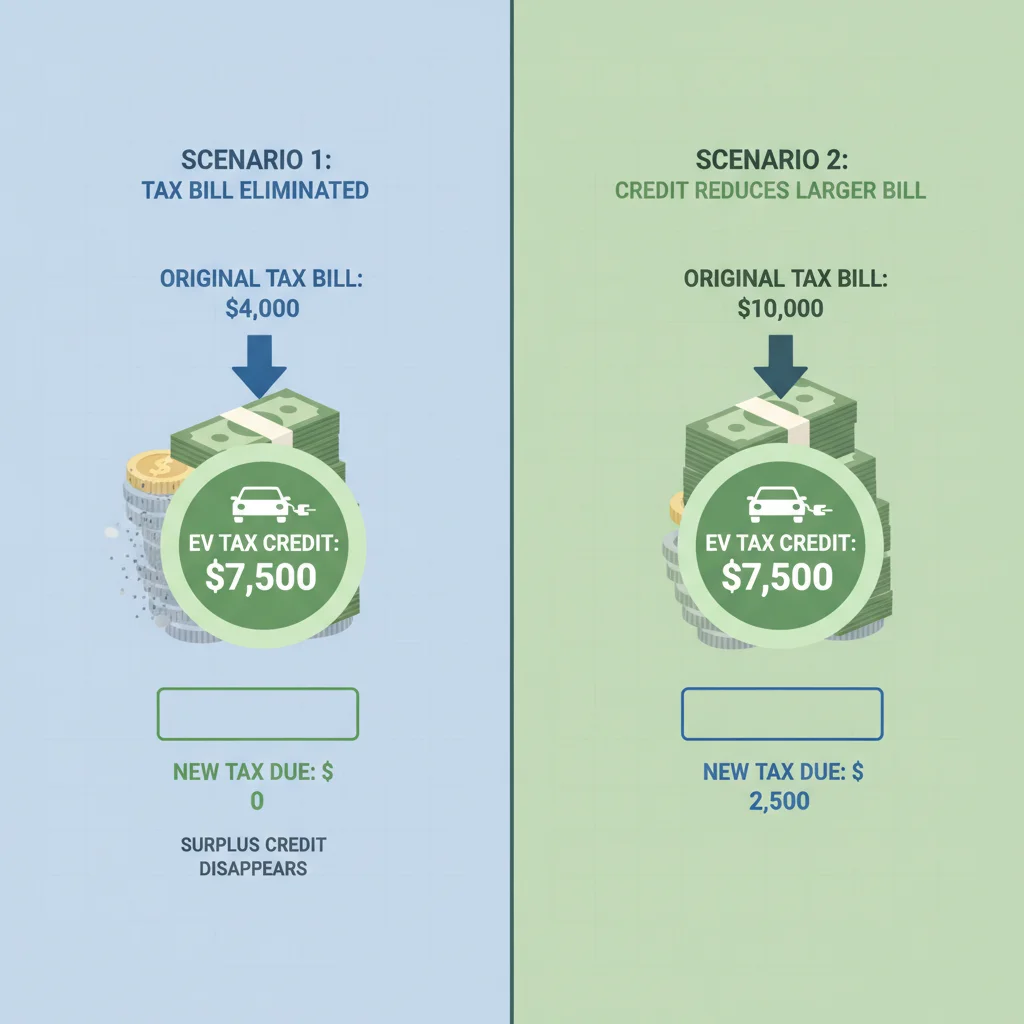
The federal EV tax credit is a non-refundable credit. If your total federal tax liability is $4,000 and the credit is worth $7,500, you only capture $4,000 in savings — the remaining $3,500 disappears. There is no carryforward to future tax years. This distinction matters enormously when calculating the real financial impact of the credit on your purchase decision.
Incorrect Claims Can Trigger IRS Penalties
Claiming the EV credit when you don't actually qualify — whether due to income exceeding the cap, the vehicle not meeting assembly rules, or a documentation error — can result in IRS recapture of the full credit amount, plus interest and potential accuracy-related penalties. <a href="/electric-vehicles/ev-ownership-costs/ev-tax-credits/what-happens-if-you-claim-the-ev-credit-but-didnt-actually-qualify">Understand the consequences of an incorrect claim</a> before you sign anything.
Vehicle Eligibility
Buyer Income Eligibility
Tax Liability Check
Point-of-Sale Transfer Option
State & Additional Incentives
Documentation & Filing Preparation
Credit Eligibility Changes Frequently
The list of qualifying vehicles is updated on a rolling basis as manufacturers adjust their battery sourcing agreements and supply chains. A model that qualified when you first researched it may no longer qualify by the time you sign. Always re-verify on fueleconomy.gov within 48 hours of your purchase date to get the most current status.
Private Party Sales Don't Qualify for the New Credit
The new clean vehicle credit under IRC §30D requires purchase from a licensed dealer. Buying a brand-new EV from an individual — for example, someone selling a factory order they can no longer take delivery of — will disqualify the credit entirely, even if the vehicle itself meets all other requirements.
Point-of-Sale Transfer Can Be Reversed
If you accept the credit as a price reduction at the dealership and your actual tax liability for the year falls short of the credit amount, the IRS can recapture the difference when you file. This is not a hypothetical risk — it's an explicit part of the Inflation Reduction Act rules. Run your numbers before you agree to a point-of-sale transfer.
Understanding the Income Cap Rules
The income limits for the new vehicle credit are firm cutoffs, not phase-outs. Cross the threshold by even one dollar of MAGI and you lose the entire credit — there's no partial credit for being slightly over the limit. The thresholds as of the 2024 tax year:
| Filing Status | MAGI Limit |
|---|---|
| Single / Married Filing Separately | $150,000 |
| Head of Household | $225,000 |
| Married Filing Jointly / Qualifying Surviving Spouse | $300,000 |
The legislation includes a useful provision: you qualify if your MAGI is below the cap in either the year of delivery or the preceding tax year. If you earned $145,000 last year but expect to earn $160,000 this year, you still qualify based on last year's income. Conversely, if last year you earned $310,000 as a married joint filer but this year you expect to earn $280,000, you qualify based on the current year.
MAGI for this purpose is your adjusted gross income with certain deductions added back — foreign income exclusions, student loan interest, IRA deductions, and a few others. For most W-2 earners, MAGI is very close to AGI. If you have rental income, self-employment income, or significant investment income, the difference can matter. Pull your prior year's Form 1040 and look at Line 11 (AGI) as a starting point, then confirm with your tax preparer whether any add-backs apply.
One practical strategy: if you're borderline on income this year, consider maximizing pre-tax retirement contributions before year-end. Every dollar you contribute to a traditional 401(k) or deductible IRA reduces your MAGI by one dollar. Contributing the annual maximum to a 401(k) could, in some cases, move you from just over the limit to just under it.
The Point-of-Sale Transfer: What It Means in Practice
Starting in 2024, buyers can transfer the federal EV credit directly to a registered dealer at the point of sale, effectively receiving it as an immediate price reduction rather than waiting until you file your tax return. This is a genuinely useful option — but it comes with conditions most buyers don't fully understand before signing.
First, the dealer must be registered with the IRS through the Energy Credits Online portal. Not every dealer has completed this registration. Before assuming the point-of-sale option is available, ask the finance manager to show you their IRS registration confirmation.
Second, both parties must complete attestation documentation. You'll be certifying your income eligibility and confirming you haven't claimed the credit on another vehicle in the same tax year. The dealer submits the transaction data to the IRS. These aren't optional formalities — they're the mechanism that makes the transfer legally valid.
Third, and critically: the transfer is an advance. If your actual tax liability when you file turns out to be lower than the credit amount you received at the point of sale, the IRS can recapture the shortfall. For example, if you took a $7,500 credit reduction at purchase but your tax bill only supports a $5,000 credit, you owe the $2,500 difference back at filing. Run your estimated tax liability numbers before accepting any point-of-sale transfer.
To verify your vehicle's credit status before you even walk into the lot, use the DOE tool described in how to check whether a specific EV qualifies.
After Purchase: Protecting Your Credit When You File
Completing this checklist before purchase is the primary goal, but a few documentation steps post-purchase are equally important for ensuring the credit survives IRS scrutiny.
The dealer is required to provide you with a written disclosure that includes the vehicle's VIN, the maximum credit amount, and confirmation that the vehicle meets the IRS eligibility criteria. Keep this document with your tax records. If you're ever audited, this is the first piece of documentation the IRS will request.
When you file, claim the credit on IRS Form 8936. The form walks through the vehicle's eligibility, your personal eligibility, and the credit calculation. If you used tax software, the interview process handles this automatically — but it's worth reviewing the completed form before submitting to confirm the VIN and purchase date are entered correctly. Errors on the VIN alone can trigger IRS correspondence.
If you want to understand the compliance risks in detail — including what happens in a worst-case scenario where a claim is disallowed — what happens if you claim the EV credit but didn't actually qualify covers the IRS recapture process and penalty exposure clearly.
Finally, once you've confirmed your tax credit eligibility, it's worth reviewing your insurance coverage as well. EV policies have unique coverage considerations — battery replacement costs, charging equipment protection, and more. The EV insurance policy checklist is a practical follow-on step before you finalize the full purchase.

All claims are backed by peer-reviewed research. Sources on request.