
Key Takeaways
EV Credit Recapture
EV credit recapture is what happens when the IRS determines you claimed a federal electric vehicle tax credit you weren't actually entitled to. The agency reverses the credit, meaning you owe back the tax savings you received — plus potential penalties and interest. This can happen because of income, vehicle eligibility, or transfer errors made at the time of purchase or filing.
Under IRC Section 30D (new clean vehicles) and Section 25E (used clean vehicles), the IRS has the authority to assess additional tax equal to the full credit amount if the credit was claimed improperly. Amended returns may mitigate penalties if filed proactively.
The Risk Most EV Buyers Don't Think About
Most coverage of the federal EV tax credit focuses on how to get it. Far less attention goes to what happens when someone claims it incorrectly — and the answer is uncomfortable. The IRS treats an improperly claimed credit as a tax underpayment, and it will collect accordingly.
This isn't a theoretical risk. The Inflation Reduction Act overhauled the clean vehicle credit rules starting in 2023, introducing new income caps, battery sourcing requirements, North American assembly rules, and a used-vehicle credit that didn't exist before. Each of those rules creates another opportunity for a good-faith mistake — or an outright disqualifying error — to slip through.
If you're trying to understand your exposure, or you've already filed and you're now second-guessing your eligibility, this article breaks down exactly what recapture looks like, how the IRS detects improper claims, and what your options are if you need to correct course.
For a full map of who qualifies and how to file correctly in the first place, see our complete EV tax credit walkthrough.

What Triggers Disqualification in the First Place
Before getting into consequences, it's worth understanding the most common reasons a credit claim gets invalidated. These aren't obscure edge cases — they're the everyday mistakes that trip up well-meaning buyers.
Income Limit Applies to Two Tax Years
The IRS applies the income test using the lower of your MAGI from the year you purchased the vehicle or the year you file the return. If your income was under the threshold in the purchase year but jumped above it during the filing year — or vice versa — the lower figure controls. This rule is designed to prevent people from timing purchases to exploit a low-income year, but it also provides a safety valve in some scenarios.
Dealer Reporting Is Now Mandatory
Since the 2023 tax year, dealers must file reports with the IRS for every clean vehicle sale where a credit is transferred or expected. These reports include the buyer's Social Security number, VIN, and sale price. The practical effect is that the IRS has independent confirmation of EV transactions — reducing the ability to claim a credit without a matching dealer record.
Income Limits (MAGI Thresholds)
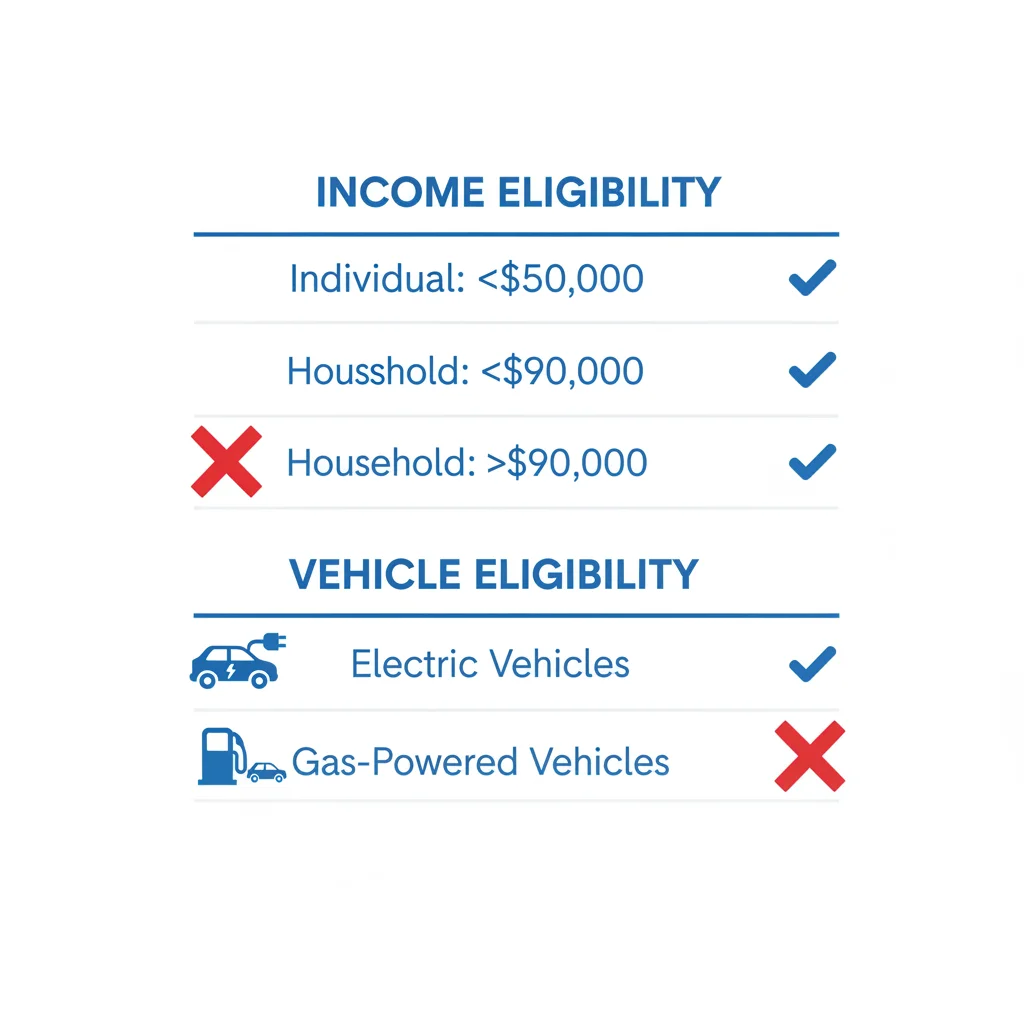
The Section 30D new clean vehicle credit phases out based on modified adjusted gross income (MAGI). For 2024, the limits are:
- Single filers: $150,000
- Head of household: $225,000
- Married filing jointly: $300,000
There's no partial phase-out — you're either under the limit or you're not. And the IRS uses the lower of your MAGI in the year of purchase or the year you file. That means a raise, a bonus, or a large capital gains event after you buy could retroactively disqualify you.
Vehicle Eligibility
Not every EV qualifies. Battery critical mineral and component sourcing rules determine whether a vehicle gets the full $7,500, a partial $3,750, or nothing at all. The vehicle must also have been assembled in North America. The IRS and Department of Energy maintain a qualified vehicle list, but that list changes — sometimes mid-model-year — as manufacturers adjust their supply chains.
Dealers sometimes quote the credit incorrectly. Our article on why your EV might not actually qualify covers the specific battery and assembly rules that most commonly catch buyers off guard.
Business Use Requirement Errors
For the credit to apply under Section 30D, the vehicle must be used predominantly for personal use (not commercial). Buying an EV for a business and claiming the personal credit rather than the commercial clean vehicle credit (Section 45W) is a common but serious error.
Used EV Credit (Section 25E) Pitfalls
The used clean vehicle credit has its own rules: the vehicle must be at least two model years old, purchased from a licensed dealer, cost no more than $25,000, and the buyer's income must fall below $75,000 (single) or $150,000 (joint). First-time-in-a-lifetime restrictions also apply — you can only claim the used credit once every three years.
What Recapture Actually Looks Like
When the IRS determines a credit was improperly claimed, it doesn't just send a polite letter. Here's the mechanics of what happens:
$7,500
Maximum recaptured credit for new EVs
The full Section 30D credit amount is added back to tax liability if the IRS determines the claim was invalid.
~8%
IRS underpayment interest rate (2024)
The federal short-term interest rate plus 3 percentage points, applied daily on the unpaid tax from the original due date.
20%
Accuracy-related penalty rate
Applied to the underpayment amount when the IRS finds negligence or disregard of rules in an improper credit claim.
3 years
Standard IRS audit window
The IRS generally has three years from the return due date to assess additional tax; extends to six years for substantial understatement.
$300K
Joint filer MAGI limit for new EV credit
Buyers filing jointly with MAGI above $300,000 are fully disqualified — no partial credit applies under current law.
The Core Tax Liability
The credit amount — up to $7,500 for new vehicles, up to $4,000 for used — is added back to your tax liability for the year it was claimed. If you owed $0 after the credit and the credit gets recaptured, you suddenly owe $7,500 (or whatever the credit was worth) plus everything else described below.
Underpayment Interest
The IRS charges interest on unpaid tax from the original return due date — typically April 15 of the filing year. As of 2024, the federal short-term rate plus 3 percentage points has kept that rate around 8%. Interest accrues daily and compounds. The longer you wait, the more it costs.
Accuracy-Related Penalty
If the IRS finds you claimed the credit without a reasonable basis — or if it determines negligence — it can add a 20% accuracy-related penalty on top of the tax owed. On a $7,500 recapture, that's an additional $1,500.
Failure-to-Pay Penalty
If the IRS sends a notice and you don't pay promptly, a failure-to-pay penalty of 0.5% per month can pile on, capped at 25% of the unpaid tax. This is separate from the accuracy penalty.
In egregious cases involving intentional fraud, civil fraud penalties of 75% of the underpayment apply, and criminal referrals are theoretically possible — though practically, they're reserved for deliberate schemes, not good-faith errors.
“The complexity of the clean vehicle credit rules means that even well-intentioned taxpayers can end up on the wrong side of the IRS. Documentation at the time of purchase is your only real defense after the fact.”
— Nina Olson, Former IRS National Taxpayer Advocate, Executive Director of the Center for Taxpayer Rights
How the IRS Detects Improper Claims
Some taxpayers assume that with tens of millions of returns filed annually, an EV credit error is unlikely to get noticed. That assumption is less safe than it used to be.
Dealer Reporting to the IRS
Starting with the 2023 tax year, dealers who sell qualified vehicles are required to submit reports to the IRS that include the buyer's name, taxpayer ID, vehicle identification number (VIN), and sale price. This creates a direct data trail the IRS can match against your return.
VIN-Level Matching
The IRS receives qualified vehicle lists from the Department of Energy. If you claimed a credit for a VIN that wasn't on the eligible list for that model year and configuration, that's a detectable mismatch.
Income Data Cross-Reference
The IRS receives W-2, 1099, and other income data independently from your return. If your reported MAGI exceeds the applicable threshold, that inconsistency can trigger review, particularly now that income limits are a hard cutoff rather than a phase-out.
Verify Eligibility Before the Point-of-Sale Transfer
If you're planning to take the EV credit as an upfront dealer discount, run a thorough eligibility check before signing — not after. Once the transfer is complete and the dealer receives the credit from the IRS, you bear the full recapture risk if the IRS later disqualifies the claim. The convenience of upfront savings isn't worth the exposure if your income is near the threshold or your vehicle's qualification status is ambiguous.
File an Amended Return Before the IRS Contacts You
If you discover an error in your EV credit claim, don't wait. Filing Form 1040-X proactively is the single most effective step you can take to reduce penalty exposure. The IRS views voluntary correction favorably — and it almost always results in lower penalties than responding to a notice after the agency has already flagged your return.
Keep Your Purchase Documents for Six Years
Retain your purchase agreement, dealer disclosure of credit eligibility, VIN documentation, and proof of MAGI for at least six years from the filing date. If the IRS ever questions your claim — especially on the basis of substantial understatement — having contemporaneous records demonstrating good-faith reliance on dealer representations is a meaningful defense.
Point-of-Sale Transfer: A New Wrinkle
Since 2024, buyers can elect to transfer the credit to a dealer at purchase, effectively receiving it as an immediate price discount rather than a year-end tax reduction. This sounds cleaner, but it introduces a specific risk: if the IRS later determines you didn't qualify, you still owe the full credit amount at tax time — even though the money has already been spent. The dealer keeps the discount; you absorb the IRS liability.
If you used the point-of-sale transfer option and you're now uncertain about your eligibility, read our pre-purchase eligibility verification checklist to understand exactly what should have been confirmed before signing.
What to Do If You Think You Claimed the Credit Incorrectly
If you've worked through your eligibility and concluded you may have claimed a credit you didn't deserve, acting proactively is always better than waiting for the IRS to find it first. Here's the sequence:
Step 1: Verify the Error
Before assuming the worst, verify the specific rule you think you may have violated. Check the IRS qualified vehicle list for the exact model year and VIN configuration, confirm your MAGI for both the purchase year and the filing year, and review the income thresholds that applied for the tax year in question. Sometimes what feels like an error isn't one — and the reverse is also true.
Step 2: Consult a Tax Professional
This isn't a DIY amendment if the numbers are significant. A CPA or enrolled agent with federal tax experience can assess whether the credit was truly improperly claimed, calculate exposure, and advise on the best amendment strategy. Attorney-client privilege matters if you believe the situation could be serious.
Step 3: File Form 1040-X
An amended return corrects the original filing. You'll recalculate your tax without the credit, show the increased liability, and pay what's owed. Filing before the IRS contacts you generally eliminates or reduces accuracy-related penalties, though underpayment interest still runs from the original due date.
Step 4: Pay the Liability
If you can't pay the full amount immediately, the IRS offers installment agreements and, in genuine hardship cases, offers in compromise. Ignoring the liability doesn't make it go away — it makes it more expensive.
Income Limit Applies to Two Tax Years
The IRS applies the income test using the lower of your MAGI from the year you purchased the vehicle or the year you file the return. If your income was under the threshold in the purchase year but jumped above it during the filing year — or vice versa — the lower figure controls. This rule is designed to prevent people from timing purchases to exploit a low-income year, but it also provides a safety valve in some scenarios.
Dealer Reporting Is Now Mandatory
Since the 2023 tax year, dealers must file reports with the IRS for every clean vehicle sale where a credit is transferred or expected. These reports include the buyer's Social Security number, VIN, and sale price. The practical effect is that the IRS has independent confirmation of EV transactions — reducing the ability to claim a credit without a matching dealer record.
How to Avoid This Situation Entirely
The cleanest outcome is never making an ineligible claim in the first place. Here's what that actually requires:
Check the Vehicle Before the Dealer Does
Don't rely on the dealer to confirm credit eligibility — dealers have a financial incentive to close the sale, and their staff may not be current on IRS rules. The IRS maintains a public fuel economy and qualified vehicle site (fueleconomy.gov) that lists eligible vehicles by VIN. Cross-reference it yourself before signing.
Many buyers overlook how easily misinformation spreads in showrooms. Our EV tax credit myths guide identifies the most common dealer and media misstatements that lead buyers to claim credits they're not entitled to.
Run Your MAGI Before You Buy
If you're close to an income threshold, don't guess. Calculate your MAGI using your most recent tax return as a starting point, then adjust for any income changes expected during the current year. Include capital gains, retirement distributions, and business income — all of which flow into MAGI even if they don't show up on your W-2.
Understand the Two-Year Rule for MAGI
The IRS uses the lower of your MAGI from the year of purchase or the year you file the return. A sudden income spike after you buy doesn't automatically eliminate eligibility — but it can. Track your income through year-end before assuming you're in the clear.
Get the VIN Confirmed in Writing
If a dealer confirms that a specific vehicle qualifies, ask for that confirmation in writing and keep it. It won't eliminate your IRS liability, but it creates a record that supports a good-faith reliance argument if things go sideways — and it may give you standing to pursue the dealer under state consumer protection statutes.
Verify Eligibility Before the Point-of-Sale Transfer
If you're planning to take the EV credit as an upfront dealer discount, run a thorough eligibility check before signing — not after. Once the transfer is complete and the dealer receives the credit from the IRS, you bear the full recapture risk if the IRS later disqualifies the claim. The convenience of upfront savings isn't worth the exposure if your income is near the threshold or your vehicle's qualification status is ambiguous.
File an Amended Return Before the IRS Contacts You
If you discover an error in your EV credit claim, don't wait. Filing Form 1040-X proactively is the single most effective step you can take to reduce penalty exposure. The IRS views voluntary correction favorably — and it almost always results in lower penalties than responding to a notice after the agency has already flagged your return.
Keep Your Purchase Documents for Six Years
Retain your purchase agreement, dealer disclosure of credit eligibility, VIN documentation, and proof of MAGI for at least six years from the filing date. If the IRS ever questions your claim — especially on the basis of substantial understatement — having contemporaneous records demonstrating good-faith reliance on dealer representations is a meaningful defense.
The EV credit rules are genuinely complicated, and they changed substantially in 2023 and again in 2024. That complexity is exactly why a small verification step before purchase is worth far more than an amended return and an IRS payment plan after the fact.

All claims are backed by peer-reviewed research. Sources on request.