Key Takeaways
Summary
28 items · 45–90 minutes on-site, plus additional time for remote research
Why Used EV Inspections Require a Different Approach
Buying a used electric vehicle is not the same as buying a used gas car. The mechanical checklist overlaps somewhat — you still inspect tires, brakes, suspension, body panels, and interior condition. But the things that actually determine whether a used EV is a smart buy or an expensive mistake are largely invisible to the naked eye. The battery pack, charging system, thermal management hardware, and software stack require targeted investigation that most general mechanics aren't equipped to perform.
EVs also have fewer moving parts, which means lower routine maintenance costs. But that doesn't mean fewer inspection points — it means different inspection points. A degraded battery on a vehicle with only 40,000 miles can be far more costly than a worn engine on a comparable gas vehicle, and it won't show up in a standard oil change or tire rotation history. For a broader overview of used car buying fundamentals, see our complete used car buying guide.
This checklist is designed specifically for the unique inspection demands of used EVs. Work through it systematically — ideally in person, with the seller present, and with the help of an independent inspection from a shop that actually works on EVs.
Before you arrive to inspect a vehicle in person, spend time researching the specific model's known issues, available warranty coverage, and whether it qualifies for federal incentives. A little upfront homework makes the physical inspection far more productive. If tax credit eligibility matters to your budget, see our guide on verifying EV tax credit eligibility before you sign.
Tools and Resources You'll Need
You don't need a garage full of equipment, but a few specific tools and data sources will make this inspection dramatically more effective. Some of these are free online resources; others are small investments that pay off immediately.
OBD-II Bluetooth Adapter (EV-compatible)
Connects to the vehicle's diagnostic port so model-specific apps can pull battery state of health, cell data, and fault codes.
Model-Specific Diagnostic App (e.g., Leaf Spy, EVNotify, Tesla API app)
Reads EV-specific battery and drivetrain data that generic OBD apps cannot access.
VIN History Report (Carfax or AutoCheck)
Reveals accident history, title status, odometer rollback flags, and prior use as a fleet or rental vehicle.
NHTSA Recall Lookup (nhtsa.gov)
Verifies whether any open safety recalls exist for the specific vehicle and whether they have been completed.
Portable Level 2 Charging Adapter or EVSE
Allows you to test that the vehicle charges correctly at Level 2 speed, not just from a wall outlet.
Flashlight or Inspection Light
Needed to inspect the battery pack underbelly, charge port, and wheel wells in low-light conditions.
Independent EV-Qualified Pre-Purchase Inspection Service
A certified mechanic or EV specialist who can perform a thorough diagnostic beyond what a layperson can assess on-site.
For a model-specific OBD app, research your target vehicle beforehand. For example, Tesla owners use third-party apps that pull battery data directly from the vehicle's API. Nissan LEAF owners can use the Leaf Spy app with a Bluetooth OBD-II adapter. Many Chevy Bolt owners use a compatible scanner to read battery module data. Knowing what's available for your specific target model before you arrive is essential.
The Full Pre-Purchase EV Inspection Checklist
Work through these items in order. The groups are sequenced so you handle remote research first, then move to documentation, then to physical and electrical inspection. Don't skip the documentation phase — it will tell you more about a vehicle's true condition than a visual walkthrough ever could.
Battery Replacement Can Cost More Than the Car
On older or high-mileage used EVs, a degraded battery pack may need replacement sooner than you expect. Costs range from roughly $5,000 to over $20,000 depending on the make, model, and pack size — and these costs are typically not covered once the original warranty has expired. Before making any offer, confirm the battery SOH and factor replacement cost into your maximum purchase price if health is below 80%.
Remote Research (Before You Visit)
Documentation & Service Records
Battery & Charging System
Drivetrain & Powertrain
Exterior, Suspension & Undercarriage
Interior & Technology Systems
Don't Rely on the Seller's Own Battery Report
Some sellers present battery health screenshots from their own app or a dealer-produced report. These can be accurate, but they can also be cherry-picked or manipulated. Always verify battery health independently using your own OBD-II adapter and app, or through a third-party inspection service. If the seller objects to an independent diagnostic, treat that as a serious red flag.
Warranty Transfer Is Not Automatic With Every Brand
Most major EV manufacturers offer transferable battery and powertrain warranties, but the terms vary significantly. Some brands require formal transfer registration within a set window after the sale — if that step is missed, the warranty may not be valid for the new owner. Confirm the transfer process and any deadlines in writing before you close the deal.
For context on how this EV-specific checklist differs from a standard used vehicle inspection, compare it against our complete pre-purchase vehicle inspection checklist, which covers gas and hybrid vehicles in depth.
What to Do During the Test Drive
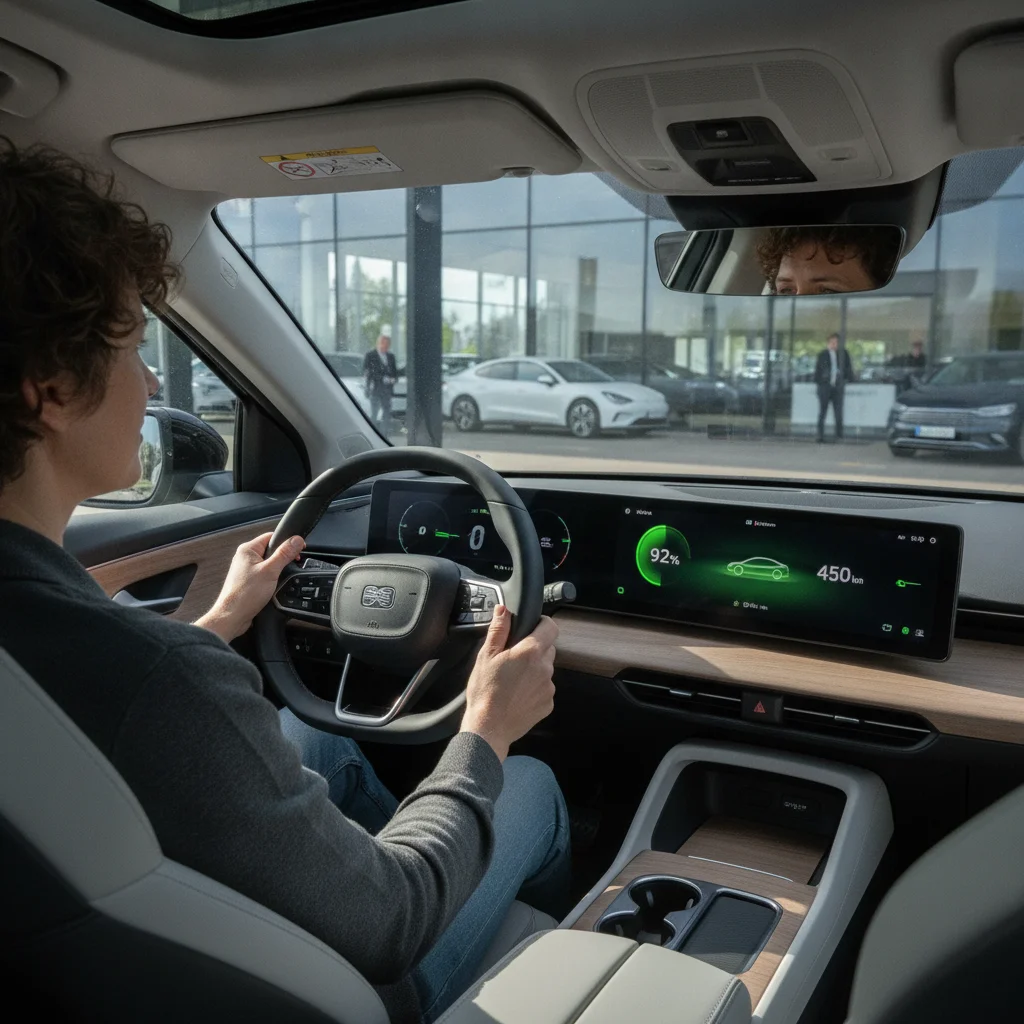
The test drive on a used EV isn't just about how it feels to drive — it's a data-collection opportunity. Before you pull out of the driveway, make sure the battery is charged to at least 80% so you can assess real-world range behavior. A seller who refuses to charge the vehicle before your visit is a red flag.

During the drive, pay attention to the following:
- Regenerative braking feel: It should be smooth and consistent. Unusual surging or weak regen can indicate battery or motor controller issues.
- Acceleration linearity: EVs should accelerate smoothly from a stop. Hesitation, stuttering, or unusual sounds during acceleration warrant further investigation.
- Range display behavior: Watch how quickly the estimated range drops during your test route. A dramatic drop — especially in mild temperatures — is a strong signal of battery degradation.
- Climate system performance: Heat pump systems (used on many newer EVs) can be expensive to repair. Run the heat and AC and confirm they operate normally.
- Cabin technology: Test the infotainment, driver assistance features, and any connected car functions. Software updates matter on EVs — check that the vehicle is running current firmware.
Our dedicated guide on evaluating an EV or hybrid on a test drive covers the nuances of reading range estimates, testing charge port function, and feeling for subtle drivetrain irregularities during a test drive.
Battery Health: The Number That Drives Everything
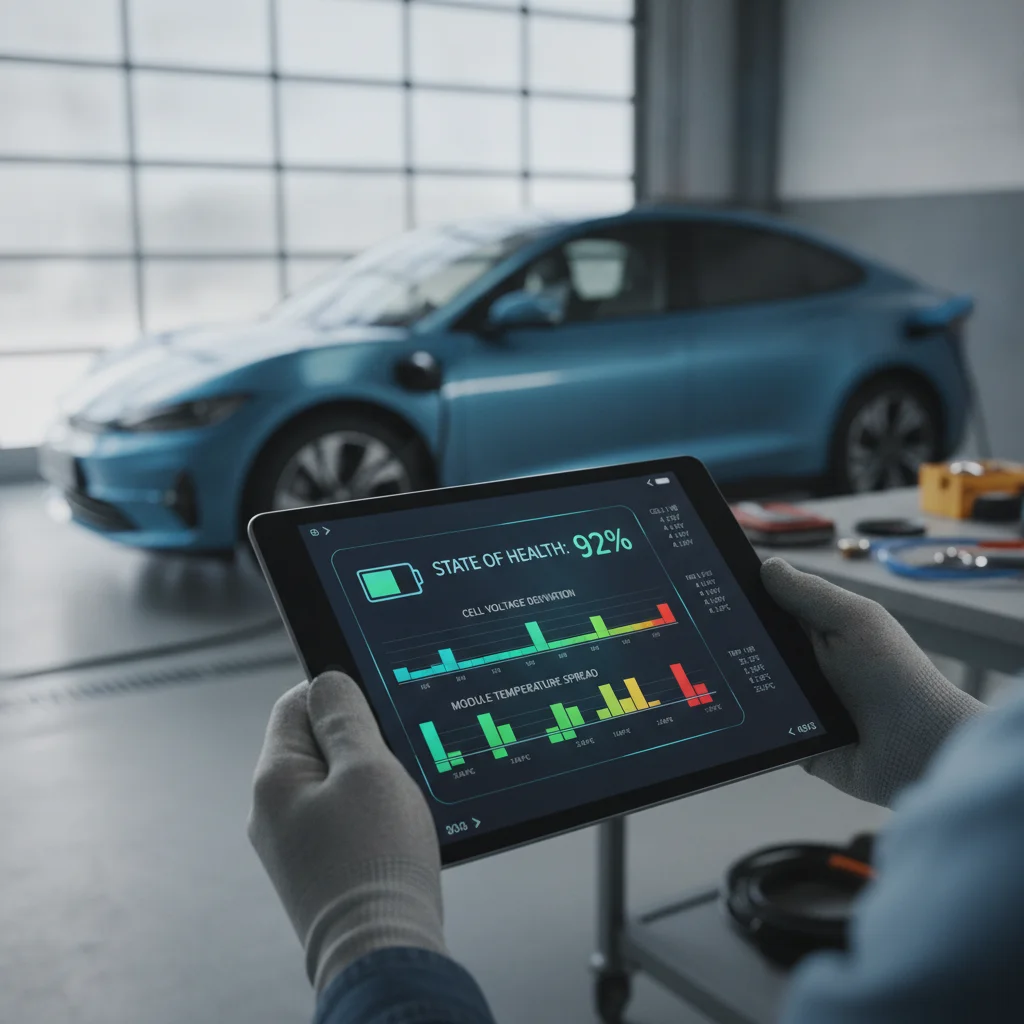
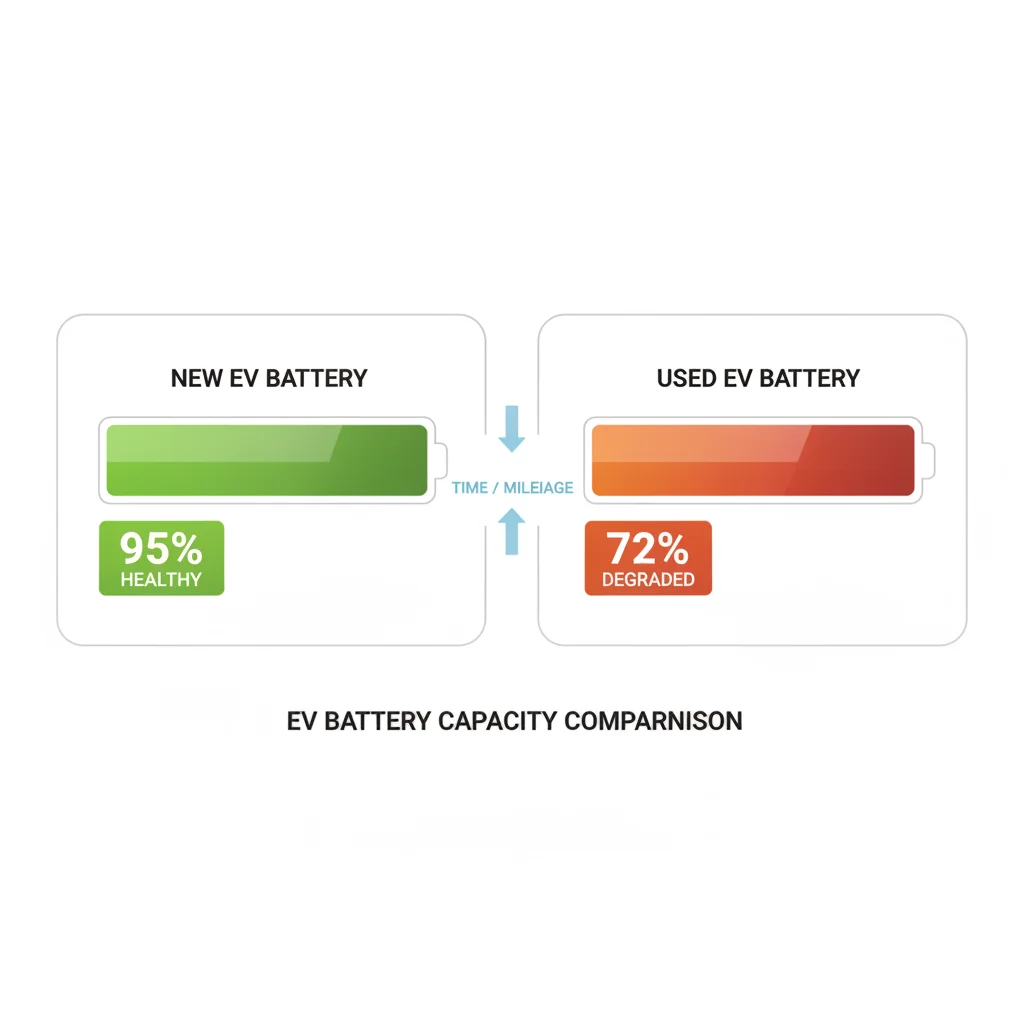
Battery state of health (SOH) is the most consequential number in a used EV transaction. It represents how much usable capacity the battery retains compared to its original specification. A vehicle showing 100% SOH has its full original range; a vehicle at 75% SOH has lost a quarter of its range — and that loss is permanent without a battery replacement.
Battery replacements are expensive. Depending on the make and model, a full pack replacement can cost anywhere from $5,000 to $20,000 or more. This means a significant discount on a used EV with poor battery health may still be a worse deal than paying full price for one with an intact pack.
Here's how to get meaningful battery health data:
- Ask for a dealership or manufacturer SOH printout. Many EV brands and their certified dealers can pull a battery health report directly. This is standard practice at Tesla, Rivian, and most major EV-certified dealer networks.
- Use a compatible OBD-II app. For many non-Tesla EVs, a Bluetooth OBD-II adapter paired with a model-specific app (like Leaf Spy for Nissan LEAFs or EVNotify for others) will display cell-level battery data, state of health percentage, and charge cycle count.
- Observe range at full charge. If you can charge the vehicle to 100% (or as close as the owner allows), compare the displayed range to the EPA-rated range for that model year. Expect some degradation — 10–15% over 5 years is typical — but anything beyond 20–25% deserves serious negotiation leverage or an outright pass.
Also check the charging history if accessible. Vehicles that were primarily fast-charged at DC fast chargers degrade faster than those predominantly charged at Level 1 or Level 2. Some manufacturers track this data in the vehicle's service records.
Understanding how battery health affects depreciation is also useful context. See our article on gauging a used car's remaining depreciation risk for broader context on how condition affects resale trajectory.
After the Inspection: What to Do With What You Find
Once you've completed the checklist, you'll have a clear picture of the vehicle's condition — and meaningful leverage in negotiations. Any deficiencies you document become negotiating points. A vehicle with 82% battery SOH is worth less than one with 94% SOH, full stop. Use diagnostic data to back up any price reduction requests.
If everything checks out, verify two final things before you sign:
- Warranty transferability: Confirm in writing that the remaining powertrain and battery warranty transfers to you as the new owner. Get the specific terms — mileage and years remaining — documented on the purchase agreement.
- Used EV tax credit eligibility: The federal used clean vehicle tax credit can reduce your purchase price by up to $4,000 if the vehicle, sale price, and your income all qualify. Use our guide to check EV tax credit eligibility before visiting the lot to verify this before you finalize the deal.
After purchase, your next step is making sure your insurance policy is actually built for an electric vehicle. Standard auto policies may not adequately cover charging equipment, battery replacement, or EV-specific roadside assistance. Our EV insurance policy checklist walks you through what to verify before you sign a policy. And if you haven't done a full comparison of EV inspection versus conventional car inspection, our test drives and inspections hub is a useful reference point for putting all of this in context.
A used EV can be an excellent purchase — often delivering better reliability and lower running costs than an equivalent gas vehicle. But the upside depends entirely on the battery, and the battery requires active investigation. Do the work up front, and you'll make a decision you can stand behind.

All claims are backed by peer-reviewed research. Sources on request.