
Key Takeaways
Why EVs Create Unique Insurance Exposure
Electric vehicles are engineered differently from the ground up — and that engineering gap extends to insurance. The same policy that adequately covered your last gas-powered sedan may leave you dangerously exposed in an EV. The reasons are structural: higher vehicle purchase prices, enormously expensive battery systems, specialized repair requirements, and depreciation curves that diverge sharply from conventional cars.
It's tempting to shop for the cheapest premium available and assume coverage is coverage. But for EV owners, that assumption routinely leads to devastating out-of-pocket costs following accidents, theft, weather events, and even routine claim scenarios. Repair costs, battery replacement, and specialized parts all push EV premiums higher than comparable gas models — and underinsuring compounds every one of those factors.
The mistakes outlined below aren't hypothetical. They're patterns that claims adjusters, independent agents, and EV owners themselves report with frustrating regularity. Understanding where coverage gaps hide — and why they're so costly for electric vehicles specifically — is the first step to protecting what is likely one of the largest purchases of your life.
The Most Costly Underinsurance Mistakes EV Owners Make
Each of the errors below has a distinct financial mechanism. Some involve choosing limits that are simply too low. Others involve misunderstanding what a standard policy actually covers — or doesn't. A few involve add-on coverages that feel optional until you need them.
Relying on state minimum liability limits when driving — or potentially damaging — other EVs.
Why it happens: Most drivers set liability limits once, at policy inception, and never revisit them. State minimums feel like an official benchmark of adequacy, but they were established decades before EVs pushed average repair costs significantly higher.
Assuming comprehensive and collision coverage fully protects the battery pack without reviewing policy language.
Why it happens: Policyholders reasonably assume that if the car is covered, all its components are covered. But some insurers include exclusionary language around battery degradation, pre-existing capacity loss, or components covered under manufacturer warranty — language that only surfaces at claim time.
Skipping gap insurance on a financed or leased EV.
Why it happens: Gap coverage is often presented as optional at the dealership, where it may be priced at inflated dealer rates. Buyers decline it there and intend to add it through their insurer later — then forget, or assume their policy includes it by default.
Failing to cover home charging equipment under any policy.
Why it happens: The EVSE (Electric Vehicle Supply Equipment) installed at home occupies a gray zone between auto and homeowners insurance. Most buyers assume one policy or the other covers it without confirming, and insurers rarely volunteer the information proactively.
Setting rental reimbursement limits too low for the extended timelines EV repairs typically require.
Why it happens: Default rental reimbursement limits — often $30 per day for 30 days — were calibrated for conventional vehicle repair timelines. EV owners don't realize that parts scarcity and limited certified technician availability can double or triple repair duration.
Carrying collision coverage with a deductible that exceeds practical out-of-pocket capacity relative to battery risk.
Why it happens: High-deductible strategies that make sense for low-value or older vehicles are often applied incorrectly to EVs. Owners raise deductibles to $2,000 or more to reduce premiums without modeling what a battery-involved claim would actually cost them net of deductible.
Purchasing a policy without EV-specific roadside assistance that covers running out of charge.
Why it happens: Standard roadside assistance was designed for gas vehicles. Running out of fuel is solved with a gasoline delivery. Running out of charge requires a flatbed tow to the nearest compatible charging station — a materially different and more expensive service that most standard roadside plans don't cover as written.
$10,000–$22,000
Typical EV battery pack replacement cost
Battery replacement estimates vary by model and manufacturer; figures reflect current market pricing for popular long-range EV models as reported by repair industry sources in 2024.
26%
Higher average EV collision repair cost vs. gas vehicles
According to Mitchell International's 2023 industry report, EV collision repair costs averaged approximately 26% more than comparable internal combustion engine vehicle repairs.
30%+
Value lost by some EVs within 24 months
iSeeCars analysis of 2023–2024 used EV pricing found select models depreciated more than 30% within two years, accelerating the loan-to-value gap that makes gap insurance critical.
16.8 days
Average EV repair cycle time after collision
CCC Intelligent Solutions reported in 2023 that EV collision repair cycle times averaged 16.8 days, compared to 12.3 days for gas-powered vehicles — a gap driven by parts availability.
$600–$2,400
Home Level 2 charger total installed cost
The U.S. Department of Energy estimates Level 2 EVSE hardware plus installation averages $600 to $2,400, depending on electrical panel upgrades required — an asset most policies don't explicitly address.
For a deeper look at what catches first-time EV owners off guard before they even file a claim, see our guide on what new EV owners should understand before buying a policy.
The Battery Replacement Gap
No single component defines EV insurance exposure more than the battery pack. On most modern electric vehicles — including popular models from Tesla, Chevrolet, Ford, Hyundai, and Kia — the battery pack represents between 30% and 50% of the vehicle's total manufacturing cost. When that battery is damaged in a collision, flood event, or fire, insurers may face a replacement bill anywhere from $8,000 on a compact EV to more than $22,000 on a long-range luxury model.
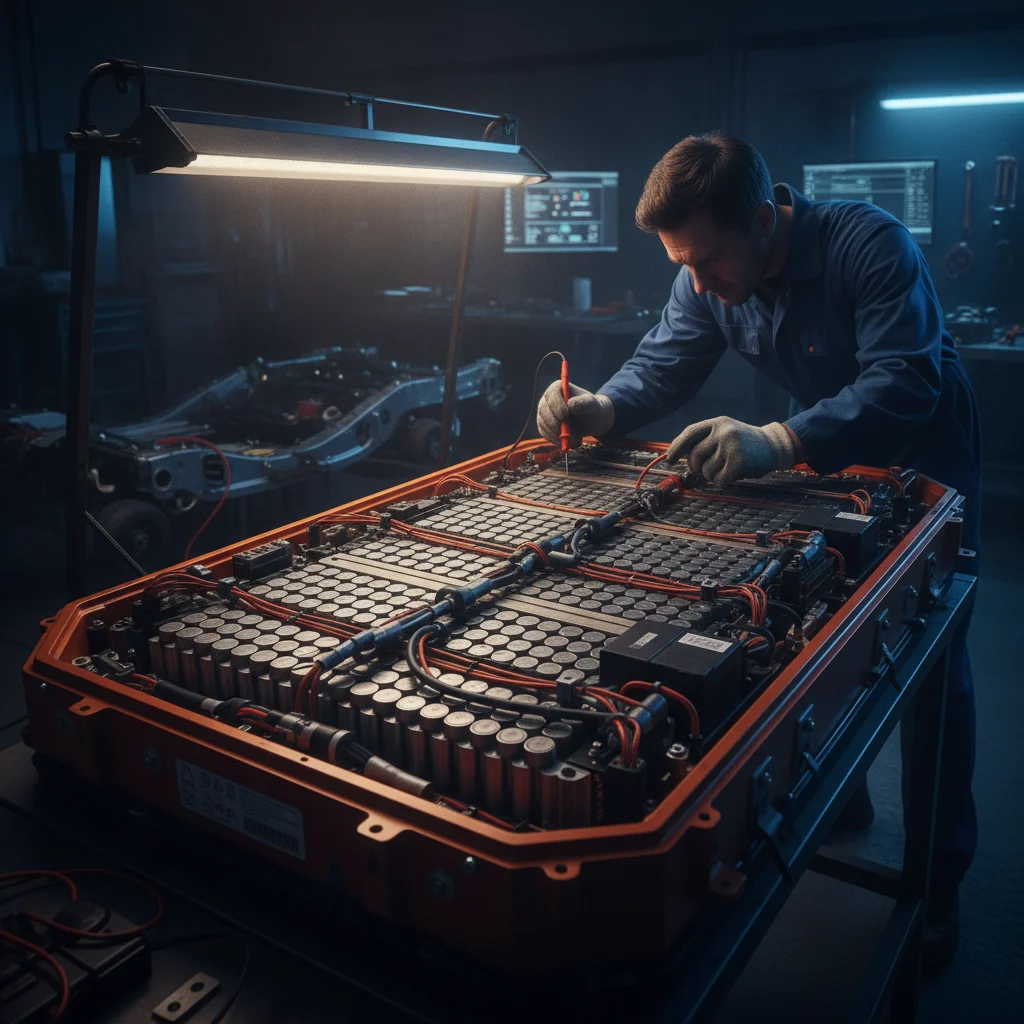
The problem isn't that comprehensive and collision coverage refuses to pay for battery damage — in most cases, they do. The problem is what happens when the coverage limit is set too low, when the actual cash value calculation is contested, or when a policy contains exclusions that quietly carve out battery cells deemed to have degraded beyond a threshold the insurer defines internally.
Watch for Battery Exclusion Language
Some standard auto policies contain language excluding coverage for battery cells that have experienced capacity degradation below a manufacturer-defined threshold. This exclusion can appear in policy documents under 'mechanical breakdown' or 'wear and tear' clauses. Review your policy's exclusion section specifically — or ask your agent in writing — before assuming your battery is fully covered in a total-loss or major damage scenario.
Don't Let Default Limits Stand on a New EV
When you add a new electric vehicle to an existing policy, many insurers automatically apply the same coverage limits and deductibles as your previous vehicle. If you traded in a five-year-old gas car worth $18,000 for a new EV worth $52,000, those limits are almost certainly no longer appropriate. Request a full coverage review at every policy update, not just at renewal.
Confirming Coverage Before a Claim Is Always Cheaper
Gaps in EV insurance coverage are almost never discovered at a convenient time. They surface during a claim — after an accident, theft, or weather event — when your negotiating position is weakest and your financial stress is highest. A 30-minute call with your insurance agent to audit your policy against the specific risks of your EV costs nothing. Discovering a gap at claim time routinely costs thousands.
Owners of used electric vehicles face this risk acutely. A pre-owned EV may carry a degraded battery that the original manufacturer's warranty no longer covers, and some insurers factor that degradation into their payout calculations. A used EV with a degraded battery presents different insurance considerations than buying new — and the gap between what you expect to receive and what you actually get can be significant.
Liability Limits That Don't Reflect EV Repair Costs
State minimum liability requirements were not designed with electric vehicles in mind. Most state minimums for property damage liability sit between $5,000 and $25,000. The average repair cost for a damaged EV — even a moderate-impact collision — frequently exceeds those figures. The Insurance Institute for Highway Safety has documented repair costs for popular EV models that outpace comparable gas vehicles by 20% to 40%, driven by aluminum-intensive construction, integrated battery housing, and the scarcity of certified repair technicians.
If you're at fault in a collision involving another driver's electric vehicle, your property damage liability coverage is what pays for their repairs. Carry $10,000 in property damage liability and cause $35,000 in damage to someone's EV battery enclosure, and you're personally liable for the $25,000 difference. That gap can pursue you through civil court for years.
At-Fault EV Accidents Can Produce Catastrophic Liability
When you cause a collision that damages another driver's electric vehicle, your property damage liability is the only buffer between their repair bill and your personal finances. With EV repairs averaging significantly more than gas vehicle repairs, and battery damage claims frequently exceeding $15,000, state minimum property damage liability limits of $5,000 to $25,000 can be exhausted quickly. Carrying limits of $100,000 or more in property damage liability is strongly advisable for any driver who regularly operates in areas with significant EV traffic.
A Totaled EV Without Gap Insurance Can Cost You Thousands Upfront
If your EV is declared a total loss and your insurer pays actual cash value — which reflects current market depreciation, not what you paid or what you owe — you may still owe your lender the difference between that payout and your remaining loan balance. For EVs that have depreciated sharply in their first two to three years, this gap can reach $8,000 to $15,000. Gap insurance eliminates this exposure for a cost that typically amounts to less than $40 per year on your auto policy.
The same calculus applies to bodily injury liability. Medical costs associated with EV fires — which, while statistically rare, produce intense, chemically complex burns — can escalate rapidly. Carrying only state minimum bodily injury limits in an environment where EVs are increasingly common is a meaningful financial risk that most agents advise against. See also: common physical damage mistakes that leave drivers exposed after a claim.
Charging Equipment, Depreciation, and the Gaps Nobody Talks About
Two underinsurance categories that rarely make headlines — but regularly produce five-figure surprises — involve home charging equipment and gap coverage on financed or leased EVs.
Home Charging Equipment Coverage
A Level 2 home charger (EVSE) typically costs $400 to $900 for the hardware alone, plus $200 to $1,200 for professional installation, depending on electrical panel work required. Most standard auto policies do not cover this equipment. Standard homeowners or renters policies may cover it under personal property — but only up to sub-limits that often fall below replacement cost, and only against specific perils that may not include electrical surge or mechanical breakdown.
If a storm, fire, or surge damages your home charging unit and neither your auto policy nor your home policy covers it, you absorb the full replacement cost. Some EV-specific insurers and endorsements address this directly — but you have to ask. For a full picture of what EV roadside and charging-related coverage should include, our guide on EV-specific roadside assistance requirements is a useful companion read.
Gap Insurance and EV Depreciation
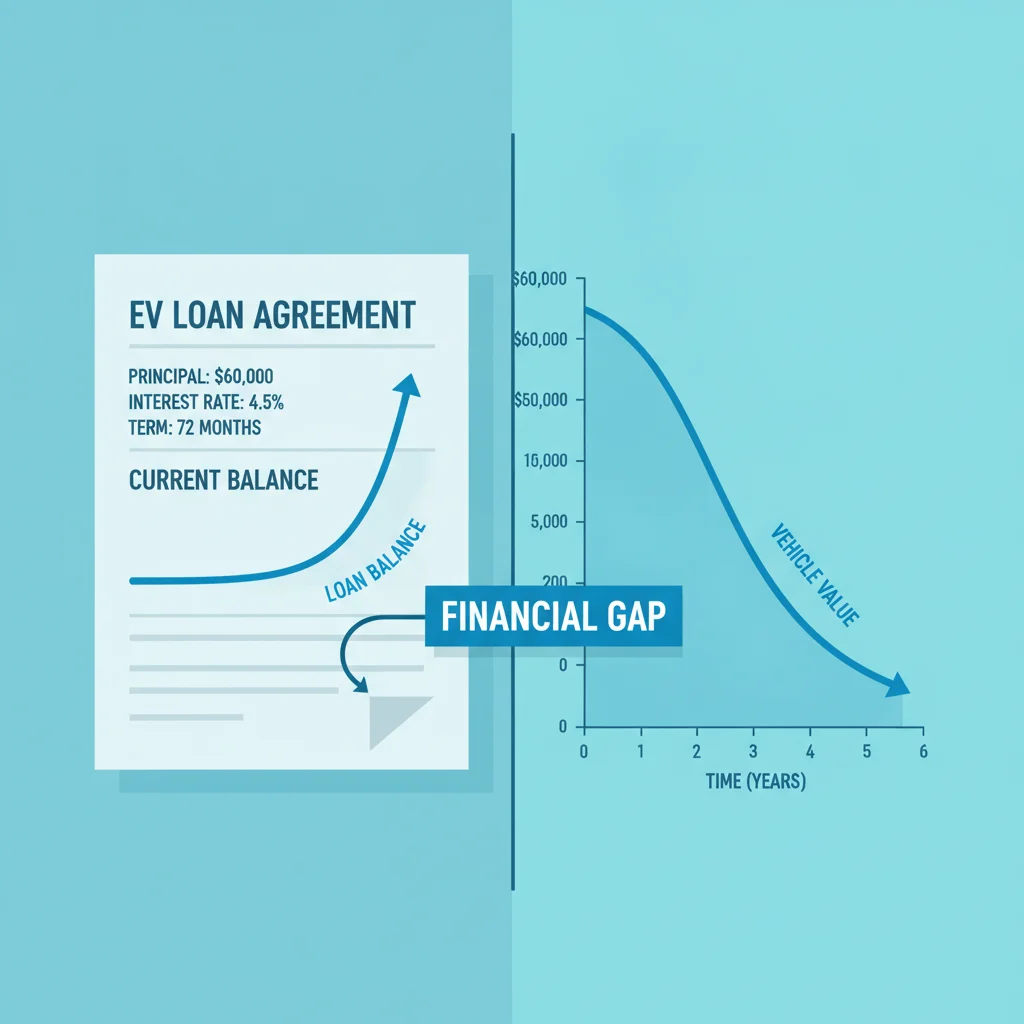
Electric vehicles, particularly those financed at or near MSRP, can depreciate faster than the loan payoff schedule — sometimes dramatically so. Several EV models have shed 30% or more of their value within 24 months of purchase due to rapid technology cycles, federal tax credit availability on competing new models, and softening resale markets.
If you total your EV in year two of a 60-month loan and your insurer pays actual cash value — say, $28,000 — while you still owe $38,000 to your lender, you're personally responsible for the $10,000 gap. Gap insurance covers that difference. It's an add-on that costs $20 to $40 per year when bundled with your auto policy, yet many buyers skip it or aren't offered it proactively. EVs can depreciate faster than their loan payoff schedule, making gap coverage critical — a risk unique in its severity for this vehicle category.
Rental Reimbursement Shortfalls
EV repairs take longer. That's not a stereotype — it's a structural reality. Certified technicians for brands like Tesla, Rivian, and Lucid are concentrated in specific metro areas. Parts lead times for battery modules, high-voltage wiring harnesses, and regenerative braking components routinely stretch into weeks. A rental reimbursement benefit capped at $30 per day for 30 days — a common default — may cover only a fraction of the actual rental period after a significant EV collision claim.
Owners who skip rental reimbursement entirely, or fail to raise the daily limit above the default, often find themselves paying out of pocket for a rental car for weeks while their EV sits at a body shop awaiting parts. The math is simple: 45 days at $60 per day equals $2,700 in rental costs. A policy paying $30 per day for 30 days covers $900 of that. The gap is yours to absorb.
For a broader view of coverages that look optional until they're not, a single tow can cost more than a year of roadside premiums illustrates how add-on decisions compound over time.
At-Fault EV Accidents Can Produce Catastrophic Liability
When you cause a collision that damages another driver's electric vehicle, your property damage liability is the only buffer between their repair bill and your personal finances. With EV repairs averaging significantly more than gas vehicle repairs, and battery damage claims frequently exceeding $15,000, state minimum property damage liability limits of $5,000 to $25,000 can be exhausted quickly. Carrying limits of $100,000 or more in property damage liability is strongly advisable for any driver who regularly operates in areas with significant EV traffic.
A Totaled EV Without Gap Insurance Can Cost You Thousands Upfront
If your EV is declared a total loss and your insurer pays actual cash value — which reflects current market depreciation, not what you paid or what you owe — you may still owe your lender the difference between that payout and your remaining loan balance. For EVs that have depreciated sharply in their first two to three years, this gap can reach $8,000 to $15,000. Gap insurance eliminates this exposure for a cost that typically amounts to less than $40 per year on your auto policy.
Building a Policy That Actually Fits an Electric Vehicle
Avoiding these mistakes doesn't require spending lavishly on insurance — it requires spending strategically. The goal is to match coverage to the actual risk profile of your specific EV: its purchase price, depreciation trajectory, battery health, financing situation, and local repair infrastructure.
Start by auditing your current policy against the line items that matter most for EVs: property damage liability limits, comprehensive and collision deductibles relative to battery replacement cost, gap coverage status, rental reimbursement daily limits and maximum days, and whether home charging equipment is explicitly addressed somewhere in your coverage stack.
Then compare. EV-specialized insurers and traditional carriers with EV-specific endorsements often offer meaningfully different policy language. Common beliefs about EV insurance don't always hold up to scrutiny — including the assumption that the cheapest policy is a reasonable starting point for a $45,000 vehicle with a $15,000 battery.

Finally, don't ignore the discount side of the equation. Many EV owners overpay in some coverage areas while underinsured in others. Green vehicle discounts, bundling, and low-mileage programs can trim EV insurance costs without reducing the coverage that actually matters. The objective isn't to spend more — it's to spend correctly.
Understanding the full cost of EV ownership, including insurance, also means recognizing how insurance interacts with other major expense categories. Estimating and reducing EV charging costs is another piece of the ownership puzzle that shapes long-term financial planning for electric vehicle buyers.
Watch for Battery Exclusion Language
Some standard auto policies contain language excluding coverage for battery cells that have experienced capacity degradation below a manufacturer-defined threshold. This exclusion can appear in policy documents under 'mechanical breakdown' or 'wear and tear' clauses. Review your policy's exclusion section specifically — or ask your agent in writing — before assuming your battery is fully covered in a total-loss or major damage scenario.
Don't Let Default Limits Stand on a New EV
When you add a new electric vehicle to an existing policy, many insurers automatically apply the same coverage limits and deductibles as your previous vehicle. If you traded in a five-year-old gas car worth $18,000 for a new EV worth $52,000, those limits are almost certainly no longer appropriate. Request a full coverage review at every policy update, not just at renewal.
Confirming Coverage Before a Claim Is Always Cheaper
Gaps in EV insurance coverage are almost never discovered at a convenient time. They surface during a claim — after an accident, theft, or weather event — when your negotiating position is weakest and your financial stress is highest. A 30-minute call with your insurance agent to audit your policy against the specific risks of your EV costs nothing. Discovering a gap at claim time routinely costs thousands.
Underinsurance is rarely a deliberate choice. It's the product of assumptions — that standard policies cover everything, that minimums are sufficient, that add-ons are unnecessary extras. For electric vehicles, those assumptions carry a higher price tag than most owners anticipate. The coverage decisions you make today set the floor for what you can recover tomorrow.
All claims are backed by peer-reviewed research. Sources on request.