Key Takeaways
Our Verdict
Insuring a used EV is not simply a cheaper version of insuring a new one — it's a structurally different risk calculation. The savings on premiums are real, but so are the coverage gaps around battery valuation, warranty status, and repair costs. Buyers who understand these divergences before signing a policy end up better protected at a lower net cost.
| Best for | Recommended |
|---|---|
| Budget-conscious buyers seeking lower premiums | Used EV with comprehensive coverage and a verified battery health report |
| Buyers concerned about catastrophic battery loss | New EV or certified pre-owned EV with active manufacturer battery warranty |
| High-mileage commuters who prioritize repair cost protection | Used EV with an EV-specialist insurer offering battery replacement endorsements |
| Those wanting the simplest, most complete coverage | New EV with a full factory warranty and an insurer's new-car replacement add-on |
Why Used EV Insurance Isn't Just a Discount on New EV Insurance
When most buyers compare the cost of insuring a used electric vehicle against a new one, they focus on the obvious variable: the lower sticker price produces a lower insured value, which in turn produces a lower premium. That logic is directionally correct — but it's also incomplete, and in some scenarios dangerously so.
The insurance product you buy for a used EV is not simply a scaled-down version of what you'd carry on the same vehicle fresh off the lot. The risk profile changes in at least four distinct ways: battery condition, warranty coverage, parts availability, and the insurer's own actuarial data on that specific model year. Each of those shifts can either create savings or introduce exposures that standard policy language doesn't address.
As EVs age, the gap between what an insurer will pay and what a repair or replacement actually costs can widen considerably. Understanding that gap — before you finalize your purchase and before you sign a policy — is the essential task this article addresses. For the broader landscape of how EVs are rated differently from gas-powered cars in the first place, see how insurers price EVs differently from gas-powered cars.
The Battery Degradation Variable: How It Reshapes Every Coverage Decision
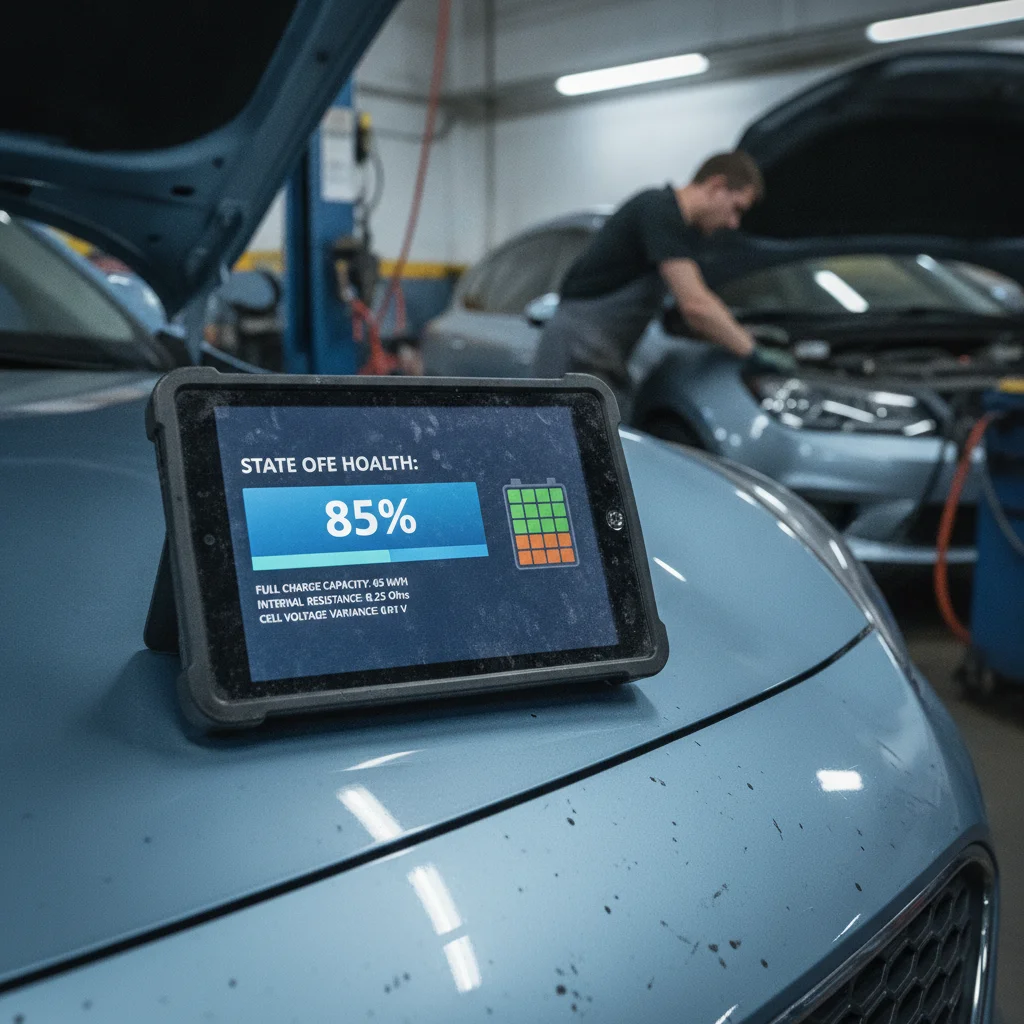
A lithium-ion battery pack is simultaneously the most valuable component in an EV and the one most subject to gradual, measurable loss of value. After 100,000 miles or five to eight years of typical use, most battery packs retain between 70% and 85% of their original capacity — but that number varies enormously by model, charging habits, and climate history.
From an insurance standpoint, battery degradation creates two problems that don't exist with a gasoline vehicle's engine.
Problem 1: The Actual Cash Value Disconnect
Insurers determine a total-loss payout using actual cash value (ACV), which factors in depreciation. A degraded battery accelerates depreciation beyond what standard depreciation tables — often built on gas-vehicle data — may reflect. If an insurer uses generic EV depreciation curves rather than model-specific battery health data, the ACV assigned to your vehicle may be higher than its real-world resale value, or in some cases lower, depending on how recently the insurer updated its data.
Before purchasing a used EV, request a battery health report from the seller or conduct a third-party diagnostic. Some insurers will ask for this data; others won't, but having it lets you contest an ACV calculation if a total-loss event occurs.
70–85%
Typical battery capacity retained after 100K miles
Based on real-world data aggregated by Recurrent Auto across thousands of used EVs tracked in the U.S. fleet.
8 years / 100K miles
Federal minimum battery warranty for EVs
U.S. federal regulations require all EV manufacturers to warranty high-voltage battery packs for at least eight years or 100,000 miles.
10–25%
EV insurance premium surcharge vs. equivalent gas vehicles
Industry analyses including data from the Insurance Information Institute and Consumer Reports consistently cite this range for like-for-like comparisons.
40%+
Premium spread across insurers for used EVs
Quotes gathered on older EV models show significantly wider variance than on new EVs, reflecting differing actuarial data quality among carriers.
Problem 2: The Repair vs. Replace Threshold
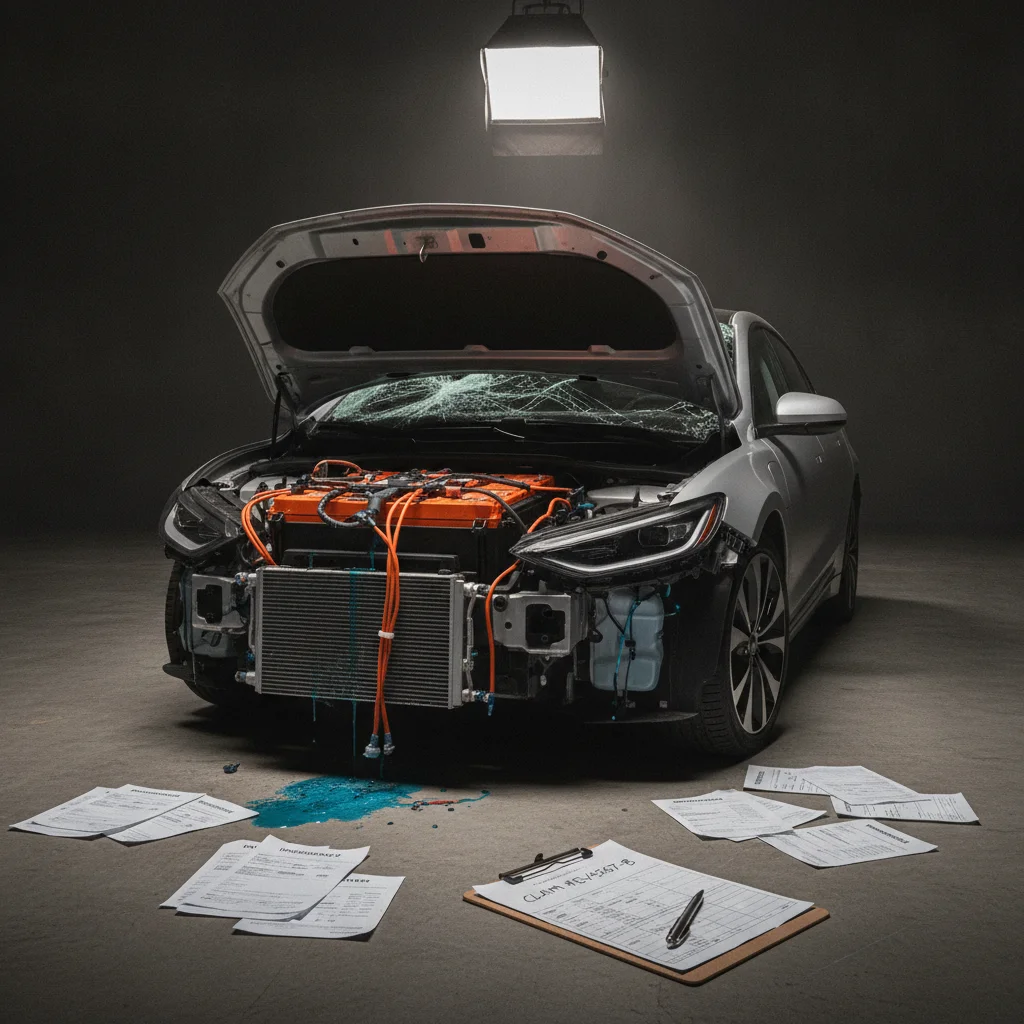
High-voltage battery packs are rarely repaired at the module level by most shops. When a battery is damaged — whether by collision, flooding, or thermal event — the default resolution is replacement. For a vehicle with a degraded pack, that replacement cost may actually exceed the vehicle's ACV, triggering a total-loss determination on a car whose body and drivetrain are otherwise intact. How insurers handle battery total-loss situations is a separate and nuanced process worth understanding before you're in that situation.
Flooding Can Total a Used EV Instantly
High-voltage battery packs exposed to water intrusion are frequently deemed unrepairable due to corrosion risk and the difficulty of fully assessing internal cell damage. For a used EV with a degraded battery, the ACV may be low enough that even a moderate flood event triggers a total-loss determination — with a payout that doesn't cover replacement. If you live in a flood-prone area, verify your comprehensive coverage terms carefully and consider whether the vehicle's ACV accurately reflects your replacement cost exposure.
Don't Assume a Low Premium Means Adequate Coverage
A used EV purchased for $18,000 may carry a lower comprehensive and collision premium than the same car new — but if the battery replacement cost is $12,000 and the insurer's ACV calculation only values the vehicle at $14,000, a total-loss payout leaves you with very little to work with. The premium savings are real; so is the coverage shortfall. Evaluate the two numbers together before accepting the cheapest quote.
Warranty Status: The Coverage Variable Most Buyers Overlook
New EVs typically come with separate powertrain and battery warranties. Federal regulations require a minimum eight-year, 100,000-mile battery warranty for EVs sold in the U.S. — though several manufacturers exceed that threshold. When you buy used, the relevant question is how much of that warranty remains, and whether it transfers to a subsequent owner.
Most manufacturer battery warranties do transfer, but the terms vary. Some require the transfer to be registered within a specific window after purchase. Others impose mileage-based proration that reduces the coverage value with every mile driven. A small number of third-party battery warranty products exist, but they carry their own exclusions and are not a substitute for the original manufacturer coverage.
The insurance implication is direct: an in-warranty battery is effectively a no-cost repair for covered defects. An out-of-warranty battery shifts that cost entirely to you or to your insurer. Standard comprehensive and collision policies do not cover mechanical failure or degradation — they cover damage from external events. If a battery fails due to a covered peril (say, flooding), a claim applies. If it simply wears out, no policy will cover it.
Request a Battery State-of-Health Report
Before finalizing any used EV purchase, obtain a documented battery state-of-health (SOH) reading from the vehicle's diagnostic system or a third-party inspection service. Keep this report in your records and share it with your insurer at policy inception. If a total-loss dispute arises, a documented SOH provides an objective basis for challenging an undervalued ACV calculation.
Verify CPO Battery Warranty Transfer in Writing
Dealer representations about warranty coverage are not legally binding without documentation. Contact the manufacturer directly using the vehicle's VIN to confirm the remaining battery warranty, its transferability to you as a subsequent owner, and any registration deadlines that apply. Get the confirmation in writing before closing the purchase.
Consider an OEM Parts Endorsement on Any Used EV
Aftermarket components for EV battery management and high-voltage systems are not always equivalent to factory-spec parts. An OEM parts endorsement — typically a modest premium add-on — ensures that if your vehicle is repaired after a covered loss, the insurer cannot substitute cheaper aftermarket alternatives. This is particularly valuable on models where battery thermal management is tightly integrated with proprietary software.
Certified pre-owned (CPO) programs from manufacturers like Tesla, GM, and Hyundai often reinstate or extend warranty coverage and typically include a battery health inspection. CPO status doesn't directly lower your insurance premium, but it does reduce the exposure that your insurance policy might otherwise need to address. For a broader view of evaluating pre-owned vehicles, the used car buying guide covers the full evaluation process.
Side-by-Side: Insuring a New EV vs. a Used EV
The differences between insuring a new and used EV are not uniform across all coverage lines. Some lines favor the used buyer; others introduce exposures that a new-car buyer doesn't face. The table below maps the most consequential variables.
| Coverage Variable | New EV | Used EV (3–6 Years Old) | |
|---|---|---|---|
| Comprehensive & collision premium | Higher (reflects higher ACV) | Lower (reflects depreciated ACV) | |
| Battery replacement coverage | Manufacturer warranty backstop | Warranty may be expired or partial | |
| Total-loss ACV accuracy | Generally reflects market value | Risk of insurer undervaluation | |
| New car replacement availability | Often available as endorsement | Not applicable | |
| OEM parts availability | Strong, current supply chain | Potentially limited for older configs | |
| Gap insurance relevance | High if financed near MSRP | Low; depreciation already absorbed | |
| Battery health documentation | Not needed; warranty active | Critical for ACV disputes | |
| Premium quote variance across insurers | Moderate (10–20%) | Wide (up to 40%+) |
The pattern that emerges: used EV buyers pay less but carry more unaddressed exposure in the specific areas where EV risk concentrates — battery valuation, repair cost unpredictability, and the absence of manufacturer backstops. The cost of underinsuring an EV illustrates how these gaps translate to real dollar exposure when a claim occurs.
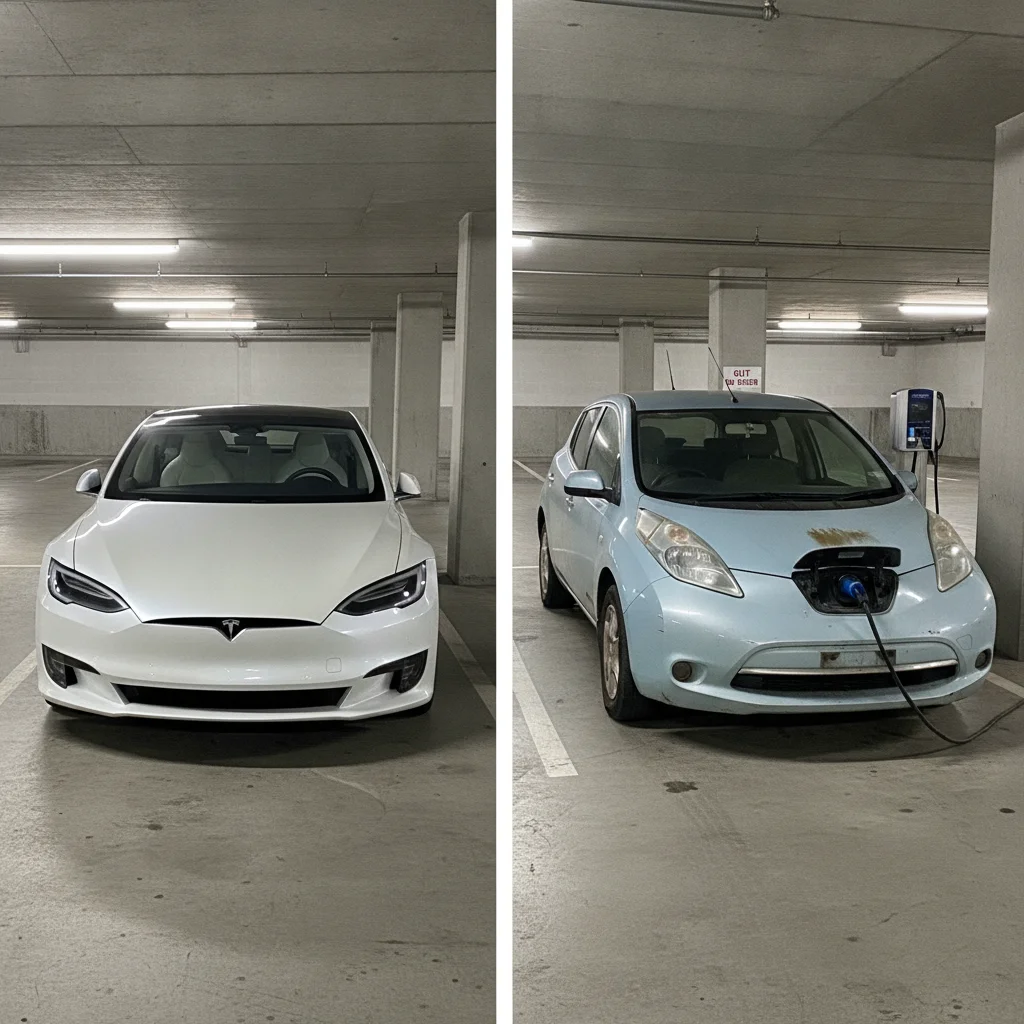
Premium Differences in Practice: Where You Save and Where You Don't
Used EV premiums are generally lower than new EV premiums for the same coverage levels, and the savings are real. A vehicle with a lower market value produces lower comprehensive and collision premiums by definition. Industry data consistently shows that EV premiums run 10–25% higher than equivalent gas vehicles, but that surcharge shrinks as the vehicle ages and its value depreciates toward parity with the gas-vehicle comparison set.
Where used EV buyers don't save — and may actually pay more than expected — is in liability and uninsured motorist coverage, which are driven by your personal risk profile, not the vehicle's value. If you carry robust liability limits (which you should, regardless of vehicle type), that portion of your premium will be similar whether you insure a new Model Y or a five-year-old Chevy Bolt.
The other area where savings can be illusory is repair cost inflation. Older EVs may lack the parts availability that newer models enjoy, particularly for vehicles whose manufacturers have updated or discontinued specific battery configurations. When a part is scarce, repair costs rise — and if those costs approach or exceed ACV, a total-loss outcome follows. That outcome may produce a payout that leaves you well short of what you need to replace the vehicle.
For a methodical approach to comparing policies on this basis, comparing EV insurance policies the right way provides a structured framework that goes beyond premium price.
Coverage Add-Ons Worth Considering on a Used EV
Several optional endorsements take on greater relevance when the vehicle in question is a used EV rather than a new one. None of them apply universally — the right choice depends on the vehicle's age, mileage, battery health, and your financial situation.
Battery Value Protection Riders
A small but growing number of insurers offer endorsements that specify how the battery pack will be valued in a total-loss event — either at replacement cost or at a defined percentage of the vehicle's ACV. These riders matter most on vehicles where the battery's replacement cost is disproportionately high relative to the car's overall ACV. On a five-year-old EV with a degraded pack, the default ACV calculation may significantly undervalue the battery's functional replacement cost.
New Car Replacement — Not Applicable, But OEM Parts Endorsements Are
New car replacement coverage doesn't apply to used vehicles by definition. However, some insurers offer original equipment manufacturer (OEM) parts endorsements that require the use of factory-spec components rather than aftermarket alternatives in a repair. Given the complexity of EV battery management systems and high-voltage components, OEM parts can make a material difference in safety and long-term function. This endorsement is worth the modest additional premium on any EV, new or used.
Gap Insurance — Often Unnecessary, Sometimes Misleading
Gap insurance covers the difference between what you owe on a loan and the vehicle's ACV at the time of a total loss. On a used EV purchased at fair market value with a modest loan, the gap is typically small or nonexistent, because EVs depreciate sharply in their first few years and then stabilize. Gap coverage makes more sense on a new EV financed at or near MSRP; on a used purchase, scrutinize whether the premium cost justifies the narrow protection window.
Request a Battery State-of-Health Report
Before finalizing any used EV purchase, obtain a documented battery state-of-health (SOH) reading from the vehicle's diagnostic system or a third-party inspection service. Keep this report in your records and share it with your insurer at policy inception. If a total-loss dispute arises, a documented SOH provides an objective basis for challenging an undervalued ACV calculation.
Verify CPO Battery Warranty Transfer in Writing
Dealer representations about warranty coverage are not legally binding without documentation. Contact the manufacturer directly using the vehicle's VIN to confirm the remaining battery warranty, its transferability to you as a subsequent owner, and any registration deadlines that apply. Get the confirmation in writing before closing the purchase.
Consider an OEM Parts Endorsement on Any Used EV
Aftermarket components for EV battery management and high-voltage systems are not always equivalent to factory-spec parts. An OEM parts endorsement — typically a modest premium add-on — ensures that if your vehicle is repaired after a covered loss, the insurer cannot substitute cheaper aftermarket alternatives. This is particularly valuable on models where battery thermal management is tightly integrated with proprietary software.
The full spectrum of EV-specific coverage decisions is covered in depth in the comprehensive EV insurance guide, which addresses both new and used ownership scenarios.

How to Shop for Used EV Insurance Effectively
The insurer you choose matters more on a used EV than on a new one, because the actuarial data quality and policy language vary more widely for older EV models. Some insurers have accumulated years of claims data on early-generation EVs — first-gen Nissan Leafs, early Tesla Model S units, the Chevy Bolt — and price accordingly. Others still apply generic electric vehicle surcharges regardless of the vehicle's vintage, leaving money on the table for the buyer.
Steps to Take Before Requesting Quotes
- Obtain a battery health report. Use the vehicle's native app, an OBD-II adapter with EV-specific software, or a third-party inspection service. Document the state-of-health (SOH) percentage and bring it to your insurance conversation.
- Confirm warranty transferability. Contact the manufacturer directly with the VIN to confirm remaining battery warranty terms, not just the dealer's representation.
- Research that model year's claims history. NHTSA and IIHS both maintain safety and recall data. A model year with a documented battery recall or fire investigation history may carry higher premiums — or be excluded by some carriers.
- Get at least four quotes. Premium variance on used EVs across major insurers can exceed 40% for identical coverage levels. The spread is wider than on new EVs because older models have more heterogeneous risk profiles.
Used EV buyers also benefit from understanding how plug-in hybrids are treated differently — because if you're cross-shopping a used PHEV alongside a used BEV, the insurance calculus shifts again. How insurers treat BEVs and PHEVs differently clarifies those distinctions.
Finally, if you're new to EV ownership entirely and this is your first electric purchase — new or used — review the coverage surprises that first-time EV owners commonly encounter: what catches new EV owners off guard on insurance. Many of those surprises are amplified, not diminished, when the vehicle is pre-owned.

Flooding Can Total a Used EV Instantly
High-voltage battery packs exposed to water intrusion are frequently deemed unrepairable due to corrosion risk and the difficulty of fully assessing internal cell damage. For a used EV with a degraded battery, the ACV may be low enough that even a moderate flood event triggers a total-loss determination — with a payout that doesn't cover replacement. If you live in a flood-prone area, verify your comprehensive coverage terms carefully and consider whether the vehicle's ACV accurately reflects your replacement cost exposure.
Don't Assume a Low Premium Means Adequate Coverage
A used EV purchased for $18,000 may carry a lower comprehensive and collision premium than the same car new — but if the battery replacement cost is $12,000 and the insurer's ACV calculation only values the vehicle at $14,000, a total-loss payout leaves you with very little to work with. The premium savings are real; so is the coverage shortfall. Evaluate the two numbers together before accepting the cheapest quote.
All claims are backed by peer-reviewed research. Sources on request.