Key Takeaways
Why Switching to an EV Is a Material Change for Your Insurance
When you trade a gasoline vehicle for an electric one, your insurer treats it as a material change to your policy — the same category as adding a teenage driver or moving to a new ZIP code. That label matters because it can affect your premium, your eligibility for certain endorsements, and, in some cases, whether your current carrier even wants to keep your business at the same rate.
The reasons are rooted in repair economics. The battery pack alone on a mid-range EV can cost $10,000–$20,000 to replace, and the high-voltage systems that power the drivetrain require technicians with specialized training and equipment. Labor rates at certified EV repair facilities routinely run 20–40% higher than at general auto shops, according to CCC Intelligent Solutions data tracking claims costs. All of that exposure lands on your insurer — so they price it accordingly.
Beyond repair costs, EVs introduce coverage questions that simply don't exist for conventional vehicles: Is the battery covered if it degrades below a manufacturer-specified threshold? Does your policy extend to the Level 2 charger installed in your garage? What happens if a power surge damages your vehicle's onboard charging system overnight? These aren't hypothetical edge cases — they're documented claim types that standard auto policies frequently exclude or handle inconsistently.

The good news is that updating your insurance for an EV is a manageable process if you approach it methodically. The steps below walk through everything from notifying your insurer on delivery day to comparing carriers who specialize in EV coverage. For a broader orientation on how electric vehicle insurance is structured overall, the complete EV insurance guide is a useful companion resource to bookmark alongside this article.
What Changes in Your Coverage When You Go Electric
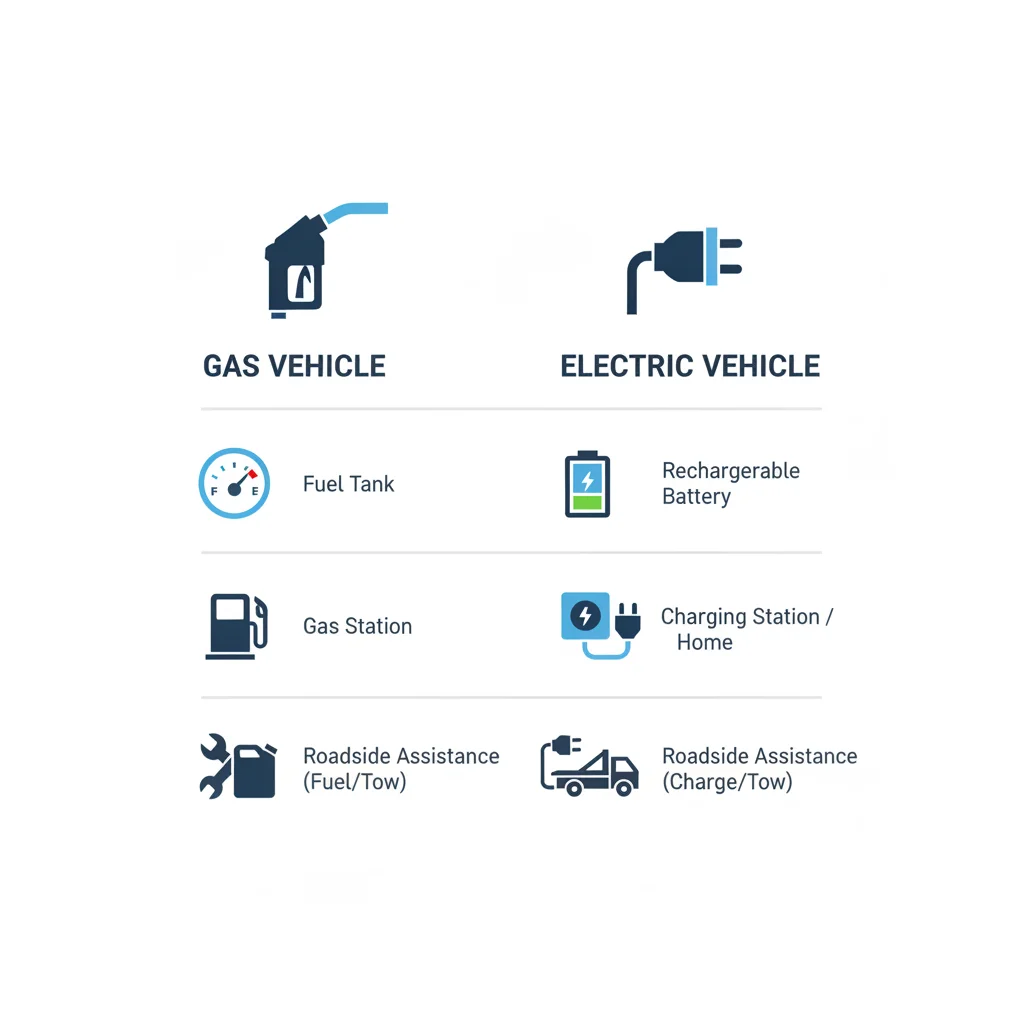
Before diving into the steps, it helps to understand exactly which parts of a standard auto policy look different when the vehicle has a plug. A side-by-side comparison of EV and traditional auto insurance covers the structural differences in depth, but here's the short version:
| Coverage Area | Gas Vehicle | Electric Vehicle |
|---|---|---|
| Comprehensive & Collision | Standard | Higher ACV due to battery value |
| Battery Pack | Not applicable | Often excluded or requires endorsement |
| Charging Equipment | Not applicable | Rarely covered without an add-on |
| Roadside Assistance | Standard tow | EV-specific flatbed or mobile charge needed |
| Rental Reimbursement | Standard | Limited supply of EV loaners may extend claim duration |
| OTA Software Damage | Not applicable | Emerging coverage; rare but growing |
Understanding these gaps is what allows you to have a productive conversation with your agent rather than discovering a coverage hole at claim time. Keep this table in mind as you work through each step below.
It's also worth noting that EVs carry different depreciation curves. Some models retain value well (particularly those with strong brand recognition and software update longevity), while others depreciate steeply in years one through three. That trajectory directly affects how much gap insurance you need and whether new-car replacement coverage makes financial sense — both topics covered in the steps ahead.
Coverage Gaps Can Appear on Day One
A 14-day grace period sounds reassuring, but it's not universal — and even where it exists, it may not cover new vehicle types, endorsements, or higher liability limits your lender requires. Treating the grace period as a buffer rather than a deadline to work within is one of the most common and costly assumptions new EV buyers make. Confirm coverage is bound in writing before you drive off the lot.
Not All Policies Cover EV-Specific Repairs
Some insurers limit covered repairs to shops within their preferred network. If that network doesn't include certified EV technicians for your brand — particularly for high-voltage battery work — you may be forced to use a non-specialist shop, which can void your vehicle's warranty or result in lower-quality repairs. Before finalizing your policy, ask whether certified brand-specific service centers are included in the repair network.
Step-by-Step: Updating Your Auto Insurance for an EV
Work through these steps in order. Several of them need to happen before — or on the same day as — vehicle delivery to ensure there's no lapse in coverage.
What you will need
Vehicle VIN and purchase agreement
Required by your insurer to bind coverage and confirm vehicle specifications before delivery.
Current insurance declarations page
Provides baseline coverage levels and premium so you can make apples-to-apples comparisons when shopping new quotes.
Loan or lease agreement
Specifies minimum coverage limits required by your lender or lessor — non-compliance puts your financing in default.
Online insurance comparison platform (e.g., The Zebra, Policygenius)
Allows you to gather multiple EV-specific quotes quickly before calling individual carriers for endorsement details.
Home EVSE documentation
Purchase receipt and installation invoice needed to establish equipment value for charging equipment endorsement claims.
EV manufacturer app or battery health report
Documents baseline battery state-of-health, useful as evidence if you ever file a battery-related insurance claim.
Notify your current insurer before or on delivery day
Contact your insurance company — by phone, app, or agent — the moment you know your delivery date. Most policies include a short grace period (typically 14–30 days) to add a new vehicle, but that window is not universal, and EVs are not generic new cars. Your insurer needs time to assess the vehicle's VIN, confirm eligibility under their current EV underwriting guidelines, and attach any required endorsements before coverage is effective.
When you call, have the following ready: the vehicle's VIN (often available in your purchase agreement or delivery confirmation email), the purchase price, and whether you're financing or leasing. If leasing, your lessor will have minimum coverage requirements — typically higher liability limits and a lower comprehensive/collision deductible — that you must meet or the lease agreement is technically in default from day one.
Remove the old vehicle from your policy (or keep it temporarily)
If you traded in your gas car at the dealership, you'll need to remove it from your policy to stop paying its premium. However, time the removal carefully: wait until the dealer has accepted the trade-in and you've confirmed it's off your hands legally. If the deal falls through and you're driving back home in the old car, you don't want a coverage gap.
If you're keeping the gas vehicle — perhaps as a household second car — simply add the EV as an additional vehicle. Multi-car discounts often apply and can offset some of the EV's higher premium. Inform your insurer of both vehicles' primary drivers, as misassignment can lead to premium miscalculation and potential claim complications. See also the overview of what happens to your policy when you buy a new car for additional context on the mechanics of swapping vehicles on a policy.
Request an EV-specific battery coverage endorsement
This is the single most important coverage add-on unique to electric vehicles. A standard comprehensive policy covers your EV against theft, fire, and collision — but the battery pack, which can represent 30–50% of the vehicle's total value, is often treated differently. Some policies cover battery damage only from physical collision or fire; others exclude degradation and electromechanical failure entirely.
Ask your insurer directly: "Does my policy cover battery replacement if the pack fails outside the manufacturer's warranty?" and "Is battery degradation below the warranted capacity threshold a covered event?" The answers will tell you whether you need an endorsement, a rider, or a different carrier. Document the agent's responses in writing — a follow-up email confirming the conversation is standard practice and protects you at claim time.
Add charging equipment coverage
A Level 2 home charger (EVSE) typically costs $500–$1,500 for the unit plus $200–$600 for installation by a licensed electrician. Public charging adapters, portable Level 1 cords, and smart charging hardware add to that total. Standard auto policies rarely cover this equipment, and homeowner's policies cover it inconsistently — typically only if the damage results from a named peril like fire or theft, not electrical faults.
Several carriers now offer a charging equipment endorsement that can be attached to your auto policy, your homeowner's policy, or both. When evaluating this endorsement, check: the per-incident limit (ideally matching your equipment replacement cost), whether surge and power-spike damage is included, and whether portable charging equipment used away from home is covered.
Evaluate gap insurance and new-car replacement coverage
EVs can depreciate sharply in the first 12–24 months of ownership, particularly as newer model-year vehicles with improved range and features enter the market. If your EV is totaled or stolen within the first few years and you're carrying a loan or lease, the insurance settlement based on actual cash value (ACV) may fall short of what you owe — sometimes by several thousand dollars. That shortfall is your problem without gap coverage.
Gap insurance covers the difference between your loan balance and the ACV settlement. New-car replacement coverage goes further: instead of paying ACV, your insurer replaces the vehicle with a comparable new model (typically for the first one to three model years). For a vehicle that may have cost $45,000 new but depreciated to $36,000 ACV by year two, that coverage difference is substantial.
If you financed through a dealership or bank, check whether gap coverage was bundled into your loan contract — it's common, but you may have declined it at signing without fully registering what you were declining. Buying gap through your insurer is generally less expensive than the dealership's version.
Upgrade your roadside assistance plan
Standard roadside assistance was designed for gas vehicles: a tow to the nearest repair shop and a fuel delivery if you run dry. Neither service maps cleanly to an EV. Running out of charge on the highway requires either a flatbed truck (because not all EVs can be flat-towed without drivetrain damage) or a mobile charging unit — services that most basic roadside plans don't include.
Review your current roadside assistance terms — whether through your insurer, automaker, or a third-party service — and specifically ask: "Do you dispatch flatbed tows for EVs by default?" and "Do you offer mobile charge delivery?" Several insurers and automakers (Tesla, Rivian, and others) have built proprietary roadside networks with EV-specific protocols, which can be more reliable than generic plans for stranded EV owners.
Shop competing carriers for EV-specific quotes
Your current insurer may not be the most competitive option for an EV — and the gap between carriers can be significant. In a 2024 analysis by Insurify, annual EV premiums for the same driver profile varied by as much as $800–$1,200 across major carriers, depending on the vehicle model and state. That's a spread worth at least 90 minutes of comparative shopping.
When gathering quotes, don't optimize solely on price. Ask each carrier about: battery coverage scope, charging equipment endorsements, roadside assistance EV capability, rental reimbursement limits (EV loaners are scarcer than gas-car loaners, so a longer rental period may be needed), and any green-vehicle or telematics discounts available. A lower premium that excludes battery coverage is not a better deal — it's a worse one with a deferred cost.
The guide to comparing EV insurance policies provides a structured framework for evaluating these factors side by side. Before signing anything, run through the EV policy checklist to confirm every material coverage area is addressed.
Telematics Discounts Favor EV Drivers
Usage-based insurance programs track driving behavior — acceleration, braking, speed, and time of day. Because EVs deliver smooth, progressive acceleration by design and tend to attract range-conscious drivers who avoid aggressive inputs, EV owners often score well on telematics programs. Ask your carrier about programs like Snapshot (Progressive) or Drivewise (Allstate) before your policy renews — qualifying drivers typically save 5–15% annually.
Bundle Auto and Home Policies for EV Charging Coverage
If your homeowner's and auto insurance are with the same carrier, bundling creates an opportunity to negotiate a single endorsement that covers your home EVSE under both policies. Bundled customers also tend to receive more favorable adjuster attention when claims involve ambiguous coverage territory — like a charging-related electrical incident that touches both the vehicle and the home wiring.
Document Everything at Delivery
Take timestamped photos of your EV's exterior, interior, charging port, and any visible battery or high-voltage system components during the delivery inspection. Store these alongside your insurance binder and VIN documentation. In the event of an early claim, pre-delivery condition photos are your strongest evidence against disputes over pre-existing damage.
Battery Coverage Is Not Automatic
The EV's battery pack is its most expensive single component, yet most standard auto policies do not explicitly cover electromechanical failure, degradation, or software-related battery damage. Never assume your comprehensive policy includes the battery in full. Get the specific battery coverage terms in writing — including what triggers a covered loss and what exclusions apply — before your policy is bound. Discovering this gap at claim time, when your battery repair estimate arrives at $15,000, is not a recoverable position.
Common Mistakes and How to Avoid Them
Even methodical buyers make a handful of recurring errors when updating their insurance for an EV. Knowing them in advance saves time, money, and frustration.
Assuming your existing policy automatically covers the battery
Most standard comprehensive and collision policies cover the vehicle as a whole — but battery packs occupy a gray zone. Some carriers explicitly exclude degradation and electromechanical failure, covering only collision or fire damage to the pack. Others bundle battery protection into a broader endorsement. Never assume: get the answer in writing from your insurer before delivery day.
Forgetting the home charger
A Level 2 EVSE (Electric Vehicle Supply Equipment) is a permanent fixture once installed, which may move it into homeowner's insurance territory — not auto. But if the damage originates from a vehicle-related incident (a short circuit through the charging cable, for instance), auto could apply. This ambiguity means you need to have the conversation with both your auto and homeowner's insurers. Some carriers now offer a bundled endorsement that bridges the gap explicitly.
Not shopping at policy renewal
The EV insurance market is evolving rapidly. Carriers who had uncompetitive rates eighteen months ago may now be aggressive on EV pricing, while others have quietly raised surcharges. Comparing EV insurance policies the right way means going beyond the premium quote to evaluate battery coverage terms, roadside assistance type, and repair network access — details that standard online comparison tools often strip out.
Skipping the policy checklist before signing
Before you finalize any EV policy, run through a structured review of its specific provisions. The EV insurance policy checklist covers battery coverage, charging equipment protection, rental reimbursement adequacy, and more — a practical filter that takes less than 15 minutes to complete.
The Cost Reality: EV Insurance Premiums vs. What You Save Elsewhere
EV insurance premiums run 10–25% higher than equivalent gas-vehicle policies on average, according to Bankrate and NerdWallet analysis of 2023–2024 rate data. However, total ownership cost is a more relevant number than the premium line item alone.
Consider the offsets: EVs eliminate oil changes, transmission fluid services, spark plug replacements, and exhaust system work. The EV maintenance basics hub documents average annual maintenance savings of $600–$1,200 versus a comparable ICE vehicle. Federal tax credits — detailed in the EV tax credits hub — can further reduce the effective cost of ownership by up to $7,500 on qualifying vehicles.
Telematics discounts are also more accessible with EVs. Because EVs accelerate smoothly and tend to attract careful drivers who monitor range anxiety, usage-based programs frequently return favorable scores. Programs from insurers like Progressive (Snapshot) and Allstate (Drivewise) can trim premiums 5–15% for drivers who qualify — partially closing the gap between EV and ICE insurance costs.
The full pros-and-cons breakdown of EV vs. gas car insurance puts all of these factors on a single ledger so you can run the numbers for your specific situation before committing to a carrier or coverage level.
After You Update: Ongoing Insurance Hygiene for EV Owners
Updating your policy at purchase is the critical moment, but EV ownership introduces a few recurring insurance maintenance tasks worth building into your annual routine.
Review coverage at each policy renewal
The EV insurance market changes quickly. Carrier underwriting criteria, battery coverage definitions, and telematics discount structures all shift year over year. Set a calendar reminder two weeks before renewal to request updated quotes from at least two additional carriers. If your current carrier hasn't updated its EV endorsement terms in 18 months, that's a signal to shop seriously.
Report home charging equipment upgrades
If you upgrade from a Level 1 outlet to a hardwired Level 2 EVSE — or add a smart home energy management system tied to your charger — notify both your auto and homeowner's insurers. Coverage applicability can change with the type of equipment installed, and unreported upgrades can create claim disputes.
Track battery health reports
Most EVs generate periodic battery health reports through their companion apps. Keep screenshots or PDF exports of these reports. If you ever need to file a battery-related claim, documented baseline health data from before the incident significantly strengthens your position with the insurer's adjuster.
Update your policy if you add a home solar or storage system
Bidirectional charging (vehicle-to-home) capability is increasingly common, and pairing an EV with a home battery system creates new liability and property coverage questions. Inform your insurers proactively; don't wait for a claim to reveal the gap.
Also worth reviewing: if you ever relocate across state lines with your EV, the update process overlaps with but differs from what you just completed. The guide to updating auto insurance when moving to a new state covers the parallel steps in detail.
All claims are backed by peer-reviewed research. Sources on request.