Key Takeaways
EV Battery Total Loss
An EV battery total loss occurs when a high-voltage battery pack is damaged to the point where repair or replacement costs — combined with any other vehicle damage — exceed the car's actual cash value. Because EV battery packs can cost $10,000 to $30,000 or more, even minor physical damage to the cells can trigger a total loss declaration on an otherwise structurally sound vehicle. Insurers evaluate the entire repair estimate, not just the battery in isolation.
Insurers use a total loss threshold (TLT) — typically 70–100% of actual cash value depending on the state — to make this determination. Some states mandate a specific threshold; others allow carriers to set their own.
Why EV Batteries Change the Total Loss Equation
In a conventional gas-powered car, the most expensive repair scenarios typically involve the engine or transmission. An EV's high-voltage battery pack is, in most models, the single most expensive component in the vehicle — and it is also among the most vulnerable to damage from floods, fires, and collisions.
When a lithium-ion battery pack is compromised, the damage isn't always visible. A hard collision that leaves the body panels intact can still deform the battery enclosure, crush individual cell modules, or puncture the thermal management system. Because insurers cannot safely authorize a "partial" battery repair in most cases — individual cell replacement is not yet standard industry practice — the effective repair cost becomes the price of a full replacement pack.
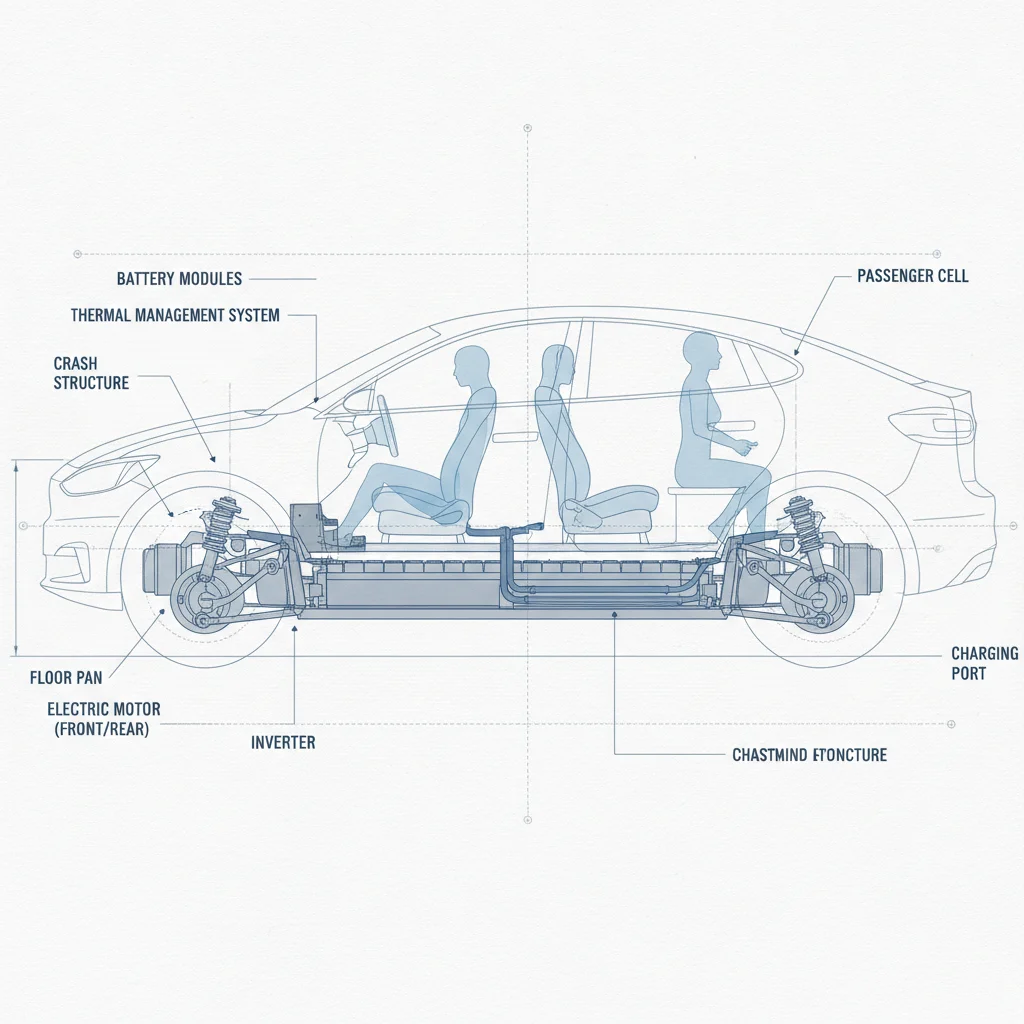
This dynamic pushes EV total loss rates higher than those for comparable ICE vehicles. A 2023 analysis by Mitchell International found that EVs were declared total losses at a rate roughly 25% higher than non-EVs after collision claims, largely driven by battery replacement costs. Understanding how EV battery packs are engineered helps explain why repair complexity is so much greater than it first appears.
~25%
Higher total loss rate for EVs vs. ICE vehicles
According to a 2023 Mitchell International analysis of collision claims, EVs were declared total losses at approximately 25% higher rates than non-EVs.
$10K–$30K
Typical EV battery pack replacement cost
Replacement costs vary widely by model, capacity, and manufacturer, with premium long-range packs reaching the higher end of this range.
8 years / 100K mi
Federal minimum EV battery warranty
The U.S. federal government mandates all EV manufacturers warrant high-voltage battery packs for at least 8 years or 100,000 miles.
70–100%
Typical total loss threshold range by state
State laws or insurer guidelines set the repair-cost-to-ACV ratio at which a vehicle must be declared a total loss, varying significantly by jurisdiction.
3x
Higher EV repair costs vs. conventional vehicles
CCC Intelligent Solutions reported that average EV repair costs after collision were roughly three times higher than for comparable non-EV models as of 2023.
How Insurers Calculate Actual Cash Value for an EV
The total loss determination hinges on the vehicle's actual cash value (ACV) — what the car was worth on the open market immediately before the loss. For EVs, establishing ACV introduces wrinkles that don't exist with gas-powered vehicles.
Depreciation Curves Differ by Model
Some EVs depreciate faster than their gasoline counterparts, in part because battery technology advances quickly and older range figures become less competitive. A three-year-old model with a 200-mile range may carry a significantly lower ACV than its original MSRP suggests, especially if the manufacturer has since released an updated version with 300+ miles of range. Insurers use auction data, dealer listings, and third-party valuation tools to establish a market-based ACV — and those tools are only as accurate as the comparable sales data feeding them.
Federal Tax Credits and ACV
Here is a wrinkle many owners overlook: if a buyer received a federal or state EV tax credit at purchase, that incentive reduced the effective out-of-pocket purchase price, but ACV is calculated based on fair market resale value — not the original net price paid. Depending on how much the vehicle has depreciated, owners may find the ACV settlement is lower than their remaining loan balance. See the EV tax credit hub for context on how these incentives affect the total cost of ownership picture.
ACV vs. Replacement Cost: An Important Distinction
Actual cash value reflects what the car was worth before the loss — not what it costs to replace it with a new vehicle. On an EV that has depreciated 30% in three years, that gap can be substantial. Standard policies pay ACV; only specific endorsements or policy types cover replacement cost. Review your declarations page carefully to understand which basis applies to your policy.
Battery Health Data and Future Underwriting
Several insurers and startups are exploring programs that incorporate real-time battery state-of-health data into EV underwriting and claims decisions. As telematics data sharing becomes more common, battery health reporting at the time of policy inception or claim filing may become standard practice. For now, the market remains largely inconsistent on this point.
Warranty and Insurance Coordination Can Be Complex
When a battery failure overlaps with both warranty coverage and an insured event — such as a collision that may have triggered a latent defect — coordinating between the manufacturer and insurer can delay claims resolution. Document all communications with both parties and request written explanations for any coverage denials from either side.
State Total Loss Thresholds
Every state sets — or allows insurers to set — a total loss threshold. Most fall between 70% and 100% of ACV. A state with a 75% threshold means the insurer declares a total loss when repair costs reach or exceed 75% of what the car was worth before the accident. Because battery replacements alone can easily hit $15,000–$25,000 on a mid-range EV worth $35,000, crossing that threshold is far less unusual than it would be for a gas-powered sedan of equivalent value.
Battery Damage Scenarios That Trigger Total Loss
Not every battery incident leads to a total loss, but several common scenarios make that outcome highly probable.
Collision Damage
EV battery packs are typically mounted in the floor pan — a structural location that offers some protection but also places the pack directly in harm's way during side-impact or underbody collisions. If crash forces deform the pack's housing or breach the cell modules, insurers will generally require full replacement. Repair shops certified to work on high-voltage systems are still limited in number, which can add labor costs on top of parts expense.
Flood and Water Intrusion
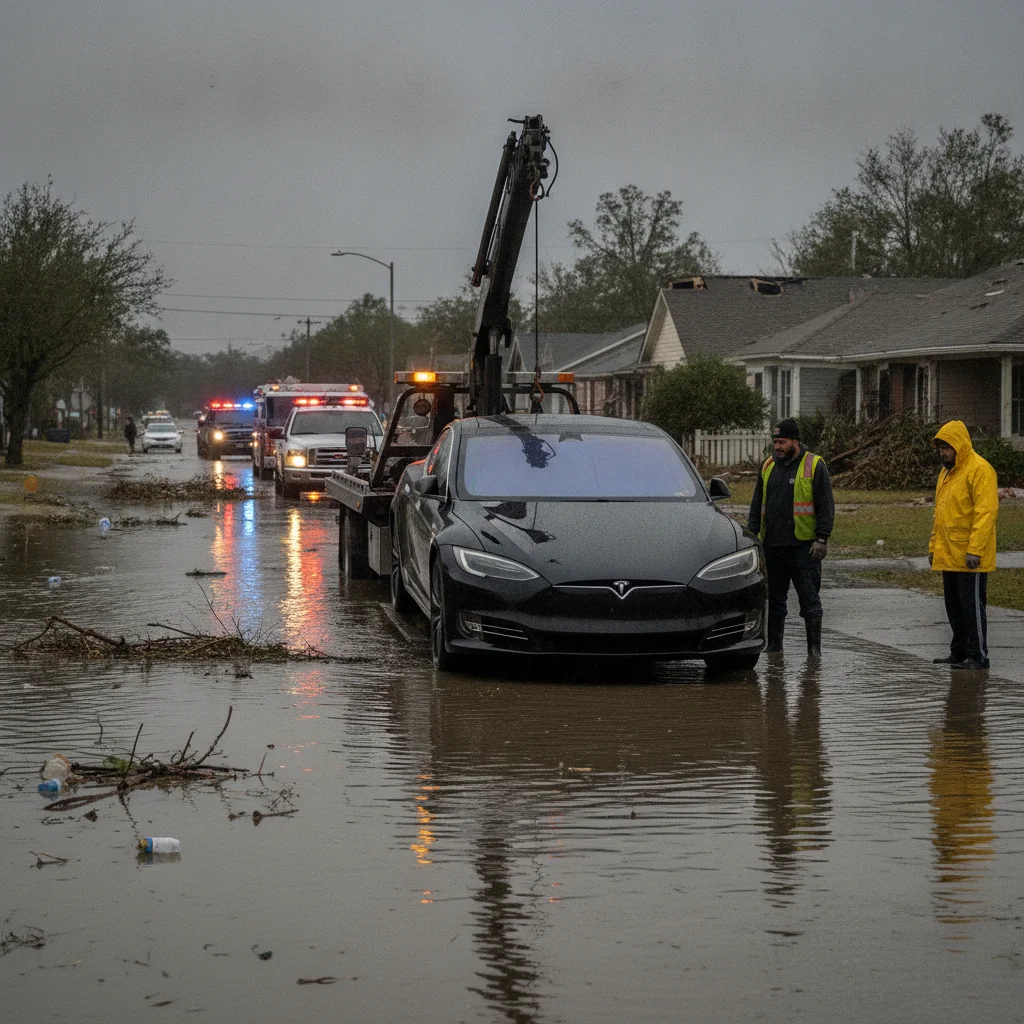
Saltwater immersion is particularly destructive to lithium-ion chemistry. Even after a vehicle is dried and inspected, saltwater intrusion into the battery pack creates ongoing corrosion and short-circuit risk. Many insurers and manufacturers take the position that a flood-immersed battery cannot be certified as safe for continued use, effectively requiring full replacement — and frequently resulting in a total loss declaration.
Thermal Runaway and Fire
A battery fire caused by thermal runaway — a chain reaction where cell temperatures escalate uncontrollably — typically destroys the pack entirely and often causes significant body and structural damage as well. These events almost universally produce a total loss outcome. Fire investigations also raise subrogation questions, since a defective battery may create liability for the manufacturer.
Document Battery Health Before a Claim
Request a battery health report from your dealer or a certified EV service center annually and keep records. If your battery's state of health is ever contested in a claim, documentation showing pre-loss capacity gives you a stronger basis for negotiating ACV. Some manufacturers provide this data through their companion apps at no cost.
Review Gap and Replacement Coverage at Purchase
The best time to add gap insurance or a new car replacement endorsement is when you first finance or lease an EV — not after an accident. Ask your insurer specifically whether their new car replacement coverage applies to EVs and what the model year cutoff is, as policy language varies by carrier.
Charging System Faults
In rare cases, a severe overcharge event or DC fast charger malfunction can damage cells internally without causing a fire. Diagnosis requires specialized equipment and, if significant cell degradation is confirmed, replacement may be the only certified repair path.
The Claims Process: What EV Owners Should Expect
Filing a total loss claim on an EV follows the same general arc as any other total loss, but with additional steps specific to high-voltage vehicles.
- Initial report and triage: After reporting the claim, an adjuster — ideally one with EV training — is assigned. Some carriers now route EV claims to specialized desks.
- Vehicle inspection and teardown estimate: The vehicle is typically transported to a certified repair shop capable of handling high-voltage systems. The battery must be assessed by trained technicians before a repair estimate can be finalized. This stage can take longer than a standard collision inspection.
- ACV determination: The insurer's valuation team establishes ACV using market comparables. Owners have the right to challenge this figure by presenting their own comparable listings.
- Total loss declaration (if applicable): If the repair estimate exceeds the state's threshold relative to ACV, the vehicle is formally declared a total loss.
- Settlement offer: The insurer offers ACV minus any applicable deductible. Owners still carrying a loan must satisfy the lender first; gap insurance covers any remaining balance above ACV.
- Title transfer and salvage: The owner surrenders the title. The insurer takes possession of the vehicle and typically sells it at a salvage auction.
For a deeper look at how this process works across all vehicle types, see how insurers decide on total loss payouts.
“The auto insurance industry hasn't fully caught up to the reality that a minor accident can total an EV. When the most expensive component in the car sits in the floor and gets hit from every direction, the math changes fundamentally.”
— Nicole Beck, Senior automotive insurance analyst, specializing in EV claims and emerging vehicle technology
Salvage Titles and EV Batteries: A Complicated Afterlife
When an EV is declared a total loss, the salvage vehicle enters a secondary market that is still adapting to high-voltage technology. Several complications arise that don't exist with conventional salvage vehicles.
Safety Inspection Requirements
Many states require salvage vehicles to pass a rebuilt title inspection before they can be re-registered. For EVs, this inspection must confirm the battery pack is safe — a requirement that few inspection facilities are currently equipped to meet in a standardized way. The result is that some salvage EVs sit in legal limbo, technically repairable but practically un-registerable.
Battery Resale and Second-Life Markets
Undamaged or lightly degraded battery packs from totaled EVs have value in the second-life energy storage market — stationary applications like home or grid storage. Some salvage buyers specifically target EV wrecks for battery harvesting. This secondary demand can push salvage auction prices higher than insurers might expect, which in turn affects the insurer's net loss on the claim.
What Happens When the Owner Retains the Vehicle
Owners sometimes choose to retain a totaled vehicle and accept a reduced settlement (ACV minus the salvage value the insurer would have received). For EVs, this strategy carries unique risk: a battery pack that cannot be certified as roadworthy may be impossible to re-insure, and some insurers will not write comprehensive or collision coverage on a rebuilt-title EV at all.
Coverage Strategies to Reduce Total Loss Risk
Because the financial stakes of an EV total loss are higher than average, deliberate coverage choices at the policy level can significantly affect outcomes.

Gap Insurance
Gap (Guaranteed Asset Protection) insurance covers the difference between ACV and the remaining loan balance if the car is declared a total loss while underwater on financing. Given that EVs can depreciate faster than loan balances shrink — particularly in the early ownership years — gap coverage is worth strong consideration for financed EV buyers.
Agreed Value vs. Actual Cash Value Policies
Standard auto policies pay ACV at the time of loss. Some specialty carriers offer agreed value policies that lock in a set payout amount at policy inception. This is most relevant for limited-edition or high-value EVs where market comparables may be sparse and ACV determinations contentious.
New Car Replacement Coverage
Some insurers offer endorsements that pay for a brand-new replacement vehicle — rather than ACV — if the car is totaled within the first one to three model years. For EV buyers concerned about rapid depreciation, this endorsement can be a meaningful safeguard.
Document Battery Health Before a Claim
Request a battery health report from your dealer or a certified EV service center annually and keep records. If your battery's state of health is ever contested in a claim, documentation showing pre-loss capacity gives you a stronger basis for negotiating ACV. Some manufacturers provide this data through their companion apps at no cost.
Review Gap and Replacement Coverage at Purchase
The best time to add gap insurance or a new car replacement endorsement is when you first finance or lease an EV — not after an accident. Ask your insurer specifically whether their new car replacement coverage applies to EVs and what the model year cutoff is, as policy language varies by carrier.
Understanding the Impact on Premiums
These total loss dynamics feed directly into why EV insurance premiums are often higher than those for comparable ICE vehicles. Insurers price policies anticipating the elevated probability and cost of a total loss event. How EVs affect insurance rates covers this broader premium picture in detail, while the variables insurers weigh when pricing EV coverage breaks down the specific rating factors involved.
Used EVs: When Battery History Complicates the Picture
Total loss considerations become even more layered for used EV buyers. A pre-owned EV may carry a battery that has already degraded meaningfully from its original capacity — and that degradation directly affects both ACV and the likelihood of a total loss event.
If a used EV's battery is at 80% of original capacity when purchased, the ACV at the time of any future claim will reflect that reduced capacity. Meanwhile, the cost of a new replacement pack is unchanged. The gap between replacement cost and actual market value therefore starts wide on day one, making a total loss more mathematically likely earlier in the ownership period.
Manufacturer battery health reports and third-party diagnostics — available from services like Recurrent or via OBD-II scan tools — can provide a state-of-health estimate before purchase. Insurers may eventually use this data in their underwriting processes, though as of 2024, standardized battery health reporting in insurance pricing remains nascent. Insuring a used EV addresses these considerations in greater depth.
ACV vs. Replacement Cost: An Important Distinction
Actual cash value reflects what the car was worth before the loss — not what it costs to replace it with a new vehicle. On an EV that has depreciated 30% in three years, that gap can be substantial. Standard policies pay ACV; only specific endorsements or policy types cover replacement cost. Review your declarations page carefully to understand which basis applies to your policy.
Battery Health Data and Future Underwriting
Several insurers and startups are exploring programs that incorporate real-time battery state-of-health data into EV underwriting and claims decisions. As telematics data sharing becomes more common, battery health reporting at the time of policy inception or claim filing may become standard practice. For now, the market remains largely inconsistent on this point.
Warranty and Insurance Coordination Can Be Complex
When a battery failure overlaps with both warranty coverage and an insured event — such as a collision that may have triggered a latent defect — coordinating between the manufacturer and insurer can delay claims resolution. Document all communications with both parties and request written explanations for any coverage denials from either side.
Manufacturer Warranties and How They Interact With Insurance
Federal law requires EV manufacturers to warrant the high-voltage battery pack for at least 8 years or 100,000 miles — whichever comes first — and the battery must be covered against defects and significant capacity loss (typically defined as capacity dropping below 70% of original). Some manufacturers, like Hyundai and Tesla on certain models, offer longer coverage periods.
This warranty creates an important decision point: if a battery suffers damage that could be attributed to a manufacturing defect, the warranty claim route may be available before — or instead of — an insurance claim. Pursuing a warranty claim avoids a claim on your insurance record and the potential premium increase that follows. However, warranty coverage applies to defects, not collision or flood damage. The line between the two can sometimes be contested — particularly in thermal runaway events where root cause analysis is complex.
When the vehicle is still under battery warranty and is damaged in an accident, coordination between the manufacturer and insurer may be necessary to establish which party bears which portion of the repair cost. This is relatively new legal and contractual territory, and outcomes vary by manufacturer, insurer, and jurisdiction.
ACV vs. Replacement Cost: An Important Distinction
Actual cash value reflects what the car was worth before the loss — not what it costs to replace it with a new vehicle. On an EV that has depreciated 30% in three years, that gap can be substantial. Standard policies pay ACV; only specific endorsements or policy types cover replacement cost. Review your declarations page carefully to understand which basis applies to your policy.
Battery Health Data and Future Underwriting
Several insurers and startups are exploring programs that incorporate real-time battery state-of-health data into EV underwriting and claims decisions. As telematics data sharing becomes more common, battery health reporting at the time of policy inception or claim filing may become standard practice. For now, the market remains largely inconsistent on this point.
Warranty and Insurance Coordination Can Be Complex
When a battery failure overlaps with both warranty coverage and an insured event — such as a collision that may have triggered a latent defect — coordinating between the manufacturer and insurer can delay claims resolution. Document all communications with both parties and request written explanations for any coverage denials from either side.
All claims are backed by peer-reviewed research. Sources on request.