Key Takeaways
Our Verdict
No single electrified vehicle type wins outright on five-year costs. BEVs deliver the lowest ongoing fuel and maintenance expenses but require higher upfront investment and can face steeper insurance costs. PHEVs offer flexibility but add mechanical complexity that erodes some savings. HEVs are the low-friction, low-risk entry point for buyers who want fuel savings without charging commitments. The right choice depends on your driving patterns, access to charging, and total budget.
| Best for | Recommended |
|---|---|
| High-mileage commuters with home charging access | BEV |
| Drivers who take frequent long trips and want charging flexibility | PHEV |
| Budget-conscious buyers who want fuel savings without infrastructure changes | HEV |
| Buyers maximizing federal tax credit value | BEV or PHEV |
Why Purchase Price Is Only the Beginning
Walk into any dealership and the sticker price is the first number you see. It's also one of the least useful numbers when comparing electrified vehicles over time. A $28,000 hybrid and a $45,000 battery-electric sedan don't stay $17,000 apart once you factor in five years of fuel, maintenance, insurance, and depreciation.
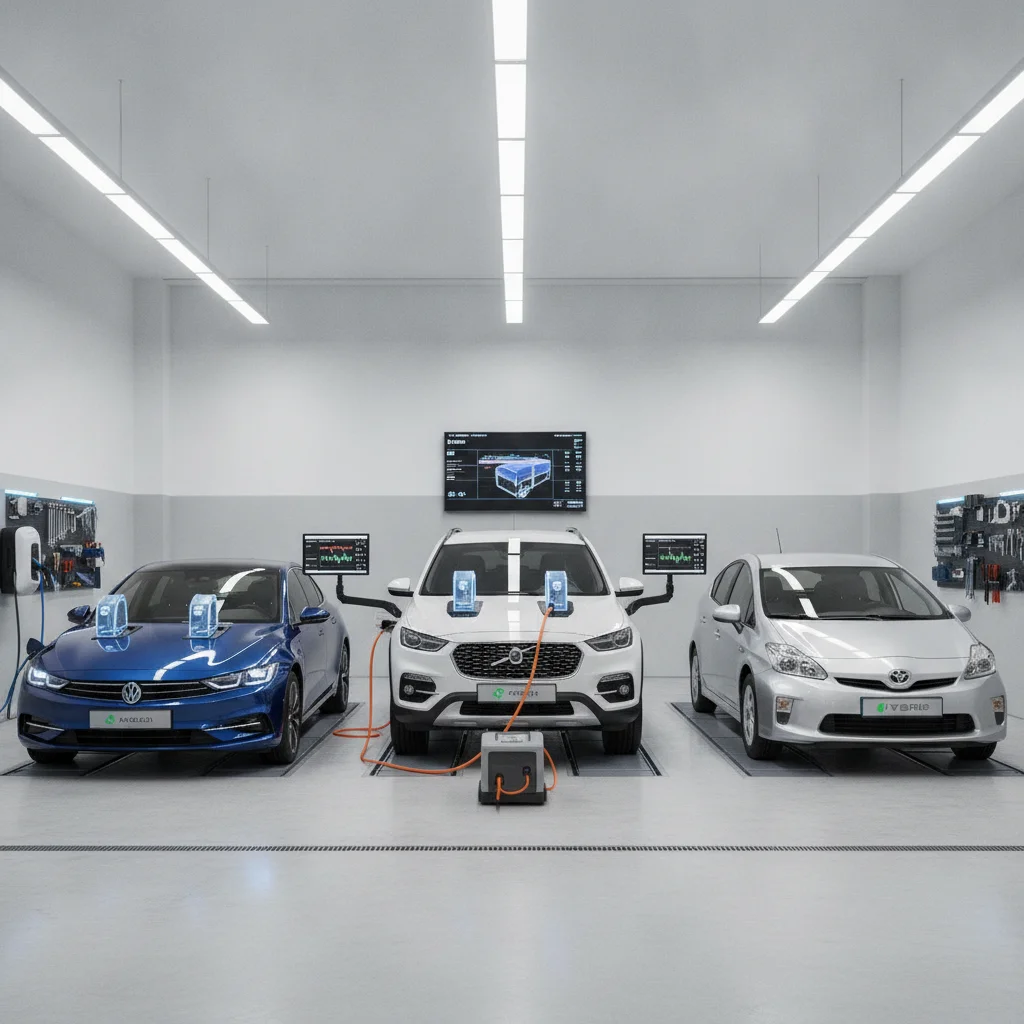
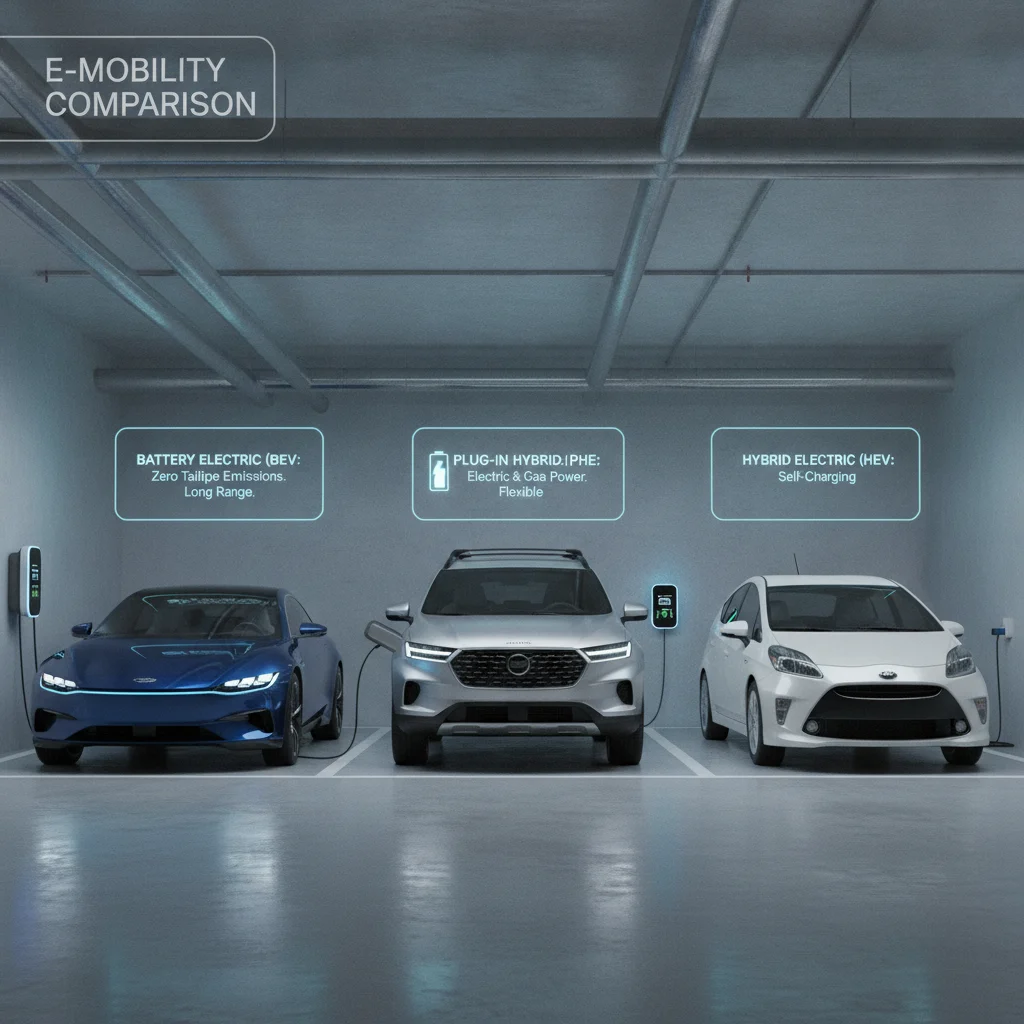
This comparison focuses on three mainstream electrified categories that buyers actually choose from today:
- BEV (Battery Electric Vehicle): Runs entirely on electricity. No gasoline engine. Examples: Tesla Model 3, Chevrolet Equinox EV, Hyundai Ioniq 6.
- PHEV (Plug-in Hybrid Electric Vehicle): Has both a battery pack you can charge externally and a gasoline engine. Examples: Toyota RAV4 Prime, Ford Escape PHEV, Jeep Wrangler 4xe.
- HEV (Hybrid Electric Vehicle): Uses a small battery to assist a gasoline engine, but you never plug it in. Examples: Toyota Camry Hybrid, Honda CR-V Hybrid, Ford Maverick Hybrid.
The numbers below are built on publicly available data from the U.S. Department of Energy, EPA fuel economy estimates, AAA cost studies, and insurance industry benchmarks. They represent typical mid-market vehicles in each category driven 15,000 miles per year over five years — the national average. Your actual numbers will vary, but the relationships between categories hold broadly across the market.
For a deeper look at how long-range depreciation and charging fit into the bigger picture, see this breakdown of the full EV ownership cost equation.
Purchase Price and Incentives: The Starting Gap
Average transaction prices in 2024 vary meaningfully across electrified categories. Based on Kelley Blue Book and Cox Automotive data:
- BEVs: $45,000–$55,000 average transaction price (mid-market, non-luxury)
- PHEVs: $38,000–$48,000 average transaction price
- HEVs: $28,000–$38,000 average transaction price
Those gaps are real — but they're partly offset by federal tax credits under the Inflation Reduction Act. Qualifying BEVs and PHEVs may be eligible for up to $7,500 in federal tax credits at point of sale (as of 2024). HEVs that you can't plug in do not qualify for the federal EV credit.

After applying a $7,500 credit to a qualifying BEV at $48,000, the effective out-of-pocket cost drops to $40,500 — putting it closer to PHEV territory. This makes the credit a pivotal variable, which is why income limits and MSRP caps matter: not every buyer or vehicle qualifies. Always verify eligibility through the IRS or your dealer before assuming the credit applies to your purchase.
State-level incentives add another layer. California, Colorado, New York, and several other states offer rebates of $1,000–$5,000 on top of the federal credit, almost exclusively for BEVs and PHEVs. If you live in a high-incentive state, the upfront gap closes further.
Always Net the Incentives Before Comparing Prices
When comparing sticker prices across vehicle types, apply all federal and state incentives to the BEV or PHEV first. A $48,000 BEV with a $7,500 federal credit and a $2,000 state rebate has an effective cost of $38,500 — directly competitive with many HEV transaction prices. Use the IRS Clean Vehicle Credit tool and your state's DMV or energy office website to confirm eligibility before purchase.
Model Your Actual Driving Pattern, Not the Average
The 15,000-mile national average masks wide variation. If you drive 20,000+ miles per year, BEV fuel savings compound dramatically and payback periods shorten. If you drive 8,000 miles per year, the savings shrink and a well-priced HEV may be the smarter choice. Build a simple spreadsheet with your actual annual mileage, local fuel and electricity prices, and your target ownership horizon before committing to any category.
Fuel Costs Over Five Years: Where BEVs Dominate
Fuel is where electrified vehicles generate their headline savings — but the advantage varies sharply by type and driving pattern.
Using national average figures: gasoline at $3.40/gallon, residential electricity at $0.16/kWh (U.S. Energy Information Administration, 2024), and 15,000 miles/year:
| Cost Category | BEV | PHEV | HEV | |
|---|---|---|---|---|
| Avg. transaction price (2024) | $45,000–$55,000 | $38,000–$48,000 | $28,000–$38,000 | |
| Federal tax credit available | Up to $7,500 | Up to $7,500 | None | |
| 5-yr fuel cost (15k mi/yr) | ~$3,500–$4,500 | ~$4,500–$6,500 | ~$7,500–$9,500 | |
| 5-yr maintenance cost | ~$2,300 | ~$4,500–$5,500 | ~$3,500–$4,200 | |
| Insurance premium vs. ICE | 10–25% higher | 5–15% higher | Roughly equivalent | |
| 5-yr depreciation (% of MSRP retained) | 45–55% | 48–58% | 52–65% | |
| Charging infrastructure needed | Required for full benefit | Strongly recommended | None | |
| Maintenance complexity | Low | High | Moderate | |
| Best use case | High-mileage, home charging | Long-range flexibility | Low-friction fuel savings |
A few important caveats on PHEV fuel costs: these numbers assume a charging pattern where the driver plugs in regularly and uses the electric range (typically 25–50 miles per charge) for most daily driving. A PHEV owner who rarely charges and runs primarily on gas will pay closer to what a non-hybrid gasoline vehicle costs. The EPA labels PHEVs with both an "EV mode" MPGe and a gasoline-only MPG for this reason.
BEV charging costs also depend heavily on where you charge. Home charging at $0.16/kWh is dramatically cheaper than DC fast charging at public stations, which can run $0.30–$0.50/kWh at some networks. A BEV owner who relies on public fast charging for 40% of their miles may see fuel savings erode by $400–$800 over five years compared to a home-charger-dominant pattern. The charging costs and savings hub has detailed guidance on optimizing your charging mix.
Maintenance Costs: The Hidden Advantage of Fewer Parts
Maintenance is where BEVs quietly build a durable cost advantage, and where PHEVs give some of it back.
A BEV has no oil changes, no spark plugs, no timing belt, no transmission fluid, and no exhaust system to service. The primary recurring maintenance items are tire rotation, cabin air filters, brake fluid (less frequent due to regenerative braking), and wiper blades. AAA estimates BEV maintenance at roughly $0.031 per mile versus $0.061 per mile for conventional gasoline vehicles — about half the cost.
Over five years at 15,000 miles/year, that translates to approximately:
- BEV: ~$2,300 in maintenance
- HEV: ~$3,500–$4,200 (oil changes still required; more systems to service than BEV, fewer than full ICE)
- PHEV: ~$4,500–$5,500 (full ICE maintenance schedule plus EV components)

PHEVs carry a real complexity penalty. You're maintaining two complete powertrains — an internal combustion engine with all its associated fluids, belts, and wear items, plus the battery, electric motor, and charging system. This doesn't mean PHEVs are unreliable, but the maintenance schedule is longer and more expensive than either a BEV or a dedicated hybrid.
HEVs occupy a middle position. They still require oil changes and full engine service, but the regenerative braking system reduces brake wear meaningfully. Toyota's hybrid system, in particular, has an excellent long-term reliability record.
For a full itemized breakdown, this five-year EV maintenance cost estimate walks through each cost category in detail. You can also compare specific maintenance tasks between types in this maintenance differences breakdown.
PHEV Maintenance Costs Are Frequently Underestimated
Many buyers assume PHEVs combine the best of both worlds — and they do for fuel flexibility. But they also combine the maintenance requirements of both powertrains. You still need regular oil changes, transmission service, exhaust system upkeep, and all associated engine wear items, on top of battery and electric motor maintenance. Budget for PHEV maintenance closer to a conventional vehicle than a BEV, and factor this into your five-year total cost model.
Insurance Costs: The BEV Premium That Buyers Often Miss
Insurance is one of the most overlooked variables in electrified vehicle comparisons — and it systematically disadvantages BEVs.
According to data from Insurify and the Insurance Information Institute, BEVs cost on average 10–25% more to insure than comparable gasoline vehicles. The reasons are structural:
- Higher replacement part costs (particularly battery packs and specialized components)
- Fewer certified repair shops with EV-specific training
- Higher average vehicle values increasing total loss payouts
- Longer repair times driving up rental car costs in comprehensive claims
PHEVs typically fall between BEVs and HEVs on insurance cost — their higher vehicle values increase premiums relative to HEVs, but they're generally cheaper to repair than BEVs because more shops have experience with hybrid drivetrains and replacement parts are more standardized.
23%
Higher average BEV insurance premiums vs. ICE vehicles
According to Insurify's 2023 State of Insurance Report, BEV drivers pay an average of 23% more for auto insurance than drivers of comparable gasoline vehicles.
$0.031/mi
Average BEV maintenance cost per mile
AAA's 2023 Your Driving Costs study estimates BEV maintenance at roughly half the per-mile cost of conventional gasoline vehicles.
$7,500
Maximum federal EV tax credit (IRA 2024)
Under the Inflation Reduction Act, qualifying new BEVs and PHEVs may receive up to $7,500 at point of sale, subject to income limits and MSRP caps.
15,000
Average annual miles driven by U.S. motorists
The Federal Highway Administration's most recent data puts average annual vehicle miles traveled per driver at approximately 15,000 miles.
52–65%
5-year value retention for leading HEV models
iSeeCars 2024 depreciation data shows Toyota and Honda hybrid models among the strongest value-retention vehicles in the mainstream segment.
HEVs, on average, cost only slightly more to insure than equivalent gasoline vehicles. The modest price premium and conventional repair ecosystem keep premiums competitive.
Over five years, the insurance gap between a BEV and a comparable HEV can reach $1,500–$3,000 depending on the vehicle, driver profile, and insurer. This doesn't flip the overall cost equation against BEVs, but it meaningfully reduces their total savings advantage. The EV insurance guide explains how to shop coverage effectively for each vehicle type.
Depreciation: The Wildcard in the Five-Year Calculation
Depreciation is often the largest single cost of vehicle ownership, yet it's the most buyer-specific and hardest to predict. A few patterns hold across the electrified market right now:
BEVs: Depreciation has been volatile. Tesla price cuts in 2022–2023 hammered resale values across the BEV segment. However, vehicles with strong brand loyalty (Tesla Model Y, Rivian R1T) and those in high-demand categories are stabilizing. As a rough benchmark, mid-market BEVs currently depreciate to about 45–55% of MSRP after five years — similar to or slightly worse than mainstream gasoline vehicles.
PHEVs: Tend to hold value reasonably well, particularly utility-focused models like the RAV4 Prime. The combination of EV incentives and gas-backup range appeals to a broad resale market. Expect 48–58% of MSRP remaining after five years for popular models.
HEVs: Toyota hybrids in particular have exceptional resale value. The Camry Hybrid and RAV4 Hybrid consistently rank among the lowest-depreciation vehicles in their segments. Expect 52–65% of MSRP after five years for mainstream hybrid models.
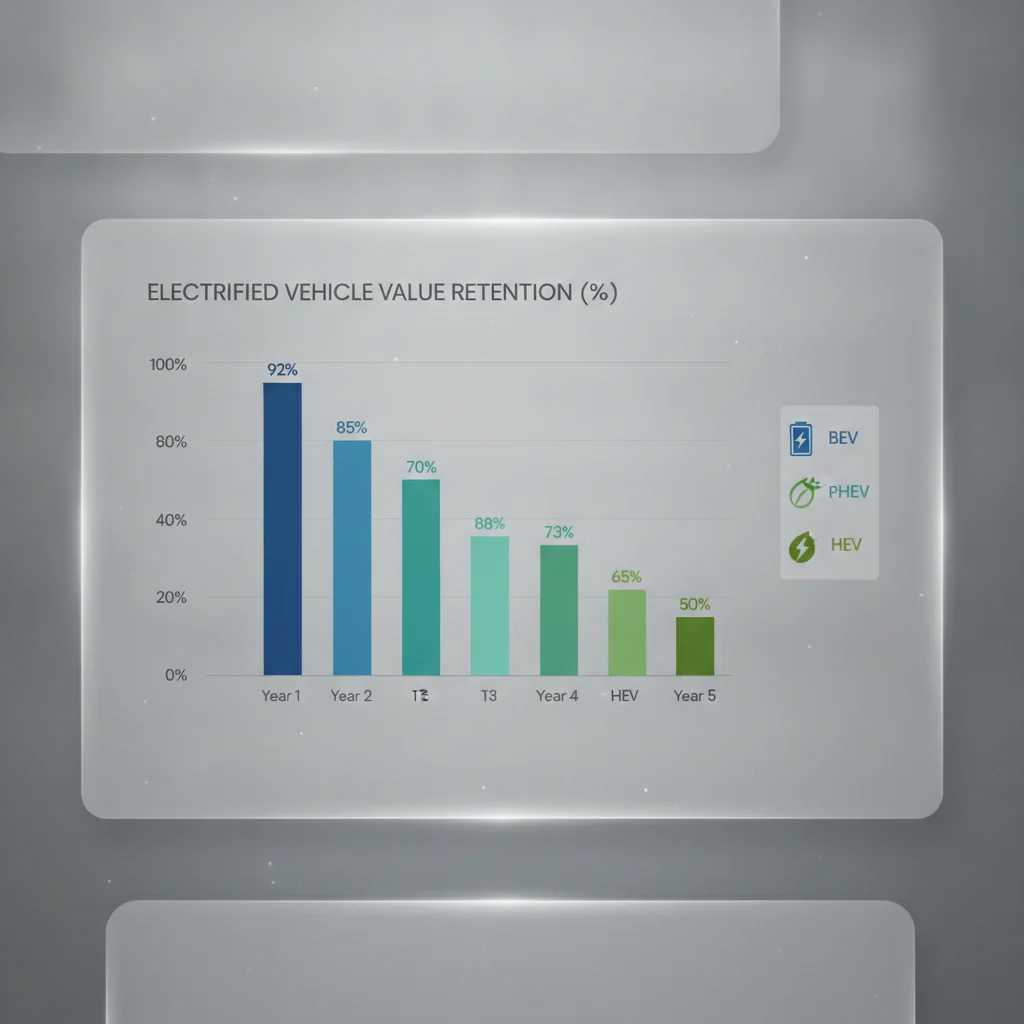
It's worth noting that federal tax credits complicate the depreciation picture. If you bought a BEV for $48,000 and received a $7,500 credit, your effective cost basis is $40,500 — so even if the vehicle depreciates to $22,000, the actual dollar loss from your pocket is smaller than the raw resale number suggests. Model the depreciation against your net purchase cost, not the sticker price.
For broader context on which vehicle categories minimize long-term ownership expense, this guide to the lowest-cost vehicles over five years includes electrified and non-electrified options.
Five-Year Total Cost Summary: Putting It All Together
Combining all five cost categories — net purchase price (after federal credit where applicable), fuel, maintenance, insurance, and depreciation — here's how a representative mid-market vehicle in each category stacks up over five years at 15,000 miles/year:
Assumptions used: Gasoline $3.40/gallon; electricity $0.16/kWh (home charging); BEV qualifies for $7,500 federal credit; insurance based on national averages by type; depreciation based on industry residual value benchmarks.
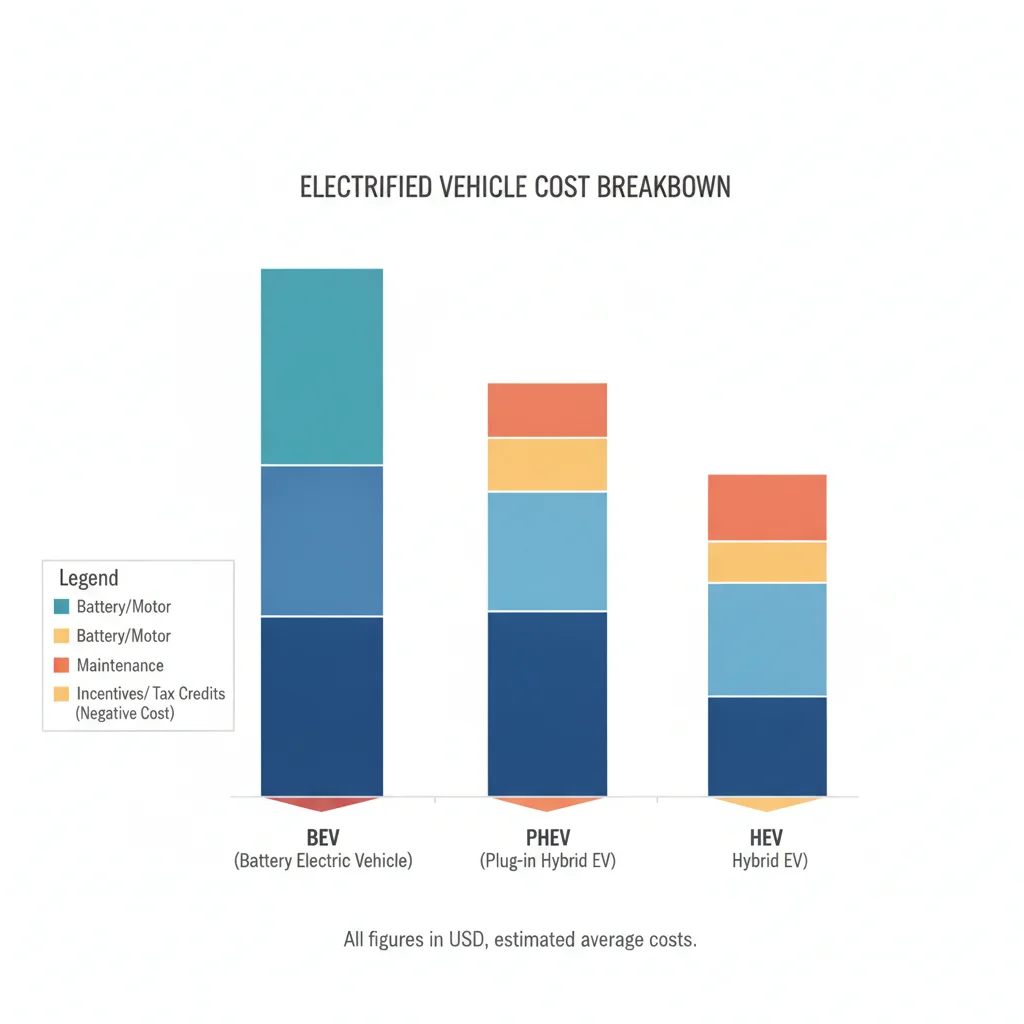
These are representative figures, not guarantees. The range within each category is wide — a base Toyota Camry Hybrid will have a very different total cost profile than a Hyundai Tucson Hybrid, even though both are HEVs. Similarly, a Tesla Model 3 Long Range and a Nissan Leaf differ significantly within the BEV category.
The key relationships that hold across nearly every comparison:
- BEVs save the most on fuel and maintenance but cost more upfront and to insure.
- HEVs provide the lowest upfront cost and best depreciation with meaningful fuel savings, but leave fuel savings on the table versus BEVs.
- PHEVs are positioned in the middle on almost every dimension — but the maintenance complexity is a real and underappreciated cost.
If you want to go deeper on EV maintenance specifically, this side-by-side EV vs. gas maintenance breakdown and this comprehensive EV lifetime maintenance guide are worth reading before you commit.
Always Net the Incentives Before Comparing Prices
When comparing sticker prices across vehicle types, apply all federal and state incentives to the BEV or PHEV first. A $48,000 BEV with a $7,500 federal credit and a $2,000 state rebate has an effective cost of $38,500 — directly competitive with many HEV transaction prices. Use the IRS Clean Vehicle Credit tool and your state's DMV or energy office website to confirm eligibility before purchase.
Model Your Actual Driving Pattern, Not the Average
The 15,000-mile national average masks wide variation. If you drive 20,000+ miles per year, BEV fuel savings compound dramatically and payback periods shorten. If you drive 8,000 miles per year, the savings shrink and a well-priced HEV may be the smarter choice. Build a simple spreadsheet with your actual annual mileage, local fuel and electricity prices, and your target ownership horizon before committing to any category.
How to Choose Based on Your Driving Profile
The numbers above are averages. Your specific situation can shift the outcome by thousands of dollars. Here's a quick decision framework:
Choose a BEV if:
- You drive 12,000+ miles per year and have home charging (the fuel savings compound significantly)
- You live in a state with strong EV incentives on top of the federal credit
- Your commute is within range and public fast-charging is accessible for longer trips
- You want the lowest ongoing maintenance burden
Choose a PHEV if:
- You have home charging but regularly drive distances beyond 200–300 miles
- You're not ready to commit fully to EV infrastructure but want meaningful electric-only operation for daily driving
- Your vehicle of choice (e.g., a truck or off-road SUV) has limited BEV alternatives
Choose an HEV if:
- You don't have home charging and depend heavily on public infrastructure
- You want the simplest, lowest-risk path to fuel savings
- Your budget makes the $38,000–$55,000 BEV range difficult to justify
- You prioritize resale value stability
One final consideration: if you're financing rather than paying cash, the monthly payment difference between a $40,500 net BEV and a $30,000 HEV still matters. At a 7% loan rate over 60 months, that $10,500 gap translates to roughly $207/month more for the BEV. Fuel and maintenance savings typically don't recoup that gap quickly enough to matter if you're cash-flow constrained. Run the full monthly budget math, not just the lifetime totals.

All claims are backed by peer-reviewed research. Sources on request.