Key Takeaways
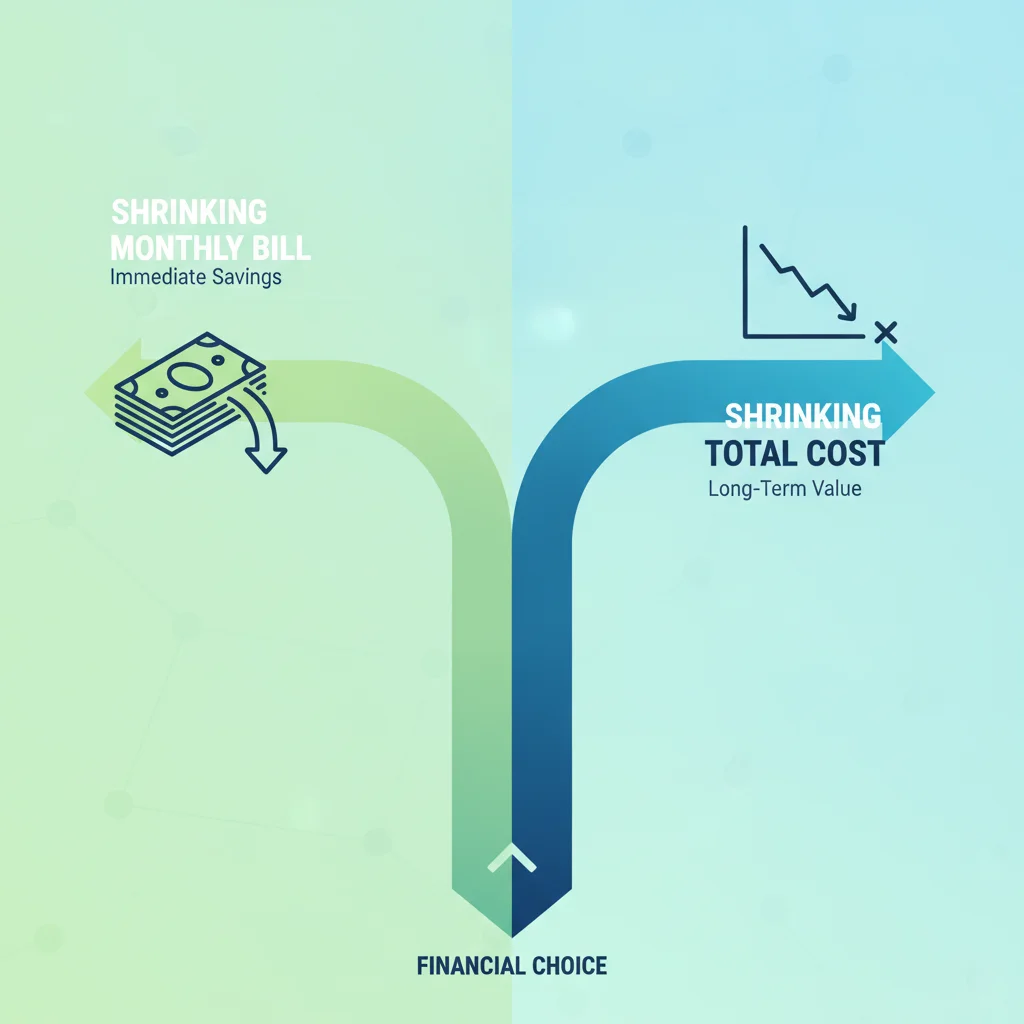
Option A
Lowering Your Monthly Payment
The cash-flow-first approach to refinancing.
Best for: Borrowers under short-term budget pressure who need immediate monthly relief, even if it costs more over the loan's life.
Option B
Reducing Total Interest
The long-term savings approach to refinancing.
Best for: Borrowers in a stable financial position who want to minimize what they ultimately pay for their vehicle.
If your budget is stretched and you need breathing room right now
Lowering Your Monthly Payment
Extending the term reduces your monthly obligation immediately, which matters more than lifetime cost when you're struggling to cover essentials. Just go in with eyes open about the extra interest you'll pay.
If your income is stable and you want to minimize what the car actually costs you
Reducing Total Interest
Shortening your term or securing a significantly lower rate keeps more money in your pocket over the loan's life — a clear win when your monthly budget can handle the payment.
If your credit score has improved significantly since you first borrowed
Reducing Total Interest
Better credit means access to lower rates, and pairing a lower rate with a shorter term is the most powerful combination for cutting lifetime interest without dramatically changing your monthly payment.
If you're planning to sell or trade in the car within the next two years
Lowering Your Monthly Payment
You won't be holding the loan long enough for lifetime interest to matter much. Focus on freeing up cash flow and avoid prepayment penalties that eat into your proceeds.
If you want the best of both outcomes
Reducing Total Interest
Refinancing to a lower rate while keeping the same remaining term can modestly reduce your monthly payment and meaningfully cut total interest — the most balanced option when it's available.
Why This Trade-Off Exists in the First Place
When you refinance an auto loan, you're essentially replacing your existing loan with a new one — ideally at a lower interest rate, a different term, or both. But here's the friction most borrowers don't anticipate: the changes that shrink your monthly payment often increase what you pay overall, and vice versa.
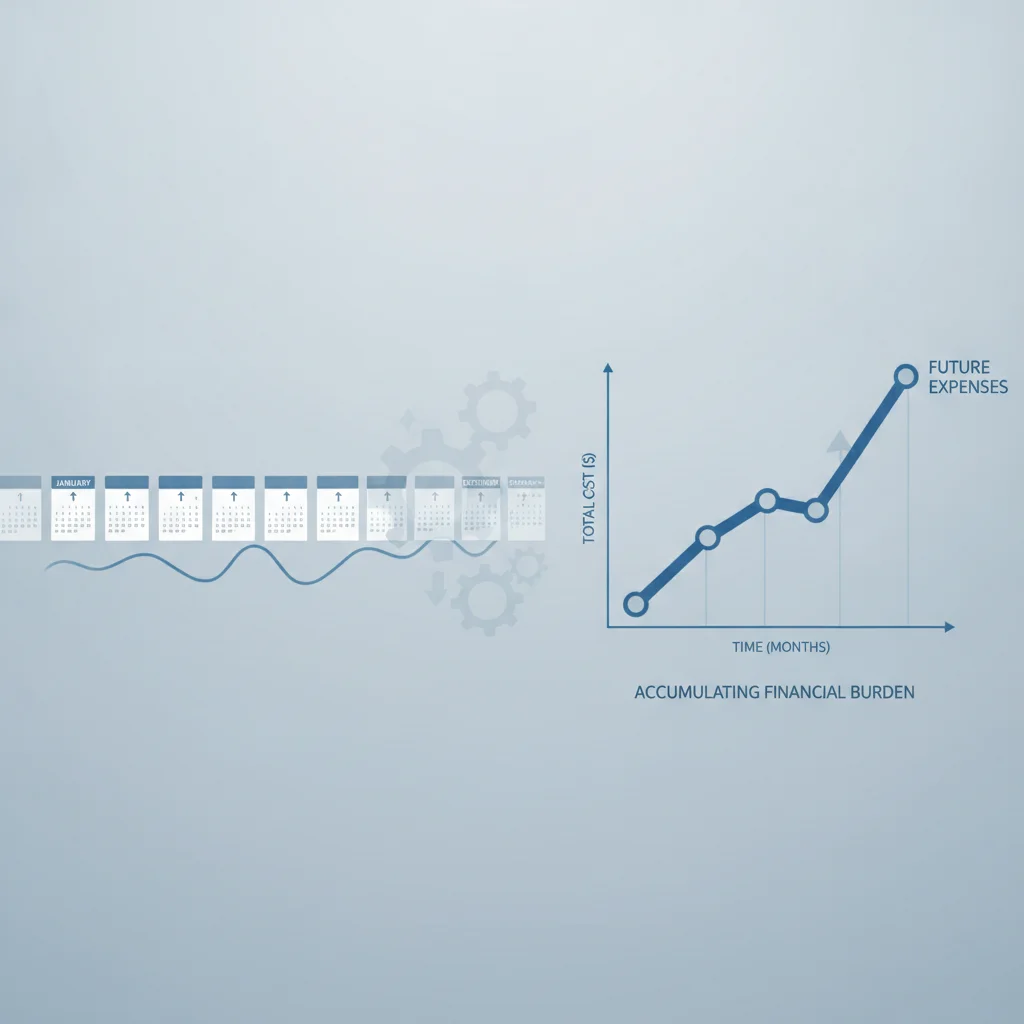
This happens because of how loan amortization works. Early in a loan, the majority of each payment goes toward interest rather than principal. As you extend the repayment window, you're giving interest more time to accumulate. As you shorten it, you compress that accumulation but need to repay the principal faster — which means larger monthly payments.
The rate you're charged compounds this dynamic. A lower rate helps regardless of which direction you adjust the term, but the term change itself is what determines whether you prioritize monthly affordability or lifetime cost. Understanding this relationship is the foundation for every smart refinancing decision. For a deeper look at how interest rates interact with term length, see our guide on how term length and APR trade off.
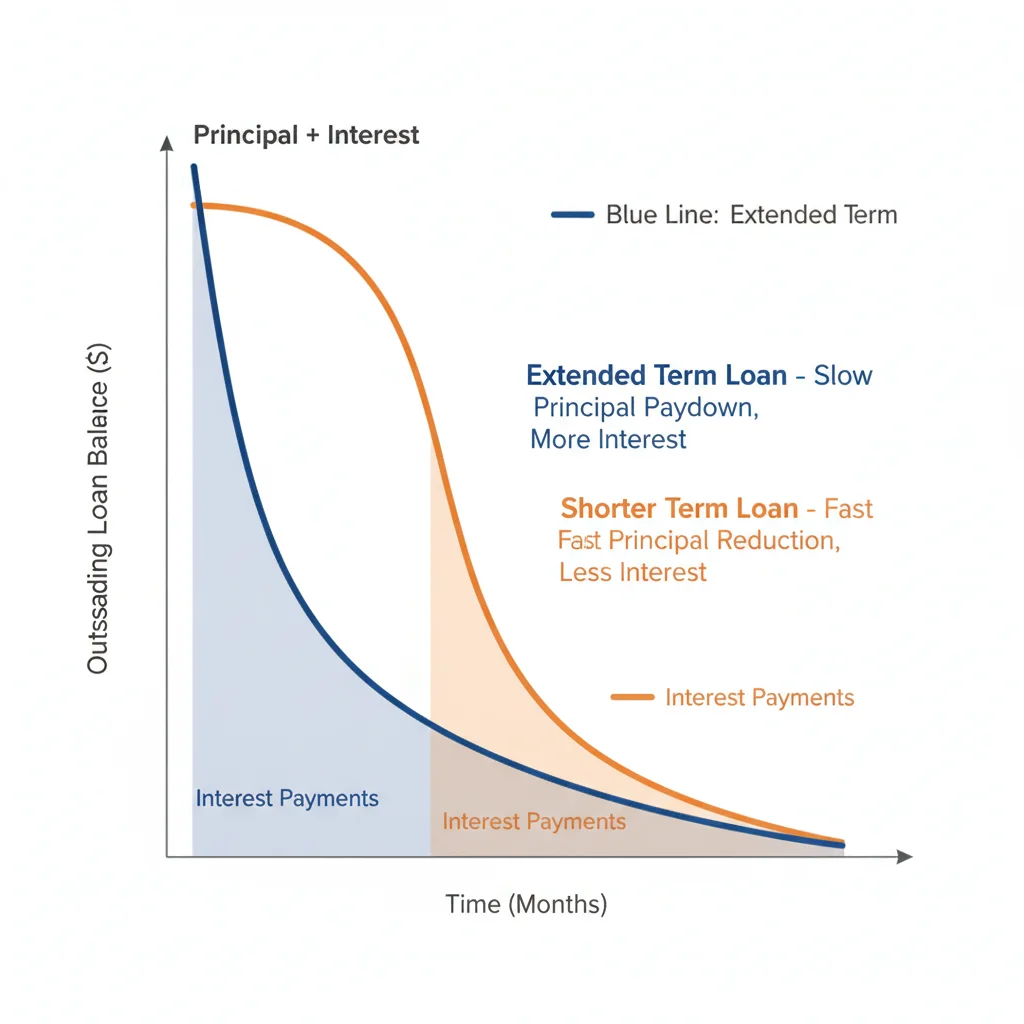
There are really only three levers available to you when refinancing: the loan balance (which is fixed by what you owe), the interest rate (which you negotiate), and the term (which you choose). The interaction between those last two levers creates the trade-off this article is about.
What Happens When You Prioritize a Lower Monthly Payment
The most common reason people refinance is to get relief on their monthly payment. This is especially true when income has dropped, expenses have risen, or the original loan was simply structured in a way that strains the budget each month.
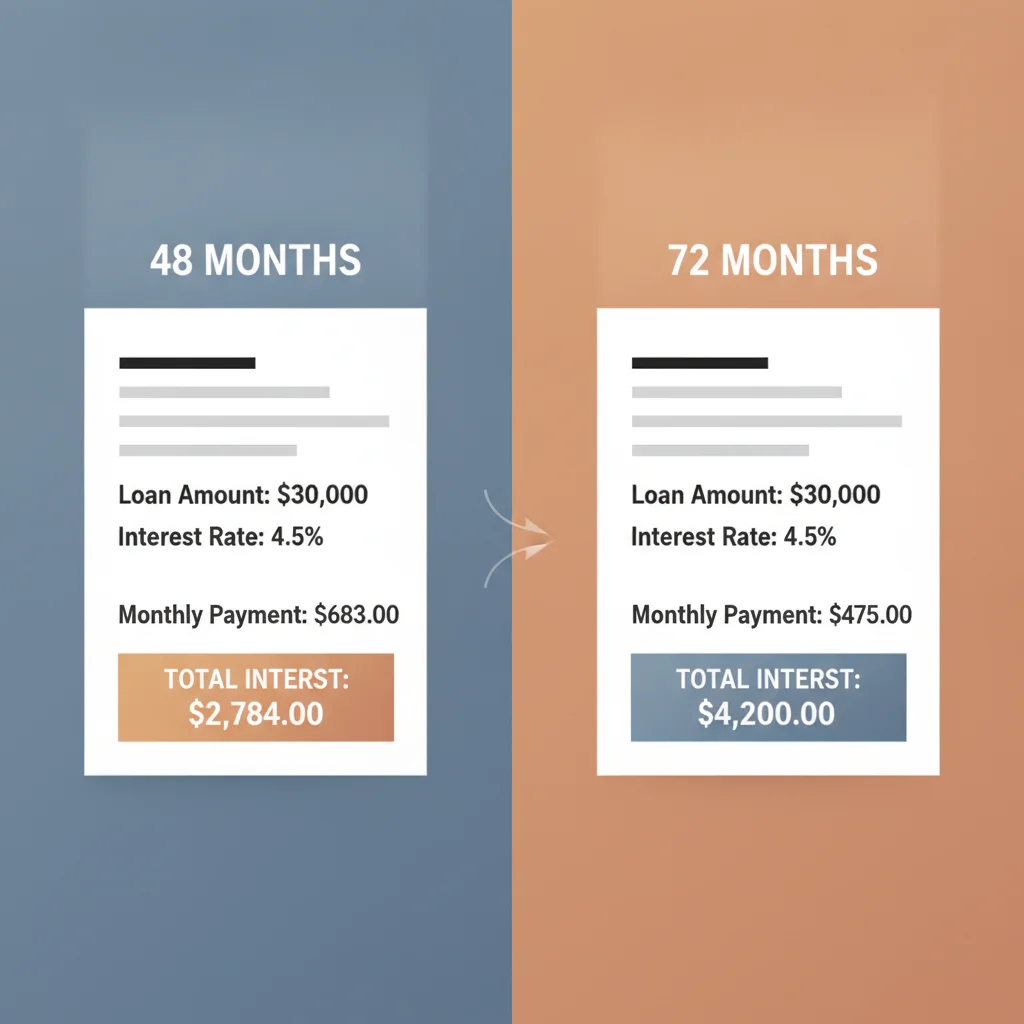
The most direct way to lower a monthly payment through refinancing is to extend the loan term. If you have 36 months remaining and refinance into a new 60-month loan, you're spreading the remaining balance over a longer period. The payment drops — sometimes significantly — but the math behind that drop reveals the real cost.
Here's a concrete example. Suppose you owe $18,000 at 7.5% APR with 36 months remaining. Your monthly payment is approximately $559. If you refinance that balance into a new 60-month loan at the same 7.5% rate, your payment drops to about $360 — a reduction of nearly $200 per month. But you'll pay roughly $3,600 in total interest over the life of the new loan, compared to about $2,100 on the original remaining balance. That's $1,500 in extra interest in exchange for $200 in monthly relief.
| Criterion | Lower Monthly Payment (Extended Term) | Reduce Total Interest (Shorter Term) |
|---|---|---|
| Monthly payment impact | Decreases significantly | Increases moderately |
| Total interest paid | Increases over loan life | Decreases over loan life |
| Loan payoff timeline | Extended further out | Shortened or maintained |
| Risk of negative equity | Higher — principal paid slower | Lower — principal paid faster |
| Best market condition | Any rate environment | Rate drop or credit improvement |
| Ideal financial profile | Budget-constrained borrower | Financially stable borrower |
| Planning horizon | Short-term vehicle ownership | Long-term vehicle ownership |
| Cash flow effect | Frees up monthly cash | Reduces available monthly cash |
Whether that trade-off is worth it depends entirely on your situation. If that $200 per month is the difference between making rent or not, the math is clear. But if you have financial flexibility, it's worth asking whether you can achieve monthly relief through a lower interest rate alone — without extending the term.
One important risk of extending your term is the potential to go underwater on the loan — meaning you owe more than the vehicle is worth. Cars depreciate, and longer terms mean slower principal paydown. This matters most if you want to sell, trade in, or need to make an insurance claim in the next year or two. For a balanced look at all the implications, see the pros and cons of extending your loan term during a refinance.
$1,500+
Extra interest from a 36→60 month extension
On an $18,000 balance at 7.5% APR, extending from 36 to 60 months adds roughly $1,500 in total interest while saving about $200 per month.
43%
Of new auto loan terms exceed 60 months
According to Experian's State of the Automotive Finance Market report, over 40% of new vehicle loans have terms of 61 months or longer.
$700
Interest saved by shortening from 36 to 24 months
On an $18,000 balance at 7.5% APR, refinancing from 36 to 24 months remaining reduces total interest paid by approximately $700.
1%–3%
Typical rate improvement from credit score gains
Borrowers who improve their credit score by 40–60 points between loan origination and refinancing commonly qualify for rates 1–3 percentage points lower, per Experian lending data.
32%
Of auto loan borrowers are underwater on their vehicle
Edmunds data shows that nearly one in three borrowers with a trade-in owe more than their vehicle is worth, a risk amplified by long-term loans.
What Happens When You Prioritize Reducing Total Interest
If your financial situation is stable and your primary concern is what the car ultimately costs you, reducing total interest is the right goal. There are two ways refinancing can accomplish this: securing a meaningfully lower interest rate, or shortening the remaining loan term, or ideally both.
A lower rate reduces the cost of carrying the remaining balance regardless of the term. Even a 1.5% rate reduction on an $18,000 balance saves real money over time. Our guide on how much rate reduction actually saves you walks through the numbers across different balances and terms — the results often surprise people.
Shortening the term works by compressing the time interest has to accumulate. Continuing with the $18,000 example: if you refinance from 36 remaining months down to 24 months at the same 7.5% rate, your payment rises from $559 to about $808. That's a significant monthly increase. But your total interest drops from roughly $2,100 to about $1,400 — saving you $700 while paying the loan off a full year earlier.

The most powerful scenario is when you can secure both a lower rate and a shorter term simultaneously. This is most often possible when your credit score has improved since you first took out the loan — lenders price rates based on credit risk, and even a 40-point improvement can move you into a meaningfully lower rate tier.
A shorter term through refinancing does require one honest self-assessment: can you genuinely sustain the higher monthly payment without financial stress? If there's any doubt, refinancing to a shorter term may deliver interest savings that are undone by missed payments or forced penalties later. The goal is a loan structure you can maintain comfortably, not one you're white-knuckling through.
When a Rate Cut Can Deliver Both Outcomes
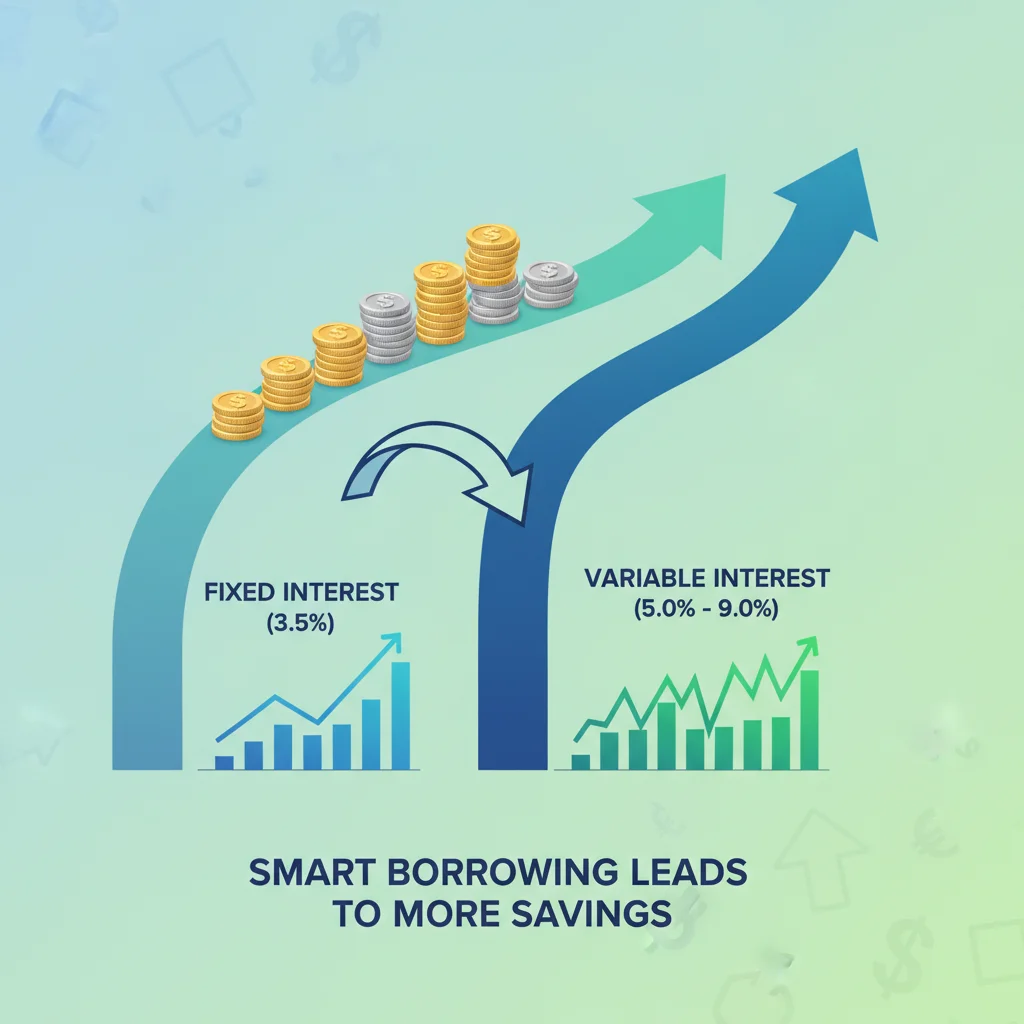
The good news is that these two goals aren't always in direct conflict. There's a specific scenario where refinancing can simultaneously lower your monthly payment and reduce your total interest: when you secure a meaningfully lower rate without changing the term.
If your original loan carried a 9% APR — common for borrowers with fair credit or those who financed through a dealership — and you can now qualify for 6% after improving your credit, refinancing at the same remaining term length produces both wins. Your monthly payment drops because less of each dollar goes to interest. Your total interest drops for the same reason.
The Rate-Only Refinance: A Hidden Middle Ground
Many borrowers assume refinancing must involve choosing between a shorter or longer term. But if your goal is simply to lower your rate, you can refinance into a new loan that mirrors your remaining term — neither extending nor shortening it. This approach can reduce both your monthly payment and your total interest simultaneously, though the savings may be smaller than a term change would produce. Ask lenders specifically for a quote that matches your remaining months — not their standard 48- or 60-month products.
This is why it's worth checking your rate options before assuming you have to choose between the two goals. If you can lower your rate enough, the term decision becomes about optimizing rather than compromising. If the rate reduction is modest — say, 0.5% — you'll likely need to make a deliberate choice between monthly affordability and lifetime savings.
To determine whether any specific refinance scenario actually saves you money after accounting for fees and prepayment penalties, the next step is calculating your break-even point. Our guide on calculating your refinance break-even point walks you through that process precisely. A refinance that looks good on monthly payment terms can still be a net loss if fees are high and you sell the car in 18 months.
How to Decide Which Goal Should Drive Your Refinance
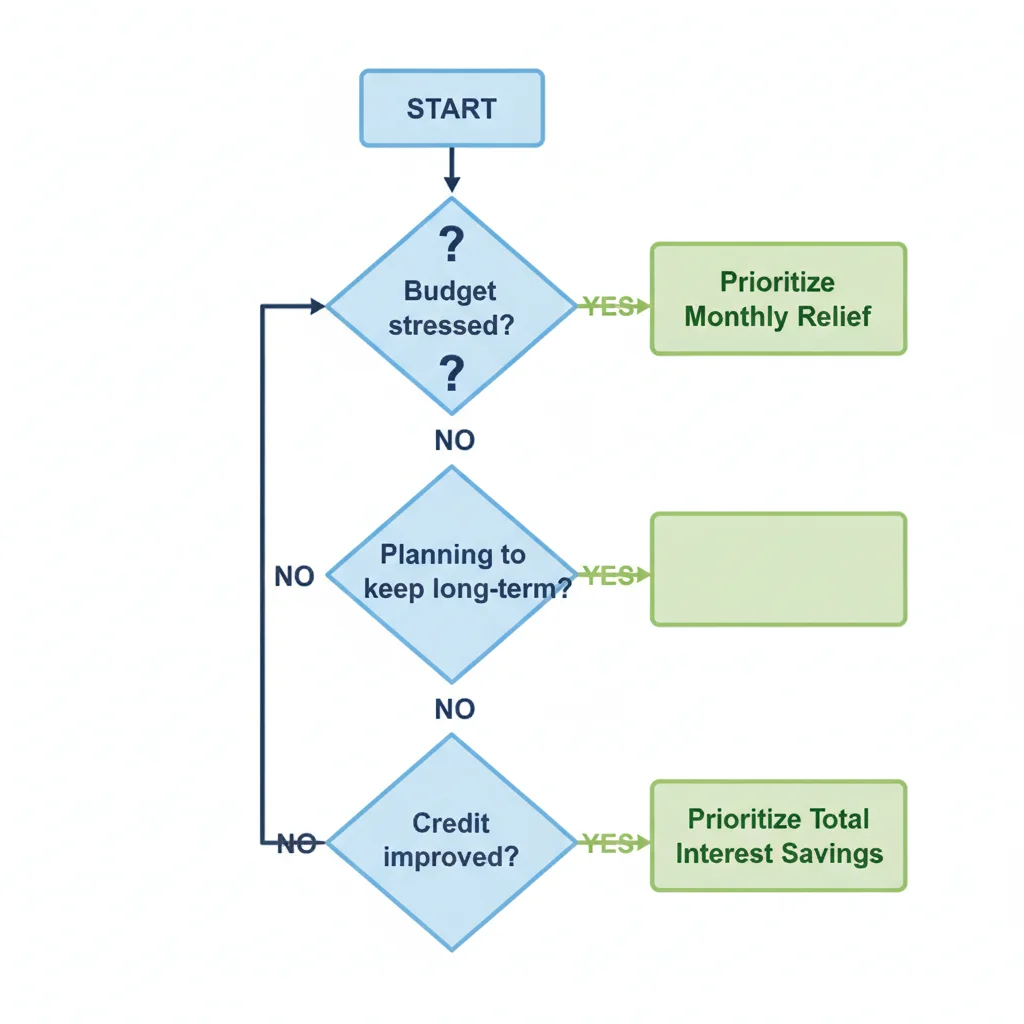
Neither goal is inherently better. The right priority depends on where you are financially right now and what you're trying to accomplish over the next few years. Here's a framework for thinking it through.
Ask yourself: What is my biggest pain point today?
If the answer is I'm struggling to make payments, monthly relief is the right focus. Prioritizing lifetime interest savings when you're at risk of missing payments is backwards — late fees, credit damage, and potential repossession cost far more than a few hundred dollars in extra interest.
If the answer is my payments are fine but I feel like I'm paying too much for this car overall, total interest reduction is the right focus. You're in a position to optimize rather than stabilize.
Consider your planning horizon
How long do you intend to keep this vehicle? If you plan to sell or trade in within two years, the lifetime interest argument weakens — you won't be in the loan long enough for the math to fully play out. If you're planning to drive the car until it's paid off, every dollar of interest you eliminate is a real dollar saved.
This is also where the short-term vs. long-term refinancing comparison becomes directly relevant. The new loan length you choose should reflect how long you actually intend to keep the vehicle — not just which monthly payment feels manageable.
Factor in alternatives to refinancing
If you want to reduce total interest without increasing your monthly payment, refinancing isn't your only option. Making biweekly payments instead of monthly payments is a low-friction way to shorten your effective loan duration without changing the loan itself. Biweekly vs. monthly auto loan payments covers exactly how much this approach saves across different loan types. Similarly, accelerated payoff vs. refinancing compares both strategies side by side.
For foundational context on how loan terms and monthly payments interact before you apply any of this to your own situation, the Loan Terms Explained hub is a useful reference. And if you want to understand how APR factors into total cost calculations, the Interest & APR hub covers the mechanics clearly.
Finally, it's worth reading why a lower monthly payment can cost you more in the end if you're tempted to judge a refinance offer purely by what it does to your statement each month. The monthly number is real — but it's only part of the picture.
Running the Numbers Before You Commit
No matter which goal you're pursuing, the decision should be driven by actual calculations — not instinct or the lender's pitch. Here's a simple process to evaluate any refinancing offer clearly.
- Find your current total remaining cost. Multiply your current monthly payment by the number of months left. That's the maximum you'll pay if you do nothing.
- Calculate the new total cost. Multiply the proposed new monthly payment by the new number of months. Add any origination fees or prepayment penalties from your current loan.
- Compare the two numbers. If the new total is lower, you're reducing lifetime cost regardless of what happens to the monthly payment. If it's higher, you're trading future dollars for present relief.
- Check your equity position. Look up your car's current market value (Kelley Blue Book or Edmunds are reliable). If your loan balance exceeds that value, be cautious about extending the term — you'd be compounding the negative equity problem.
- Calculate the break-even timeline. If there are any fees involved, divide the total fees by your monthly savings to determine how many months it takes to break even. If you're not planning to keep the loan that long, the refinance may not pay off.
This process takes about 20 minutes and a basic calculator, but it changes the refinancing conversation completely. Instead of asking is this payment lower? you're asking does this loan serve my financial goals? — which is the right question.
The trade-off between monthly payment relief and lifetime interest savings is real and unavoidable in most refinancing scenarios. But once you understand the mechanics, you can navigate it deliberately rather than reacting to whatever monthly number a lender puts in front of you.

All claims are backed by peer-reviewed research. Sources on request.