Key Takeaways
Our Verdict
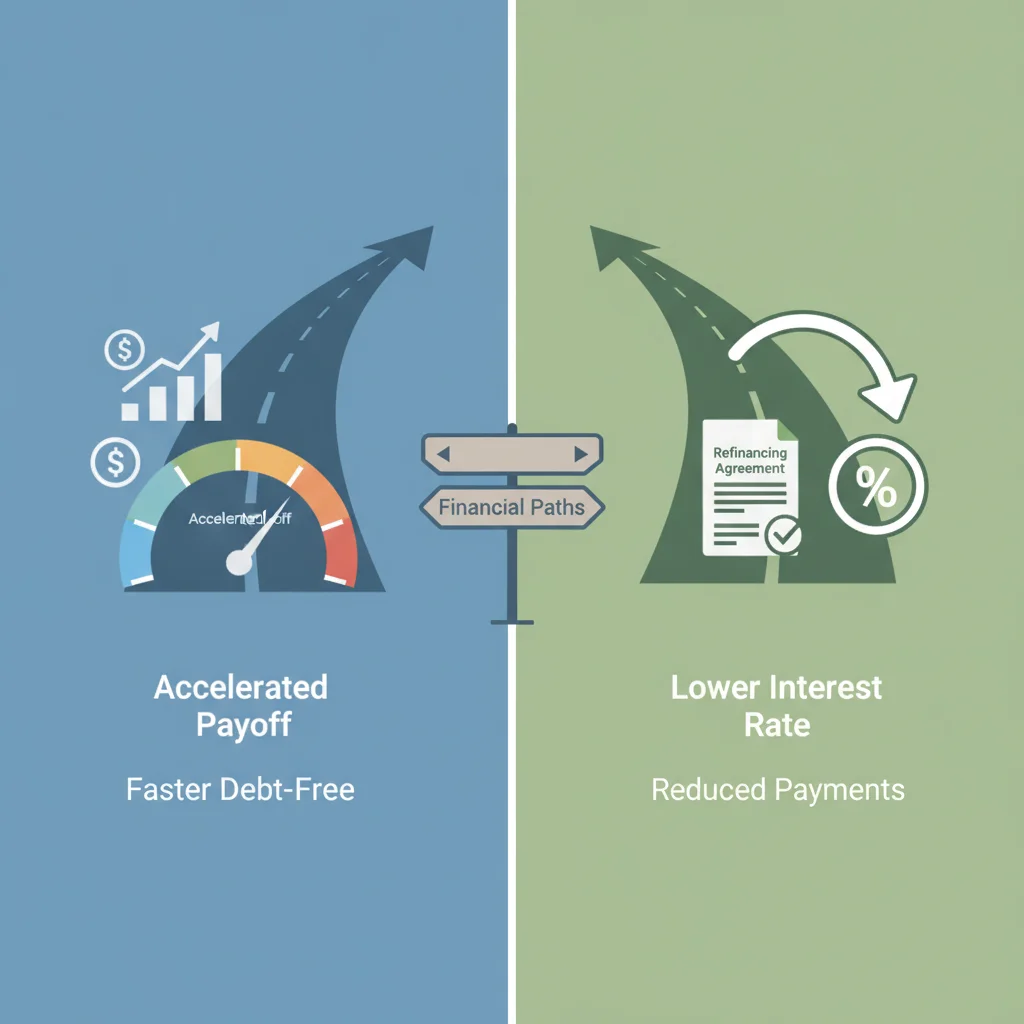
Accelerated payoff and refinancing both cut auto loan interest, but through different mechanisms. Refinancing works best when you can secure a meaningfully lower rate early in your loan — it reduces the cost of every remaining payment. Accelerated payoff works best when your rate is already competitive or you simply have extra cash you can direct at the principal. Many borrowers get the biggest win by combining both: refinancing first, then attacking the new balance with extra payments.
| Best for | Recommended |
|---|---|
| Borrowers who qualified for a high rate but now have improved credit | Refinancing |
| Those with competitive rates who want a simple, no-application payoff strategy | Accelerated Payoff |
| Borrowers early in a long loan term seeking maximum total savings | Refinancing first, then Accelerated Payoff |
| Those in the final 12–18 months of repayment | Accelerated Payoff |
How Each Strategy Attacks Loan Interest
Auto loan interest is calculated on your outstanding principal balance. Every dollar you owe today generates interest tomorrow. That single mechanic is why both accelerated payoff and refinancing work — they just attack it from different angles.
Accelerated payoff shrinks the balance faster than your amortization schedule requires. When you pay extra each month — or make a lump-sum principal payment — you reduce the base on which interest accrues immediately. The loan's interest rate doesn't change, but the balance it applies to shrinks sooner. The result is fewer total interest dollars and a shorter payoff timeline.
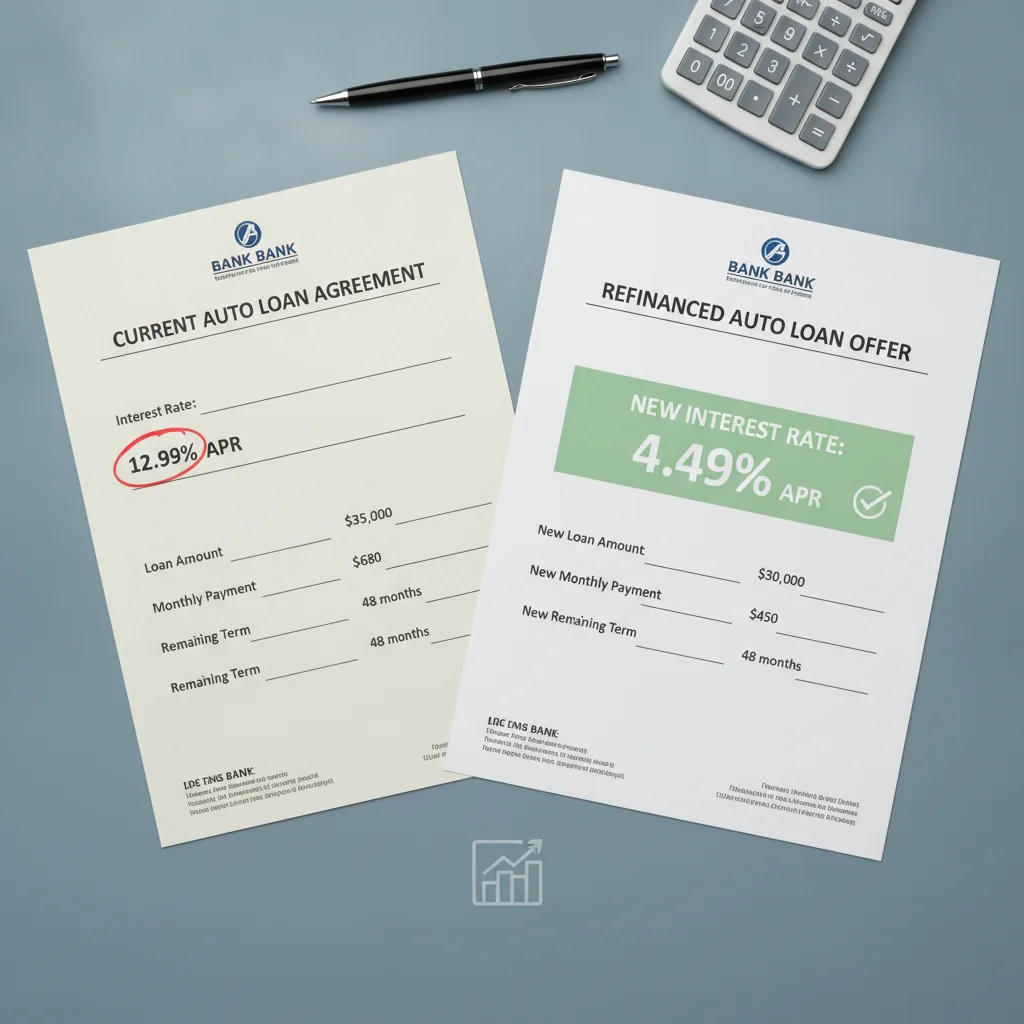
Refinancing swaps your existing loan for a new one at a lower interest rate. Your principal balance doesn't change at signing, but from that point forward, a smaller percentage of each payment goes toward interest. If you keep the same remaining term, you pay less per month and significantly less in total interest over the life of the loan.
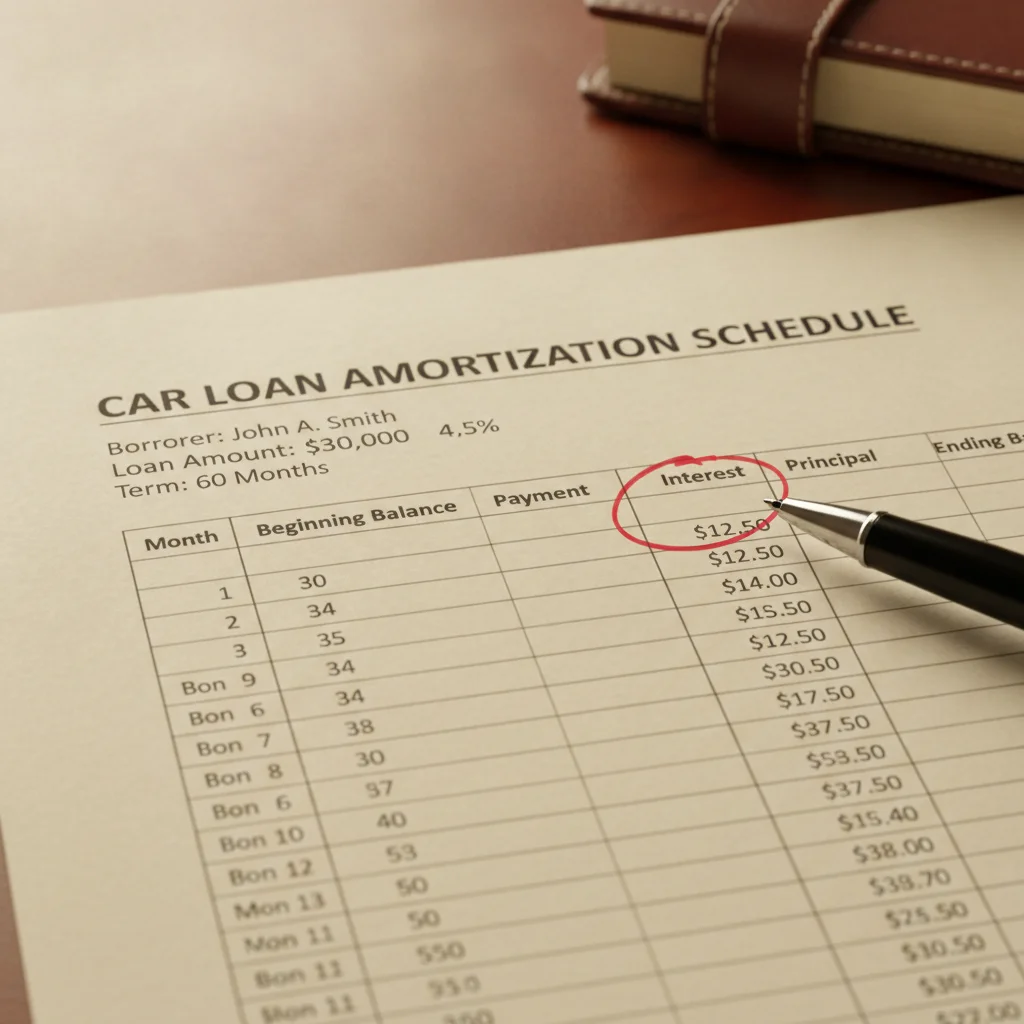
To understand why timing matters so much, you need to grasp how auto loan amortization front-loads interest. In the early months of a loan, the majority of each payment is interest. As the balance falls, that ratio gradually shifts toward principal. This is why acting early — whether refinancing or paying ahead — produces the most savings. Understanding how APR shapes every payment is the foundation you need before choosing between these two strategies.
The Numbers Side by Side
Let's make this concrete. Suppose you have a $22,000 auto loan at 8.5% APR with 48 months remaining. Here's how each strategy changes your outcome.
Scenario A — No change: You pay the standard monthly payment of approximately $543. Over 48 months, you pay roughly $4,064 in total interest.
Scenario B — Accelerated payoff (extra $150/month): You add $150 to each payment, bringing your monthly outlay to $693. This cuts the payoff to about 37 months and reduces total interest to approximately $3,130 — a savings of roughly $934. You also own the car free and clear 11 months sooner.
Scenario C — Refinance to 5.5% APR, same term: Your monthly payment drops to about $512, and total interest over 48 months falls to roughly $2,576 — a savings of about $1,488 without paying a dollar extra each month.
Scenario D — Refinance to 5.5%, then add $150/month: Monthly payment of $662, payoff in roughly 38 months, total interest of approximately $1,980. This combination saves over $2,000 compared to doing nothing.
These figures illustrate a consistent pattern: refinancing delivers larger absolute savings at the same payment level, but accelerated payoff can close the gap if the rate difference is small. Even a 1% rate reduction compounds into real money across different loan balances — the math is often more significant than borrowers expect.
| Accelerated Payoff | Refinancing | |
|---|---|---|
| How it works | Extra payments reduce principal faster | New loan replaces old at lower rate |
| Application required | No | Yes — credit check and lender approval |
| Upfront costs | None (check for prepayment penalties) | Possible fees and title costs |
| Best timing | Any point in loan; later terms acceptable | Early in loan; 30+ months remaining |
| Credit score impact | None | Hard inquiry; new account lowers average age |
| Monthly cash flow | Increases (you're paying more) | Can decrease if rate drops significantly |
| Savings source | Shorter interest accrual period | Lower rate on every remaining payment |
| Complexity | Low — just pay more | Moderate — shop lenders, compare offers |
~$1,488
Saved by refinancing 8.5% to 5.5% APR
Based on a $22,000 loan with 48 months remaining, keeping the same term and standard payments.
$934
Saved by paying $150 extra monthly
Same $22,000 loan at 8.5% APR — extra payments reduce term by 11 months and cut total interest paid.
>$2,000
Combined strategy interest savings
Refinancing to 5.5% APR and adding $150 per month saves over $2,000 compared to standard repayment.
60–80%
Of early payment goes to interest
In the first few months of a typical auto loan, the majority of each payment covers interest, not principal.
When Accelerated Payoff Makes More Sense
Accelerated payoff is the simpler tool — no credit check, no application, no closing fees, no new loan contract. You just instruct your lender to apply extra payments to principal and keep paying more than you owe. That simplicity is a real advantage in several situations.
You already have a competitive rate
If you locked in a low rate — say, 3% to 5% — refinancing is unlikely to produce meaningful savings because there's little room to improve. In that case, directing extra cash toward the principal is the most efficient use of those dollars. Compare the guaranteed return of eliminating 4% interest against any other use of the money.
You're carrying a short remaining term
Refinancing in the final stretch of repayment rarely saves money. By that point, amortization has already extracted most of the interest. A new loan would restart the interest-heavy early months of a fresh amortization schedule. Accelerated payoff lets you escape the debt faster without that drawback.
You have periodic windfalls
Tax refunds, bonuses, or gifts can be applied as lump-sum principal payments with no friction. Applying a tax refund strategically to your car loan can meaningfully cut your remaining interest without disrupting your monthly budget. See also how lump-sum payoffs compare to extra monthly payments in terms of interest savings.
Check for Prepayment Penalties First
Before making a single extra payment, read your loan agreement carefully for prepayment penalty language. Some contracts — especially those with Rule of 78s interest calculations — charge you for paying off early in a way that can eliminate or reverse your interest savings. If you're unsure what the contract says, call your lender directly and ask. Get the answer in writing.
Your credit won't qualify for a better rate
Refinancing saves money only if you can obtain a rate lower than what you currently carry. If your credit score has dropped or your debt-to-income ratio is unfavorable, a new loan might carry a higher rate than your existing one. In that case, accelerated payoff is not just preferred — it's the only strategy that helps.

When Refinancing Makes More Sense
Refinancing earns its place when the rate difference is substantial enough to overcome the transaction costs and you still have enough repayment time left to benefit from the lower rate.
Your credit score has improved significantly
If you financed with subprime credit at, say, 12% APR and your score has since risen by 80 or more points, you may now qualify for rates in the 5%–7% range. That gap is large enough to generate thousands of dollars in savings. The trigger for refinancing matters — a personal credit improvement and a market rate drop both justify the process, but through different logic.
Market rates have dropped materially since you borrowed
Auto loan rates move with broader credit market conditions. If rates have fallen significantly since your origination date, your existing loan may be priced above the current market. Refinancing to lower your APR makes sense whenever the rate improvement, net of fees, produces a genuine positive break-even within your remaining term.
You're still early in a long loan term
Refinancing pays off most when done early. If you have 36 or more months remaining, even a modest rate reduction has significant time to compound into savings. The longer the remaining term, the more each payment benefits from the lower rate.
You need monthly payment relief
Accelerated payoff increases your monthly outlay. Refinancing — especially to a lower rate with the same or slightly longer term — reduces it. If cash flow is tight but you want to reduce total interest, refinancing is the lever that does both simultaneously. Just be careful about the trade-off between lowering your payment and reducing total interest — extending your term while lowering the rate doesn't always result in less interest paid overall.
Always Specify 'Apply to Principal'
When making extra payments, explicitly tell your lender — in writing or through your online account settings — to apply the additional amount to your principal balance, not your next scheduled payment. Many servicers default to advancing your due date instead, which doesn't reduce interest the same way. Confirm this setting each time you send an extra payment.
Shop at Least Three Lenders Before Refinancing
Rate shopping for auto loan refinancing is low-risk when lenders use soft credit pulls for pre-qualification. Even if you receive a hard inquiry at formal application, multiple inquiries within a 14–45 day window are typically treated as a single inquiry by credit scoring models. Get quotes from your bank, a credit union, and an online lender to ensure you're seeing the real market.
Model the Full Payoff Timeline Before Deciding
Use a free auto loan payoff calculator to model all four scenarios: standard payoff, accelerated payoff, refinanced at lower rate, and refinanced plus accelerated. Seeing the exact dollar difference in total interest — not just the monthly payment — often makes the right choice obvious. Many banks and credit unions offer these tools at no cost on their websites.
Hidden Costs That Can Undercut Either Strategy
Neither strategy is cost-free in every situation. Before you commit, you need to check for two specific contract features that can significantly reduce — or eliminate — your projected savings.
Prepayment penalties on your current loan
Some auto loans, particularly those originated through dealership financing, include prepayment penalty clauses. These charge you a fee — sometimes a percentage of the outstanding balance — for paying off the loan ahead of schedule. Prepayment penalties can neutralize refinancing savings entirely. They also eat into the benefit of accelerated payoff. Pull out your original loan agreement and look for terms like "prepayment fee," "early termination charge," or "Rule of 78s" — that last one is a particularly borrower-unfavorable interest calculation method. For a detailed walkthrough of problematic loan structures, see signs your auto loan terms make early payoff less worthwhile.
Refinancing fees and origination costs
A new loan isn't free. Depending on the lender, you may face application fees, title transfer costs, or origination charges. These need to be factored into your break-even calculation. Calculating your refinance break-even point accounts for all upfront costs — divide the total fees by your monthly savings to determine how many months you need before the refinance starts generating a net positive.
The amortization reset problem
When you refinance, you often restart the clock on a new amortization schedule. Even at a lower rate, the early months of the new loan are more interest-heavy than the later months of your old loan would have been. If you're 36 months into a 60-month loan, refinancing into another 60-month loan extends your total repayment period — potentially costing more in aggregate even with a lower rate. Model the full picture before signing.
Combining Both Strategies: The Strongest Approach
For borrowers who have both the opportunity to refinance and the cash flow to pay extra, the most powerful move is to do both in sequence. Refinance first to lock in the lower rate, then immediately begin accelerating payments on the new loan.
Here's why the sequence matters: refinancing reduces the rate, which means every extra dollar you pay toward principal saves more interest than it would have at the old rate. You're essentially amplifying the benefit of each additional payment. And because you've reset to a lower base payment, your cash flow may even improve slightly, giving you flexibility to redirect funds toward the loan.
If you're looking for structured approaches to extra payment prioritization, debt payoff methods like the avalanche approach can be applied to your auto loan — particularly useful if you're juggling multiple debts and need a framework for allocating extra cash. You can also explore practical ways to free up cash for faster payoff if your budget feels stretched but you want to accelerate.
Always Specify 'Apply to Principal'
When making extra payments, explicitly tell your lender — in writing or through your online account settings — to apply the additional amount to your principal balance, not your next scheduled payment. Many servicers default to advancing your due date instead, which doesn't reduce interest the same way. Confirm this setting each time you send an extra payment.
Shop at Least Three Lenders Before Refinancing
Rate shopping for auto loan refinancing is low-risk when lenders use soft credit pulls for pre-qualification. Even if you receive a hard inquiry at formal application, multiple inquiries within a 14–45 day window are typically treated as a single inquiry by credit scoring models. Get quotes from your bank, a credit union, and an online lender to ensure you're seeing the real market.
Model the Full Payoff Timeline Before Deciding
Use a free auto loan payoff calculator to model all four scenarios: standard payoff, accelerated payoff, refinanced at lower rate, and refinanced plus accelerated. Seeing the exact dollar difference in total interest — not just the monthly payment — often makes the right choice obvious. Many banks and credit unions offer these tools at no cost on their websites.
One important note: if your refinanced loan has any prepayment penalty provisions — which is rare but not impossible with certain lenders — confirm those terms before you begin accelerating. The strategy only works cleanly when extra principal payments apply without penalty.
It's also worth evaluating whether paying off your car early is always the optimal use of extra cash. Comparing early payoff to investing the extra money depends heavily on your auto loan rate — if it's below 5%, putting excess funds into an index fund may outperform eliminating the debt.
A Decision Framework: Which Path Is Right for You?
Use the following criteria to determine your starting point. These aren't rigid rules — they're the most relevant variables in real borrower situations.
- What is your current APR? If it's above 7%, refinancing deserves serious consideration. If it's below 5%, accelerated payoff is likely more practical.
- How many months remain on your loan? More than 30 months remaining? Refinancing has time to generate meaningful savings. Fewer than 18 months? Stick with accelerated payoff.
- Has your credit score improved by 60+ points since origination? If yes, check current rate offers from at least three lenders — you may qualify for a materially better rate.
- Do you have extra cash flow or windfalls available? If yes, accelerated payoff is available to you regardless of creditworthiness. High-interest loan holders benefit most from aggressive payoff when refinancing isn't an option.
- Does your loan have prepayment penalties? Read the original contract. If yes, factor that cost into any early payoff or refinancing calculation before proceeding.
- What does your break-even timeline look like? If refinancing fees take 24 months to recover but you only have 28 months left, the math barely works. Be precise.
For most borrowers carrying above-market rates with solid remaining terms, refinancing is the higher-leverage first move. For borrowers who already have reasonable rates or limited remaining terms, consistent extra principal payments are the more direct route. And for those with the means to do both — the combined approach almost always wins.
Always Specify 'Apply to Principal'
When making extra payments, explicitly tell your lender — in writing or through your online account settings — to apply the additional amount to your principal balance, not your next scheduled payment. Many servicers default to advancing your due date instead, which doesn't reduce interest the same way. Confirm this setting each time you send an extra payment.
Shop at Least Three Lenders Before Refinancing
Rate shopping for auto loan refinancing is low-risk when lenders use soft credit pulls for pre-qualification. Even if you receive a hard inquiry at formal application, multiple inquiries within a 14–45 day window are typically treated as a single inquiry by credit scoring models. Get quotes from your bank, a credit union, and an online lender to ensure you're seeing the real market.
Model the Full Payoff Timeline Before Deciding
Use a free auto loan payoff calculator to model all four scenarios: standard payoff, accelerated payoff, refinanced at lower rate, and refinanced plus accelerated. Seeing the exact dollar difference in total interest — not just the monthly payment — often makes the right choice obvious. Many banks and credit unions offer these tools at no cost on their websites.
Explore the full hub on when to refinance for deeper guidance on identifying the right moment to act on your specific loan situation.

All claims are backed by peer-reviewed research. Sources on request.