
Key Takeaways
Why the Break-Even Point Is the Only Number That Really Matters
Most refinancing conversations start and end with the monthly payment. A lender shows you that you could drop from $520 to $440 a month, and that $80 difference feels like an obvious win. But that monthly savings number tells you almost nothing on its own — not until you compare it against what refinancing actually costs you to execute.
The break-even point is the moment in time when your accumulated monthly savings finally cancel out every dollar you spent to refinance. Before that point, you are technically losing money. After it, every month puts real savings in your pocket. The calculation is straightforward, but most borrowers never do it — and that omission is exactly how refinancing turns into a money-losing move.
Understanding how interest rates and APR affect your loan's true cost is the foundation for this analysis. Once you know how your current loan is structured, you can accurately measure what a new one will actually deliver.

This guide walks you through each component of the break-even calculation — fees, prepayment penalties, monthly savings, and loan term effects — so you can make a decision grounded in your specific numbers rather than a lender's pitch.
What You Need Before You Start
Accurate inputs are everything. The break-even calculation is only as reliable as the figures you feed into it. Before you sit down to run the math, pull together the following from your current loan agreement and any refinance offers you have received.
What you will need
Loan amortization calculator
Calculates your new monthly payment and generates a full payment schedule showing principal vs. interest each month.
Current loan payoff quote
Provides the exact dollar amount needed to pay off your existing loan, which becomes the principal on the new loan.
Original loan contract
Contains prepayment penalty clauses and other terms that affect the true cost of exiting your current loan early.
Spreadsheet application (Excel or Google Sheets)
Lets you model multiple refinancing scenarios side by side and recalculate quickly when variables change.
Lender fee disclosure document
Lists all fees the new lender will charge, ensuring your total refinancing cost calculation is complete and accurate.
If you do not have a current payoff quote from your existing lender, call and request one. This is different from your remaining balance — a payoff quote accounts for interest accrued through a specific date, and it is the number a new lender will actually use to pay off your loan. Most lenders provide this within one business day, either by phone or through your online account portal.
Verbal Fee Estimates Are Not Binding
A lender's loan officer may quote you a low or zero origination fee over the phone, but fees can appear in the formal loan documents that you sign at closing. Always request a written Loan Estimate or fee disclosure before proceeding. Compare this document line by line against what you were told verbally.
Refinancing Resets Your Loan's Amortization Schedule
Auto loans front-load interest, meaning you pay more interest in the early months than toward the end. When you refinance, you restart this schedule. If you are already well into your current loan term, a significant portion of your remaining payments go toward principal — refinancing can shift that balance back toward interest, especially on a longer new term.
Step-by-Step: Calculating Your Break-Even Timeline
Follow these steps in order. Each one builds on the previous, and skipping ahead is where errors creep in. Work through all of them even if an early result looks promising — the full picture often changes the conclusion.
Add Up Every Cost of Refinancing
Refinancing is not free. Before calculating any savings, you need an accurate total of what the transaction will cost you. These costs typically include:
- Origination or application fees charged by the new lender — usually $100 to $400
- Title transfer fees required by your state DMV when the lienholder changes
- Prepayment penalties on your current loan, if your original agreement includes them
- Gap insurance cancellation and repurchase if you carry gap coverage (your current policy may not transfer)
Add all of these together to get your total refinancing cost (TRC). Write this number down — it is the ceiling your savings must clear before refinancing delivers any real value.
Calculate Your New Monthly Payment
Use the refinance offer's quoted rate, your current payoff balance, and the proposed new term to calculate exactly what your new monthly payment will be. Do not rely on the lender's verbal estimate — use a loan amortization calculator yourself.
The formula for a monthly payment is:
M = P × [r(1+r)^n] / [(1+r)^n − 1]
Where P is the loan principal (your payoff balance), r is the monthly interest rate (annual rate ÷ 12), and n is the number of monthly payments.
Free online amortization calculators handle this arithmetic instantly. Input the payoff balance — not your original loan amount — as the principal. Using the original loan amount will produce an inflated payment estimate.
Find Your Monthly Savings
Subtract your new monthly payment from your current monthly payment:
Monthly Savings = Current Payment − New Payment
This is a straightforward subtraction, but confirm you are using your actual current payment — the full amount including any fees rolled into the payment — not just the principal-and-interest portion.
If your new payment is higher than your current one (which can happen when refinancing into a shorter term to save interest), the monthly savings figure will be negative. That does not mean refinancing is wrong — it means your benefit comes entirely from total interest reduction, not payment reduction. You would skip the break-even timeline calculation in that case and focus solely on the total interest comparison in Step 5.
Divide Total Refinancing Cost by Monthly Savings
This is the core break-even formula:
Break-Even Point (months) = Total Refinancing Cost ÷ Monthly Savings
The result tells you how many months you must hold the refinanced loan before your accumulated savings equal what you spent to refinance. Round up to the nearest whole month — that is your break-even month.
Example: If your total refinancing cost is $380 and your monthly savings is $62, your break-even point is $380 ÷ $62 = 6.1 months, rounded up to month 7.
Now compare this number against two things: (1) how many months remain on your loan, and (2) how long you realistically plan to keep the car. If either number is less than your break-even point, refinancing costs you money on net.
Compare Total Interest Paid on Both Loans
The break-even timeline tells you when you stop losing money. The total interest comparison tells you how much you ultimately gain — or lose — over the full life of both loans. This step is especially important if the new loan has a different term than your remaining payoff period.
Calculate total interest remaining on your current loan:
Current Remaining Interest = (Current Payment × Remaining Months) − Payoff Balance
Then calculate total interest on the new loan:
New Loan Total Interest = (New Payment × New Term Months) − Loan Principal
Subtract the new loan's interest from the current loan's remaining interest, then subtract your total refinancing cost:
Net Savings = (Current Remaining Interest − New Loan Interest) − Total Refinancing Cost
A positive result means you come out ahead. A negative result means refinancing costs you more than you save over the full loan life — even if the monthly payment is lower.
How Loan Term Changes Complicate the Math
The break-even calculation above works cleanly when you are refinancing into a loan with the same remaining term — for example, moving from 36 remaining months at 9% to 36 months at 5.5%. But most people refinancing do not keep the same term. They extend it, sometimes significantly, to bring the monthly payment down further.
Extending your term is the single most common way refinancing backfires. You might lower your monthly payment by $120 and not reach your break-even point for 14 months, but then continue paying interest for an additional 24 months beyond your original payoff date. That extension can cost more in total interest than you saved in monthly payments — especially when the rate reduction is modest.

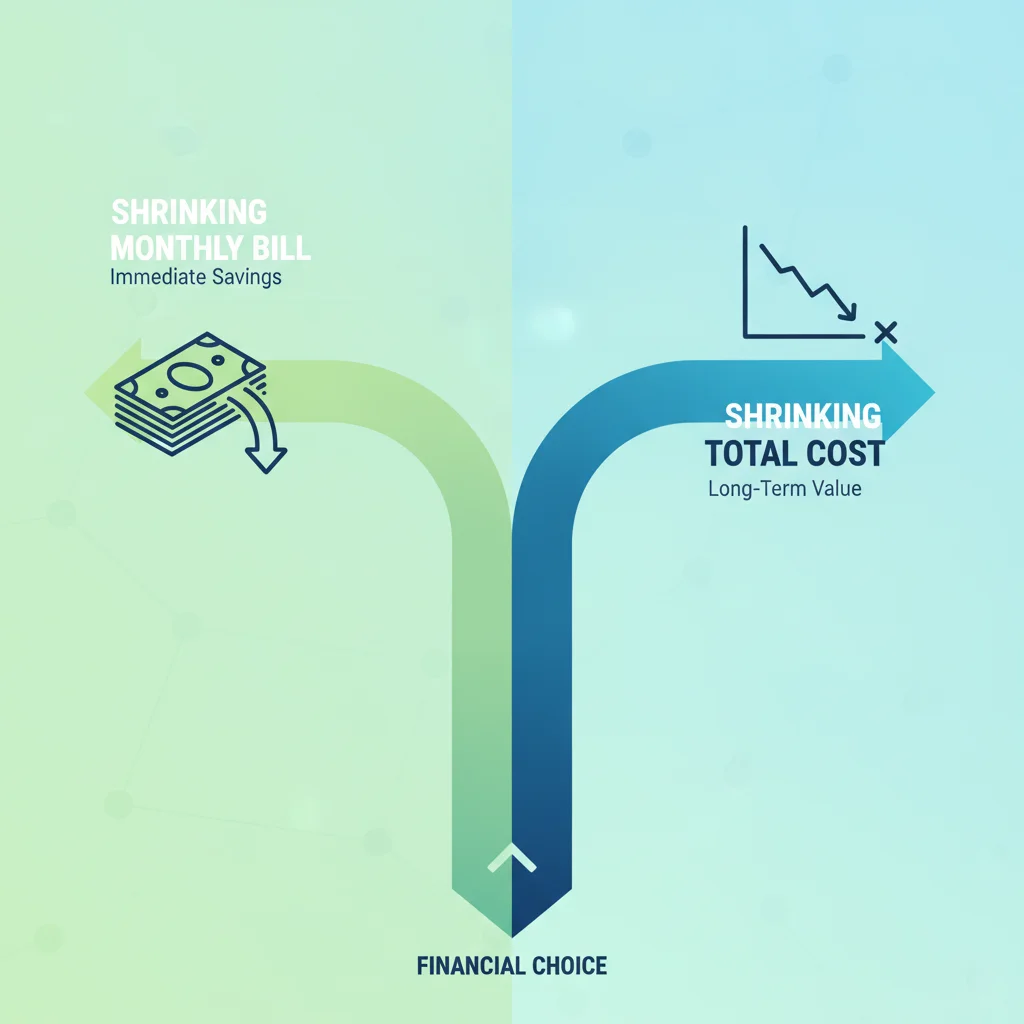
This is the core tension explained in detail in our guide on lowering your monthly payment vs. reducing total interest. As a rule of thumb: if extending the term adds more months of interest than your rate reduction saves, the refinance is a net loss regardless of how appealing the new payment looks.
To account for this, add a second comparison to your break-even worksheet:
- Calculate total interest remaining on your current loan at the current rate over its remaining term.
- Calculate total interest on the new loan at the new rate over the new (longer) term.
- Subtract the second from the first. If the result is positive, the new loan costs less in total interest. If it is negative, you will pay more overall even though your monthly payment is lower.
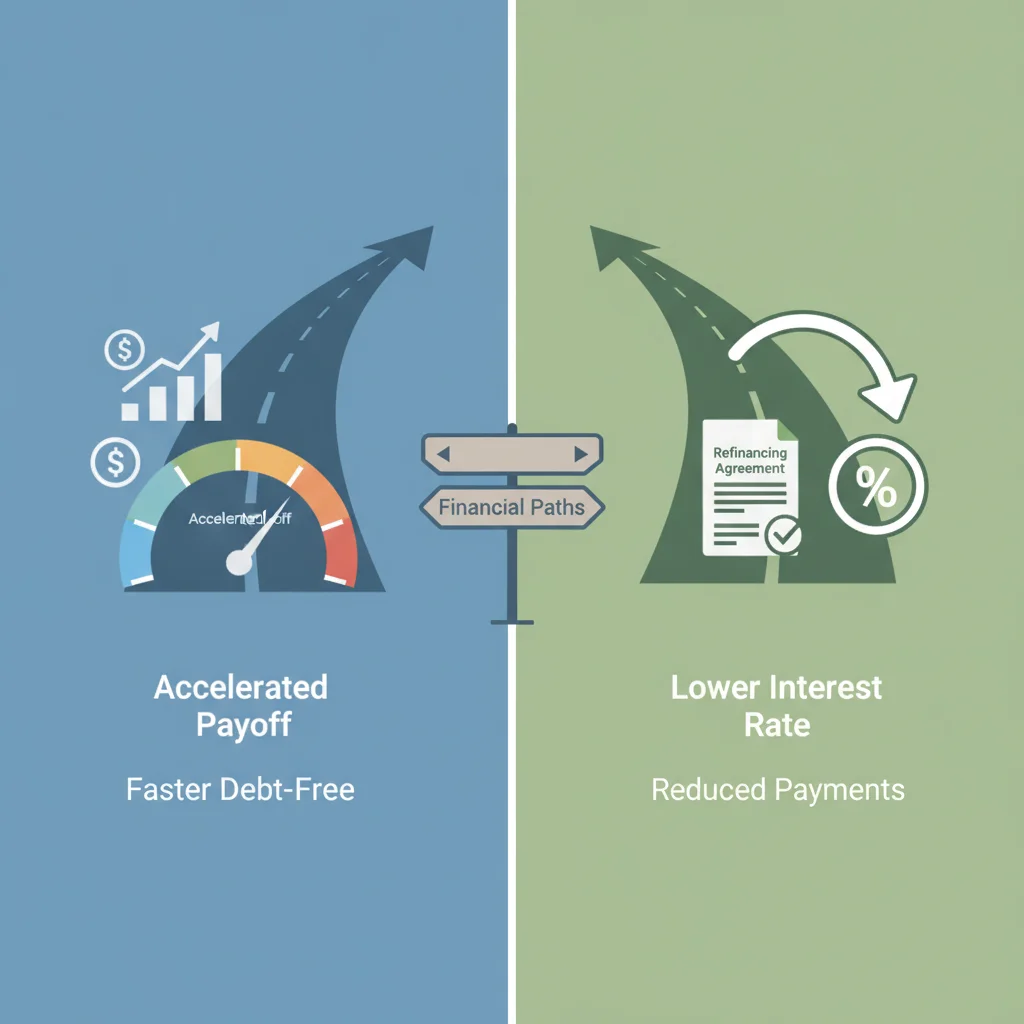
If you want the payment reduction without the interest penalty, consider a middle path: accelerating payoff on your existing loan may deliver comparable or better long-term savings without triggering refinancing fees at all.
Refinance Into the Shortest Term You Can Afford
If you can tolerate a monthly payment that is only slightly lower than your current one, refinancing into a shorter or equal term maximizes your interest savings and keeps your break-even point short. The biggest gains come from rate reduction, not payment reduction. Reserve term extensions for situations where cash flow is genuinely strained.
Get at Least Three Competing Offers
Refinancing fees and rates vary significantly between lenders. Credit unions typically offer lower rates and fewer fees than dealership-affiliated lenders, while online auto refinance lenders often provide the fastest approvals. Collecting three quotes before committing gives you real data to negotiate with and may surface a better fee structure that shortens your break-even point considerably.
When the Numbers Say No — and What to Do Instead
Not every refinance opportunity is worth taking. Here are the most common scenarios where the break-even math reveals that refinancing does not make financial sense — and what to consider in each case.
Your break-even point is beyond your planned ownership period
If you plan to sell or trade in the car in 18 months but your break-even point is month 22, you will exit the loan before recouping your costs. In this case, refinancing costs you money on net. The right move is either to stay on your current loan or to negotiate a fee waiver from a lender to move the break-even point earlier.
A prepayment penalty neutralizes early savings
Some original auto loan contracts include prepayment penalties — fees charged when you pay off the loan early, which is exactly what refinancing does. These can range from a flat fee to a percentage of the remaining balance. Our dedicated guide on how prepayment penalties can kill refinancing savings explains how to locate these clauses and calculate their impact. When a prepayment penalty is large, it can push your break-even point out by a year or more — or make refinancing a losing proposition entirely.
The rate difference is too small
A 0.5% rate reduction on a $12,000 remaining balance saves roughly $30 a month in interest. If refinancing costs you $400 in fees, your break-even point is over 13 months away — and that assumes no term extension and no prepayment penalty. As a general benchmark, you want at least a 1.5 to 2 percentage point rate reduction to make refinancing arithmetic work in your favor on a typical used-car loan balance.
A Low Payment Is Not the Same as Savings
This is the most consequential mistake borrowers make when evaluating a refinance offer. A lender can always lower your monthly payment by extending your term — but that extension often costs you more in total interest than you save from the rate reduction. Always complete the total interest comparison in Step 5 before accepting any offer. The monthly payment figure alone is not sufficient to evaluate a refinancing deal.
When refinancing is not the right move right now, it may become the right move later. If your credit score is still improving, waiting another 6 to 12 months before applying could qualify you for a meaningfully better rate — one that shifts the break-even math in your favor. In the meantime, review common refinancing mistakes to avoid so you are fully prepared when the timing is right.

Putting It All Together: A Real-World Example
Let's walk through a complete example so the process is concrete before you apply it to your own numbers.
The situation: You have 42 months remaining on your current auto loan with a balance of $18,400 at 10.2% APR. Your monthly payment is $530. A credit union has offered you a refinance at 6.4% APR over 42 months. The refinance comes with a $295 origination fee, and your current lender charges a $150 prepayment penalty.
Step 1 — Total refinancing cost
$295 (origination fee) + $150 (prepayment penalty) = $445 total cost to refinance
Step 2 — New monthly payment
Using a loan calculator: $18,400 at 6.4% over 42 months = approximately $474/month
Step 3 — Monthly savings
$530 − $474 = $56/month saved
Step 4 — Break-even point
$445 ÷ $56 = 7.9 months, so you break even at month 8
Step 5 — Total interest comparison
- Current loan: $530 × 42 = $22,260 total payments − $18,400 balance = $3,860 remaining interest
- New loan: $474 × 42 = $19,908 total payments − $18,400 balance = $1,508 total interest
- Interest savings: $3,860 − $1,508 = $2,352
- Net savings after refinancing costs: $2,352 − $445 = $1,907
In this case, the math strongly supports refinancing. The break-even point arrives at month 8, and the borrower saves nearly $1,900 in total interest by the time the loan is paid off — all while keeping the same term length. This is the kind of clear win the break-even framework is designed to surface.
Now change one variable: extend the new loan to 54 months to get the payment down to $385. The monthly savings jump to $145, and the break-even point drops to month 4 — but total payments become $385 × 54 = $20,790, meaning total interest on the new loan is $2,390. The net interest savings shrink to $3,860 − $2,390 − $445 = $1,025, and the borrower pays for an extra 12 months. Extending the term cost this borrower nearly $900 in potential savings.

Run both versions of this comparison every time you evaluate a refinance offer. The same lender rate can produce very different outcomes depending on how the term is structured.

All claims are backed by peer-reviewed research. Sources on request.