Key Takeaways
Option A
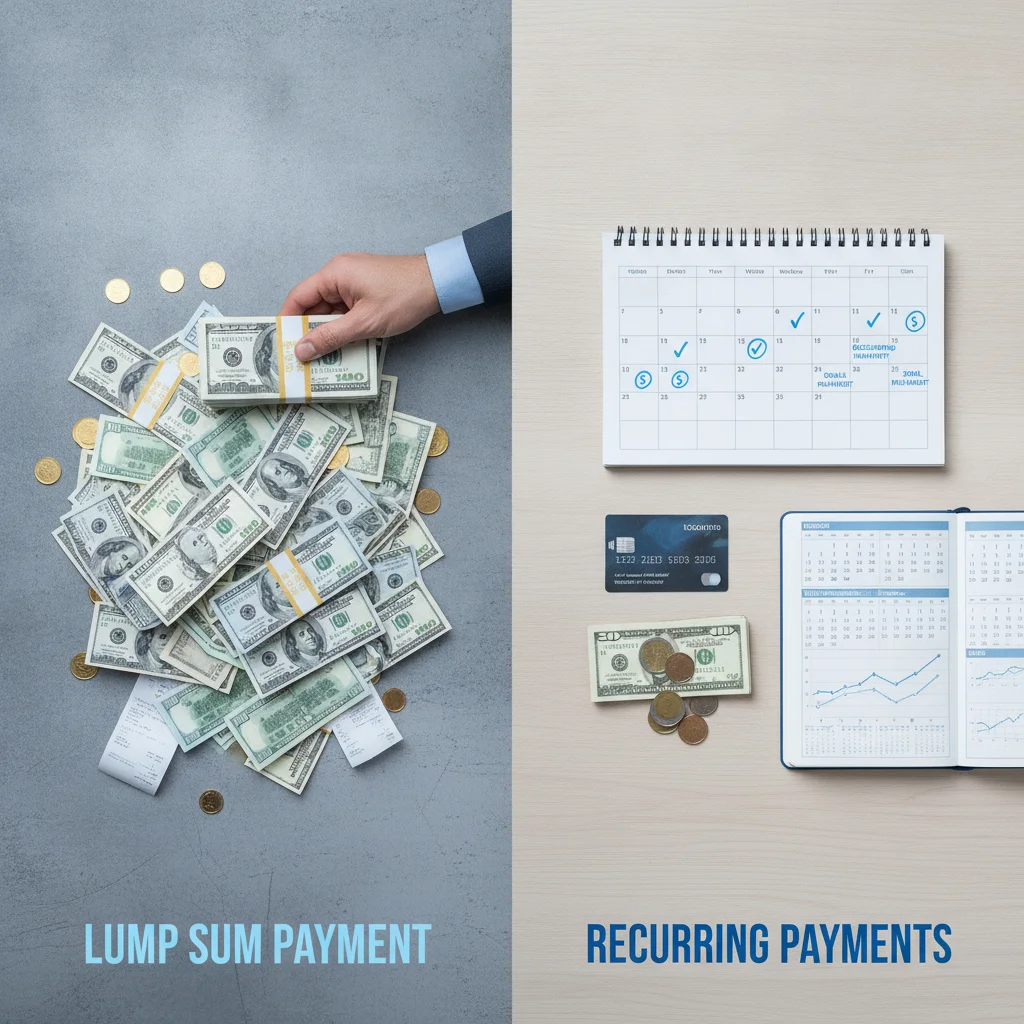
Lump-Sum Payoff
The decisive, one-time interest eliminator.
Best for: Borrowers who receive a windfall, bonus, or tax refund and want to eliminate their loan balance — and all remaining interest — in a single move.
Option B
Extra Monthly Payments
The disciplined, incremental approach to early payoff.
Best for: Borrowers who want to reduce interest steadily over time without depleting savings, by consistently adding extra money to each scheduled payment.
If you have a windfall and want the maximum one-time interest reduction
Lump-Sum Payoff
Applying a large sum directly to principal early in the loan collapses the balance that daily interest accrues on, cutting total interest cost dramatically.
If you want to reduce interest without draining your savings
Extra Monthly Payments
Adding a fixed amount to each payment — even $50 or $100 — steadily shortens your loan term and reduces interest without exposing you to a liquidity risk.
If you are early in a high-interest auto loan
Lump-Sum Payoff
Interest is front-loaded on most amortized auto loans, so a lump-sum applied in the first 12 months prevents the most expensive interest from ever accruing.
If your loan is more than halfway paid off
Extra Monthly Payments
Later in the loan term, interest charges are smaller; consistent extra payments still accelerate payoff without the cash-flow disruption of a lump sum.
If you are uncertain whether your loan has prepayment penalties
Extra Monthly Payments
Smaller incremental extra payments typically trigger fewer contractual complications and give you time to verify the terms before committing a large sum.
Why Payoff Strategy Matters More Than Most Borrowers Realize
Most auto loan borrowers focus entirely on the monthly payment when they sign. The total interest cost — which can run into the thousands of dollars over a 60- or 72-month term — barely registers. That's understandable. But once you're in repayment, the order and size of your payments become the primary levers for reducing what you ultimately pay.
Two strategies dominate the conversation: applying a single large payment to knock down the balance all at once, or adding a consistent extra amount to each monthly payment to shorten the loan term incrementally. Both approaches work. Both genuinely save interest. But they work through different mechanisms, and the better choice depends on your loan structure, how far into repayment you are, and how much cash you can access without straining your finances.
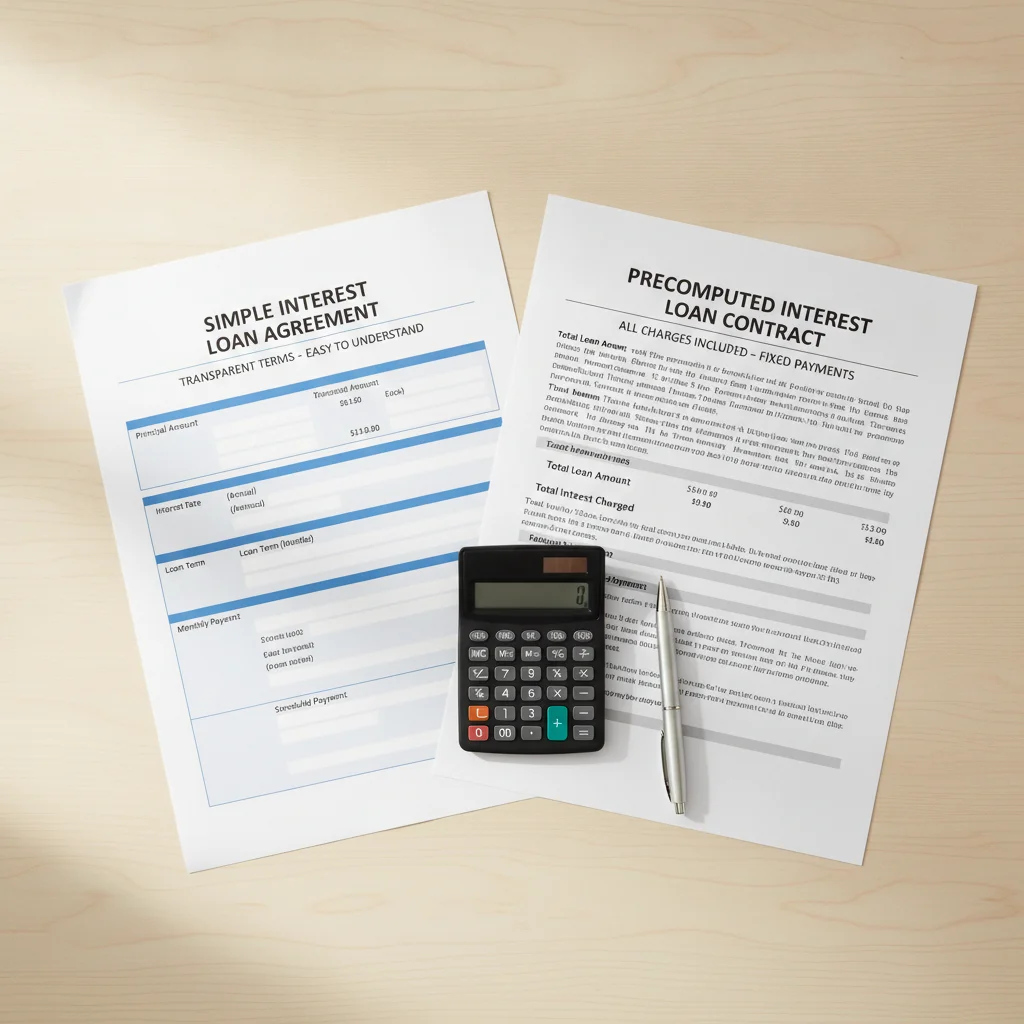
Before diving into the comparison, it's worth establishing one foundational rule: these strategies only deliver full savings on simple interest loans. If your loan uses a precomputed interest structure, your interest is fixed at origination and reducing the principal early may not reduce the total interest at all. See our guide to precomputed vs. simple interest auto loans to identify which structure you have before doing anything else.
Assuming you have a simple interest loan — which is the most common type issued by banks, credit unions, and most captive lenders — let's break down how each strategy actually moves the numbers.
How Simple Interest Amortization Creates the Payoff Opportunity
On a standard amortized auto loan, every payment you make is split between interest and principal. In the early months, a disproportionately large share goes to interest. As the principal balance falls, interest charges shrink, and more of each payment chips away at the balance you actually owe.
This schedule is not arbitrary — it's mathematical. Your lender calculates daily interest by multiplying your outstanding principal by your annual percentage rate divided by 365. Each day that passes, a small interest charge accrues. When your payment arrives, that accrued interest is collected first, and whatever remains reduces the principal.
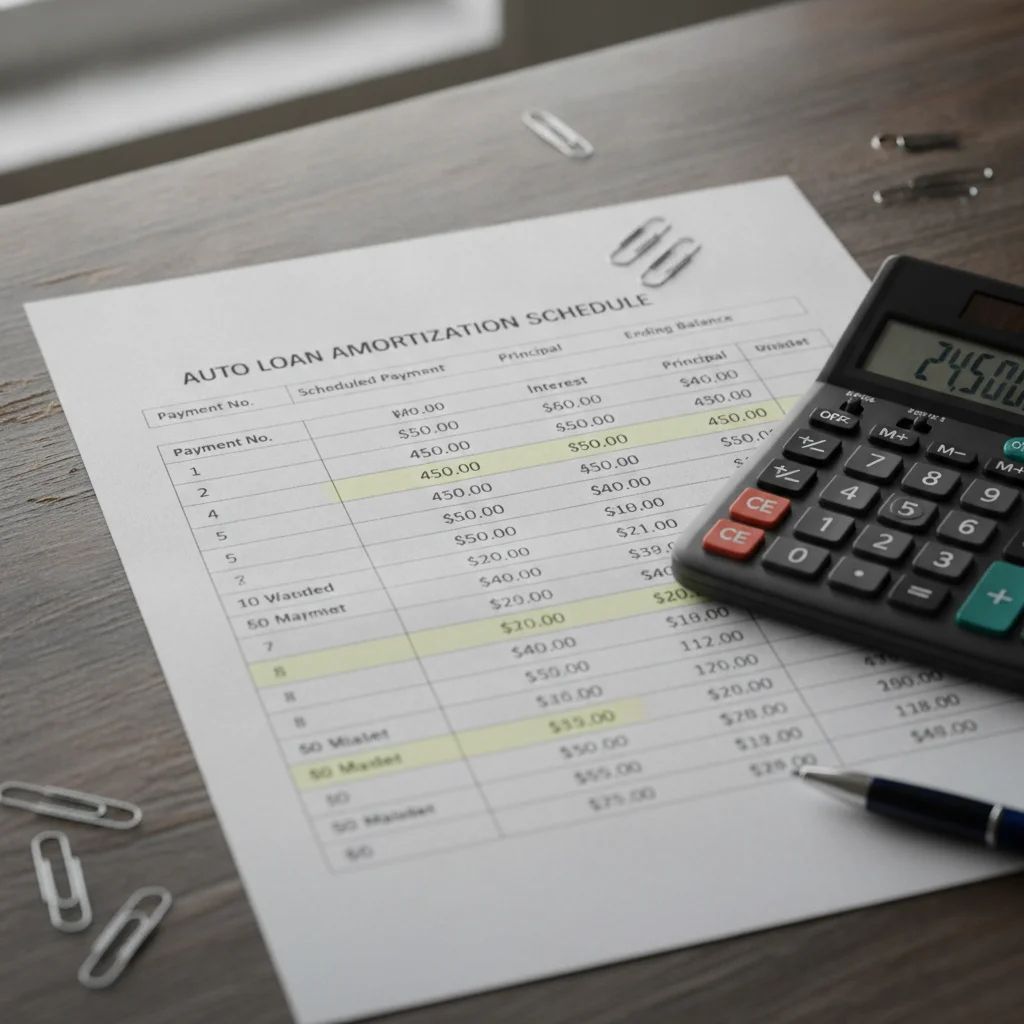
This dynamic is exactly what makes early payoff so powerful: the sooner you reduce the principal, the fewer days that principal has to generate interest. A $2,000 payment applied in month three of a 60-month loan saves more interest than the same $2,000 applied in month 40 — because in month three, that balance would have accrued interest for another 57 months. In month 40, only 20 months remain.
This is the core logic you need to evaluate both strategies. The lump sum versus extra payments debate is really a question of: how much principal can I remove, and how early?
For a deeper look at what early payoff does to your total interest obligation, see what happens to your interest when you pay off a car loan early.
| Criterion | Lump-Sum Payoff | Extra Monthly Payments |
|---|---|---|
| Interest savings potential | Highest — especially if applied early | Significant — grows with consistency |
| Cash flow impact | Large one-time outlay | Modest, recurring increase |
| Best timing | As early in the loan as possible | Starting from the first payment |
| Flexibility | Low — funds committed immediately | High — can pause or adjust monthly |
| Savings account risk | Higher — may deplete emergency fund | Lower — preserves liquid savings |
| Prepayment penalty exposure | Higher — large payments may trigger clause | Lower — smaller amounts less likely to trigger |
| Requires lender coordination | Yes — get payoff quote first | Yes — confirm principal-only designation |
| Works on precomputed interest loans | Usually not | Usually not |
| Loan term reduction | Can eliminate loan entirely at once | Gradual — typically 10–24 months shorter |
| Ideal borrower profile | Windfall recipient with stable emergency fund | Budget-conscious borrower with steady income |
The Lump-Sum Payoff: Maximum Impact, Maximum Commitment
A lump-sum payoff means applying a single large payment — enough to either close the loan entirely or substantially reduce the principal — at one point in time. This might come from a tax refund, an inheritance, a year-end bonus, or proceeds from selling another asset.
The Interest Math on a Lump Sum
Consider a $25,000 auto loan at 7% APR with a 60-month term. Your monthly payment is approximately $495. Over the full term, you'd pay roughly $4,700 in total interest. Now assume that in month six, you apply a $10,000 lump sum directly to the principal:
- Your remaining balance drops from approximately $21,400 to $11,400.
- Your remaining interest obligation falls by roughly $2,200.
- Your loan can be paid off approximately 22 months early at the same monthly payment amount.
That's the power of a well-timed lump sum. You're not just making a big payment — you're collapsing the principal that would have been charging interest for nearly two more years.
$4,700+
Total interest on a typical 60-month $25,000 loan at 7% APR
Calculated using standard amortization on a $25,000 balance at 7% APR over 60 months — illustrating how much is at stake before any early payoff strategy is applied.
~$2,200
Interest saved by a $10,000 lump sum applied in month six
Modeled on a $25,000 / 7% APR / 60-month loan; the lump sum reduces the balance by nearly half at a point when over 50 months of interest-generating principal remain.
~$1,400
Interest saved by adding $150/month to the same loan
Consistent extra monthly payments of $150 on the same loan structure shorten the term by roughly 14 months and eliminate approximately $1,400 in total interest charges.
13
Full payments made per year on a biweekly schedule
Biweekly payment plans result in 26 half-payments annually — equivalent to one full extra monthly payment per year — steadily shortening loan terms without requiring a lump sum.
22 months
Early payoff achieved with a $10,000 lump sum in month six
On a $25,000 loan at 7% APR over 60 months, a $10,000 principal-only payment in month six allows the borrower to complete repayment nearly two years ahead of schedule.
The Risks and Limitations of Going All-In
The lump sum strategy has two genuine risks. First, it depletes cash reserves. If you use a $10,000 emergency fund to pay down your car loan, you have no cushion for a job loss, medical bill, or unexpected repair. Financial planners typically recommend maintaining three to six months of expenses in liquid savings before making aggressive loan prepayments. Second, some lenders impose prepayment penalties — fees triggered when you pay off a loan faster than scheduled. These are more common on older loan contracts and some dealer-arranged financing. Always review your loan agreement or call your lender before sending a large extra payment. Our article on signs your auto loan terms make early payoff less worthwhile walks through the red flags to check.
Extra Monthly Payments: Consistent, Compounding, and Cash-Flow Friendly
Rather than a single large payment, this strategy means adding a fixed additional amount to every scheduled payment — say, an extra $100 or $150 each month, applied directly to principal. The benefit builds gradually, but it is real and measurable.
The Interest Math on Extra Monthly Payments
Using the same $25,000 loan at 7% APR over 60 months, adding $150 extra each month to your $495 payment ($645 total) produces this outcome:
- Your loan pays off approximately 14 months early.
- You save roughly $1,400 in total interest.
- You never need to access a large lump sum or deplete savings.
That's a meaningful result — fewer monthly obligations, real interest savings — achieved without requiring any financial windfall. The strategy is also flexible: if a month is tight, you can revert to the minimum payment and resume extra payments the following month without penalty.

Variations: Rounding Up and Biweekly Payments
Extra monthly payments come in several forms. The simplest is rounding up — paying $550 instead of $495, for example. Our article on rounding up your car payment shows how even modest rounding generates real savings over a 60-month term.
A more structured variation is switching to biweekly payments. By paying half your monthly amount every two weeks, you end up making 26 half-payments — effectively 13 full payments — per year instead of 12. That one extra monthly payment per year significantly shortens your loan term. See the full breakdown in our biweekly vs. monthly payments comparison.
For borrowers carrying high-rate loans, combining extra payments with other targeted approaches can accelerate results further. See payoff strategies for high-interest auto loans for a full playbook.
Always Specify "Principal Only" in Writing
When you send an extra payment — whether a lump sum or an ongoing addition — your lender's default may be to apply it as a prepaid future installment rather than a direct principal reduction. A prepaid installment advances your due date but does not reduce your balance immediately, meaning interest continues to accrue on the full remaining principal. Always call or write to your lender specifying that extra funds should be applied to principal only, and review the next statement to confirm the application was correct.
Loan Structure Changes Everything
The strategies described here apply specifically to simple interest auto loans, which calculate interest daily on the outstanding principal. Precomputed interest loans — sometimes called "Rule of 78s" loans — calculate and lock in the total interest at origination. On these loans, paying early does not reduce the total interest you owe, and may actually result in paying a larger share of interest up front. If you're unsure which structure you have, look for the phrase "precomputed" or "Rule of 78s" in your loan agreement, or call your lender directly.
Down Payment Size Shapes Your Starting Position
The larger the principal balance at loan origination, the more interest you'll pay over the loan term — and the more aggressively early payoff strategies can work in your favor. Borrowers who made a smaller down payment carry a higher balance and have more to gain from extra payments or lump-sum reductions early in the term. See our <a href="/auto-loans/loan-basics/down-payments">Down Payments hub</a> for context on how initial loan size connects to long-term interest cost.
Direct Comparison: Which Strategy Saves More?
The honest answer is: a well-timed lump sum typically saves more in absolute interest dollars than a comparable amount spread across extra monthly payments. But the comparison is rarely apples-to-apples, because most borrowers can't choose between paying $10,000 today versus paying an extra $167 a month for 60 months — those represent very different cash flow realities.
Here's the more practical framing:
- If you have a large sum available now, applying it as a lump sum early in the loan beats spreading equivalent dollars across extra payments — because it removes more principal faster, stopping interest from accruing for longer.
- If you have consistent monthly capacity but no windfall, extra monthly payments are the superior tool because they are sustainable, flexible, and don't require depleting savings.
- If you have a modest lump sum and ongoing capacity, combining both approaches — a one-time principal reduction plus ongoing extra payments — often delivers the best total result.
The key variable in every scenario is loan position: how early in the term you apply the extra money. Both strategies lose potency as you approach the end of the loan, because less remaining principal means less remaining interest to save. If your loan is more than halfway through its term, the math still favors early action — just with diminishing returns.
Borrowers weighing these strategies alongside refinancing as an alternative should review accelerated payoff vs. refinancing to see how a rate reduction compares with principal reduction in terms of total cost savings.
And if you're trying to decide whether to pay off the car loan at all versus putting that money to work elsewhere, paying off your car early vs. investing the extra money lays out the trade-offs clearly.
How to Execute Either Strategy Correctly
Whether you choose a lump sum, extra monthly payments, or a combination, execution details matter. Extra payments that aren't applied correctly can end up prepaying future installments rather than reducing principal — which does nothing to reduce your interest.
Steps to Apply a Lump-Sum Payment
- Call your lender first. Confirm there are no prepayment penalties and ask how to designate the payment as a principal-only reduction. Get the answer in writing if possible.
- Get your current payoff quote. This tells you the exact amount required to close the loan today, including accrued interest. It's different from your outstanding balance.
- Send the payment with clear instructions. Include a note or use the lender's online portal to mark the extra funds as "principal reduction only."
- Confirm the new balance in writing. Request an updated loan statement after the payment posts to verify it was applied correctly.
Steps to Set Up Extra Monthly Payments
- Contact your lender or servicer to confirm how to mark extra payment amounts as principal-only on recurring payments.
- Automate the extra amount through your bank or the lender's autopay system, if they allow principal-specific designations.
- Review your statement monthly for the first few cycles to confirm the extra amount is reducing principal and not prepaying future installments.
- Reassess your amount periodically. If your income increases or expenses drop, bumping your extra payment even modestly can meaningfully shorten your timeline.
Both strategies fall within the broader toolkit covered in our Loan Terms Explained hub, where you can also explore how loan length and payment structure interact with total cost. For borrowers managing debt across multiple accounts, the frameworks described in snowball vs. avalanche debt payoff methods applied to auto loans can help you prioritize which debt to hit hardest.

The bottom line: the strategy that saves the most interest is the one you can actually execute — consistently, correctly, and without compromising your financial stability. Run the numbers for your specific loan using your lender's amortization schedule or an online payoff calculator, and always verify the mechanics with your lender before sending extra money.

All claims are backed by peer-reviewed research. Sources on request.