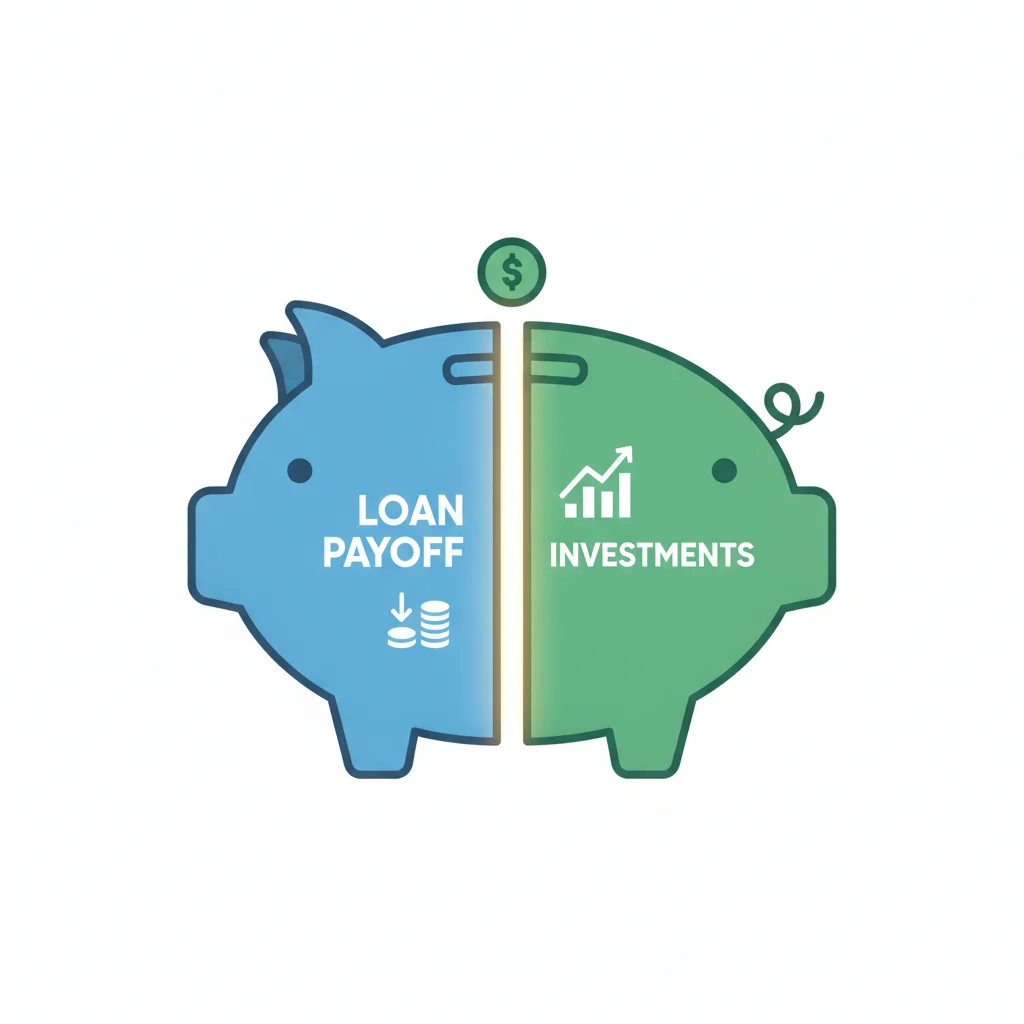
Key Takeaways
Our Verdict
Neither early payoff nor investing is universally superior — the right choice hinges on your loan's interest rate compared to realistic investment returns, your personal risk tolerance, and whether your lender charges prepayment penalties. For borrowers carrying rates above 7%, early payoff delivers a guaranteed, risk-free return that most conservative investments can't match. For those with sub-5% loans and a steady income, investing the difference in a diversified account is likely to come out ahead over time.
| Best for | Recommended |
|---|---|
| Borrowers with high-rate auto loans (7% or above) | Pay Off Early |
| Borrowers with low-rate loans (under 5%) and long investment horizons | Invest the Extra Money |
| Those with no emergency fund or high anxiety about debt | Pay Off Early |
| Borrowers who want balance without choosing one extreme | Hybrid: Split Extra Funds Between Both |
Why This Decision Is More Than Just Math
When you have an extra $200 or $500 a month, two camps immediately form: pay down the car loan faster, or put the money to work in the market. Both arguments sound compelling, and both have legitimate merit. The frustrating truth is that neither answer is correct in every situation.
What separates a smart choice from a lucky guess is understanding which variables actually drive the outcome. The core of this comparison is an interest rate arbitrage question: does the guaranteed return of eliminating loan interest beat the probabilistic return of investing? But layered on top of that math are real-world complications — prepayment penalties, loan amortization structure, your personal risk tolerance, and what happens to your cash flow after the loan disappears.
Before you decide, it helps to understand exactly what happens to your interest charges when you accelerate repayment. Early payoff can dramatically cut total interest, but the savings depend heavily on how far along you are in the loan term and whether your lender uses simple or precomputed interest. Once you have that baseline, the investment comparison becomes much clearer.

The Rate Arbitrage Framework: What the Numbers Actually Say
The cleanest way to think about this choice is through rate arbitrage — comparing a known, guaranteed cost against an expected, uncertain return.
The Guaranteed Return: Your Loan's APR
Every dollar you put toward your loan principal today saves you exactly that dollar times your interest rate, compounded over the remaining loan term. If your auto loan carries a 9% APR, paying it down early gives you a guaranteed, risk-free 9% return on that money. No brokerage account, no market timing required.
The Expected Return: Stock Market History
The S&P 500 has historically returned roughly 10% annually before inflation, or about 7% after inflation, averaged over long periods. But that average comes with enormous year-to-year variance — some years return 25%, others lose 30%. A five-year auto loan is a short enough window that sequence-of-returns risk is a real concern. You could invest your extra money for three years only to see the market drop 20% right as your loan matures.
~7%
Historic inflation-adjusted S&P 500 annual return
Vanguard and Morningstar research consistently cite roughly 7% real returns for the S&P 500 over rolling 30-year periods — but short 5-year windows vary widely.
9.93%
Average new car loan APR (2023)
According to Federal Reserve data for Q4 2023, average new vehicle loan rates exceeded 9%, making early payoff a compelling guaranteed return for most recent borrowers.
38%
Share of auto borrowers with rates above 8%
Experian's State of the Automotive Finance Market (Q4 2023) found that over a third of active auto loans carried rates above 8% APR.
50–100%
Effective return from employer 401(k) match
A standard 50% employer match on contributions up to 6% of salary represents an immediate 50% return — far exceeding any auto loan interest rate.
The Break-Even Rate
A useful rule of thumb: if your auto loan rate is above 7%, the guaranteed return of early payoff is difficult to beat on a risk-adjusted basis. Between 5% and 7%, you're in a gray zone where your timeline, tax situation, and risk tolerance matter. Below 5%, investing in a diversified portfolio has historically come out ahead over periods of five or more years — though not guaranteed.
| Criterion | Pay Off Early | Invest the Extra Money | Hybrid Approach | |
|---|---|---|---|---|
| Return type | Guaranteed, risk-free | Expected, variable | Partial guaranteed + partial variable | |
| Best loan rate range | Above 7% APR | Below 5% APR | 5%–7% APR gray zone | |
| Market risk exposure | None | Full | Reduced | |
| Cash flow impact | Payment eliminated at payoff | Monthly payment unchanged | Payment reduced gradually | |
| Interest savings | High, front-loaded in early term | None on loan | Moderate | |
| Complexity | Low — straightforward | Moderate — requires account management | Moderate — requires discipline to split | |
| Emotional benefit | High — debt-free feeling | Low — debt persists | Moderate — progress on both fronts | |
| Ideal for | High-rate borrowers, debt-averse | Low-rate borrowers with long horizon | Middle-range borrowers, balanced risk |
One thing the math above doesn't capture is loan amortization front-loading. Auto loans typically front-load interest, meaning your early payments are mostly interest and your later payments are mostly principal. If you're in the first half of a loan, every extra dollar toward principal eliminates disproportionately more future interest than the same dollar paid in month 48 of a 60-month loan. How you structure extra payments also affects the final savings — lump sums vs. recurring overpayments produce different outcomes depending on your loan balance and timing.
Factors That Shift the Math in Favor of Early Payoff
The numbers lean toward paying off early when several conditions align. Here's when eliminating the loan is the stronger financial move:
- Your loan rate is above 7%. This is the clearest signal. A high-rate loan is essentially a high-cost investment you're holding in reverse. Eliminating it is a better use of cash than chasing market returns that may or may not materialize.
- You're early in the loan term. Since interest is front-loaded in standard amortizing loans, paying extra principal in months 1–24 of a 60-month loan eliminates far more total interest than the same extra payment in months 48–60.
- You carry no other high-interest debt. If you have credit card debt at 20–25% APR, that always takes priority over both early auto payoff and investing. Once that's gone, then compare the auto loan to market investing.
- Your emergency fund is fully funded. Early payoff only makes sense after you have three to six months of expenses liquid. Otherwise, if you face an unexpected expense, you may need to take on new high-cost debt.
- You have strong debt aversion. Being debt-free provides psychological security that has real value. If your loan causes persistent stress, the mental ROI of eliminating it can be worth more than the spreadsheet suggests.
Check Your Payoff Quote Before Sending Extra Money
Before making a large additional principal payment, call your lender or log in to your account and request an official payoff quote. This gives you the exact amount needed to close the loan completely, including any accrued daily interest. If you're making a partial extra payment, also confirm how the lender applies it — some automatically apply overpayments to future scheduled payments rather than current principal unless you specify otherwise in writing.
Automate the Hybrid Split to Stay Consistent
The biggest risk with the hybrid approach isn't the math — it's behavioral drift. Set up automatic transfers on payday: one to your brokerage or retirement account, one as an extra loan principal payment. When the split happens automatically before you see the money, you eliminate the temptation to spend it. Review and rebalance the split every six months as your loan balance decreases.
Redirect Your Car Payment the Day the Loan Closes
Many borrowers pay off their car loan and then watch the freed-up payment silently disappear into everyday spending. Prevent this by setting up a recurring transfer for the exact monthly payment amount — starting the very next month after payoff — into a savings or investment account. You were already living without that money, so the adjustment is painless.
It's also worth checking whether your lender charges a prepayment penalty before sending in extra principal. These penalties are less common on auto loans than on mortgages, but they exist. Read your contract or call your lender to confirm before you accelerate payments.
Factors That Shift the Math in Favor of Investing
Investing the extra cash becomes more compelling under a different set of conditions. Here's when the market edge wins:
- Your loan rate is below 5%. Cheap financing is a gift. If you locked in a 3.9% or 4.5% rate — common during 2019–2021 — you're borrowing money at a cost that historical stock market returns have consistently beaten over long horizons.
- You have a long investment time horizon. Market volatility smooths out over 10, 20, or 30 years. If you're investing in a 401(k) or IRA with decades until retirement, short-term fluctuations matter far less than compound growth over time.
- Employer match is on the table. If your employer offers a 401(k) match and you're not maxing it, investing to capture that match is an immediate 50–100% return — far above any loan interest savings.
- You have tax-advantaged space available. Contributing to a Roth IRA or traditional 401(k) provides tax benefits that effectively boost your real return. If you haven't maxed those accounts, investing there before paying down a low-rate loan is often the smarter move.
- You have a stable income and strong emergency reserves. Investing only makes sense if you're not exposed to financial shocks that could force you to liquidate at a loss.

Don't Invest While Ignoring High-Interest Debt
Investing in a stock portfolio while carrying a 19% APR credit card balance is a guaranteed way to lose money in net terms. Before comparing auto loan payoff to investing, eliminate any consumer debt with rates above 10%. Auto loan payoff vs. investing is only a worthwhile comparison once high-cost debt is off the table.
Short Time Horizons Amplify Market Risk
The historical averages that make investing look attractive assume you're in the market for 10, 20, or 30 years. If your investment horizon is only two to five years — roughly the length of a car loan — you face meaningful sequence-of-returns risk. A market downturn early in a short investment window can leave you worse off than a guaranteed loan payoff would have been. Be honest about your actual timeline before choosing investing over early payoff.
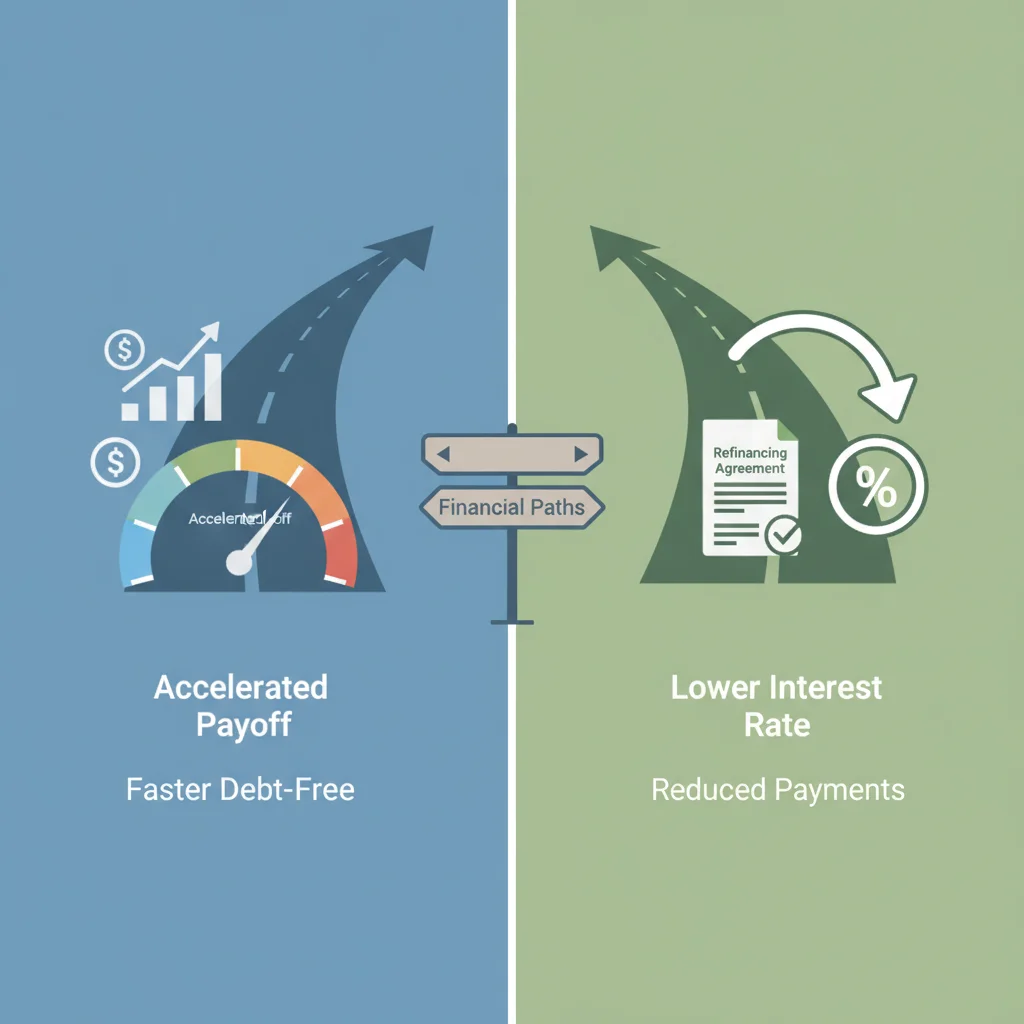
If you're considering whether to pay down the loan or refinance to a lower rate first, those are actually two separate decisions. Accelerated payoff and refinancing both reduce total interest — but they work differently. In some cases, refinancing to a lower rate first, then applying extra payments, produces the best outcome of all three options.
The Hybrid Approach: Splitting the Difference
For borrowers in the middle zone — loan rates between 5% and 7%, moderate risk tolerance, solid emergency savings — the hybrid strategy is often the most practical choice. Instead of choosing sides, you divide the extra cash flow between both goals simultaneously.
A Simple Hybrid Framework
- Cover your employer 401(k) match first. This is non-negotiable. Free money has a 100% return.
- Fund your emergency reserve to three to six months of expenses. Do this before any accelerated payoff or investing.
- Split remaining surplus — for example, 60% toward additional loan principal, 40% into a Roth IRA or taxable brokerage account.
- Reassess every six months. As the loan balance drops, the interest savings shrink. Gradually shift the allocation toward investing as the loan approaches payoff.
The hybrid approach doesn't maximize either outcome on paper, but it reduces risk on both sides. You're not fully exposed to market volatility, and you're not foregoing decades of compound growth either. For most moderate-risk borrowers, that tradeoff is a reasonable one.
Finding extra budget to execute this strategy is its own challenge. Practical methods for freeing up cash — from subscription audits to side income — can surface more margin than you expect in a monthly budget.
Check Your Payoff Quote Before Sending Extra Money
Before making a large additional principal payment, call your lender or log in to your account and request an official payoff quote. This gives you the exact amount needed to close the loan completely, including any accrued daily interest. If you're making a partial extra payment, also confirm how the lender applies it — some automatically apply overpayments to future scheduled payments rather than current principal unless you specify otherwise in writing.
Automate the Hybrid Split to Stay Consistent
The biggest risk with the hybrid approach isn't the math — it's behavioral drift. Set up automatic transfers on payday: one to your brokerage or retirement account, one as an extra loan principal payment. When the split happens automatically before you see the money, you eliminate the temptation to spend it. Review and rebalance the split every six months as your loan balance decreases.
Redirect Your Car Payment the Day the Loan Closes
Many borrowers pay off their car loan and then watch the freed-up payment silently disappear into everyday spending. Prevent this by setting up a recurring transfer for the exact monthly payment amount — starting the very next month after payoff — into a savings or investment account. You were already living without that money, so the adjustment is painless.
Cash Flow Consequences You Might Overlook
Both strategies affect your cash flow in ways that matter beyond the interest calculation. Here are a few downstream effects worth planning for:
After Early Payoff: Redirecting the Monthly Payment
Once your loan is gone, you suddenly have your entire monthly car payment free. The critical question is: what happens to that cash? Borrowers who pay off a car loan but immediately fold the payment back into lifestyle spending forfeit most of the financial benefit. The smartest move is to immediately redirect the former car payment into savings or investments the month after the loan closes — before it disappears into discretionary spending.
After Investing: Your Loan Payment Doesn't Change
If you choose to invest instead of paying down the loan, your monthly obligation doesn't change. You're adding an investment contribution on top of your existing payment. This requires more monthly budget discipline but leaves your investment compounding while the loan amortizes on its original schedule.
Selling the Car Before the Loan Ends
If there's any chance you'll sell or trade in the car before the loan is fully paid, early payoff becomes more complicated. Carrying a loan balance at sale requires a payoff quote and title coordination with your lender. Timing your payoff relative to when you list the car for sale can affect how cleanly that transaction goes, even if it doesn't change the actual sale price.
Refinancing as a Third Path
If you're on a high-rate loan but don't have a large lump sum to apply toward principal, refinancing to a lower rate first is worth exploring before committing to an accelerated payoff plan. Knowing the right signals for when to refinance can help you decide whether that step makes sense before you choose between payoff and investing.
Making the Decision: A Step-by-Step Process
Rather than treating this as a single yes-or-no question, work through these steps in order to arrive at your own answer:
- Find your exact loan APR and remaining balance. Log into your lender's portal or call to get the current payoff amount and your contractual interest rate.
- Check for prepayment penalties. Review your loan contract or ask your lender directly. If a penalty applies, factor that cost into your payoff savings calculation.
- Confirm whether you're using simple or precomputed interest. Most auto loans use simple daily interest, which means extra principal payments immediately reduce future interest. A small number of older or subprime loans use precomputed interest, which can eliminate the benefit of early payoff entirely.
- Identify your tax-advantaged investment space. Are you leaving employer match on the table? Do you have IRA contribution room available? If yes, invest there before making extra loan payments.
- Assess your emergency fund. Three to six months of essential expenses, liquid. If you don't have this, build it before accelerating anything else.
- Compare your rate to the break-even threshold. Above 7% → lean toward early payoff. Below 5% → lean toward investing. In between → consider the hybrid approach.
- Factor in your risk tolerance honestly. A 10% average market return is meaningless if you'll panic-sell during a 25% correction. Your actual return is what you realize, not what the index delivered.
Don't Invest While Ignoring High-Interest Debt
Investing in a stock portfolio while carrying a 19% APR credit card balance is a guaranteed way to lose money in net terms. Before comparing auto loan payoff to investing, eliminate any consumer debt with rates above 10%. Auto loan payoff vs. investing is only a worthwhile comparison once high-cost debt is off the table.
Short Time Horizons Amplify Market Risk
The historical averages that make investing look attractive assume you're in the market for 10, 20, or 30 years. If your investment horizon is only two to five years — roughly the length of a car loan — you face meaningful sequence-of-returns risk. A market downturn early in a short investment window can leave you worse off than a guaranteed loan payoff would have been. Be honest about your actual timeline before choosing investing over early payoff.
Once you've worked through this process, the answer usually becomes clearer than it seemed at first. The goal isn't to pick the option that sounds most financially sophisticated — it's to pick the one you'll actually execute consistently over time.

All claims are backed by peer-reviewed research. Sources on request.