Key Takeaways
Interest on Early Loan Payoff
When you pay off a car loan ahead of schedule, you stop accumulating interest on the remaining balance from that point forward. Because most auto loans use simple interest, you only owe interest for the days you actually carried the balance. Paying early eliminates future interest charges — but the exact savings depend on how your loan is structured and whether any fees apply.
On a simple-interest loan, interest accrues daily on the outstanding principal. Your payoff amount = remaining principal + accrued interest to date. Pre-computed interest loans (less common) may have already baked the full interest cost into the payment schedule, reducing or eliminating savings from early payoff.
How Interest Actually Accrues on a Car Loan
Before you can understand what happens when you pay off early, you need to understand how your lender charges interest in the first place. The overwhelming majority of auto loans — from banks, credit unions, and dealer-arranged financing — use a simple interest method.
Here's how it works: interest is calculated on your outstanding principal balance each day. Every morning your loan is open, a small interest charge accrues. When you make a monthly payment, a portion goes toward that accrued interest, and the rest reduces your principal. Your next month's interest charge is then calculated on that lower balance.
The daily interest formula is straightforward:
Daily Interest = (Annual Interest Rate ÷ 365) × Remaining Principal
For a $20,000 balance at 7% APR, that's roughly $3.84 per day. Over a 60-month loan, you'd pay roughly $3,761 in total interest if you made every payment on schedule. Pay it off 12 months early and you eliminate approximately $700 of that — though the exact figure depends on where you are in the amortization schedule.
This daily accrual structure is why the timing of your payoff matters. The sooner you eliminate the balance, the fewer days interest can accumulate.
Simple Interest Is the U.S. Standard
Under the federal Truth in Lending Act (TILA), lenders are required to disclose your APR and total finance charge before you sign. Most consumer auto loans in the U.S. are simple-interest contracts. If you're uncertain which type you have, look for language like 'interest accrues daily on the unpaid principal balance' in your loan agreement — that confirms simple interest.
The Rule of 78s Is Restricted in Some States
Several states have limited or banned the use of the Rule of 78s for loans longer than 61 months, and federal law prohibits it on loans over 5 years. However, it can still appear on shorter-term loans from non-bank lenders. If your loan term is 24–48 months and you financed through a dealership's in-house program, it's worth checking your contract for this clause before assuming early payoff will save you money.
Simple Interest vs. Pre-Computed Interest: The Critical Difference
Not every loan rewards early payoff equally. The distinction comes down to how your interest was originally calculated.
Simple Interest Loans
As described above, interest accrues daily on the remaining principal. Pay off early, and you stop the clock on future interest charges. These loans are the standard for auto financing in the U.S.
Pre-Computed Interest Loans
Some lenders — particularly certain subprime lenders and buy-here-pay-here dealers — use a pre-computed interest model. In this structure, the total interest for the life of the loan is calculated upfront and added to your principal. Your monthly payment schedule is then built around that fixed total.
The problem with pre-computed loans: if you pay early, you may not save as much interest as you'd expect — or any at all. The lender may use a method called the Rule of 78s to determine how much interest is "earned" through each month of the loan. Under this method, a disproportionate share of interest is front-loaded, so early payoff in the final third of the loan yields minimal savings.
~80%
Auto loans using simple interest in the U.S.
The vast majority of bank, credit union, and captive lender auto loans use daily simple interest, making early payoff directly beneficial for most borrowers.
$1,200+
Potential interest saved with early payoff
On a $25,000 loan at 6.5% APR paid off 3 years early, a borrower can eliminate over $1,600 in future interest charges based on standard amortization calculations.
Rule of 78s
Front-loads interest on pre-computed loans
Under the Rule of 78s method, a borrower paying off in month 6 of a 12-month loan has already 'owed' roughly 67% of total interest — limiting early payoff savings significantly.
30 days
Typical lien release window after payoff
Most states require lenders to release the vehicle lien within 30 days of final payoff, after which the borrower receives a clean title.
10–15 days
Lead time for a valid payoff quote
Lenders recommend requesting a payoff quote dated 10–15 days ahead to account for payment processing time and accruing per-diem interest.
Check whether your loan structure makes early payoff less worthwhile — especially if you financed through a dealer with in-house financing or a non-bank lender.
Always Request a Written Payoff Quote
Don't estimate your payoff amount from your monthly statement. Call your lender and ask for a formal payoff quote — good through a specific date — in writing. This protects you if there's a dispute about remaining balance or fees. Many lenders will email or fax the quote same-day.
Run the Numbers Before Choosing Early Payoff
Before sending a lump sum, use your lender's online payoff calculator or an amortization tool to project your interest savings. Then check whether your contract has a prepayment penalty and factor in that cost. A five-minute calculation can tell you definitively whether early payoff makes financial sense at your current stage of repayment.
What Your Payoff Amount Actually Includes
Your monthly statement balance and your true payoff amount are not the same number. This surprises a lot of borrowers who assume sending in the "amount owed" on their statement clears the loan.
A formal payoff quote — which your lender is required to provide — includes:
- Remaining principal: The balance you still owe on the original loan amount.
- Accrued interest: Daily interest that has accumulated since your last payment but hasn't yet been billed.
- Per diem interest: Because it takes time for your payment to arrive and be processed, lenders add a per-diem (daily) interest amount for each day through the payoff date.
- Any applicable fees: Some lenders charge a small payoff processing fee. Prepayment penalties, if they exist in your contract, also appear here.
Always request a payoff quote for a specific future date — typically 10 to 15 days from when you call. This gives you a firm target that accounts for mail or wire transfer time. If your payment arrives after that date, call back for an updated figure.

Once you send your final payment and the lender processes it, they are required to release the lien on your vehicle title. In most states, this happens automatically within 30 days. If you financed through a bank or credit union, you'll receive a lien release document or a clean title in the mail. Keep this document — you'll need it when you sell or trade the car.
The Math: How Much Interest Do You Actually Save?
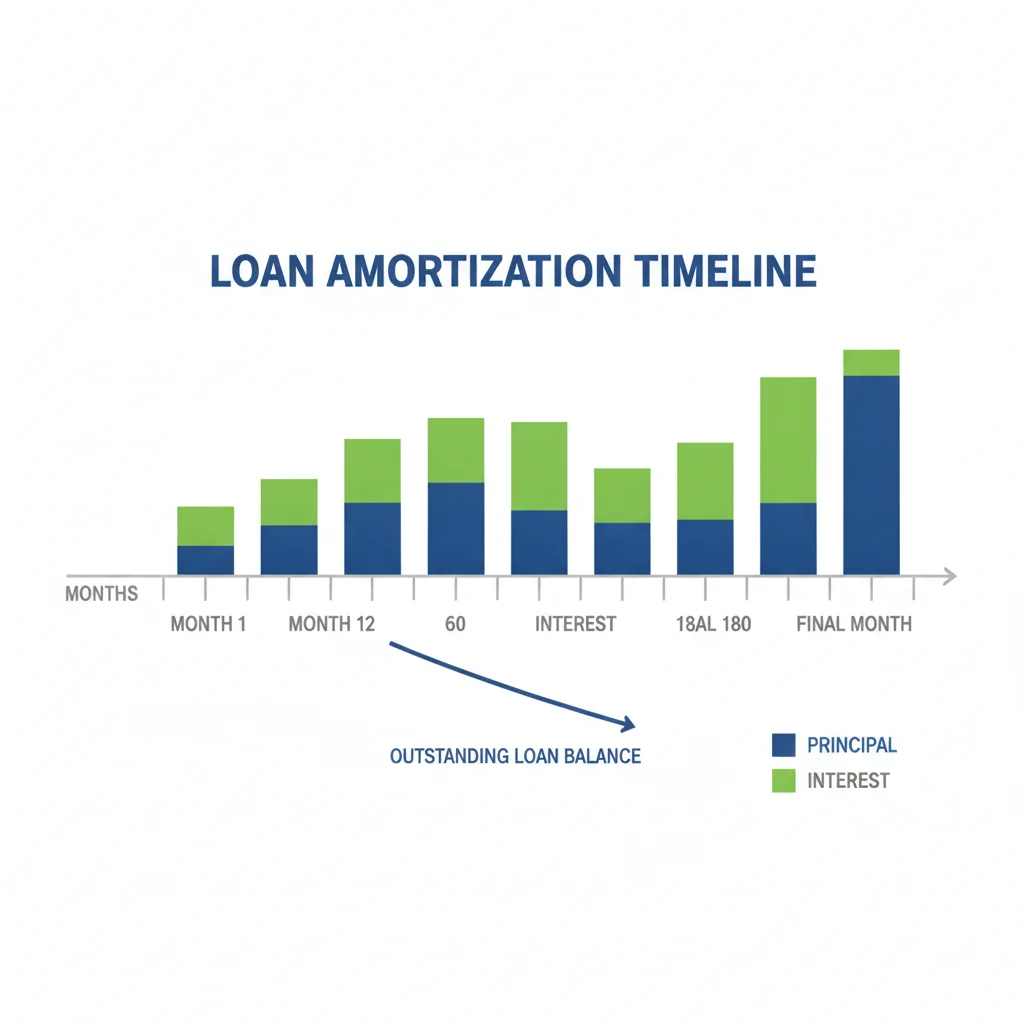
The interest savings from early payoff are front-loaded by amortization. In the early months of a loan, more of each payment goes toward interest. In later months, more goes toward principal. This means paying off in month 12 of a 60-month loan saves significantly more than paying off in month 48.
Here's a concrete example using a $25,000 loan at 6.5% APR over 60 months (monthly payment: approximately $487):
| Payoff Point | Remaining Principal | Interest Saved |
|---|---|---|
| Month 12 (pay off 4 years early) | ~$21,100 | ~$2,680 |
| Month 24 (pay off 3 years early) | ~$16,900 | ~$1,690 |
| Month 36 (pay off 2 years early) | ~$12,400 | ~$870 |
| Month 48 (pay off 1 year early) | ~$7,600 | ~$260 |
The takeaway: if you're planning to make a lump-sum payoff, doing it earlier in the loan term produces dramatically better returns. By the final year, you've already paid the majority of your interest.
“Amortization is designed to protect the lender's yield. In the first half of most loans, you're mostly paying interest. If you want to save real money, that's exactly when extra payments to principal hit hardest.”
— Greg McBride, Chief Financial Analyst, Bankrate
Keep in mind that these figures assume no prepayment penalty. If your contract includes one, understand exactly how prepayment penalties work and when they apply before committing to a payoff strategy.
Extra Payments vs. Full Early Payoff: Which Works Better?
You don't have to come up with a lump sum to save on interest. Making consistent extra payments — even small ones — applied to principal can significantly cut your total interest cost and shorten your loan term.
Using the same $25,000 loan at 6.5% APR:
- Adding $50/month to your payment shaves roughly 6 months off the loan and saves around $340 in interest.
- Adding $100/month eliminates about 11 months and saves roughly $620.
- Adding $200/month cuts the loan by nearly 20 months and saves over $1,000.
The key is making sure extra payments are applied to principal, not held as a credit toward next month's payment. Call your lender to confirm their policy, and include a note with paper checks or a designation in online payment portals. Some lenders require a phone call to allocate an extra payment correctly.
For a structured approach to eliminating your balance ahead of schedule, follow our complete roadmap for paying off a car loan early.
When Early Payoff Isn't the Right Move
Early payoff is generally a solid financial decision — but not always. A few scenarios where caution makes sense:
You Have a Prepayment Penalty
If your contract includes a penalty clause, calculate whether the interest savings exceed the penalty cost. On a $15,000 balance with a 2% prepayment penalty, you'd owe $300 upfront. If you're only saving $260 in future interest, you're losing money. Prepayment penalties can also kill refinancing savings — the same math applies.
Your Interest Rate Is Very Low
If you financed at 0% or 1.9% APR during a promotional period, the interest savings from early payoff are minimal. That cash might work harder in a high-yield savings account, an emergency fund, or paying off higher-interest debt.
You're Underwater on the Loan
If you owe more than the car is worth, payoff strategy gets more complicated. Early payoff when you're underwater on a car loan requires a different approach entirely.
You're Near the End of the Loan
In the final 6–12 months, most of each payment is already going to principal. The interest savings from accelerating payoff at this stage are modest — often less than $150–$200 on a mid-size loan. It may not be worth disrupting your cash flow.
Always Request a Written Payoff Quote
Don't estimate your payoff amount from your monthly statement. Call your lender and ask for a formal payoff quote — good through a specific date — in writing. This protects you if there's a dispute about remaining balance or fees. Many lenders will email or fax the quote same-day.
Run the Numbers Before Choosing Early Payoff
Before sending a lump sum, use your lender's online payoff calculator or an amortization tool to project your interest savings. Then check whether your contract has a prepayment penalty and factor in that cost. A five-minute calculation can tell you definitively whether early payoff makes financial sense at your current stage of repayment.
For a broader look at whether your specific loan rewards early payoff, understand what early payoff actually means on your auto loan — lenders define it differently, and the fine print matters.
All claims are backed by peer-reviewed research. Sources on request.