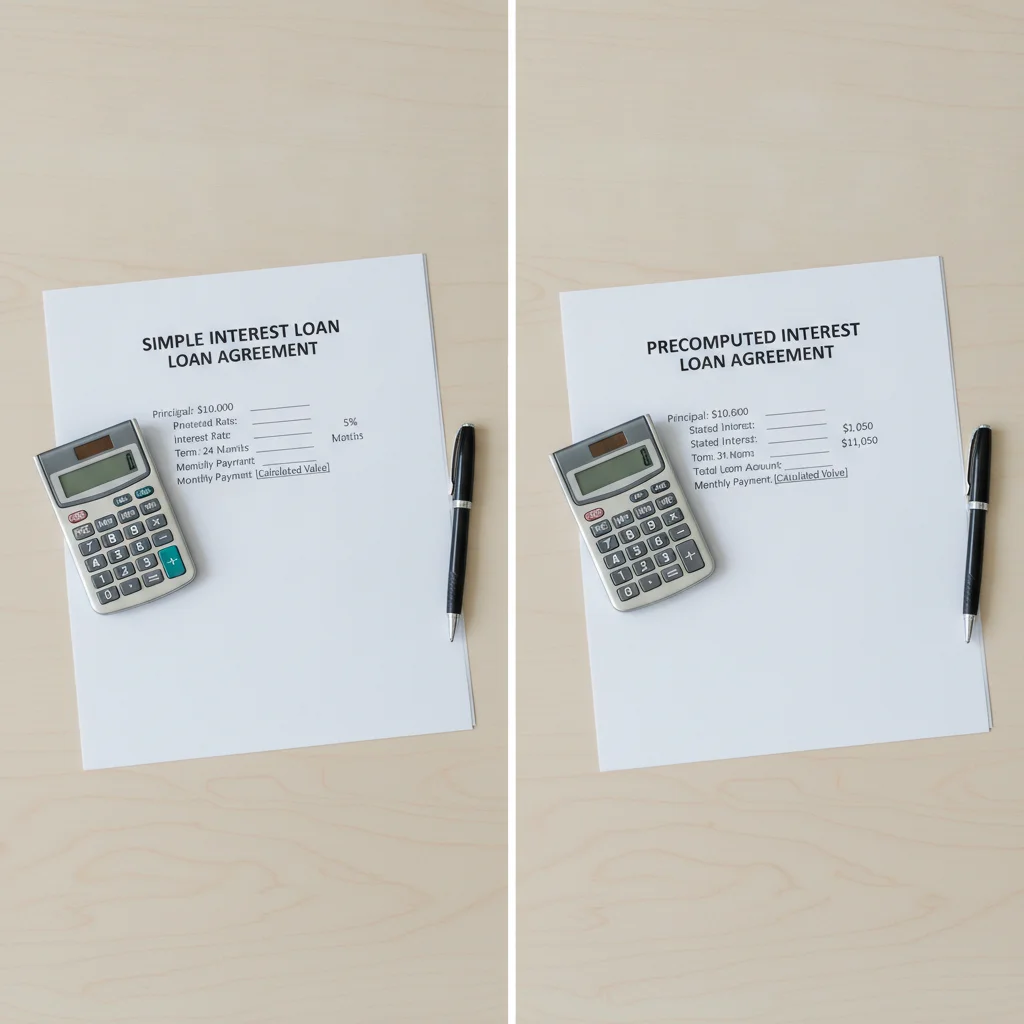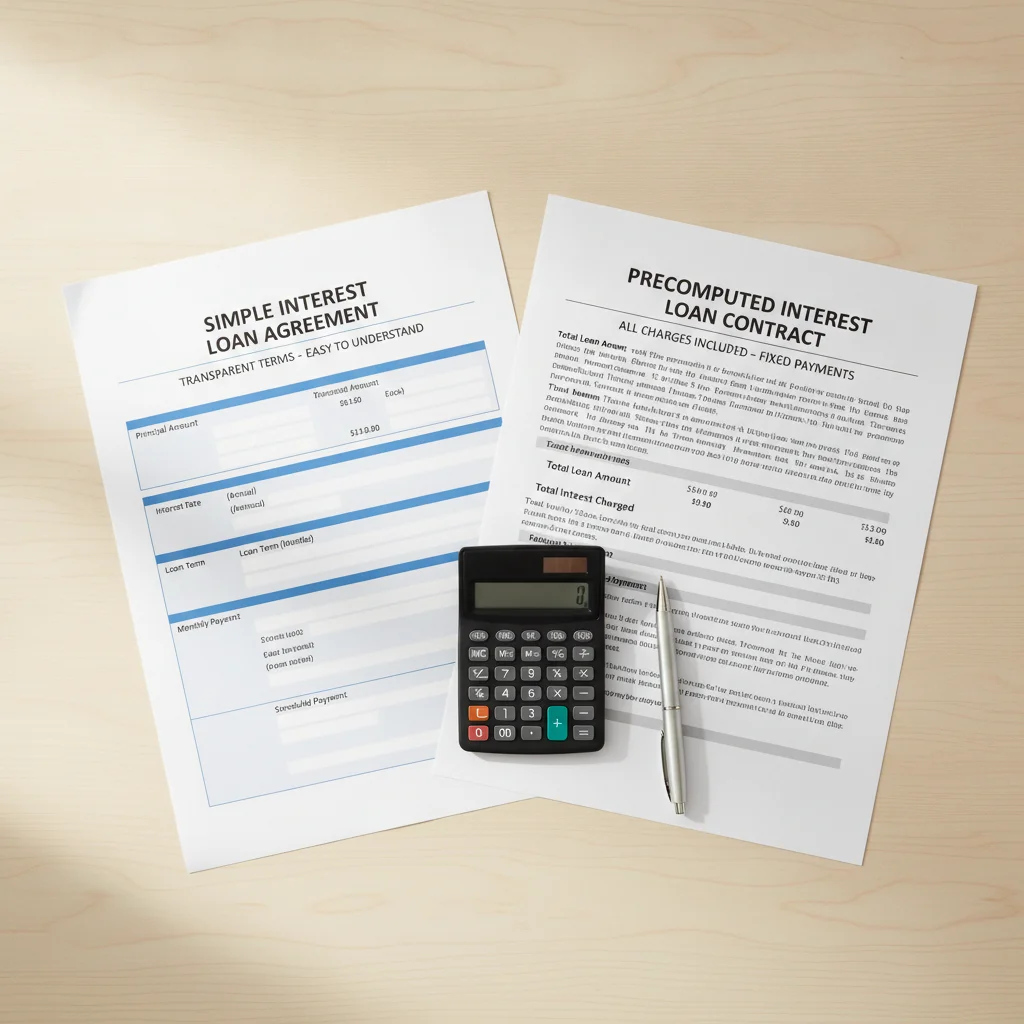
Key Takeaways
Option A
Precomputed Interest Auto Loans
The front-loaded, fixed-interest-cost structure.
Best for: Borrowers who plan to make only minimum payments and carry the loan to its full term without any early payoff.
Option B
Simple Interest Auto Loans
The flexible, pay-as-you-go interest structure.
Best for: Borrowers who want the ability to reduce total interest costs by making extra payments or paying off the loan early.
If you plan to pay the exact minimum every month until the final payment
Precomputed Interest Auto Loans
If you never deviate from the payment schedule, the total cost difference is minimal and the predictability of precomputed interest may be convenient.
If you want to pay off your car loan ahead of schedule
Simple Interest Auto Loans
Simple interest rewards extra payments immediately by reducing the outstanding balance on which interest accrues, cutting your total cost significantly.
If you're a first-time borrower trying to understand and control costs
Simple Interest Auto Loans
The daily-accrual model is more transparent and easier to verify — your payoff amount at any point reflects your actual remaining balance plus accrued interest.
If you're financing through a buy-here-pay-here dealership
Precomputed Interest Auto Loans
These lenders commonly use precomputed structures, so understanding the Rule of 78s rebate formula is essential to avoid surprises if you pay off early.
If you're refinancing and want the most flexibility going forward
Simple Interest Auto Loans
Refinancing into a simple interest loan gives you full control over how interest accumulates, making extra payments and early payoff financially meaningful.
How Each Interest Method Works
Before comparing total costs or payoff strategies, you need to understand the fundamental mechanics of each structure. The difference is not just a calculation detail — it changes what you actually owe at any point during the loan.
Precomputed Interest: The Total Is Locked In at Signing
With a precomputed interest loan, the lender calculates the full amount of interest you'll pay over the entire loan term before you make your first payment. That interest total is then added to the loan principal to create a single combined figure — sometimes called the "total of payments" — which is divided into equal monthly installments.
Here's a simplified example: Suppose you borrow $15,000 at 9% interest over 48 months. The lender computes the total interest for 48 months — roughly $2,900 — and combines it with the principal to get $17,900. Divide by 48, and your monthly payment is about $373. Notice that the interest cost is set regardless of how fast you pay.
Simple Interest: You Pay Only for What You Use
Simple interest auto loans work differently. Interest accrues daily on your current outstanding balance. Each time you make a payment, a portion covers the interest that has accumulated since your last payment, and the remainder reduces your principal. Because the principal drops with every payment, the interest you owe each subsequent period is slightly less.
This is why paying even a modest amount extra — or paying a few days early — chips away at the total interest you'll pay over the life of the loan. The interest and APR hub has additional resources on how daily accrual affects your real cost of borrowing.
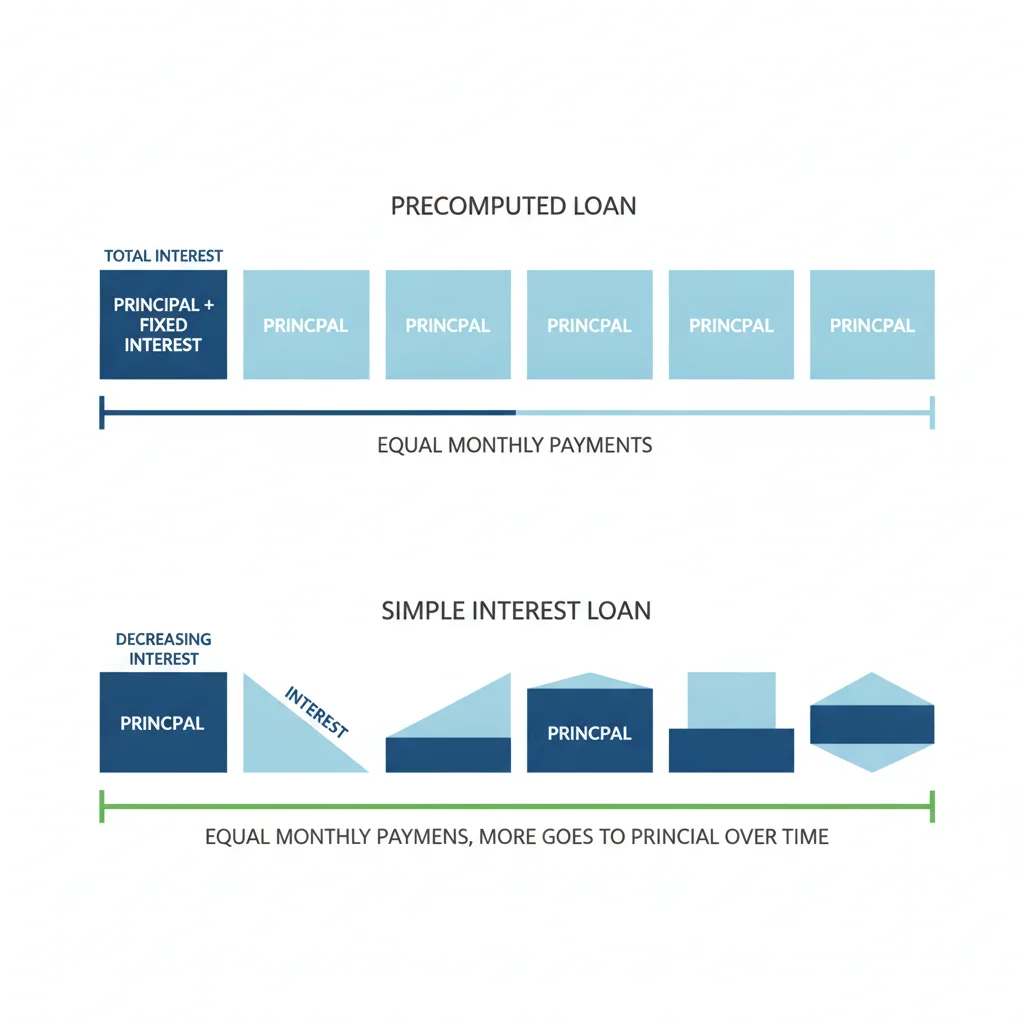
The core distinction: precomputed interest is a fixed fee determined at origination. Simple interest is a running cost that responds to your behavior as a borrower.
What Early Payoff Actually Costs You in Each Scenario
This is where the two structures diverge most sharply — and where many borrowers are caught off guard.
Early Payoff on a Simple Interest Loan
If you have a simple interest loan and decide to pay it off six months early, your payoff amount is straightforward: your remaining principal balance plus any interest that has accrued since your last payment. You are not charged interest for months you won't be borrowing. The savings are real and immediate.
For example, if you're 30 months into a 60-month simple interest loan and your balance is $8,200, your payoff amount might be $8,200 plus 12 days of accrued interest — perhaps $8,230 total. You've already paid all the interest that corresponded to your first 30 months of borrowing, and nothing more is owed for the remaining 30 months you won't use.
78%
Share of auto loans using simple interest
Consumer Financial Protection Bureau data indicates the vast majority of retail auto installment contracts use simple interest accrual structures.
Rule of 78s
Most common precomputed rebate method
The Rule of 78s front-loads interest so that early payoff on a 12-month loan returns only 1/78 of total interest for the first month's early payment.
$1,000+
Potential interest savings from simple interest early payoff
On a $20,000 loan at 10% over 60 months, paying off 12 months early can save over $1,000 in interest — savings largely unavailable on precomputed loans.
Early Payoff on a Precomputed Interest Loan
Here's the critical difference: on a precomputed loan, the total interest has already been baked into your payment schedule. If you want to pay off the loan early, you don't simply get credited the remaining months of interest. Instead, the lender applies a rebate formula to determine how much interest you get back — and that formula is rarely in your favor.
The most common formula is the Rule of 78s (also called the sum-of-digits method). It front-loads interest toward the early months of the loan, meaning you've already paid a disproportionately large share of total interest by the time you try to pay off early. The "rebate" you receive for the unused months is smaller than you'd expect from a simple calculation.
To understand the Rule of 78s in depth — and how it compares to the actuarial method some lenders use instead — see our detailed breakdown in Simple Interest vs. Precomputed Interest on Car Loans.
| Criterion | Precomputed Interest | Simple Interest |
|---|---|---|
| How interest is calculated | Fixed total set at loan origination | Accrues daily on remaining balance |
| Impact of early payments | Little to no direct savings | Directly reduces interest owed |
| Early payoff benefit | Partial rebate via Rule of 78s | Full credit for unused interest days |
| Transparency | Less transparent; front-loaded | More transparent; balance-driven |
| Common lender type | Buy-here-pay-here, subprime lenders | Banks, credit unions, major lenders |
| Borrower control over cost | Low — interest pool is fixed | High — extra payments reduce total cost |
| Best suited for | Full-term payers, no extra payments | Borrowers who may pay off early |
The practical takeaway: on a precomputed loan, the earlier you pay off, the less benefit you receive relative to what you'd save on a simple interest loan of the same terms. Paying off in month 10 of a 60-month precomputed loan may return only a fraction of the remaining 50 months of interest.
If early payoff is on your radar, our guide on What Happens to Your Interest When You Pay Off a Car Loan Early walks through the exact math with real loan scenarios.
How Loan Term Length Amplifies the Difference
Loan term — the number of months over which you repay — interacts with both interest structures in important but distinct ways.
Longer Terms on Simple Interest Loans
On a simple interest loan, stretching the term to 72 or 84 months lowers your monthly payment but significantly increases the total interest you pay. This happens because your balance decreases more slowly over a longer period, meaning the daily interest clock runs on a higher balance for more time.
However, the borrower still retains full control. Making one extra payment per year on a 72-month simple interest loan can cut months off the schedule and save hundreds of dollars in interest. Every dollar of extra principal paid is one less dollar on which interest accrues going forward.
Longer Terms on Precomputed Interest Loans
On a precomputed loan, extending the term compounds the problem. A longer loan means more total precomputed interest is built into the contract at origination. And because the Rule of 78s front-loads interest, the portion of each early payment that goes toward principal is even smaller with longer terms. A borrower 18 months into a 72-month precomputed loan may have paid a far higher share of the total interest than a borrower 18 months into a 36-month loan.
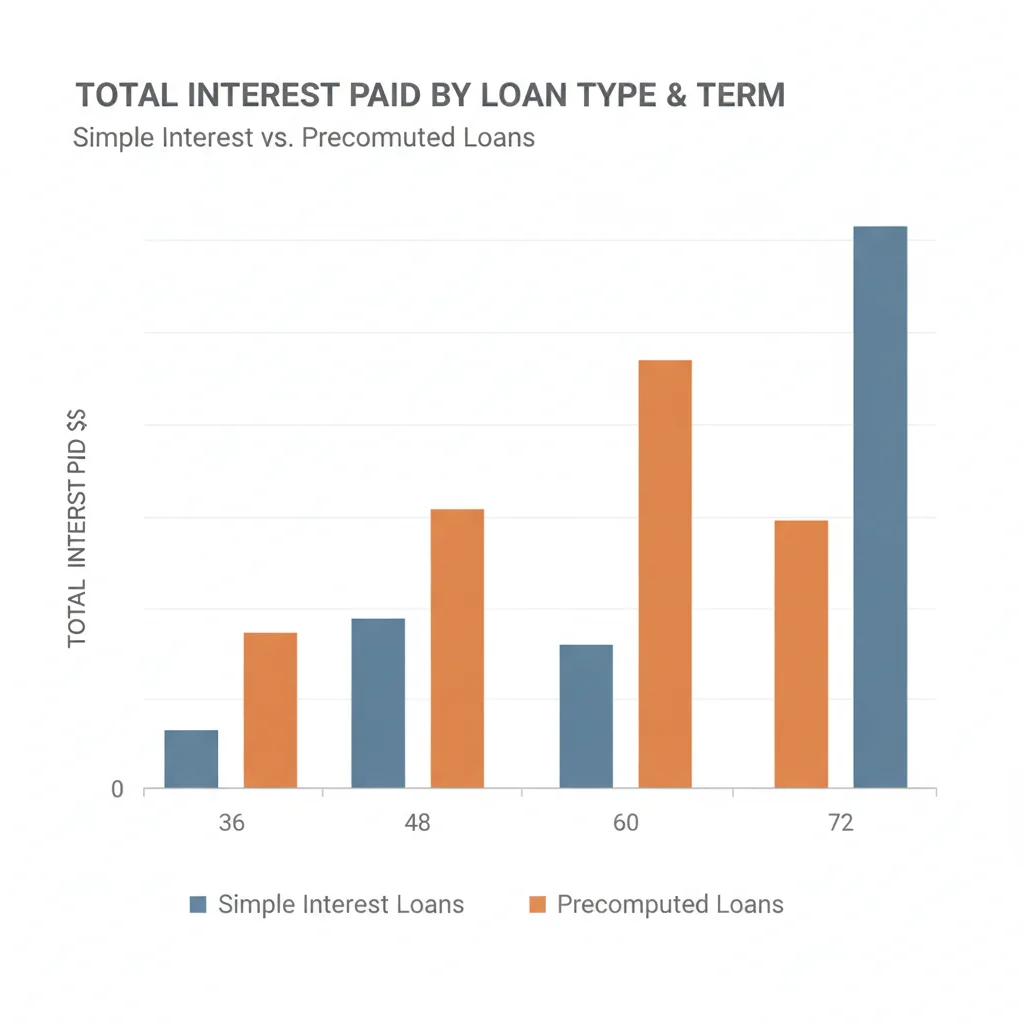
The bottom line on term length: with simple interest, a longer term is a trade-off you can partially offset with disciplined payments. With precomputed interest, a longer term locks in a larger interest pool that is harder to escape early. Early payoff strategies matter far more when you're in a simple interest loan.
Are Precomputed Loans Still Legal?
Yes, precomputed interest loans remain legal in the United States, though some states restrict the use of the Rule of 78s on loans longer than 61 months. Federal law does not prohibit precomputed interest structures outright, but the Truth in Lending Act (TILA) requires lenders to disclose the annual percentage rate (APR) and total finance charge regardless of method. Knowing your state's rules and reading the prepayment section of any contract is the most reliable protection.
Where You're Likely to Encounter Each Type
Most borrowers don't get to choose between precomputed and simple interest — the lender makes that choice. Knowing which lenders typically use which structure helps you ask better questions before you sign.
Simple Interest: The Standard at Most Banks and Credit Unions
The majority of auto loans issued today — through banks, credit unions, and most captive finance arms of major automakers — use simple interest. Federal regulators and consumer advocates have pushed toward simple interest structures because they are more transparent and borrower-friendly. If you're financing a new or certified pre-owned vehicle through a franchise dealership connected to a major lender, you're almost certainly getting a simple interest loan.
That said, always confirm. Ask the finance manager directly: "Is this a simple interest or precomputed interest loan?" A legitimate lender will give you a straight answer. Check the loan contract for a daily periodic rate or a statement that interest accrues on the unpaid balance — those are signs of simple interest.
Precomputed Interest: Common in Subprime and Buy-Here-Pay-Here Financing
Precomputed interest loans appear more frequently in subprime auto lending and buy-here-pay-here (BHPH) dealerships. These lenders often work with borrowers who have limited credit histories or damaged credit, and the precomputed structure helps them lock in their return regardless of payment behavior.
Some personal finance companies and older installment loan structures also use precomputed interest. If you're financing through a BHPH dealership, read the contract carefully for language like "precomputed" or "add-on interest" — those are key signals. You should also check whether the contract references the Rule of 78s as the rebate method.
For first-time borrowers navigating these waters, our guide to early auto loan payoff for first-time borrowers explains how to approach these conversations before you commit.
How to Identify Which Loan You Have — and What to Do About It
If you already have an auto loan and aren't sure which structure applies, here's how to find out.
Check Your Loan Documents
Look for the following terms in your retail installment contract or loan agreement:
- "Simple interest" or "daily periodic rate" — confirms simple interest accrual
- "Precomputed", "add-on interest", or "total of payments" as a fixed sum — suggests precomputed structure
- "Rule of 78s" or "sum of the digits" in the prepayment section — confirms precomputed with Rule of 78s rebate
Call Your Lender and Ask Directly
Ask: "If I pay off this loan today, how is my payoff amount calculated?" On a simple interest loan, the answer should be: current balance plus accrued interest since your last payment. On a precomputed loan, the lender should explain the rebate formula. If the answer is vague or confusing, ask them to send you the payoff calculation in writing.
Request a Payoff Quote and Compare
Ask your lender for a current payoff quote. Compare that figure to your estimated remaining balance based on your amortization schedule. If the payoff quote is significantly higher than your remaining principal, you may be on a precomputed loan where front-loaded interest has reduced how much of your principal you've retired so far.
Once you understand your structure, the right strategy follows naturally. See our full explainer on what early payoff actually means on an auto loan for a step-by-step walkthrough of how to approach payoff regardless of which structure you have.
And if you're considering refinancing out of a precomputed loan into a simple interest product — especially if interest rates have shifted — the Fixed vs. Variable Interest Rates on Auto Loans can help you understand what terms to compare when evaluating new offers.


All claims are backed by peer-reviewed research. Sources on request.