Key Takeaways
Our Verdict
Market rate drops and personal financial improvements are both legitimate reasons to refinance, but they operate on completely different timelines and require different evidence before you act. A rate drop demands you verify that auto loan rates have actually moved and that you qualify for the new floor. A personal gain scenario rewards patience — you wait until your financial profile has genuinely strengthened, then move decisively. In both cases, the break-even math is non-negotiable.
| Best for | Recommended |
|---|---|
| Borrowers whose credit and income haven't changed but market rates have fallen significantly | Market Rate Drop Refinance |
| Borrowers who took out a loan with poor credit or high debt and have since improved their financial standing | Personal Gain Refinance |
| Borrowers who want to minimize total interest paid and are early in their loan term | Personal Gain Refinance |
| Borrowers with strong credit seeking to capture a sudden, broad market rate decline | Market Rate Drop Refinance |
Two Triggers, One Decision: Why the Distinction Matters
Most people think of refinancing as a single, simple act: swap your current loan for a better one. But the reason you refinance shapes almost every practical decision that follows — which lenders to approach, what documents to gather, whether the timing is right, and whether the numbers actually work in your favor.
There are two fundamentally different triggers for refinancing an auto loan:
- Market rate drops — interest rates across the economy have fallen, meaning new loans are being offered at lower APRs than when you originally borrowed.
- Personal financial gains — your own credit profile, income stability, or debt situation has improved since you took out your loan, making you a better-qualified borrower today than you were then.
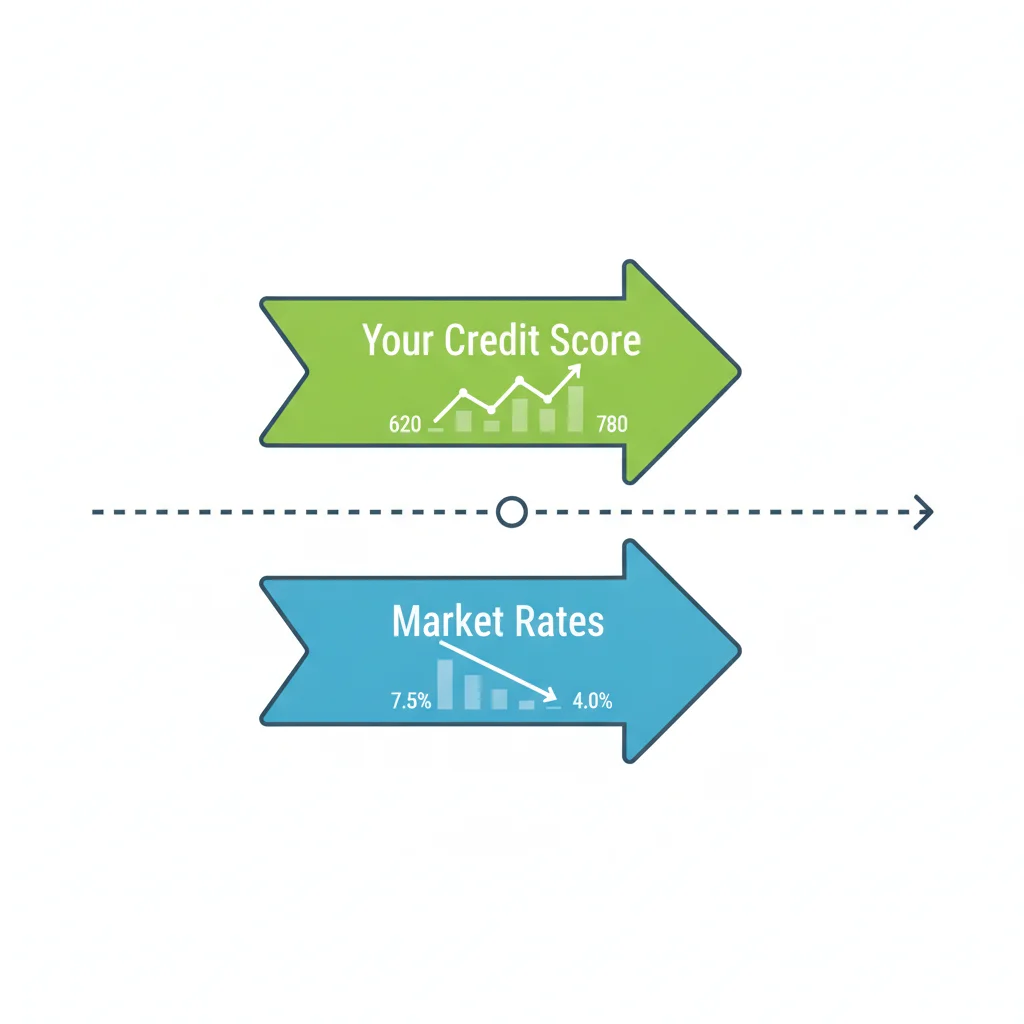
These two scenarios look similar on the surface — both can result in a lower interest rate — but they require different evidence, different timing, and different expectations. Conflating them is one of the most common mistakes borrowers make when deciding whether to refinance.
For a broader look at how APR reduction fits into the refinancing picture, see our guide to refinancing for a lower APR. This article focuses specifically on understanding which trigger is at play in your situation and how that changes your approach.
Refinancing on a Market Rate Drop: What You Need to Know
When the Federal Reserve cuts its benchmark rate or broader lending conditions loosen, auto loan rates can fall across the board. If your loan was originated when rates were higher, you might theoretically qualify for a better deal today — even if nothing about your personal finances has changed.
How Rate Drops Flow to Auto Loans
Here's the critical nuance: the Fed rate doesn't directly set auto loan rates. Banks, credit unions, and finance companies use it as a benchmark, but they layer on their own risk assessments, profit margins, and competitive positioning. A 0.50% Fed rate cut might translate to a 0.25% drop in auto loan rates — or less, or more, depending on the lender and the lending environment.
This means you need to verify, not assume, that rates have actually moved in the auto lending market. Check offers from at least three lenders — a national bank, a credit union, and an online auto lender — before concluding that market rates are meaningfully lower than your current APR. Our article on what Fed rate cuts actually mean for your refinance decision breaks this down in detail.
1.5%+
Minimum APR gap worth refinancing for
Industry guidance from Experian and NerdWallet suggests a rate difference of at least 1.5 percentage points is typically needed to offset refinancing costs and generate meaningful savings.
40–60 pts
Credit score gain that changes your rate tier
According to Experian's credit tier breakdowns, a 40–60 point score increase can move a borrower from subprime to near-prime, unlocking APR reductions of 3 percentage points or more on auto loans.
7–8 months
Average break-even period for auto refinancing
Based on average refinancing fee structures and typical monthly savings estimates tracked by LendingTree auto loan data.
When a Market Rate Drop Is Worth Acting On
A market rate drop becomes a meaningful refinancing trigger when:
- Your current APR is at least 1.5–2 percentage points above what lenders are currently quoting for your credit tier.
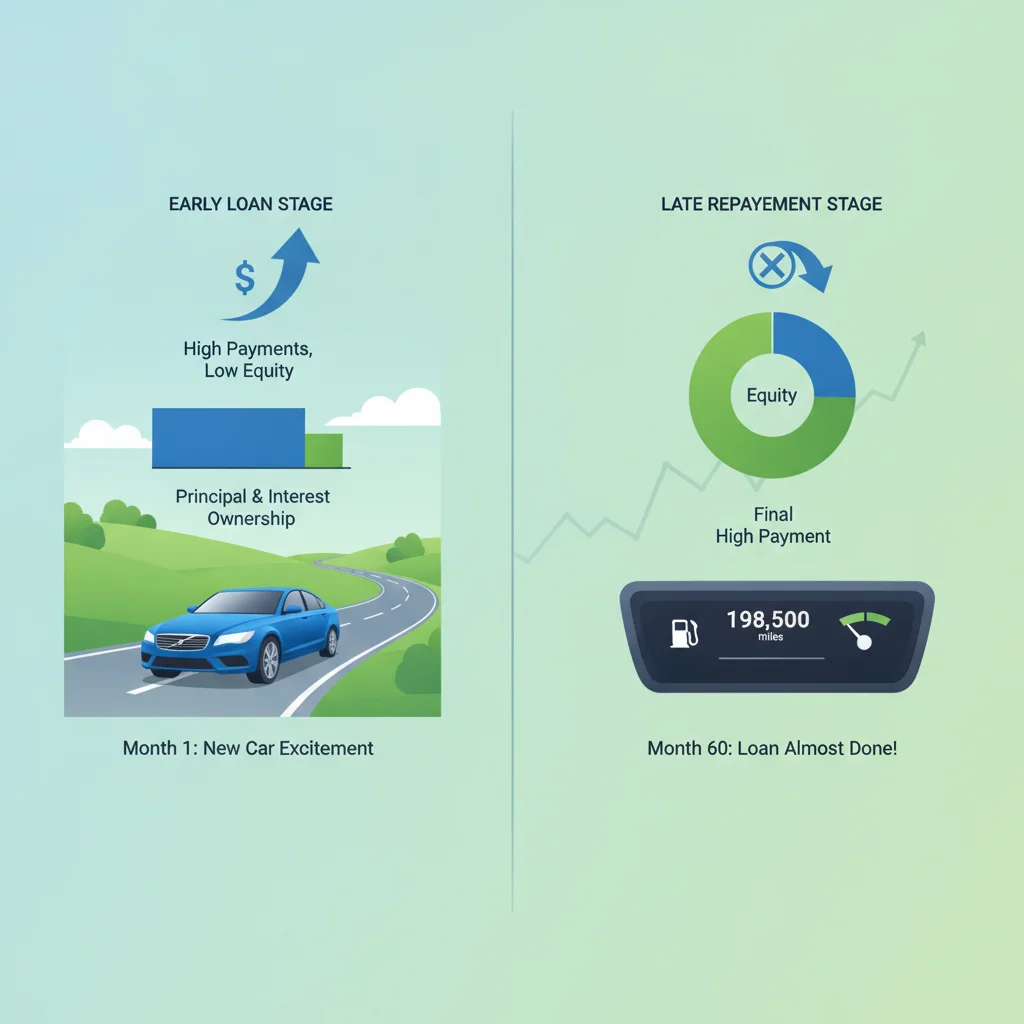
- You're still early in your loan repayment — ideally within the first half of your loan term — so there's enough remaining interest to make saving worthwhile. See our timing breakdown for early vs. late refinancing for more context.
- Your vehicle's remaining value exceeds what you owe (you're not underwater on the loan).
- You can break even on refinancing fees before you plan to sell or trade in the vehicle.
Don't Assume Lower Advertised Rates Apply to You
Advertised auto loan rates are almost always reserved for borrowers with excellent credit — typically scores above 720. If market rates have dropped but your credit score remains in the subprime range, the headline rate you see advertised is not the rate you'll be offered. Always get a personalized quote before making any refinancing decisions based on rate movement.
Term Extension Can Erase Your Rate Savings
Extending your loan term by 12 or 24 months to lower monthly payments often costs more in total interest than you save from a lower rate — especially if you're already deep into repayment where most of your payments are going to principal. Be clear about whether your goal is a lower monthly payment or a lower total cost, because these are not always compatible.
The Borrower Profile Problem
A market rate drop benefits you most when your credit profile is strong enough to actually qualify for the new, lower rates being advertised. If your credit score is in the 580s and market rates have dropped — but those rates are only available to borrowers with scores above 700 — the rate environment has improved without improving your personal situation. In that case, you're not looking at a market rate drop refinance opportunity. You're looking at a personal gain problem, which we'll cover next.
Refinancing on Personal Financial Gain: Capturing Your Own Progress
The second trigger is more personal and, for many borrowers, more powerful. This is the scenario where the market hasn't necessarily moved — but you have. If your credit score has risen significantly, your income has stabilized, you've paid down other debts, or you've removed a negative item from your credit report, you may now qualify for a meaningfully lower rate than you did when you first took out your loan.
Common Personal Gains That Unlock Better Rates
- Credit Score Improvement
- Moving from a subprime score (below 620) into the near-prime or prime range (660+) can reduce your auto loan APR by 3–6 percentage points or more. Even a 40-point increase within a credit tier can move the needle. Your credit score directly affects the rates lenders offer, so this is often the highest-leverage improvement you can make.
- Debt-to-Income Ratio Reduction
- If you've paid off a credit card, student loan, or other debt since your auto loan originated, your monthly obligations relative to your income have dropped. Lenders see this as reduced risk, which often translates to better rate offers.
- Income Stabilization or Growth
- Borrowers who were self-employed, recently hired, or in a probationary period at loan origination sometimes received higher rates because income verification was complicated. If your income is now stable and well-documented, refinancing can reflect that reliability.
- Removal of a Co-Signer Dependency — or Addition of One
- If you needed a co-signer to qualify originally, you may now be strong enough to stand on your own — or vice versa, adding a creditworthy co-signer can dramatically improve your rate offer.

How to Verify You've Actually Improved
Before approaching lenders, pull your credit report from all three bureaus and calculate your current debt-to-income ratio. Compare where you stand today against your original loan application. If your score has risen by 40 points or more, or your DTI has dropped by 5+ percentage points, you have a credible case for a lower rate — regardless of what market rates are doing.
Check Your Rate Before Checking the Market
Before researching what market rates are doing, pull your three credit reports and calculate your current debt-to-income ratio. Your personal financial profile determines which market rates you can actually access. Knowing where you stand personally tells you whether a rate drop is even relevant to your situation.
Use Pre-Qualification to Protect Your Credit
Most lenders offer pre-qualification with a soft credit pull that doesn't affect your score. Use this to get realistic rate estimates before committing to a full application. This is especially important if you're acting on a recent personal gain — a hard inquiry too early in your credit recovery can slightly reduce the score you're trying to leverage.
Time Your Application Strategically
If you're refinancing on personal gains, wait until at least 60–90 days after the improvement took hold — for example, after a major debt payoff or a derogatory item falling off your report. New improvements need time to fully register across all three credit bureaus. Applying too soon can mean you're quoted a rate that doesn't yet reflect your best profile.
Side-by-Side: Market Rate Drop vs. Personal Gain Refinancing
To make the comparison concrete, here's how these two triggers differ across the factors that matter most to borrowers:
| Market Rate Drop | Personal Gain | |
|---|---|---|
| Primary trigger | Broad decline in auto loan APRs | Improved credit score or financial profile |
| Evidence required | Verified rate quotes from current lenders | Credit report comparison, DTI recalculation |
| Borrower action needed | Monitor rates, shop lenders when drop confirmed | Build credit, reduce debt, then apply |
| Typical rate reduction | 0.25%–1.5% depending on market move | 1%–6%+ depending on credit tier jump |
| Risk of acting too early | Rates may drop further; fees may not be recovered | Credit gains may not be stable yet |
| Best loan stage to act | First half of repayment term | First half of repayment term, but gains must be solid |
| Credit score dependency | Score must be good enough to access new rates | Score improvement is the core driver |
| Market conditions required | Rates genuinely lower than at origination | Largely independent of market conditions |
Notice that the evidence required and the borrower action needed differ substantially. A market rate refinance is reactive — you're responding to external conditions. A personal gain refinance is proactive — you've done the work and now you're collecting the reward. Both are legitimate, but confusing them leads to acting at the wrong time or for the wrong reason.
The Break-Even Math: Non-Negotiable for Both Triggers
Regardless of why you're refinancing, the break-even calculation is the gating question. Refinancing isn't free. Lenders may charge origination fees, title transfer fees, and prepayment penalties on your existing loan. Before you proceed, you need to know how long it takes for your monthly savings to exceed those upfront costs.
How to Calculate Your Break-Even Point
The formula is straightforward:
Break-Even (months) = Total Refinancing Costs ÷ Monthly Savings
For example: if refinancing costs you $400 in fees and saves you $55 per month, your break-even is 400 ÷ 55 = 7.3 months. If you plan to keep the car for at least another year, the refinance makes financial sense. If you're planning to sell in six months, it doesn't.
This math works the same whether you're acting on a market rate drop or a personal gain. The difference is in how confident you can be about the monthly savings figure. With a personal gain refinance, you may be able to project your new rate more precisely — because you have documented evidence of your improved profile. With a market rate drop, you need actual rate quotes before you can run the numbers reliably.
For a deeper look at how the break-even timeline interacts with your repayment stage, see our piece on when refinancing pays off based on where you are in your loan.
Check Your Rate Before Checking the Market
Before researching what market rates are doing, pull your three credit reports and calculate your current debt-to-income ratio. Your personal financial profile determines which market rates you can actually access. Knowing where you stand personally tells you whether a rate drop is even relevant to your situation.
Use Pre-Qualification to Protect Your Credit
Most lenders offer pre-qualification with a soft credit pull that doesn't affect your score. Use this to get realistic rate estimates before committing to a full application. This is especially important if you're acting on a recent personal gain — a hard inquiry too early in your credit recovery can slightly reduce the score you're trying to leverage.
Time Your Application Strategically
If you're refinancing on personal gains, wait until at least 60–90 days after the improvement took hold — for example, after a major debt payoff or a derogatory item falling off your report. New improvements need time to fully register across all three credit bureaus. Applying too soon can mean you're quoted a rate that doesn't yet reflect your best profile.
Don't Ignore the Term Trade-Off
Both types of refinancing can be structured to either lower your monthly payment (by extending the term) or reduce your total interest paid (by keeping or shortening the term). These are not the same outcome, and choosing the wrong one can undercut an otherwise sound decision. Our article on the monthly payment vs. total interest trade-off walks through exactly how to decide which goal should drive your refinance structure.
Common Mistakes When Acting on the Wrong Trigger
Many refinancing decisions go wrong not because the borrower chose a bad lender or a bad rate, but because they misidentified why they were refinancing in the first place. Here are the most common errors that follow from trigger confusion:
Waiting for a Rate Drop When the Real Problem Is Your Credit
If your original loan carried a high APR because of a low credit score, no amount of market rate movement will fully resolve that gap. A prime-tier rate that drops from 6% to 5% still isn't available to you if your score hasn't improved. Borrowers in this position should focus on credit-building first and refinancing second.
Refinancing on Personal Gains Before the Gains Are Solid
Credit score improvements can be fragile. A single new credit inquiry, a missed payment, or a shift in your credit utilization ratio can reverse recent gains. If you refinance on the basis of a credit score that's only been elevated for 30 days, you're taking on risk that the improvement might not be durable. Give new improvements at least 60–90 days to stabilize before using them as the basis for a refinancing decision.
Extending the Term While Claiming to Save Money
Both triggers can be used to justify extending a loan term to lower monthly payments. But extending the term often increases total interest paid, even at a lower rate. This isn't always wrong — cash flow relief is a legitimate goal — but it should be an intentional choice, not a side effect of muddled reasoning about why you're refinancing.
Don't Assume Lower Advertised Rates Apply to You
Advertised auto loan rates are almost always reserved for borrowers with excellent credit — typically scores above 720. If market rates have dropped but your credit score remains in the subprime range, the headline rate you see advertised is not the rate you'll be offered. Always get a personalized quote before making any refinancing decisions based on rate movement.
Term Extension Can Erase Your Rate Savings
Extending your loan term by 12 or 24 months to lower monthly payments often costs more in total interest than you save from a lower rate — especially if you're already deep into repayment where most of your payments are going to principal. Be clear about whether your goal is a lower monthly payment or a lower total cost, because these are not always compatible.
For a more complete inventory of what goes wrong in otherwise reasonable refinancing decisions, our companion piece on common refinancing mistakes covers the full list of pitfalls to avoid.
How to Identify Which Trigger Applies to You
Before approaching a lender, take five minutes to answer these diagnostic questions. Your answers will tell you which category you're in — and whether either trigger is actually live for you right now.
- What is my current APR, and what are lenders quoting today for my credit tier? Get actual rate quotes — not headline advertisements — from two or three lenders. If the spread between your current rate and current quotes exceeds 1.5%, a market rate drop may be in play.
- Has my credit score changed since I took out this loan? Log into your bank or credit card portal for a free score estimate, then compare it against your original loan application. A 40+ point improvement suggests a personal gain opportunity.
- Has my debt-to-income ratio changed? Add up your monthly debt payments (not including your current auto loan) and divide by your gross monthly income. If this number has dropped meaningfully, you may qualify for better terms regardless of market conditions.
- How much of my loan do I have left — and how long until I plan to sell or trade in? The less time remaining on your loan and the sooner you plan to sell, the harder it is to break even on refinancing costs.
- What are the all-in costs of refinancing? Ask each lender for a full cost breakdown, not just the rate quote. Include any prepayment penalty on your existing loan.
If questions 1 and 2 both show improvement — market rates have dropped AND your personal profile has strengthened — you're in the strongest possible position. Either trigger alone is worth evaluating; both together make a compelling case to act.
If neither has meaningfully changed, refinancing is unlikely to produce real savings. The most useful thing you can do in that situation is focus on building the personal financial gains that will eventually make a personal gain refinance viable. That might include paying down revolving debt, making every loan payment on time, or disputing errors on your credit report. Our resource on credit score impact outlines exactly how your score affects the rates lenders will offer.

Finally, remember that refinancing is just one tool for reducing the cost of your auto loan. If you're committed to paying less overall, our comparison of accelerated payoff vs. refinancing may help you decide whether a different approach altogether makes more sense for your situation.

All claims are backed by peer-reviewed research. Sources on request.