Key Takeaways
Prepayment Penalty
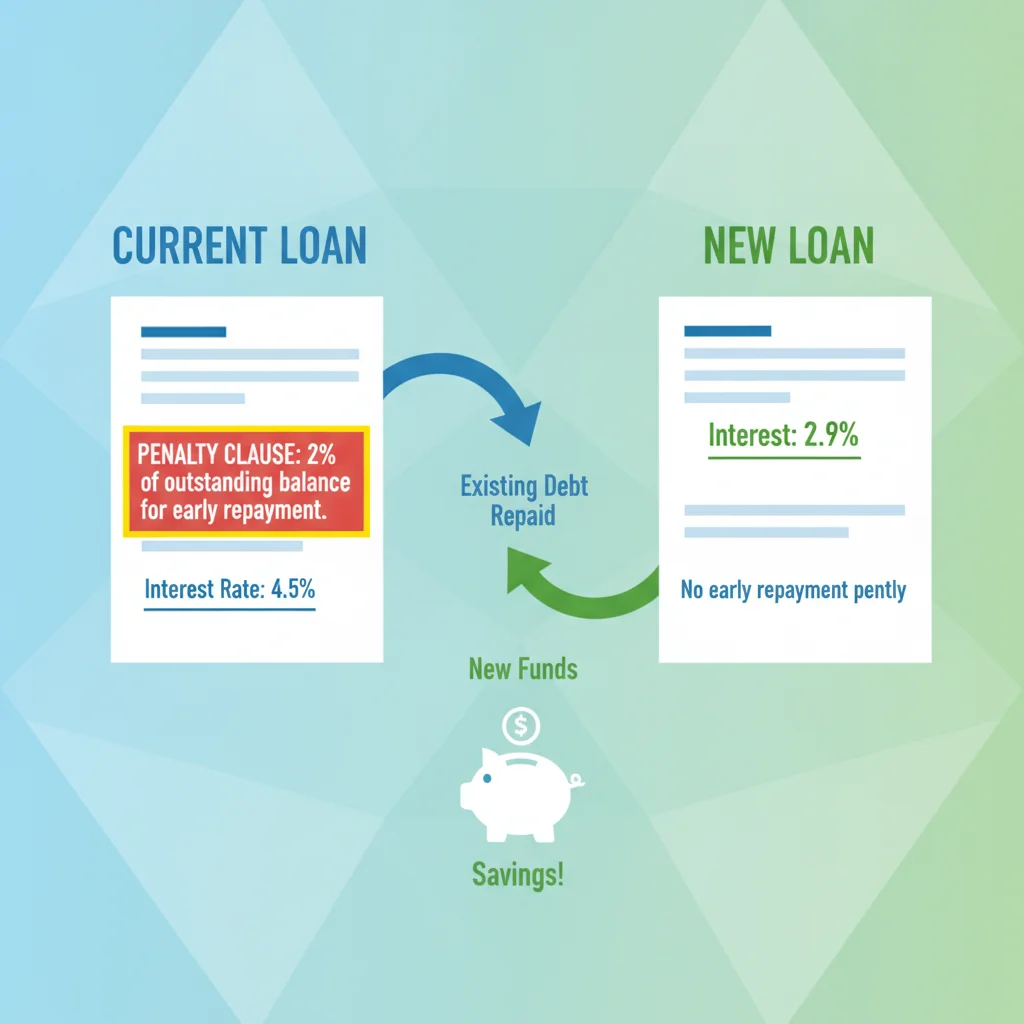
A prepayment penalty is a fee your lender charges if you pay off your auto loan before the scheduled end date. When you refinance, you're essentially paying off your old loan early — which means this penalty can apply. Depending on how it's calculated, the fee can wipe out months or even years of interest savings from your new, lower-rate loan.
Prepayment penalties are typically expressed as a flat dollar amount, a percentage of the remaining principal, or a set number of months' worth of interest. Some contracts use a 'Rule of 78s' method, which front-loads interest charges and magnifies the cost of paying off early.
Why Refinancing Automatically Triggers Early Payoff
Most people think of refinancing as simply swapping one loan for another at a better rate. What they don't always realize is that the mechanics of that swap require paying off your current loan in full — immediately — before your new loan takes over. From your current lender's perspective, that's an early payoff, and some lenders have built their profit model around charging a fee for exactly that.
This matters because the expected savings from refinancing are typically calculated on just two variables: your current interest rate versus your new interest rate, and the remaining loan balance. That math can look very attractive. But if your original contract includes a prepayment penalty, you have a third variable that most online refinancing calculators don't ask you about — and it can quietly consume a significant portion of your projected savings before you've made a single payment on your new loan.
Understanding this dynamic is essential before you start shopping for a new lender. If you skip this step, you may complete a refinance that felt like a win, only to discover a few months later that your actual savings were much smaller than expected — or that you actually paid more in the short run.
The good news is that this is entirely preventable. Knowing what to look for, where to find it in your contract, and how to factor it into your decision turns a potential financial surprise into a manageable variable you can plan around.
Where Prepayment Penalties Hide — and How to Find Them
Prepayment penalty clauses rarely appear on the first page of a loan contract. They're often buried in a section labeled something like 'Prepayment,' 'Early Termination,' or 'Additional Terms.' In some cases, the language is indirect — referencing a calculation method rather than using the word 'penalty' at all.
Common Contract Language to Watch For
- Percentage of remaining balance: A fee calculated as a fixed percentage (often 1%–3%) of what you still owe at the time of payoff.
- Flat dollar fee: A set amount charged regardless of your remaining balance — common in older or subprime contracts.
- X months of interest: A penalty equal to two, three, or six months of accrued interest based on your current rate.
- Rule of 78s: A front-loaded interest calculation method that effectively penalizes early payoff by ensuring you've already paid a disproportionate share of total interest charges. This method is banned for loans longer than 61 months under federal law, but it can still appear in shorter-term loans.
Federal Rules on the Rule of 78s
Under the Truth in Lending Act, lenders cannot use the Rule of 78s method on loans with terms longer than 61 months. However, it can still legally appear in shorter-term auto loans. If your loan term was 60 months or less, it's worth specifically searching your contract for this method, as it significantly affects how much you actually save by paying off early.
Get the Penalty Amount Before You Apply
Many borrowers make the mistake of applying for a refinance loan — triggering a hard credit inquiry — before confirming whether a prepayment penalty exists. Pull your contract and call your lender first. Protecting your credit score means only authorizing hard inquiries when you're ready to move forward with a complete picture of the costs.
If you no longer have a copy of your original loan agreement, don't guess. Call your lender's customer service line and ask two specific questions: 'Does my loan include a prepayment penalty?' and 'How is that penalty calculated?' Then ask them to send you that information in writing — via email or a secure message through your online account portal. Having it documented protects you if there's a dispute later.
Where Dealer-Arranged Financing Gets Tricky
If you financed your car at the dealership, there's an extra layer of complexity. Dealer-arranged financing is often sold to third-party lenders, sometimes including smaller finance companies or captive lenders tied to the manufacturer. These lenders may use non-standard contract terms that vary widely. The dealer who sold you the car may not even know what penalty terms were included — your contract with the actual lender is what governs.
This is also a space where loan terms that discourage early payoff appear more frequently. If your original loan carried a high interest rate or was structured for a borrower with challenged credit, it's worth being especially diligent about checking for penalties.
The Real Math: Calculating Whether Refinancing Still Makes Sense
Once you know the exact penalty amount, you can run the actual break-even analysis. This is the only way to know whether refinancing is worth it — not the rate comparison, not the monthly payment reduction, but the full-picture arithmetic.
Step-by-Step Break-Even Calculation
- Calculate your total interest cost on your current loan for the remaining term at your current rate.
- Calculate your total interest cost on the proposed new loan for the same remaining term at the new rate.
- Subtract the new total from the current total to get your gross interest savings.
- Add up all refinancing costs: lender origination fees, title transfer fees, and your prepayment penalty.
- Subtract total costs from gross savings to get your net savings.
- Divide total costs by your monthly savings to find your break-even month — how long you need to keep the car before the refinance pays off.
Up to 3%
Typical prepayment penalty as percent of balance
Many auto loan contracts that include prepayment penalties calculate them as 1%–3% of the remaining principal balance at the time of early payoff.
$500–$1,500
Estimated average penalty dollar range
On a loan balance between $15,000 and $25,000, a 2%–3% prepayment penalty translates to roughly $300–$750; a 6-month interest penalty at a high rate can reach $1,500 or more.
18–24 mo.
Typical break-even period for a refinance
Industry rule of thumb suggests that most refinances take 12–24 months to recoup closing and penalty costs through monthly savings, making loan term remaining a critical variable.
~78%
Borrowers who don't check for prepayment penalties
Consumer finance surveys consistently show the large majority of auto loan borrowers have not read or do not remember key fee clauses in their original loan contracts.
Let's make this concrete. Say you have $18,000 remaining on a 72-month loan at 9.5% APR, with 48 months left. Your remaining interest cost at that rate is approximately $3,700. A new lender offers 5.9% APR on the same remaining balance and term — cutting your future interest to roughly $2,200. That's a gross savings of $1,500.
But your current contract includes a prepayment penalty of 2% of the remaining balance: $360. Add a $150 lender fee and a $75 title fee from the new lender. Total costs: $585.
Net savings: $1,500 − $585 = $915. That's still meaningful — but it's 40% less than the headline savings figure suggested. And if you plan to sell or trade the car within the next 12 months, you may not hold the loan long enough to recoup those upfront costs.

This is why the most common refinancing mistakes involve skipping the complete cost picture. The monthly payment comparison feels intuitive, but it doesn't capture what you're actually spending and saving over time.
Scenarios Where the Penalty Kills the Deal — and Where It Doesn't
Not every prepayment penalty situation ends the same way. The outcome depends on three factors working together: the size of the penalty, the interest rate differential between your old and new loan, and how much time remains on your loan.
When the Penalty Makes Refinancing Not Worth It
The math breaks down fastest when the rate improvement is small, the remaining loan term is short, or the penalty is unusually large. If you're in the last 12–18 months of repayment, most of your interest is already paid — the remaining balance is mostly principal. A refinance in this window saves very little interest regardless, so even a modest penalty can turn a marginal deal into a money-losing one. Refinancing too late in your loan cycle is one of the most common ways borrowers lose money thinking they're saving it.
When Refinancing Still Makes Sense Despite a Penalty
If you're early in a long loan — say, 12–18 months into a 72-month term — and the rate drop is substantial (say, from 11% down to 6%), the interest savings over the remaining 54 months can be large enough to absorb a penalty and still deliver real money back in your pocket. Timing your refinance to the early stages of repayment is one of the most reliable ways to maximize its value.
Ask for a Payoff Quote, Not Just the Balance
When you contact your current lender to check on prepayment penalties, also request a formal payoff quote. This document shows the exact total — including any fees — required to close the loan on a specific date. It's more accurate than your current balance statement and gives you the precise number to use in your refinancing math.
Check for a Penalty Expiration Date
Before ruling out refinancing entirely due to a penalty clause, check whether the penalty has an expiration date. Many contracts limit penalties to the first 12–36 months. If you're close to that cutoff, waiting a few months to refinance could save you several hundred dollars with no other changes to your plan.
Also consider the interest savings from paying off the original loan's remaining interest versus starting fresh. Understanding exactly what happens to interest when you pay early helps you model this accurately and avoid overestimating your savings.
Strategies to Reduce or Eliminate the Penalty's Impact
A prepayment penalty doesn't automatically mean you're stuck. There are several practical approaches that can reduce or even eliminate its effect on your refinancing decision.
1. Ask Your Current Lender to Waive It
This sounds too simple, but it works more often than people expect. If you've made every payment on time, your current lender has a financial interest in retaining you as a customer. Call them, explain that you're considering refinancing, and ask directly whether they can waive or reduce the prepayment penalty. Some lenders will do it to keep the loan — or offer you a competitive rate match to prevent you from leaving. The worst they can say is no.
2. Time the Refinance to a Penalty Expiration
Some prepayment penalty clauses are not permanent — they expire after a certain number of months. For example, a contract might include a penalty only for payoffs that occur within the first 24 months of the loan. If you're at month 20 and planning to refinance, waiting four months could save you hundreds of dollars with no other changes to your plan.
3. Factor the Penalty into Loan Comparison Shopping
When you're getting preapproved for a refinance loan, give each prospective lender the full cost picture — including the penalty — and ask them to show you the net savings over your remaining term. A lender willing to do that math with you transparently is one you can trust.
4. Consider the Accelerated Payoff Alternative
If the refinancing math doesn't work out due to the penalty, there's another path: staying in your current loan but making extra principal payments to pay it off faster. This approach avoids triggering the prepayment clause in some contracts — though you'll need to verify this with your lender, since some penalties apply to any accelerated payoff. Comparing accelerated payoff to refinancing side by side can reveal which path keeps more money in your pocket given your specific contract terms.
“The single most overlooked cost in any refinancing decision is the prepayment penalty on the existing loan. Borrowers focus on the new rate and forget to ask what it costs to leave the old one.”
— Greg McBride, Chief Financial Analyst, Bankrate
Building This Check Into Your Refinancing Routine
The most financially damaging aspect of prepayment penalties isn't the penalty itself — it's the fact that most borrowers don't think to check for one until after they've already applied for a refinance loan, or worse, after they've accepted the new offer. By that point, the decision is already made and the cost is locked in.
Make it a rule: before you run a single refinancing calculation, locate your current loan contract and search for the words 'prepayment,' 'early payoff,' and 'termination.' If you find a penalty clause, call your lender and get the exact dollar amount for a payoff today. Then run your break-even math with that number included from the start.
Ask for a Payoff Quote, Not Just the Balance
When you contact your current lender to check on prepayment penalties, also request a formal payoff quote. This document shows the exact total — including any fees — required to close the loan on a specific date. It's more accurate than your current balance statement and gives you the precise number to use in your refinancing math.
Check for a Penalty Expiration Date
Before ruling out refinancing entirely due to a penalty clause, check whether the penalty has an expiration date. Many contracts limit penalties to the first 12–36 months. If you're close to that cutoff, waiting a few months to refinance could save you several hundred dollars with no other changes to your plan.
This single extra step — which takes about 15 minutes — can mean the difference between a refinance that genuinely saves you money and one that costs you several hundred dollars you didn't budget for. The broader strategies for paying off an auto loan early all depend on understanding your contract terms first. Refinancing is no different.
Lenders are required to disclose prepayment penalties at origination, but that doesn't mean most borrowers read or remember that section of a contract signed under the pressure of a dealership closing. Protecting your savings starts with going back to that document with fresh eyes and a specific question in mind.

All claims are backed by peer-reviewed research. Sources on request.