Key Takeaways
Option A
Refinancing Early in Your Loan
The high-potential, front-loaded savings window.
Best for: Borrowers in the first 12–24 months of repayment who want to lock in a lower rate before interest costs accumulate further.
Option B
Refinancing Deep Into Repayment
The diminishing-returns scenario most lenders won't warn you about.
Best for: Borrowers experiencing cash flow hardship who need immediate payment relief, accepting that total interest savings may be minimal.
If you are within the first 24 months of your loan and rates have dropped or your credit has improved
Refinancing Early in Your Loan
You still have the majority of interest payments ahead of you, meaning a lower rate will reduce your total cost substantially. This is the sweet spot for maximum refinancing benefit.
If you are more than halfway through repayment and primarily want to lower your monthly payment
Refinancing Deep Into Repayment
A lower payment may relieve short-term cash flow pressure, but understand that extending the term restarts the interest cycle. Run the numbers carefully before proceeding.
If you took out a high-rate subprime loan and your credit has since improved significantly
Refinancing Early in Your Loan
Subprime rates can be 8–15 percentage points higher than prime rates. Even with fees, refinancing out of a high APR loan in the early stages dramatically reduces your total cost.
If you are in the final 12 months of your loan and are financially stable
Refinancing Deep Into Repayment
In most cases, the interest savings at this stage will not exceed refinancing fees. Unless your payment is creating genuine hardship, staying the course is usually the smarter financial move.
If you experienced a major life change — divorce, job loss, or income drop — mid-loan
Refinancing Deep Into Repayment
Payment sustainability matters more than interest optimization during financial disruption. Refinancing to lower your monthly obligation can prevent missed payments and credit damage.
Why Loan Timing Changes Everything About Refinancing
Most borrowers think of refinancing as a simple rate swap: find a lower interest rate, apply, and pocket the difference. But the math is far more nuanced than that — and the single biggest variable is where you are in your loan's life cycle.
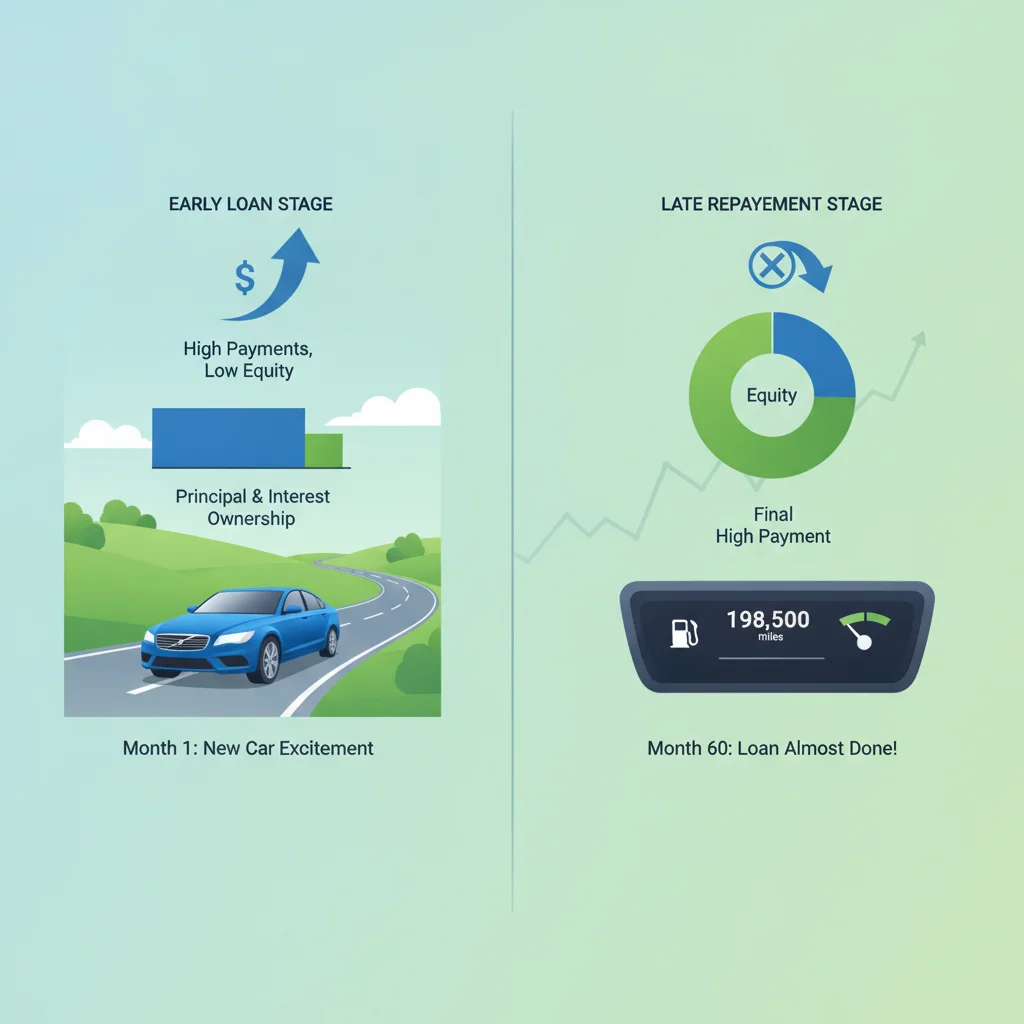
Auto loans are structured as amortizing loans, which means your monthly payment is mathematically allocated so that interest is paid first and principal second. In the early months of repayment, the vast majority of each payment goes toward interest. As you progress through the loan, that ratio gradually flips until, in the final months, nearly every dollar goes toward principal.
This front-loading of interest is exactly why timing a refinance matters so much. If you refinance in month 3 of a 60-month loan, you are resetting the amortization clock on a balance that still has almost all of its interest ahead of it — which means a lower rate produces genuine, meaningful savings. If you refinance in month 50 of that same loan, almost all your interest is already paid. A lower rate on the remaining balance generates only marginal savings, and closing costs may exceed what you'd recover.
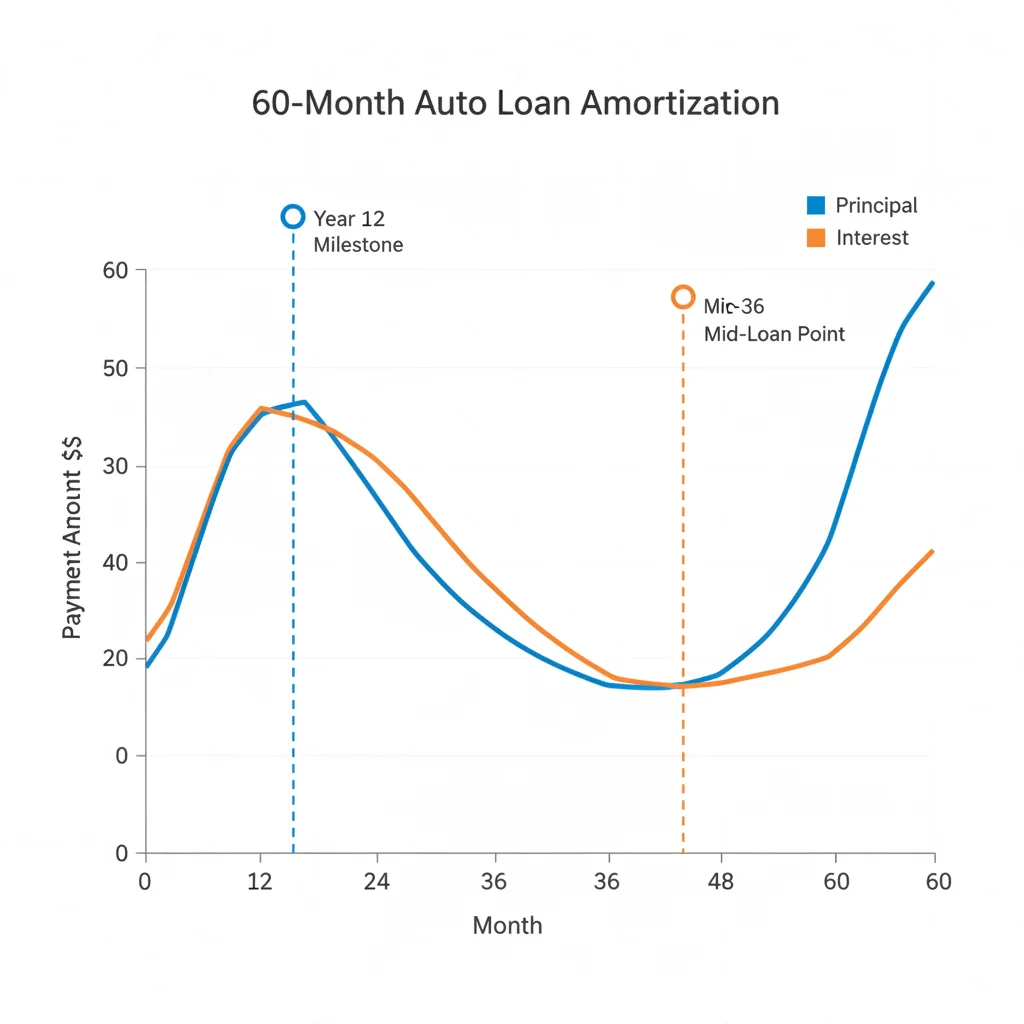
Understanding this dynamic lets you evaluate refinancing not as a yes-or-no question, but as a timing question. The sections below break down the two scenarios — early refinancing and late refinancing — so you can recognize where you stand and what the real numbers look like for your situation.
For a complementary perspective, see whether your trigger is a market rate drop or personal credit improvement — because the reason you're refinancing matters as much as when.
Refinancing Early: The Front-Loaded Opportunity
The first 12 to 24 months of an auto loan represent the highest-leverage window for refinancing. Here's why: your outstanding principal is at its largest, interest has barely been paid down, and the amortization schedule still has years of interest payments ahead of it. A rate reduction at this stage applies to the maximum possible balance for the maximum remaining term.
A Concrete Example
Suppose you took out a $28,000 loan at 9.5% APR for 60 months. Your monthly payment is approximately $586, and your total interest over the life of the loan is around $7,160. At month 12, you've paid roughly $2,260 in interest and your remaining balance is about $24,400.
If you refinance that $24,400 balance at 6.2% APR for the remaining 48 months, your new monthly payment drops to approximately $576 — a modest reduction — but your remaining interest falls from roughly $4,900 to about $3,250. That's over $1,600 in saved interest, before fees. The lower the new rate relative to the original, the larger that savings figure becomes.
| Criterion | Refinancing Early (Months 1–24) | Refinancing Late (Months 30+) |
|---|---|---|
| Remaining interest at stake | High — most interest still unpaid | Low — most interest already paid |
| Potential interest savings | Substantial (often $1,000–$3,000+) | Modest (often under $600) |
| Break-even timeline | Typically 6–12 months | May exceed remaining loan life |
| Prepayment penalty risk | Higher — balance is larger | Lower — balance is smaller |
| Monthly payment reduction | Moderate (rate-driven) | Larger if term extended significantly |
| Risk of extending into negative equity | Higher — vehicle depreciates faster early on | Lower — loan balance closer to vehicle value |
| Primary benefit | Total interest reduction | Monthly cash flow relief |
| Best trigger | Rate drop or credit score improvement | Income disruption or payment hardship |
What Makes Early Refinancing Work
- Improved credit score: If your score has risen 40+ points since origination, you may now qualify for a substantially lower rate tier. This is especially powerful if your original loan was subprime. See refinancing out of a high-rate subprime loan for a detailed breakdown of this scenario.
- Rate environment shift: If benchmark interest rates have dropped since you signed your loan, you may qualify for a lower rate even without a credit score change.
- Better lender competition: Dealership financing often carries marked-up rates. Refinancing through a credit union or direct lender early can recover that markup.
The Early-Refinance Risk: Prepayment Penalties
Some auto loans — particularly those originated through dealerships or subprime lenders — include prepayment penalty clauses. Paying off the loan early (which a refinance technically does) triggers a fee that can run 1–3% of the outstanding balance. On a $24,000 balance, that's up to $720 in penalties that directly offset your savings.
Always request a payoff quote from your current lender before applying for a refinance, and ask explicitly whether a prepayment penalty applies. Prepayment penalties can quietly kill refinancing savings — know this number before you proceed.
Minimum Seasoning Requirements Vary by Lender
Most lenders won't refinance a loan that was originated fewer than 60–90 days ago, and many require 6 months of payment history. Credit unions often have more flexible seasoning policies than traditional banks. Always confirm seasoning requirements before spending time on an application, as a hard credit inquiry will affect your score regardless of whether the loan is approved.
Break-Even Timing Must Account for All Costs
Your break-even calculation should include lender administrative fees, title transfer fees, any DMV or registration costs, and prepayment penalties on the original loan. Missing even one of these inputs can make a marginally profitable refinance look better than it actually is. Request an itemized fee disclosure from any lender before applying.
Underwater Loans Complicate Refinancing at Any Stage
If your vehicle's current market value is less than your loan payoff balance, you are considered 'underwater' or 'upside-down.' Most lenders will not refinance a loan where the balance exceeds the vehicle's value, because the car serves as collateral. This situation is most common early in a loan when depreciation is steepest, particularly if you put little or no money down at purchase.
Also worth considering: you typically need to wait at least 60–90 days after origination before most lenders will refinance a loan. Some require 6 months of payment history. Don't assume you can refinance on day one — check with prospective lenders about their minimum seasoning requirements.
Refinancing Late: Lower Payments, Limited Interest Savings
By the time you're deep into repayment — say, 30 or more months into a 60-month loan — the amortization math has shifted significantly against you as a refinancer. You've already paid most of the interest baked into the original schedule. The remaining balance is smaller, the remaining term is shorter, and a rate reduction affects a proportionally smaller interest pool.
Running the Late-Stage Numbers
Using the same $28,000 loan at 9.5% APR example: at month 36, your remaining balance is approximately $14,800, and you have 24 months left. Your remaining interest obligation at the original rate is roughly $1,500.
If you refinance at 6.2% for those same 24 months, your remaining interest drops to about $960. That's a savings of roughly $540 — which is real money, but likely less than the refinancing fees and closing costs you'd incur. Most lenders charge $200–$500 in administrative and title transfer fees. Factor in a potential prepayment penalty, and the math may turn negative.
~43%
Of total interest paid in first 12 months
On a typical 60-month loan at 9% APR, roughly 43% of lifetime interest is paid in the first year, illustrating why early refinancing is most impactful.
$200–$500
Typical auto refinance closing costs
According to industry data from Experian and LendingTree, most auto loan refinances carry $200–$500 in lender and title transfer fees that must be recovered through interest savings.
40+ points
Credit score improvement needed for a better rate tier
Lenders typically require a 40-point or greater credit score increase from origination to offer a materially lower rate tier that justifies refinancing costs.
1–3%
Prepayment penalty range on penalized loans
Borrowers with prepayment penalty clauses — more common in subprime and dealer-arranged loans — may face fees of 1–3% of outstanding balance for early payoff.
6–12 months
Minimum seasoning before most lenders will refinance
Many banks and credit unions require 6–12 months of payment history on the original loan before approving a refinance application.
When Late-Stage Refinancing Still Makes Sense
There are legitimate reasons to refinance even in the back half of a loan, but they are driven by cash flow need, not interest optimization:
- Payment unaffordability: If your income has dropped due to a job change, divorce, or health issue, extending the loan term through a refinance can lower your monthly payment even if it raises total interest. A lower payment you can sustain beats a lower interest total you can't afford. See refinancing after a major life change for a deeper look at this scenario.
- Dramatically improved credit: If your score jumped from 580 to 720 mid-loan, the rate reduction available to you may be large enough to overcome the diminishing interest savings of late-stage refinancing.
- Avoiding default: A restructured payment that prevents missed payments and credit score damage may be worth more than the interest cost difference. Protecting your credit profile has long-term financial value that doesn't show up in an interest savings calculation.
That said, if you're in the final 12 months of repayment and financially stable, the case for refinancing is extremely weak. Refinancing in the last year of a loan rarely saves enough to justify the cost — and it restarts your relationship with a lender unnecessarily.

Head-to-Head: Key Differences at a Glance
To make the comparison concrete, here's how early and late refinancing stack up across the metrics that matter most to borrowers.
| Criterion | Refinancing Early (Months 1–24) | Refinancing Late (Months 30+) |
|---|---|---|
| Remaining interest at stake | High — most interest still unpaid | Low — most interest already paid |
| Potential interest savings | Substantial (often $1,000–$3,000+) | Modest (often under $600) |
| Break-even timeline | Typically 6–12 months | May exceed remaining loan life |
| Prepayment penalty risk | Higher — balance is larger | Lower — balance is smaller |
| Monthly payment reduction | Moderate (rate-driven) | Larger if term extended significantly |
| Risk of extending into negative equity | Higher — vehicle depreciates faster early on | Lower — loan balance closer to vehicle value |
| Primary benefit | Total interest reduction | Monthly cash flow relief |
| Best trigger | Rate drop or credit score improvement | Income disruption or payment hardship |
The table above makes clear that early refinancing wins on almost every financial metric. However, late refinancing has a legitimate role when payment sustainability is the priority — it just shouldn't be framed as an interest-saving move.
One dimension the table can't fully capture is loan term extension risk. When you refinance late, you may be tempted to extend the loan term significantly to bring payments down. Refinancing a 24-month remaining balance into a new 48-month loan cuts your payment roughly in half — but you're back to paying a large share of interest on a front-loaded amortization schedule. Over the full new term, your total cost may exceed what you'd have paid staying in the original loan. Understanding the real cost of longer versus shorter refinance terms is essential before making this decision.
Calculating Your Break-Even Point Before You Commit
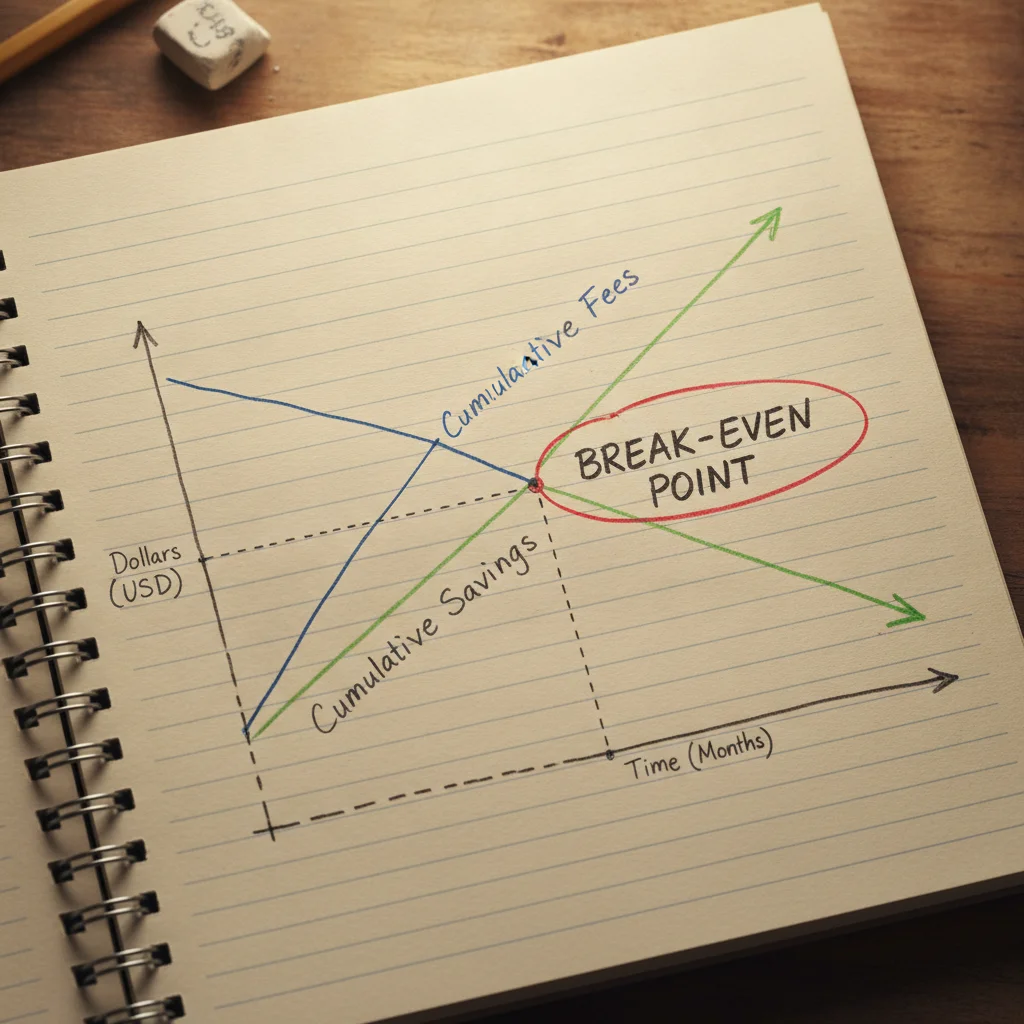
Regardless of where you are in your loan, the single most important calculation before refinancing is your break-even point — the month at which your cumulative interest savings exceed the total cost of refinancing.
The formula is straightforward:
Break-Even (months) = Total Refinancing Costs ÷ Monthly Interest Savings
If you're saving $45 per month in interest and you paid $400 in fees, your break-even is roughly 9 months. If you plan to keep the vehicle for at least 9 more months after refinancing, the deal pays off. If you're likely to sell or trade in sooner, it doesn't.
Here's where timing creates a compounding problem for late-stage refinancers: the closer you are to payoff, the less time you have to recoup fees, and the smaller your monthly interest savings to begin with. The break-even point may actually fall after the loan would have ended — meaning you never recoup the cost.
Minimum Seasoning Requirements Vary by Lender
Most lenders won't refinance a loan that was originated fewer than 60–90 days ago, and many require 6 months of payment history. Credit unions often have more flexible seasoning policies than traditional banks. Always confirm seasoning requirements before spending time on an application, as a hard credit inquiry will affect your score regardless of whether the loan is approved.
Break-Even Timing Must Account for All Costs
Your break-even calculation should include lender administrative fees, title transfer fees, any DMV or registration costs, and prepayment penalties on the original loan. Missing even one of these inputs can make a marginally profitable refinance look better than it actually is. Request an itemized fee disclosure from any lender before applying.
Underwater Loans Complicate Refinancing at Any Stage
If your vehicle's current market value is less than your loan payoff balance, you are considered 'underwater' or 'upside-down.' Most lenders will not refinance a loan where the balance exceeds the vehicle's value, because the car serves as collateral. This situation is most common early in a loan when depreciation is steepest, particularly if you put little or no money down at purchase.
For early refinancers, break-even typically arrives within 6–12 months because monthly savings are larger (applied to a bigger balance over more remaining payments) and the remaining loan life is long enough to capture compounding savings.
Walk through the full break-even calculation with your actual numbers — it's the most objective tool for making this decision.
Also consider whether there are alternatives to refinancing entirely. Accelerated payoff versus refinancing compares two paths to reducing total loan cost — sometimes paying extra each month beats refinancing when you're already mid-loan.
Practical Checklist: Are You in a Good Position to Refinance?
Before submitting a refinance application, run through these checkpoints to assess whether your timing and financial profile support a beneficial refinance:
- Confirm your loan age: Are you within the first 30 months of repayment? If yes, interest savings potential is highest. If beyond 36 months on a 60-month loan, recalculate carefully.
- Check your current interest rate: If your rate is below 5%, the room for improvement is narrow. If it's above 8%, the savings potential justifies exploring options at almost any loan stage.
- Pull your credit score: Compare today's score to your score at origination. A 40-point improvement or more typically unlocks meaningfully better rate tiers. Getting preapproved with multiple lenders lets you see exactly what rate your current profile qualifies for without committing.
- Request a payoff quote: Contact your current lender for an official payoff amount, including any prepayment penalty. This is your refinancing starting balance.
- Estimate new monthly payment and interest total: Use your payoff balance, the new rate you've been offered, and your desired loan term. Compare total interest under the new loan versus the original remaining schedule.
- Calculate your break-even point: Divide total refinancing costs by monthly interest savings. Ensure you plan to keep the vehicle past that break-even month.
- Consider loan-to-value ratio: If your vehicle is worth less than the payoff balance (you're underwater), many lenders won't refinance. This is more likely when refinancing early if you put little money down.
Minimum Seasoning Requirements Vary by Lender
Most lenders won't refinance a loan that was originated fewer than 60–90 days ago, and many require 6 months of payment history. Credit unions often have more flexible seasoning policies than traditional banks. Always confirm seasoning requirements before spending time on an application, as a hard credit inquiry will affect your score regardless of whether the loan is approved.
Break-Even Timing Must Account for All Costs
Your break-even calculation should include lender administrative fees, title transfer fees, any DMV or registration costs, and prepayment penalties on the original loan. Missing even one of these inputs can make a marginally profitable refinance look better than it actually is. Request an itemized fee disclosure from any lender before applying.
Underwater Loans Complicate Refinancing at Any Stage
If your vehicle's current market value is less than your loan payoff balance, you are considered 'underwater' or 'upside-down.' Most lenders will not refinance a loan where the balance exceeds the vehicle's value, because the car serves as collateral. This situation is most common early in a loan when depreciation is steepest, particularly if you put little or no money down at purchase.
If you pass all seven checkpoints and the break-even math is favorable, refinancing is likely a smart financial move. If two or more checkpoints raise red flags, take time to address them — particularly your credit score and payoff penalty status — before applying.
The goal of this checklist isn't to discourage refinancing. It's to ensure that when you do refinance, you've done it at a moment that actually benefits your finances — not just your lender's balance sheet.
For ongoing strategies to pay down your loan faster regardless of whether you refinance, explore practical early payoff methods that work in parallel with or instead of a refinance.

All claims are backed by peer-reviewed research. Sources on request.