


Key Takeaways
Start here
Interest Rate vs. APR: The Core Difference
Build on it
How Auto Loan Interest Is Calculated
Go deeper
What Determines Your Rate
Apply it
How to Compare Loan Offers Without Getting Burned
See the big picture
Loan Term Length and Its Hidden Cost
Protect yourself
Common First-Timer Mistakes and How to Avoid Them
Interest Rate vs. APR: The Core Difference
When a dealer or lender quotes you a number, make sure you know which number you're looking at. Most people use "interest rate" and "APR" interchangeably, but they are not the same thing, and mixing them up can cost you real money.
Interest Rate
The basic annual percentage a lender charges on the money you borrow. It does not include fees — it's just the cost of the borrowed principal itself.
APR (Annual Percentage Rate)
The interest rate plus any lender fees, expressed as a single annual percentage. APR is always equal to or higher than the interest rate and gives a truer picture of the loan's total cost.
Simple Interest
A method of calculating interest where you only pay interest on the remaining loan balance, not on previously accumulated interest. Most auto loans use this method.
Amortization
The schedule of payments that pays down a loan over time. Early payments are mostly interest; later payments are mostly principal. A full amortization table shows this split for every payment.
Principal
The actual amount of money you borrowed, not counting interest or fees. Each monthly payment chips away at the principal until the balance reaches zero.
Finance Charge
The total dollar amount you will pay in interest and fees over the life of the loan. It's the difference between what you borrowed and what you pay back in total.
Dealer Reserve
The markup a dealer adds to the interest rate above what the lender actually requires. The dealer keeps this difference as profit. It's legal but negotiable.
Loan-to-Value (LTV)
The ratio of your loan amount to the vehicle's value. A higher LTV means more risk for the lender and can result in a higher rate or loan denial.
The interest rate is simply the annual cost of borrowing the principal — the raw percentage the lender charges on the money you owe. The APR (Annual Percentage Rate) layers on top of that: it includes the interest rate plus any fees the lender rolls into the financing, such as origination fees, documentation fees, or other finance charges. The result is expressed as a single annualized percentage so you can compare apples to apples.
Here's why this matters in practice. A lender might advertise a 6.5% interest rate but charge a $400 origination fee. Once that fee is folded in, the APR on a $20,000, 60-month loan rises to roughly 6.9%. That gap is small in this example, but it widens fast on shorter loan terms or when dealers bundle multiple fees into the financing.
Rule of thumb: always ask for the APR, not just the rate. Federal law (the Truth in Lending Act) requires lenders to disclose APR before you sign, so there's no excuse for not knowing this number. If a salesperson keeps steering you back to the monthly payment instead of APR, that's a signal they'd rather you not think about the total cost.
APR Disclosure Is Required by Law
Under the federal Truth in Lending Act (TILA), lenders must disclose the APR, finance charge, amount financed, and total of payments before you sign any loan agreement. If a lender or dealer is reluctant to show you these figures in writing before you commit, that is a serious red flag.
Loan Term vs. Ownership Timeline
Most financial advisors recommend keeping your loan term equal to or shorter than the period you realistically plan to keep the vehicle. If you typically trade cars every four years, a 72-month loan means you'll likely owe money on a car you no longer own — leaving you with negative equity that rolls into your next loan.
For a full breakdown of every term you'll encounter on a loan offer — including finance charge, amortization, and more — see our auto loan interest glossary.
How Auto Loan Interest Is Calculated
Most auto loans use simple interest, not compound interest. That's actually good news for you. With simple interest, you only pay interest on the outstanding principal balance — the amount you actually still owe. As you make payments and reduce that balance, the amount of interest you owe each month shrinks alongside it.
Here's how the monthly interest charge is calculated:
Daily Interest = (Principal Balance × Annual Rate) ÷ 365
Monthly Interest ≈ Daily Interest × Days Since Last Payment
For example: You borrow $25,000 at a 7% annual rate. Your first month's interest charge is roughly ($25,000 × 0.07) ÷ 12 = $145.83. Your monthly payment (on a 60-month term) would be about $495. That means only $349 goes toward your actual loan balance in month one. The rest is pure interest cost.
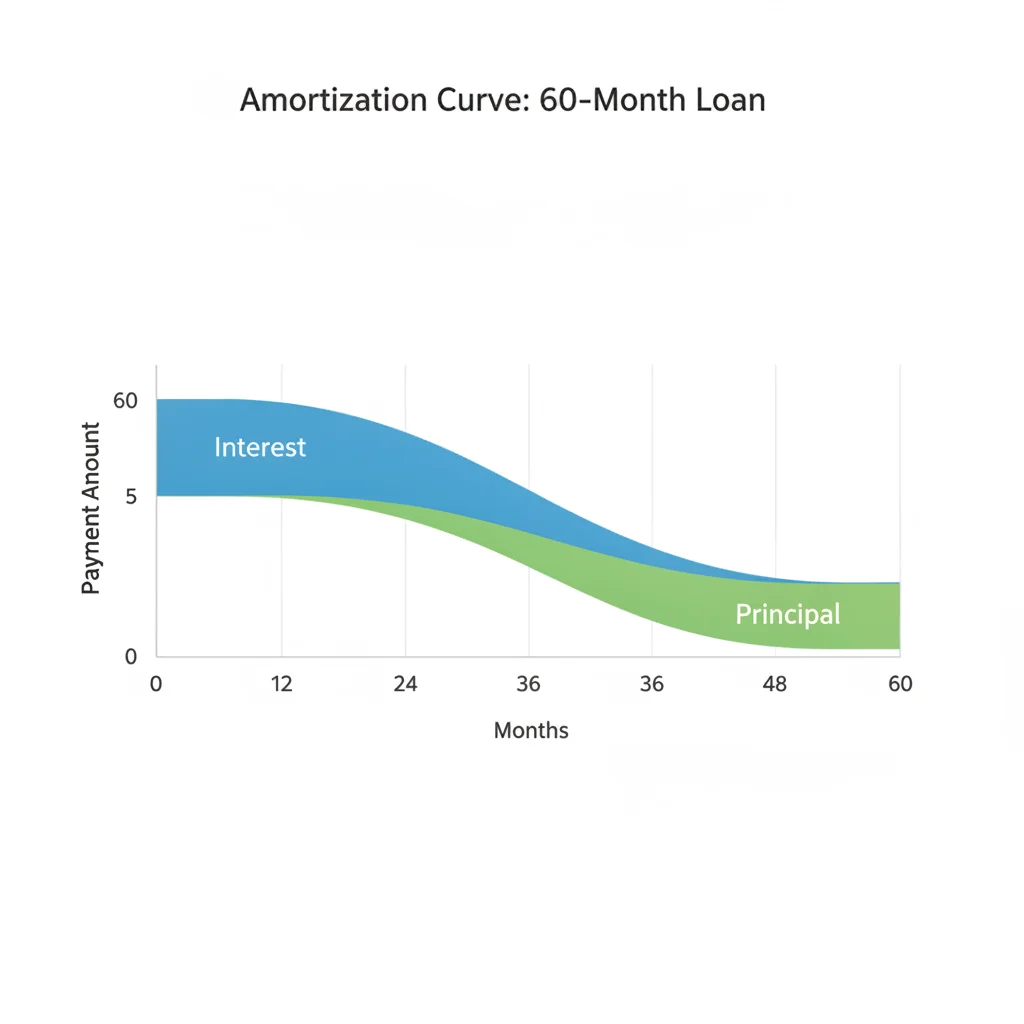
This structure is called amortization, and it front-loads interest payments. Early in the loan, most of your payment is interest. As months go by, the interest portion shrinks and the principal portion grows. This is why paying off a loan early saves you real money — you're cutting off months at the end of the schedule where your payments would finally be doing more to reduce the principal.
See our guide to early auto loan payoff for strategies to reduce total interest without disrupting your budget.
Make Your First Payment Early
Because auto loan interest accrues daily on your remaining balance, making your first payment even a week early reduces the amount of interest that accumulates before your payment is applied. It's a small habit that costs nothing and saves a little each month over the life of the loan.
Rate-Shop Within a 14-Day Window
Applying to multiple lenders within a 14-day period counts as a single credit inquiry for scoring purposes under FICO's guidelines. Don't let fear of a credit ding stop you from comparing three or four lenders — the potential savings far outweigh any minor, temporary score impact.
What Determines Your Rate
Your APR isn't random. Lenders price risk, and every factor below is a signal to them about how likely you are to repay. Understanding these factors tells you exactly what to work on before you apply.
Credit Score
This is the biggest lever. Lenders sort borrowers into tiers — often called super-prime, prime, near-prime, subprime, and deep-subprime — and each tier gets a different rate range. The difference between a 620 score and a 720 score can easily be 5–8 percentage points of APR on the same vehicle. On a $25,000 loan over 60 months, that gap represents over $5,000 in additional interest paid.
| Credit Tier | Typical Score Range | Approximate New Car APR (2024) |
|---|---|---|
| Super Prime | 781–850 | 5.0%–6.5% |
| Prime | 661–780 | 6.5%–9.0% |
| Near Prime | 601–660 | 9.0%–13.5% |
| Subprime | 501–600 | 13.5%–18.5% |
| Deep Subprime | 300–500 | 18.5%–25%+ |
Loan Term
Longer terms (72 or 84 months) typically carry slightly higher rates because lenders take on more risk over a longer repayment period. A 36-month loan almost always gets a lower rate than a 72-month loan on the same vehicle, even with identical credit.
New vs. Used Vehicle
New car loans consistently carry lower rates than used car loans. Lenders view new vehicles as more predictable collateral — the value is established, and there's less history of mechanical problems. Used car rates run 1–4 percentage points higher on average.
Lender Type
Credit unions typically offer the most competitive rates, often 0.5–2% below what banks or captive dealer lenders quote for the same borrower profile. Banks fall in the middle. Dealer-arranged financing can be competitive, but dealers have financial incentive to mark up the rate above what the lender requires — a practice called the dealer reserve.
Down Payment Size
A larger down payment reduces the lender's risk because you immediately have more equity in the vehicle. Some lenders reward this with a slightly lower rate. It also reduces your loan-to-value ratio, which affects approval odds and terms. Learn how down payment size affects your overall borrowing cost in our complete guide to auto loan down payments.
The Dealer Markup You Won't See on the Sheet
Dealer-arranged financing often includes a rate markup above what the lender actually requires. The loan documents won't label it as such — the APR listed is the final rate you're paying, but you have no way of knowing the lender's buy rate. This is why having a competing pre-approval is essential: it creates a ceiling the dealer must beat, rather than a mystery number you accept by default.
Long Terms and Upside-Down Loans
An 84-month loan on a new car with a small down payment can leave you owing 20–30% more than the car is worth for the first two or three years. If you need to sell, trade in, or the car is totaled without GAP coverage, you will owe that difference out of pocket. Think carefully before accepting any loan term beyond 60 months.
How to Compare Loan Offers Without Getting Burned
Shopping multiple lenders is the single most effective thing you can do to lower your auto loan cost. But comparing offers requires looking at the right numbers — and avoiding the traps dealers use to obscure the real cost.
Always Compare APR, Not Monthly Payment
A dealer can make almost any loan look affordable by stretching the term. A $35,000 loan at 9% APR over 72 months gives you a monthly payment of about $615. The same loan at 7% APR over 60 months costs $693/month — but you pay roughly $4,200 less in total interest and finish repaying 12 months sooner. Focusing on the monthly payment lets dealers obscure those tradeoffs.
Get Pre-Approved Before You Walk In
A pre-approval from your bank or credit union does two things: it tells you the real rate you qualify for, and it gives you a ceiling the dealer must beat to earn your financing business. Without a competing offer, you have no anchor. With one, you do.
Apply to two or three lenders within a 14-day window. Credit scoring models treat multiple auto loan inquiries within a short period as a single inquiry, so rate-shopping doesn't hurt your score the way people fear.
Check for Add-On Fees in the Financing
Dealers often bundle products — GAP insurance, extended warranties, paint protection — into the loan amount without making it obvious. Each dollar added to the financed amount means you pay interest on that dollar for the life of the loan. Ask for an itemized breakdown of exactly what's in the loan amount before you agree to anything. See our guide to car buying contracts and paperwork to know what to look for at signing.
Understand the Total Cost of the Loan
Your loan disclosure should show you the total amount you will pay over the life of the loan. Subtract the amount borrowed, and the difference is your total interest cost. This number is far more revealing than the interest rate or the monthly payment alone.
Make Your First Payment Early
Because auto loan interest accrues daily on your remaining balance, making your first payment even a week early reduces the amount of interest that accumulates before your payment is applied. It's a small habit that costs nothing and saves a little each month over the life of the loan.
Rate-Shop Within a 14-Day Window
Applying to multiple lenders within a 14-day period counts as a single credit inquiry for scoring purposes under FICO's guidelines. Don't let fear of a credit ding stop you from comparing three or four lenders — the potential savings far outweigh any minor, temporary score impact.
Loan Term Length and Its Hidden Cost
The market has shifted toward longer loan terms over the last decade. The average new car loan term is now over 69 months, and 84-month (7-year) loans are commonplace. Dealers promote them because the lower monthly payment makes expensive vehicles feel affordable. Here's what the payment hides.
The Interest Cost of Going Long
Take a $30,000 loan at 7% APR and look at how total interest cost changes with term length:
| Term | Monthly Payment | Total Interest Paid | Total Cost |
|---|---|---|---|
| 36 months | $926 | $3,336 | $33,336 |
| 48 months | $718 | $4,464 | $34,464 |
| 60 months | $594 | $5,640 | $35,640 |
| 72 months | $513 | $6,936 | $36,936 |
| 84 months | $452 | $7,968 | $37,968 |
Going from 36 to 84 months saves $474 per month — but costs you an extra $4,632 in interest. You also own the car for seven years, during which time repairs, depreciation, and the desire to buy something newer can all become painful problems.
Negative Equity Risk
Longer terms mean slower principal paydown. Cars depreciate fast — a new vehicle can lose 15–25% of its value in the first year. On a 72 or 84-month loan with a small down payment, it's common to owe more than the car is worth for years. That condition is called being underwater or having negative equity. If you total the car or want to sell, you'll owe the difference out of pocket.
The loan terms explained hub covers how term length, monthly payments, and total cost interact across different scenarios.
APR Disclosure Is Required by Law
Under the federal Truth in Lending Act (TILA), lenders must disclose the APR, finance charge, amount financed, and total of payments before you sign any loan agreement. If a lender or dealer is reluctant to show you these figures in writing before you commit, that is a serious red flag.
Loan Term vs. Ownership Timeline
Most financial advisors recommend keeping your loan term equal to or shorter than the period you realistically plan to keep the vehicle. If you typically trade cars every four years, a 72-month loan means you'll likely owe money on a car you no longer own — leaving you with negative equity that rolls into your next loan.
Common First-Timer Mistakes and How to Avoid Them
I spent years in dealer finance offices. The same mistakes show up over and over with first-time buyers. Here they are, plainly stated.
Mistake 1: Negotiating on Payment Instead of Price
When you let the conversation become about monthly payment, the dealer controls all the variables — price, rate, term, and add-ons. They can keep your payment where you want it while quietly increasing the vehicle price, stretching the term, or hiking the rate. Negotiate the vehicle price first, then the financing separately.
Mistake 2: Skipping Pre-Approval
Walking into a dealership without a pre-approval is like negotiating a salary without knowing your market rate. You don't know if the dealer's offer is good or bad because you have nothing to compare it to. Get pre-approved first — it takes 20 minutes online with most banks and credit unions.
Mistake 3: Ignoring the Full Loan Disclosure
Before signing, you are legally entitled to a Truth in Lending disclosure that shows the APR, total finance charge, total payments, and payment schedule. Read it. If any number surprises you, ask for an explanation before you sign.
Mistake 4: Financing Add-Ons You Don't Need
GAP insurance, extended warranties, and paint/fabric protection are often presented as part of the loan package rather than optional extras. Some of them are worth having — but at a price you negotiate, not the dealer's retail markup. Financing a $2,500 extended warranty at 8% APR over 60 months adds roughly $600 in interest on top of the warranty cost.
Mistake 5: Not Thinking About Refinancing Later
If you're a first-time buyer and you can't get a great rate today, that doesn't mean you're stuck forever. Once you've made 12–18 months of on-time payments and your credit score has improved, refinancing into a lower rate is a legitimate and often underused option. Our first-timer's guide to auto loan refinancing walks through exactly when and how to do it.

If your credit score is the barrier right now, our bad credit auto loan walkthrough covers every step from knowing your score to signing a loan that doesn't trap you.
Auto Loan Payment Calculator
Plug in your loan amount, interest rate, and term to see your estimated monthly payment and total interest cost before you commit to any offer.
Auto Loan Interest Glossary
A plain-English reference covering every term you'll encounter on a loan disclosure — APR, amortization, finance charge, and more — so nothing catches you off guard at signing.
AnnualCreditReport.com
The official site to access your free credit reports from all three bureaus. Review your report before applying so you know exactly what lenders will see and can dispute any errors.
Credit Union Finder (NCUA)
Use the National Credit Union Administration's search tool to find federally insured credit unions you're eligible to join — often your best source for competitive auto loan rates.
The Dealer Markup You Won't See on the Sheet
Dealer-arranged financing often includes a rate markup above what the lender actually requires. The loan documents won't label it as such — the APR listed is the final rate you're paying, but you have no way of knowing the lender's buy rate. This is why having a competing pre-approval is essential: it creates a ceiling the dealer must beat, rather than a mystery number you accept by default.
Long Terms and Upside-Down Loans
An 84-month loan on a new car with a small down payment can leave you owing 20–30% more than the car is worth for the first two or three years. If you need to sell, trade in, or the car is totaled without GAP coverage, you will owe that difference out of pocket. Think carefully before accepting any loan term beyond 60 months.
All claims are backed by peer-reviewed research. Sources on request.