Key Takeaways
Our Verdict
No single tool wins outright — each serves a different purpose in the trade-in process. Edmunds gives you the most realistic baseline for dealer negotiations. CarGurus tells you what real-world buyers are paying right now. KBB's Instant Cash Offer converts an estimate into an actual check you can hold dealers accountable to. Use all three together and you'll walk in with a number no dealer can easily dismiss.
| Best for | Recommended |
|---|---|
| Setting a realistic floor for dealership negotiation | Edmunds |
| Understanding current live market demand for your vehicle | CarGurus |
| Converting an estimate into a firm, binding offer | KBB Instant Cash Offer |
| Getting a quick ballpark before deciding whether to trade in or sell privately | KBB Trade-In Range |
Why Trade-In Estimates Vary So Widely
Walk into a dealership with a printout from Kelley Blue Book and the desk manager will nod politely — then hand you a number $2,000 lower than what you printed. That gap isn't accidental. It's structural, and understanding why starts with how these tools actually build their estimates.
KBB, Edmunds, and CarGurus don't pull from the same well. KBB leans heavily on wholesale auction transaction data blended with dealer retail listings. Edmunds uses a proprietary algorithm that weights actual completed transactions more aggressively, including what dealers are paying at auction. CarGurus takes a different route entirely: it anchors its estimates to live market listings on its own platform, adjusted for how long similar cars are sitting unsold.
The result? A 2020 Honda Accord EX-L with 52,000 miles might fetch a $17,500 trade-in estimate from KBB, a $16,800 range from Edmunds, and a $17,200 market value signal from CarGurus — all on the same afternoon. None of those numbers is wrong. They're just measuring different things.
See the full breakdown of what each tool is actually calculating if you want to understand the methodology differences in detail. For now, the critical point is this: before you trade in, you need to know which number to present, which to verify, and which dealers will actually respect.
Kelley Blue Book: The Household Name With Two Different Products
KBB is the brand everyone recognizes, but most sellers don't realize they're actually looking at two distinct products when they use the site — and confusing them is an expensive mistake.
KBB Trade-In Range
The Trade-In Range is the estimate most people see when they plug in their vehicle details. It spits out a low-to-high range (for example, $14,200–$16,500 for a fair-to-good condition car) and tells you where your car might land depending on local dealer appetite. This is a reference estimate — useful for orientation, not for negotiation. Dealers are fully aware of how KBB constructs these ranges, and they know how to discount them.
KBB Instant Cash Offer
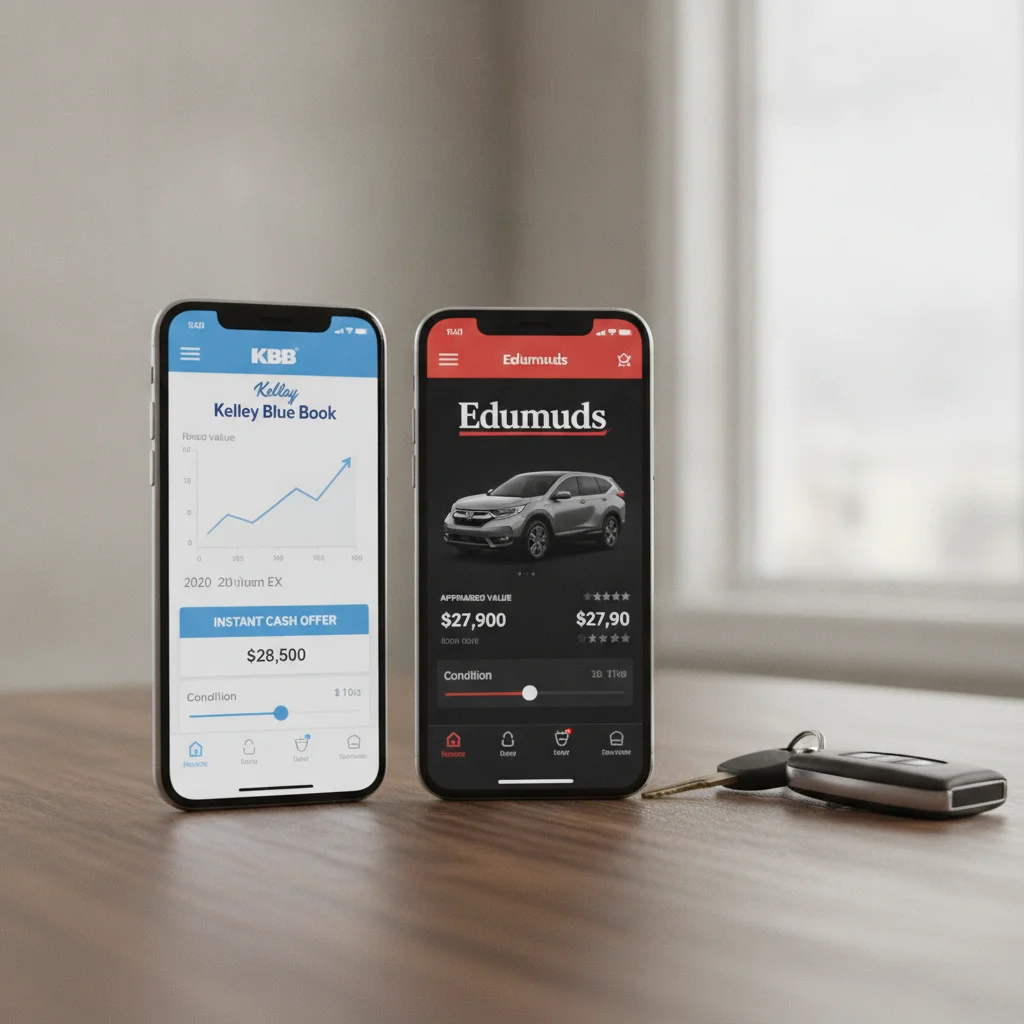
This is where KBB gets genuinely useful for trade-ins. The Instant Cash Offer (ICO) is a partnership program where participating dealers commit to honoring a specific dollar amount for a set period — typically seven days. You get an actual offer number, tied to actual inventory demand at specific dealerships near you. That's a fundamentally different animal from a range estimate.
The catch: the ICO is only redeemable at participating dealers. If the dealer closest to you isn't in the network, the offer becomes a negotiating prop rather than a hard floor. Still, having a signed ICO printout dramatically changes the energy at a dealer's appraisal desk.
Use the KBB ICO as a Negotiating Floor
Even if you prefer to trade in at a dealership that isn't in KBB's ICO network, generate an Instant Cash Offer anyway. Print it out with the timestamp visible. When the appraising dealer comes in lower, slide the ICO across the desk and ask them to beat it. The offer doesn't have to be redeemable at that dealer to function as a pricing anchor — and anchoring is one of the most powerful forces in any negotiation.
Document Maintenance Before Your Appraisal
Gather every service record you have — oil changes, tire replacements, brake work, inspections. Presenting a maintenance history at appraisal makes it harder for a dealer to downgrade your condition rating without justification. A car with documented records is a known quantity, and dealers pay more for certainty. Even a $40 detail job before the appraisal can influence how an appraiser fills out their condition sheet.
One more thing dealers know about KBB that most sellers don't: KBB is owned by Cox Automotive, the same parent company that owns Manheim auctions — where most dealers buy and sell wholesale inventory. That's not a conspiracy, but it does mean KBB's data and dealer relationships are deeply intertwined. For a deeper look at how this shapes estimates, the KBB vs. Edmunds seller comparison breaks it down plainly.
Edmunds: The Dealer-Realistic Benchmark
Edmunds built its reputation on True Market Value (TMV), a transaction-based pricing model that reflects what people are actually paying — not what dealers are asking. That same philosophy carries into its trade-in tool, and it makes Edmunds arguably the most tactically useful estimate for trade-in negotiations.
When Edmunds gives you a trade-in estimate, it's weighted toward what dealers are realistically paying for vehicles at that moment — pulling from completed sales, dealer acquisition data, and regional market conditions. It also adjusts for local supply and demand, so a truck in Dallas will carry a different Edmunds trade-in value than the identical truck in San Francisco.
The Edmunds estimate tends to land slightly lower than KBB's high-end figure, and that's actually a feature, not a bug. It's calibrated to what dealers are likely to offer rather than what they theoretically could offer. If your Edmunds estimate and your KBB estimate are close, that's a good sign you're in realistic territory. If KBB is running $2,000 higher than Edmunds, lean on the Edmunds number as your baseline — it's what a well-informed buyer's agent would consider fair market for a trade.
Never Negotiate Trade-In and Purchase Price Together
This is the most common and costly mistake sellers make in the finance office. Dealers frequently offer an inflated trade-in value while quietly adding margin on the new car side — or vice versa. Always settle your trade-in value first, get it in writing, and then negotiate the new car price separately. If a dealer insists on handling both at once, that's a signal they're managing the blended margin, not giving you a fair deal on either.
Online Estimates Are Not Dealer Commitments
KBB Trade-In Range, Edmunds, and CarGurus estimates are all reference tools — they carry no obligation from any dealership. Dealers know this, and some will use a high estimate you found online to build rapport before deflating the actual appraisal number. Only a signed, time-stamped KBB Instant Cash Offer from a participating dealer carries any binding weight. Treat all other estimates as research, not commitments.
Edmunds doesn't offer a binding cash offer program the way KBB does, which is a real limitation. Its value is primarily informational — a calibration tool, not a closing instrument. But for informational tools, it's the sharpest one in the shed for trade-in prep.
CarGurus: The Live Market Signal
CarGurus takes a different approach than either KBB or Edmunds, and it's worth understanding precisely what that difference means for trade-in strategy.
Rather than relying primarily on wholesale auction transaction data or proprietary algorithms built from historical sales, CarGurus anchors its estimates to live dealer listings on its own marketplace. It tracks how long cars at various price points are sitting, adjusts for regional supply, and rates listings as "Good Deal," "Great Deal," or "Overpriced" accordingly. Its trade-in estimate is essentially a reverse-engineered version of that same market intelligence: what would a dealer realistically need to pay you, given what they'd list a car like yours for, their margin requirements, and how fast similar vehicles are turning in your area?
This makes CarGurus particularly strong in two scenarios:
- High-demand vehicles — If your car is selling fast in your market, CarGurus will reflect that upward pressure faster than KBB or Edmunds, which update on slower cycles.
- Unique or niche vehicles — For cars with limited comparables, CarGurus' live-listing approach can surface real-time scarcity that historical tools miss entirely.
The limitation is the inverse: CarGurus' estimates can be volatile. In a cooling market, its numbers may drop faster than KBB's, which is either a warning or a lagging problem depending on your timing. For a full side-by-side of how CarGurus stacks up against the other major tools, see the major car valuation tools compared side by side.
$1,500–$3,000
Typical spread between tools for the same vehicle
Industry experience and consumer reports consistently show that KBB, Edmunds, and CarGurus estimates for identical vehicles can diverge by this range depending on market conditions.
~5%
Trade-ins that genuinely qualify as 'Excellent' condition
Automotive appraisers estimate that fewer than one in twenty trade-in vehicles meets the strict definition of excellent or outstanding condition used by valuation tools.
$589
Average consumer undervaluation of their own trade-in
According to Edmunds research, many sellers leave money on the table by failing to negotiate trade-in value separately from the new vehicle purchase price.
7 days
KBB Instant Cash Offer validity window
Participating dealers in the KBB ICO network are contractually obligated to honor the quoted amount for seven days from the time of offer generation.
Head-to-Head: What the Tools Actually Deliver
Here's a structured look at how the three tools compare across the dimensions that matter most to a seller going into a trade-in negotiation.
| Criterion | KBB Trade-In Range | KBB Instant Cash Offer | Edmunds | CarGurus | |
|---|---|---|---|---|---|
| Data source | Auction + retail listings | Dealer network demand | Completed transactions | Live marketplace listings | |
| Binding offer | No | Yes — 7-day window | No | No | |
| Negotiation realism | Moderate | High | High | Moderate-High | |
| Real-time market sensitivity | Low-Moderate | Moderate | Moderate | High | |
| Ease of use | Very Easy | Easy | Easy | Easy | |
| Best use case | Quick ballpark estimate | Firm negotiating floor | Pre-negotiation baseline | Market demand check | |
| Dealer awareness of tool | Very High | High | High | Moderate |
The table makes clear that no tool is dominant across all criteria. KBB wins on brand recognition and the binding offer product. Edmunds wins on negotiation realism. CarGurus wins on real-time market sensitivity. The smart play is to treat these as complementary instruments, not competing ones.
The Condition Problem: Where Sellers Lose the Most Money
Every one of these tools has the same fundamental vulnerability: they rely on your self-reported condition rating. And most sellers consistently over-rate their own vehicles.
Here's what the condition tiers actually mean in practice:
- Excellent / Outstanding: No mechanical issues, no accident history, interior looks new, no paintwork needed. Fewer than 5% of trade-ins qualify.
- Good: Minor cosmetic flaws only — small door dings, light interior wear — no mechanical concerns, clean title. This is the realistic ceiling for most well-maintained vehicles.
- Fair: Some mechanical attention needed, visible cosmetic damage, or a minor accident on Carfax. Dealers will put most "Good" self-rated cars here after appraisal.
- Poor / Rough: Significant mechanical or structural issues.
When a dealer appraises your "Good" car and marks it "Fair," they're not necessarily lying — they're playing the condition game by the strictest possible interpretation, because every tier down means money in their pocket. The difference between Good and Fair on a mid-size sedan can be $1,500–$2,500 depending on the tool.
To minimize this gap, document everything before you go. Service records, new tires, recent brake work — these counteract a dealer's incentive to downgrade your condition rating. The guide to getting the most accurate KBB estimate walks through exactly which inputs have the most impact on your final number.
Use the KBB ICO as a Negotiating Floor
Even if you prefer to trade in at a dealership that isn't in KBB's ICO network, generate an Instant Cash Offer anyway. Print it out with the timestamp visible. When the appraising dealer comes in lower, slide the ICO across the desk and ask them to beat it. The offer doesn't have to be redeemable at that dealer to function as a pricing anchor — and anchoring is one of the most powerful forces in any negotiation.
Document Maintenance Before Your Appraisal
Gather every service record you have — oil changes, tire replacements, brake work, inspections. Presenting a maintenance history at appraisal makes it harder for a dealer to downgrade your condition rating without justification. A car with documented records is a known quantity, and dealers pay more for certainty. Even a $40 detail job before the appraisal can influence how an appraiser fills out their condition sheet.
How to Use All Three Tools Before Walking Into a Dealership
Here's the exact process I'd walk a friend through before any trade-in negotiation — grounded in what actually moves the needle at the appraisal desk.
Step 1: Run all three estimates with identical inputs
Use the same mileage, same condition tier, same options package across KBB, Edmunds, and CarGurus. Record all three numbers. Identify where they cluster and where they diverge.
Step 2: Set your floor using Edmunds
Edmunds' trade-in estimate, when inputs are accurate, represents the low end of what a reasonable dealer should pay. Anything below this number from a dealer is either a lowball or a signal that their local market is soft for your car. Either way, you now have a response ready.
Step 3: Generate a KBB Instant Cash Offer
Even if you don't intend to sell to the ICO dealer, having a printed, time-stamped offer changes negotiation dynamics. It's tangible. Dealers can't dismiss it the way they dismiss a website printout. If the ICO offer is higher than what the dealer you prefer is quoting, hand them the sheet and ask them to beat it or match it.
Step 4: Check CarGurus for market velocity signals
Search for your specific vehicle on CarGurus and see how listings like yours are rated. If cars like yours are tagged "Good Deal" at prices above your KBB estimate, that's a demand signal you can cite. If they're sitting unsold and marked "Overpriced," adjust expectations accordingly.
Step 5: Get at least two dealer appraisals before committing
The dealer trade-in negotiation playbook covers this in detail, but the short version is: no single dealer appraisal is an objective assessment. They're opening bids. Competing appraisals force dealers to sharpen their offers or lose the deal.
Also worth considering: instant cash offer tools like Carvana, CarMax, and Vroom now compete directly with dealer trade-ins and sometimes beat them significantly. The comparison of instant cash offer tools vs. market valuation estimates is worth running alongside your KBB/Edmunds/CarGurus research before you decide where to sell.
Which Tool Should You Trust Most — and When
The framing of "which tool to trust" misses the point slightly. The right question is: which tool is most useful for each stage of the trade-in process?
Before you even walk onto a lot, the valuation tools hub gives you a fuller picture of the landscape — including NADA, which is the benchmark that banks and credit unions use when financing a car purchase, and which occasionally surfaces in trade-in conversations when dealers are also arranging your new car loan.
Here's how I'd sequence the tools based on where you are in the process:
- Deciding whether to trade in or sell privately:
- Start with KBB Trade-In Range and a private party estimate from Edmunds. The gap between those two numbers tells you whether it's worth the hassle of a private sale.
- Preparing for a trade-in negotiation:
- Edmunds for your floor, CarGurus for market context, KBB ICO for a binding fallback offer.
- In the finance office:
- Know that trade-in value and your new car purchase price are two separate negotiations. Dealers routinely bundle them to obscure whether you're actually winning on either. Negotiate them separately, and don't let a dealer credit your trade-in against your new car until both numbers are agreed on individually.
Never Negotiate Trade-In and Purchase Price Together
This is the most common and costly mistake sellers make in the finance office. Dealers frequently offer an inflated trade-in value while quietly adding margin on the new car side — or vice versa. Always settle your trade-in value first, get it in writing, and then negotiate the new car price separately. If a dealer insists on handling both at once, that's a signal they're managing the blended margin, not giving you a fair deal on either.
Online Estimates Are Not Dealer Commitments
KBB Trade-In Range, Edmunds, and CarGurus estimates are all reference tools — they carry no obligation from any dealership. Dealers know this, and some will use a high estimate you found online to build rapport before deflating the actual appraisal number. Only a signed, time-stamped KBB Instant Cash Offer from a participating dealer carries any binding weight. Treat all other estimates as research, not commitments.
The tools won't close the deal for you — but they eliminate the information asymmetry that dealers have historically counted on. Walk in knowing your number, knowing where it came from, and knowing why it's defensible. That posture alone shifts the dynamic at the appraisal desk more than any single estimate ever will.

All claims are backed by peer-reviewed research. Sources on request.