Key Takeaways
Option A
Instant Cash Offer Tools
The firm, binding offer you can act on today.
Best for: Sellers who want speed, certainty, and zero negotiation — and are willing to accept a below-retail price to get it.
Option B
Market Valuation Estimates
The informed benchmark that tells you what your car is worth.
Best for: Sellers who want to price their car competitively, negotiate from a position of knowledge, or evaluate whether an offer is fair.
If you need to sell fast with no showings or negotiation
Instant Cash Offer Tools
CarMax, Carvana, or Vroom will give you a firm number in minutes and close in days. You sacrifice some money for genuine convenience and certainty.
If you want to know whether an offer is fair before accepting
Market Valuation Estimates
KBB and Edmunds give you a credible benchmark to evaluate any offer against — instant or dealer. Never accept a number you can't compare.
If you're selling privately and need a listing price
Market Valuation Estimates
Private-party values from Edmunds or KBB track closely with what buyers actually pay. Use them to set your asking price and build in negotiating room.
If your car has high mileage, age, or condition issues
Instant Cash Offer Tools
Problem cars are hard to price privately. Instant offer platforms will still buy them — often at closer to market than you'd expect, with no hassle.
If you want to maximize total sale proceeds
Market Valuation Estimates
Use Edmunds or KBB to price your private-party listing. Selling privately typically returns $1,500–$3,000 more than the best instant offer on the same car.
Two Numbers, Two Different Questions
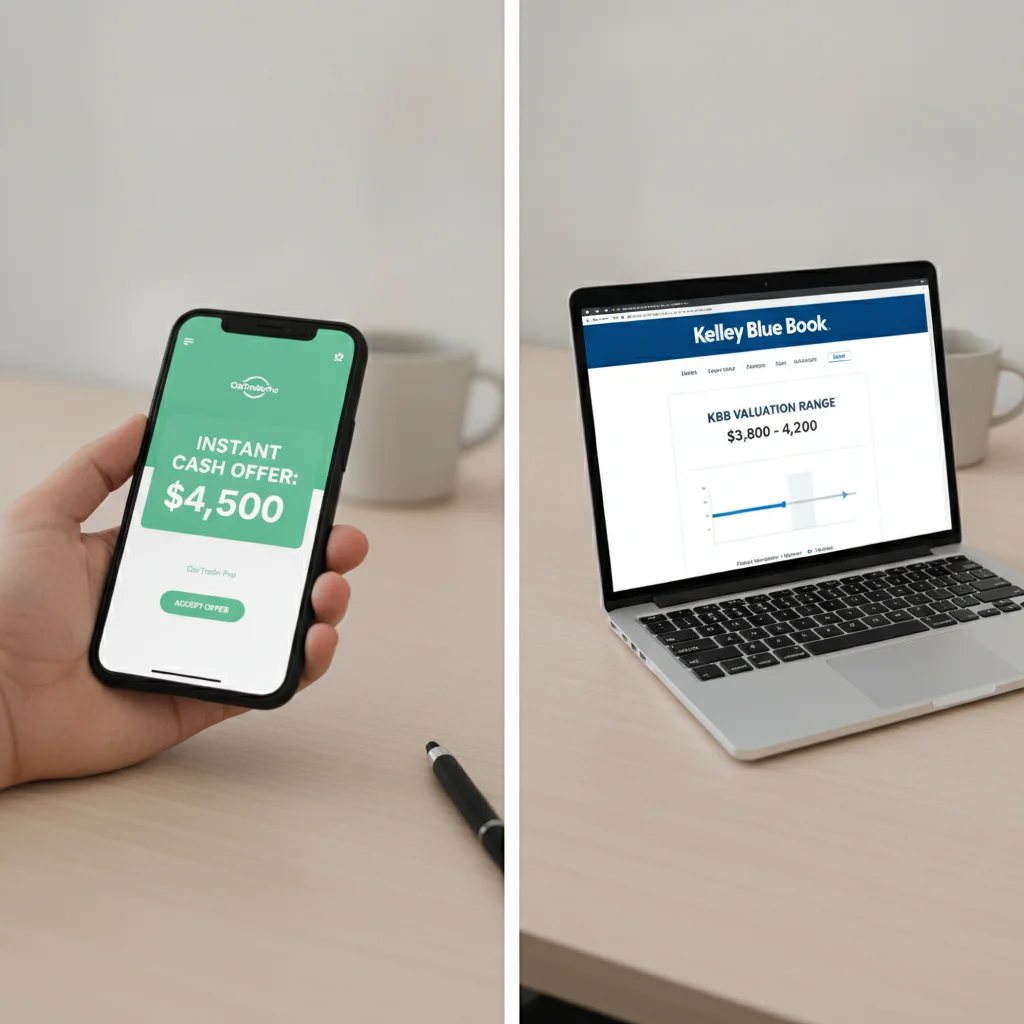
When you type your VIN into CarMax's website, you get a dollar figure back in about 90 seconds. When you do the same on Kelley Blue Book, you also get a dollar figure back — and it's almost always higher. That gap isn't a mistake, and it isn't one of the tools lying to you. It's the result of two tools answering completely different questions.
An instant cash offer from CarMax, Carvana, or Vroom answers: What will this specific company pay for your car today, given their cost to recondition it, their expected holding time, and their required profit margin?
A market valuation estimate from KBB or Edmunds answers: What have buyers in your region recently paid for comparable vehicles in comparable condition?
One is an actionable transaction price. The other is a market intelligence tool. Both numbers are useful — but only if you know which question each one is answering. Most sellers don't, and that confusion costs them money in one of two ways: they either accept an instant offer without knowing it's $2,000 below market, or they price their private listing using a retail estimate and wonder why nobody calls.
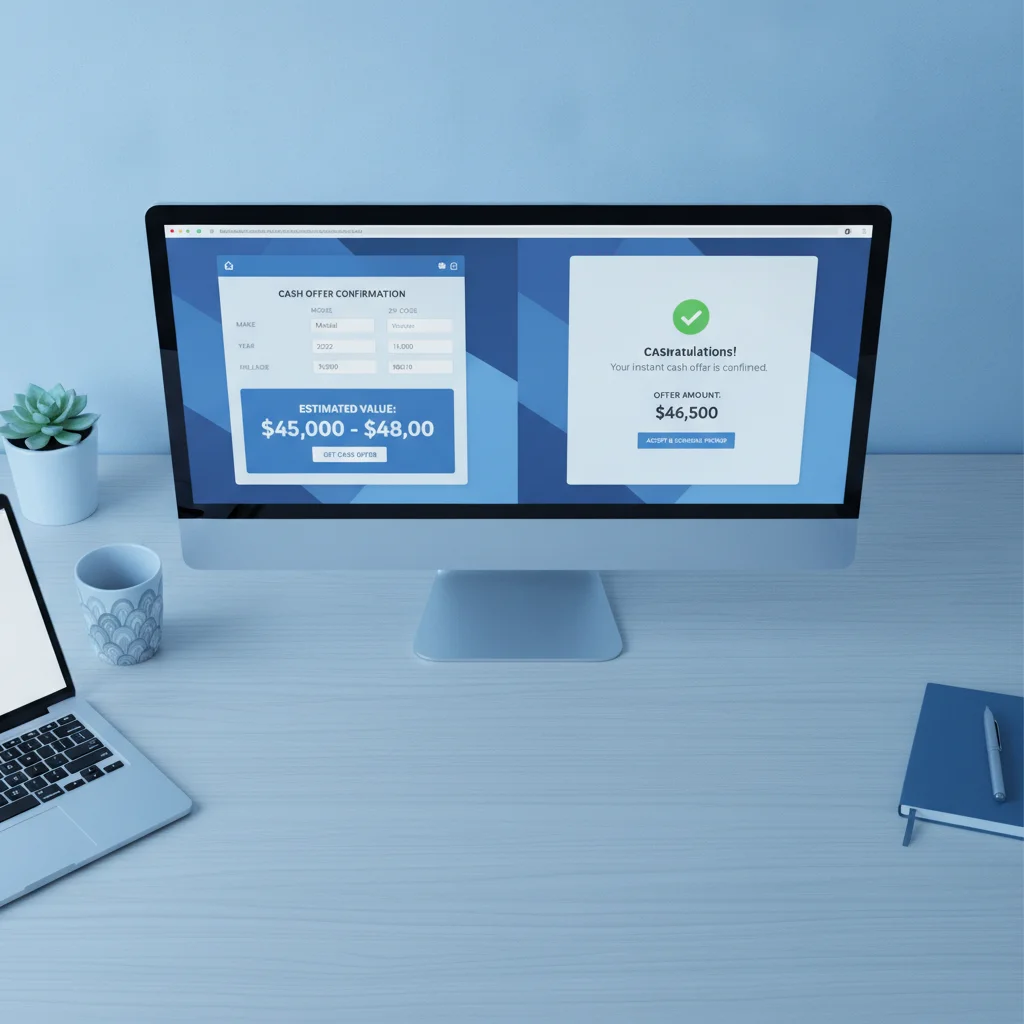
The goal of this comparison is to make both tools work for you by understanding exactly what each one measures, where the gaps come from, and when to use which.
How Instant Cash Offer Tools Generate Their Numbers
CarMax, Carvana, and Vroom are not appraisal services — they're buyers. When they give you an offer, they're telling you what they're willing to pay so they can turn around, recondition the car, and resell it at retail. Every number they generate has to clear several cost layers before it makes business sense for them.
The cost stack behind every instant offer
- Reconditioning: Most vehicles need $500–$2,500 in detailing, mechanical work, or cosmetic repair before they're retail-ready. The offer price is discounted to cover this.
- Holding costs: A car sitting on a lot for 30–60 days costs real money in capital, storage, and depreciation. Platforms build this in.
- Auction fallback: If they can't sell the car at retail, they'll send it to auction — often at a further loss. The offer hedges against that outcome.
- Profit margin: These are businesses. CarMax's gross profit per used vehicle has historically run $2,000–$2,500. That margin comes from somewhere.
The mechanics of how each platform sets prices differ slightly. Carvana and Vroom use algorithmic pricing models that factor in real-time inventory levels, regional demand, and auction comps. CarMax blends algorithmic data with in-person appraisal on some vehicles. For a deeper breakdown, see what each platform actually pays.
What affects your specific offer
The offer you receive isn't just based on your car's base value. Each platform adjusts for:
- Current retail inventory — if they already have 12 of your car in stock, the offer drops
- Regional demand — a 4WD truck gets a higher offer in Colorado than Florida
- Condition inputs you provide (mileage is the biggest single variable)
- Your car's auction liquidity — mainstream cars get better offers than oddball configurations
Offer Revisions Are Standard Practice
Every major instant offer platform reserves the right to revise their quoted price after physically inspecting the vehicle. This isn't a bait-and-switch — it's a disclosed condition in every platform's terms. If you show up with undisclosed damage, paint overspray, frame issues, or a mechanical problem, expect the offer to drop. The best way to avoid surprises is to self-inspect honestly before you submit any quote request.
One Tool Is Never Enough
No single valuation source — instant offer or market estimate — tells the complete story. Platforms have inventory gaps, algorithms have regional blind spots, and market conditions shift faster than any tool updates. The sellers who consistently get the best prices collect at least two instant offers AND check at least two market estimate sources before making a decision. It takes 30 minutes and costs nothing.
One critical point: instant offers are only as accurate as the condition information you provide. Platforms reserve the right to revise the offer when they inspect the actual vehicle. If you underreport damage or overstate condition, expect a lower number at the counter.
How Market Valuation Estimates Are Built
KBB and Edmunds take a fundamentally different approach. Rather than asking "what do we need to pay to profit on this car," they ask "what have buyers and sellers actually agreed to pay in the real market?"
Kelley Blue Book
KBB has published valuations since 1926, but its methodology has evolved significantly. Today, KBB values are informed by actual transaction data, dealer data feeds, and auction results — weighted by region, trim, mileage, and condition. KBB publishes several distinct value types that are often confused with each other:
- Private Party Value: What you can reasonably expect selling directly to another consumer
- Trade-In Range: What a dealer is likely to offer (lower than private party — dealers need margin too)
- Dealer Retail: What a dealer will likely ask on their lot (highest number, not relevant for sellers)
- Instant Cash Offer: KBB also has its own ICO product through dealers — distinct from the estimates
Edmunds Instant Market Value (IMV)
Edmunds IMV pulls from actual completed transaction data — what dealers reported paying in real sales — rather than survey-based or algorithmic projections. Because it's grounded in recent sale prices rather than asking prices, Edmunds IMV tends to be slightly more conservative than KBB's private-party value and often lands closer to what buyers will actually pay. How Edmunds IMV is calculated goes deeper on the methodology if you want to understand exactly what feeds that number.
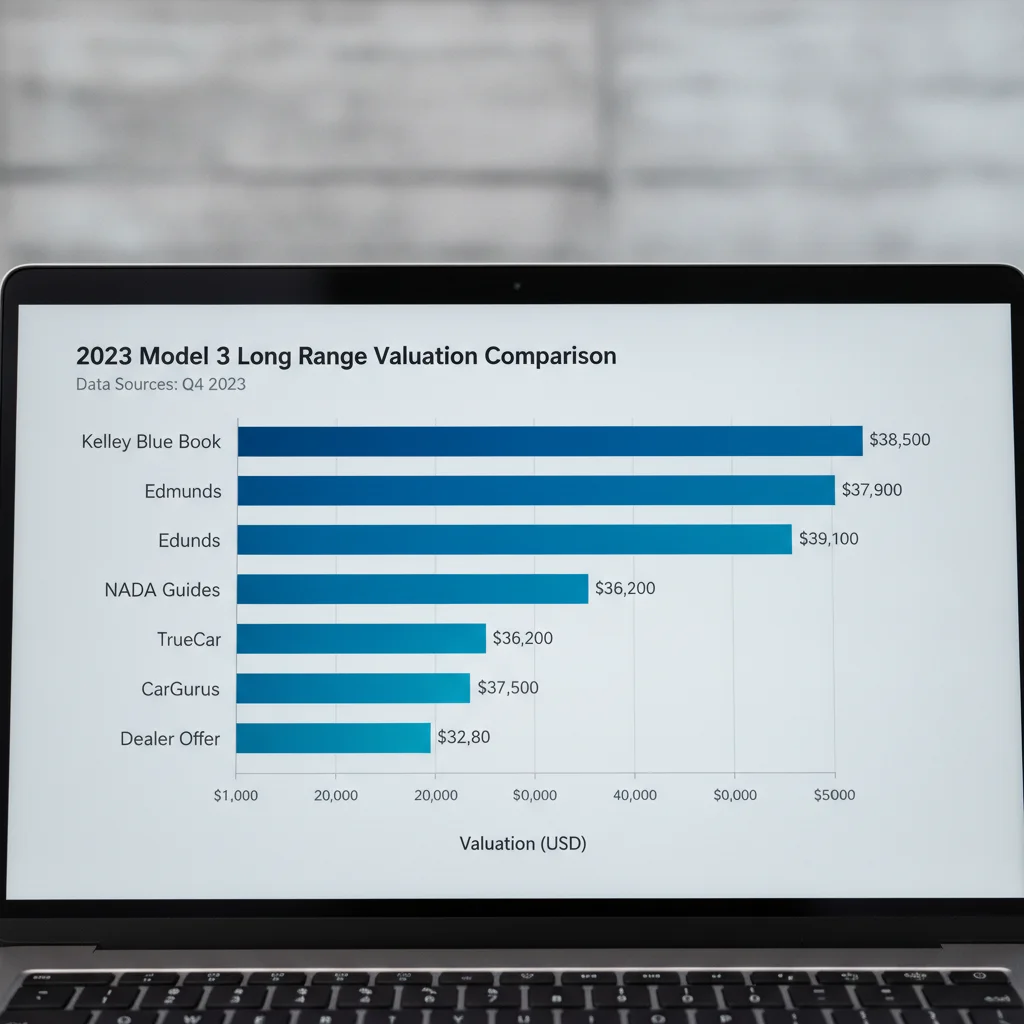
For a full side-by-side of KBB, Edmunds, NADA, and CarGurus methodologies, the major car valuation tools compared article lays it all out in one place.
| Criterion | Instant Cash Offer Tools | Market Valuation Estimates |
|---|---|---|
| What it measures | What a reseller will pay today | What buyers pay in the open market |
| Primary examples | CarMax, Carvana, Vroom | KBB, Edmunds IMV, NADA |
| Number type | Binding purchase offer | Reference benchmark |
| Typical value vs. market | $1,000–$3,000 below market | At or near actual transaction prices |
| Speed to get a number | 60–120 seconds online | 5–10 minutes to input details |
| Can you negotiate it? | No — take it or leave it | N/A — it's a data point, not an offer |
| Offer validity period | Typically 7 days | Continuously updated |
| Best use case | Quick, certain sale with no hassle | Pricing a private listing or evaluating offers |
| Condition sensitivity | Verified at inspection; offer may change | Based on self-reported condition grade |
The Gap: Why Instant Offers Are Almost Always Lower
If you run both tools on the same car, instant offers will nearly always come in below the market estimate. On a $20,000 car in good condition, you should expect the gap to be somewhere between $1,000 and $3,000 — sometimes more if the car has issues or is in low demand. This is not a coincidence or a negotiating trick. It's structural.
$1,000–$3,000
Typical gap: instant offer vs. market estimate
Based on repeated comparisons across CarMax, Carvana, and Vroom offers versus Edmunds IMV and KBB Private Party values on mainstream used vehicles.
7 days
Standard instant offer validity window
CarMax, Carvana, and Vroom all expire offers within approximately 7 days, after which the car must be re-submitted for a new quote.
3
Minimum instant offers worth collecting
Offers on the same vehicle can vary by $500–$1,500 between platforms — getting all three available quotes takes about 10 minutes and can meaningfully raise your floor.
~10%
Typical discount vs. private-party value
On average, instant cash offers run roughly 8–12% below Edmunds or KBB private-party estimates on a well-maintained mainstream used vehicle.
Here's a concrete example. A 2020 Honda CR-V EX-L with 52,000 miles in clean condition might show:
- Edmunds IMV (private party): $23,400
- KBB Private Party Value (good condition): $22,800–$24,100
- CarMax Instant Offer: $20,500–$21,500
- Carvana Instant Offer: $20,200–$21,800
The gap on that car is roughly $1,500–$3,000 depending on platform. What you're paying for in that gap is speed and certainty — the offer is firm, no showings, no tire-kickers, no deal falling through at the last minute.
When the gap narrows
The gap between instant offers and market estimates shrinks in a few specific situations:
- High-demand vehicles: Popular trucks, SUVs, and CPO candidates where platforms need inventory can push offers up
- Low-mileage, clean-title vehicles: Less reconditioning needed = better offer relative to market
- Market conditions: During the 2021–2022 used car shortage, some CarMax and Carvana offers briefly exceeded private-party market values
- Cars approaching auction age: Platforms sometimes overpay to keep desirable units off the auction block
Understanding these dynamics is exactly why you should check instant cash offers vs. dealer trade-in appraisals as well — dealer appraisals can sometimes beat the online platforms, especially on late-model domestic trucks.
Using Both Tools Together: A Practical Workflow
The sellers who get the best outcomes don't pick one tool over the other — they use both in sequence. Here's the approach that works.
Step 1: Establish your market baseline
Before you do anything else, run your car through Edmunds IMV and KBB Private Party Value. Take notes on both numbers and the condition grade you used. Be honest — if the car has a dent, use "good" not "very good." These two numbers give you your ceiling: what a motivated private-party buyer would pay in an arms-length transaction.
If you want to go deeper, using multiple valuation tools together walks through a triangulation method that also incorporates live market listings — which is the most accurate approach available to private sellers.
Step 2: Get at least two instant offers
Run your car through CarMax, Carvana, and Vroom (all three if possible — it takes about 10 minutes total). Offers vary by platform, sometimes by $500–$1,500 on the same car. Take the highest. That's your floor: the guaranteed, no-hassle exit price you can execute on right now.
Step 3: Calculate your "convenience cost"
Subtract your best instant offer from your market estimate. That spread is the price of convenience. On a $22,000 market-value car with a $20,200 best offer, the convenience cost is $1,800. Is it worth it to you? That depends on your time, your risk tolerance, and how quickly you need the money.

Step 4: Decide your channel
- If the gap is under $1,000: Take the instant offer. The private-party hassle isn't worth it.
- If the gap is $1,500–$3,000: Weigh your appetite for private-party selling. A clean, desirable car will likely sell in under two weeks at private-party price.
- If the gap is over $3,000: The private-party route is almost always worth the effort — list the car.
Also consider checking the instant offer platforms hub for additional platforms that may serve your specific market or vehicle type.
For a sharper comparison of how KBB, Edmunds, and CarGurus specifically differ as trade-in estimators, this trade-in tool comparison is worth reading before you make a final decision.
Offer Revisions Are Standard Practice
Every major instant offer platform reserves the right to revise their quoted price after physically inspecting the vehicle. This isn't a bait-and-switch — it's a disclosed condition in every platform's terms. If you show up with undisclosed damage, paint overspray, frame issues, or a mechanical problem, expect the offer to drop. The best way to avoid surprises is to self-inspect honestly before you submit any quote request.
One Tool Is Never Enough
No single valuation source — instant offer or market estimate — tells the complete story. Platforms have inventory gaps, algorithms have regional blind spots, and market conditions shift faster than any tool updates. The sellers who consistently get the best prices collect at least two instant offers AND check at least two market estimate sources before making a decision. It takes 30 minutes and costs nothing.
Common Mistakes Sellers Make With These Tools
After watching dozens of private-party transactions fall apart or leave money on the table, the same mistakes come up repeatedly.
Mistake 1: Using retail values as the pricing baseline
KBB's "Dealer Retail" value is what a dealer charges customers on the lot — it includes dealer reconditioning, overhead, and profit margin. Some sellers anchor to this number, then wonder why their private listing sits for months with no offers. The relevant number for private sellers is Private Party Value, not retail.
Mistake 2: Treating one instant offer as a market signal
One platform's offer isn't the market. Carvana might be overstocked on your car's model this week while CarMax is short. A single offer can be $800–$1,200 below what the second platform would pay. Always get at least two. The 10 minutes it takes is almost always worth it.
Mistake 3: Not accounting for condition honestly
Both market estimates and instant offers are sensitive to condition inputs. Sellers routinely rate their car "very good" when it's honestly "good" — then feel surprised when a platform revises the offer after inspection. Run your estimates in "good" condition and you'll get numbers that reflect reality.
Mistake 4: Ignoring regional variation
A diesel pickup commands a premium in rural Montana but is a slow seller in urban markets. A convertible that flies off lots in California sits unsold in Minnesota from October through April. Both KBB and Edmunds incorporate regional data, and so do the instant offer platforms. If your car has strong regional demand, factor that in — it may mean a private listing outperforms the national average gap.
For a fuller picture of how instant offer services operate and where their limitations show up in practice, what instant cash offer services are really offering you breaks down the fine print that most sellers skip past.

All claims are backed by peer-reviewed research. Sources on request.