Key Takeaways
Edmunds Instant Market Value (IMV)
Edmunds Instant Market Value is a price estimate that reflects what similar vehicles have actually sold for in your local market over a recent time window. It is calculated using real transaction data pulled from dealer sales records, not surveys or subjective condition guides. The number is meant to represent the most likely sale price for a specific car in a specific zip code.
IMV is a proprietary algorithm that weights transaction recency, regional supply-demand balance, trim-level specifics, and mileage deviation from segment norms to produce a market-derived midpoint price.
What Edmunds IMV Actually Is — and Isn't
Most car valuation tools give you a number without explaining where it came from. Edmunds Instant Market Value is different in one important way: it is anchored to actual completed transactions, not asking prices or appraisal guides built on surveys.
That distinction matters a lot when you are trying to price a car to sell it. Asking prices are aspirational. Transaction prices are what real buyers paid. IMV tries to answer the latter question.
What IMV is not: it is not a guaranteed offer, not a dealer appraisal, and not a promise of what you will pocket at the end of a sale. It is a statistically derived midpoint — the price a vehicle like yours is most likely to close at under current market conditions in your geographic area.

For context on how this compares to competing tools, see KBB, Edmunds, and NADA: What Each Valuation Tool Is Actually Measuring, which breaks down the methodology differences side by side.
The Core Data Inputs Behind the Number
Edmunds sources its transaction data from dealerships that report actual closed sales. This gives IMV a foundation that is harder to game than tools relying on self-reported trades or consumer submissions. Here are the primary variables the algorithm processes:
- Recent transaction prices: Closed sales from franchised and independent dealers in a defined trailing window — typically the last 45–90 days, weighted toward the most recent.
- Geographic market: Transactions are filtered to your metro area or zip code. Supply dynamics vary sharply by region.
- Year, make, model, and trim: Trim level is critical. An EX and an EX-L on the same platform can differ by $2,000–$3,500 in IMV.
- Mileage: Edmunds applies a depreciation curve relative to segment-average mileage for that model year. Deviations above or below the norm adjust the estimate accordingly.
- Option packages and features: Certain factory options — primarily tech packages, sunroofs, and advanced driver-assistance systems — add measurable value. Not all options are weighted equally.
- Condition: Users self-report condition on a scale. This is where most people introduce error — more on that below.
45–90
Days of transaction data in IMV window
Edmunds weights recent transaction data more heavily, with a typical lookback window of 45 to 90 days depending on model volume.
5–8%
Typical IMV accuracy range vs. final sale price
For commonly traded vehicles in active dealer markets, IMV tends to fall within 5–8% of the actual closing price.
$1,200–$2,500
IMV gap between Outstanding and Average condition
On many popular used vehicles, the difference between Outstanding and Average condition ratings translates to a $1,200–$2,500 swing in Edmunds IMV.
$300–$1,500
Typical IMV vs. KBB divergence
KBB Fair Market Range and Edmunds IMV frequently differ by several hundred to over a thousand dollars for the same vehicle due to differing data methodology.
20–35%
Recommended price reduction below IMV for problem vehicles
Vehicles with branded titles, known mechanical issues, or deferred maintenance typically need to be priced 20–35% below IMV to attract informed buyers.
For a comprehensive look at every variable that flows into a valuation estimate, Everything That Goes Into a Car's Estimated Value walks through the full data picture from VIN to zip code.
Transaction Data Coverage Varies by Market
Edmunds IMV is most reliable in high-volume urban and suburban markets where dealer transaction data is dense. In rural areas or for low-volume specialty vehicles, the algorithm may draw on a wider geographic radius to fill data gaps — which can produce estimates that don't match local pricing reality. Always sanity-check IMV against active listings in your specific area.
Branded and Salvage Titles Are Not Reflected in IMV
Edmunds IMV assumes a clean title. If your vehicle has a salvage, rebuilt, or lemon law buyback title, the standard IMV output is not applicable. Branded title vehicles typically sell for 20–40% below clean-title market value, and the buyer pool is significantly narrower. Price accordingly and disclose the title status upfront.
Why Geography Moves the Number More Than Most Sellers Expect
A 2021 Toyota Tacoma TRD Off-Road with 48,000 miles will return a meaningfully different IMV in Houston than it will in Portland, Oregon. This is not a quirk — it reflects real pricing behavior driven by local supply and buyer preferences.
Edmunds accounts for this by weighting transactions geographically. If your market has low inventory of a particular model, fewer buyers are competing for fewer vehicles, which pushes transaction prices up. The inverse is true in markets where a specific model is abundant.

Seasonal effects layer on top of geography. Convertibles see IMV spikes in spring markets. Four-wheel-drive trucks and SUVs tend to command premiums heading into fall in northern states. If you are timing a sale, checking IMV weekly during a seasonal upswing can help you identify the right moment to list.
Check IMV on Multiple Condition Tiers
Before settling on a price, pull IMV for both your honest condition grade and the tier above it. The spread between those two numbers tells you how much pricing leverage you gain by detailing, minor repairs, or fixing small cosmetic issues before listing. If a $200 detail job moves your condition rating from Average to Clean and adds $800 in IMV, that math is worth running.
Use IMV Alongside Active Listing Research
IMV reflects where transactions have closed — not where sellers are currently asking. Before finalizing your listing price, search current inventory on Edmunds, AutoTrader, and Cars.com for identical trim and similar mileage in your zip code. If active listings are consistently $1,500 above IMV with long days-on-market, you know those prices aren't clearing. Price at or slightly above IMV to be the competitive option.
The Condition Problem: Where User Error Creeps In
The single biggest source of IMV misinterpretation is condition self-reporting. Edmunds asks sellers to rate their vehicle as Outstanding, Clean, Average, or Rough. The gap between Outstanding and Average on many vehicles is $1,200–$2,500.
Most sellers rate their car one tier higher than an independent inspector would. A car with minor door dings, two small rock chips on the hood, and slightly worn driver's seat bolstering is Average — not Clean, and definitely not Outstanding. Outstanding is reserved for vehicles that are genuinely showroom-condition with full service records and no cosmetic defects.
If you want an accurate IMV, grade your car the way a dealer buyer would, not the way you see it after washing it on a Saturday morning.
One calibration approach: pull local dealer listings for comparable vehicles and look at how they describe condition relative to their asking prices. Dealer listings tend to be generous with language, but the photos tell you the real story. Match your car's actual condition to what you see in those photos, not to what you wish it were.
How IMV Compares to KBB and What the Gap Tells You
Edmunds IMV and KBB Fair Market Range are the two most commonly cited used car valuations. They frequently differ by $300–$1,500 for the same vehicle, sometimes more. Understanding why helps you use both intelligently rather than just averaging them.
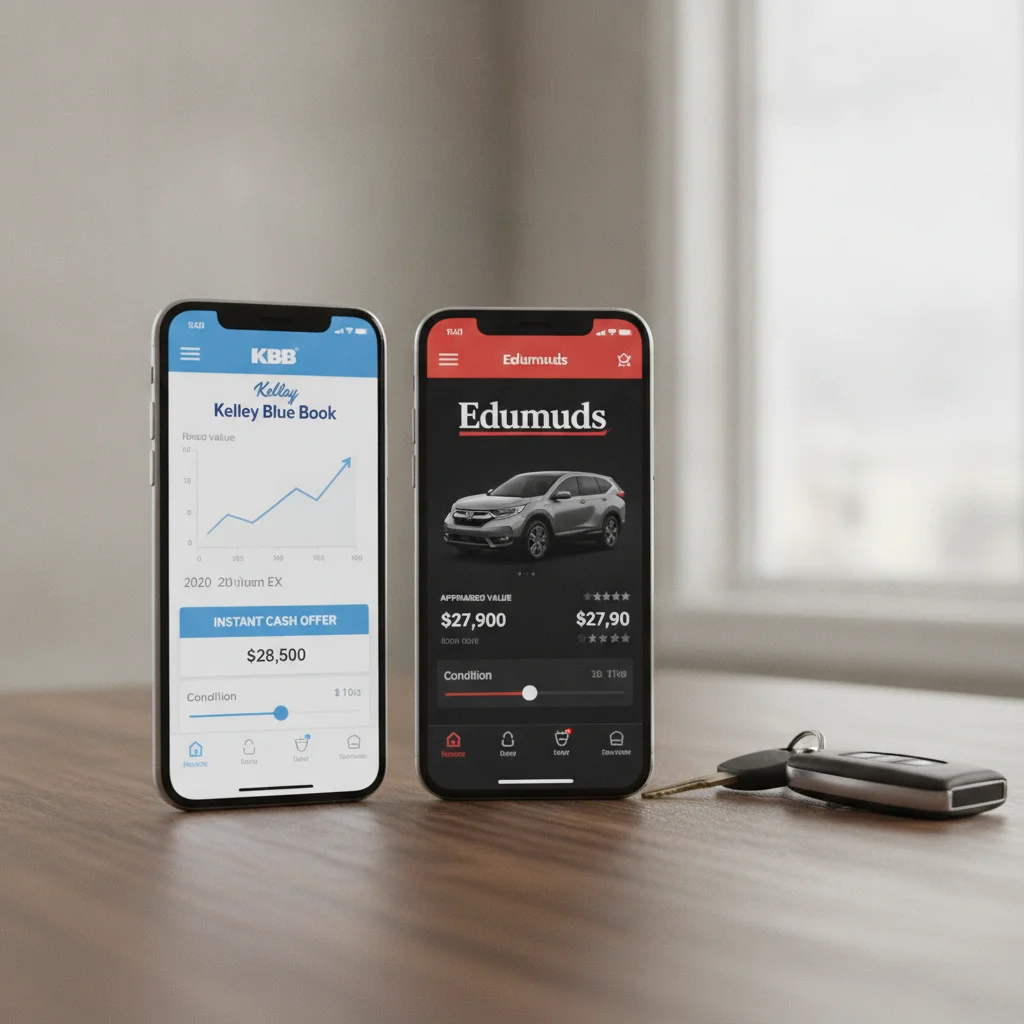
KBB blends dealer transaction data with consumer survey inputs and has historically skewed slightly higher — partly because its brand recognition leads sellers to anchor on it and push asking prices up, which gradually pulls the reported data higher. Edmunds leans more aggressively into completed transactions, which tends to produce a more conservative, market-reflective number.
“Transaction-based pricing tools remove the wishful thinking from the equation. When you anchor to what cars have actually sold for — not what sellers hoped to get — you end up with a number the market will actually validate.”
— Ivan Drury, Director of Insights at Edmunds
For sellers, the practical implication: if IMV and KBB diverge significantly, the IMV number is usually the safer bet for setting a realistic sale price. KBB's higher figure can be useful as a ceiling for your negotiation range, but pricing at KBB and expecting to close there in a normal market is often optimistic.
Kelley Blue Book vs. Edmunds: Which Number Should Sellers Trust? goes deeper on when each tool's number deserves more weight.
Also worth noting: Why Your Car's Valuation Differs Across Every Tool You Check explains the systematic reasons behind multi-tool discrepancies — useful reading before you commit to a listing price.
Using IMV Strategically: Seller Pricing Framework
Once you understand what Edmunds IMV is actually measuring, you can use it as a framework rather than just a single number. Here is how to build a pricing strategy around it:
- Pull IMV first, then check active listings. IMV tells you where transactions have closed. Active listings tell you what competition looks like right now. If listings cluster $1,000 above IMV, buyers are still getting to that IMV floor through negotiation.
- Add a negotiation buffer for private party sales. IMV is calibrated around dealer transactions. Private party buyers expect room to negotiate. Price $500–$1,000 above IMV to close near it after back-and-forth.
- Use IMV as a floor for dealer trade-in offers. If a dealer offers you significantly below IMV — more than 15–20% under — use the IMV printout to open a counter-conversation. Dealers know the tool and respect it.
- Track IMV weekly if you are not in a rush. Market conditions shift. Checking the number over 3–4 weeks shows you the trend direction for your specific vehicle.
- Compare against instant offer platforms. Services like Carvana and CarMax will give you a hard offer in minutes. Comparing that offer to IMV tells you how much convenience is costing you. Instant Cash Offer Tools vs. Market Valuation Estimates breaks down that gap in detail. You can also explore Instant Offer Platforms to compare specific services head-to-head.

Check IMV on Multiple Condition Tiers
Before settling on a price, pull IMV for both your honest condition grade and the tier above it. The spread between those two numbers tells you how much pricing leverage you gain by detailing, minor repairs, or fixing small cosmetic issues before listing. If a $200 detail job moves your condition rating from Average to Clean and adds $800 in IMV, that math is worth running.
Use IMV Alongside Active Listing Research
IMV reflects where transactions have closed — not where sellers are currently asking. Before finalizing your listing price, search current inventory on Edmunds, AutoTrader, and Cars.com for identical trim and similar mileage in your zip code. If active listings are consistently $1,500 above IMV with long days-on-market, you know those prices aren't clearing. Price at or slightly above IMV to be the competitive option.
What IMV Cannot Tell You
IMV is a strong tool, but it has real limitations sellers should know before putting too much weight on any single output.
Thin markets produce unreliable estimates. If your car is a low-volume trim or a niche model in a small metro, Edmunds may not have enough local comparable transactions to generate a confident estimate. The number will still display, but the margin of error is wider.
Aftermarket modifications are invisible to the algorithm. A lifted 4Runner with upgraded suspension, a pop-top camper van conversion, or an EV with a premium aftermarket audio system — none of these modifications are captured in IMV. You will need to price those factors manually by checking what modified examples actually sell for on enthusiast-focused platforms.
Mechanical condition is not accounted for. IMV assumes a vehicle in the selected condition tier is mechanically sound. A car with a known transmission issue, deferred maintenance, or a branded title needs to be priced well below IMV — typically 20–35% lower depending on severity — to attract buyers who understand the risk they are taking on.
Transaction Data Coverage Varies by Market
Edmunds IMV is most reliable in high-volume urban and suburban markets where dealer transaction data is dense. In rural areas or for low-volume specialty vehicles, the algorithm may draw on a wider geographic radius to fill data gaps — which can produce estimates that don't match local pricing reality. Always sanity-check IMV against active listings in your specific area.
Branded and Salvage Titles Are Not Reflected in IMV
Edmunds IMV assumes a clean title. If your vehicle has a salvage, rebuilt, or lemon law buyback title, the standard IMV output is not applicable. Branded title vehicles typically sell for 20–40% below clean-title market value, and the buyer pool is significantly narrower. Price accordingly and disclose the title status upfront.
Treat IMV as your starting benchmark, not your final answer. Layer in a physical inspection, local market research, and honest condition grading, and you will end up with a price that is realistic rather than wishful.

All claims are backed by peer-reviewed research. Sources on request.