
Key Takeaways
Option A
Leasing a New Car
The lower-payment, lower-commitment path.
Best for: Drivers who want a new vehicle every two to three years, keep mileage moderate, and prioritize lower monthly payments over long-term ownership.
Option B
Buying a New Car
The equity-building, full-ownership route.
Best for: Buyers who plan to keep their car five or more years, drive high annual mileage, and want to eliminate payments entirely once the loan is paid off.
If you drive under 12,000 miles per year and want the newest tech every 2–3 years
Leasing a New Car
Low mileage means you'll stay under cap, and lease cycling keeps you in fresh vehicles with updated safety features and warranties.
If you drive more than 15,000 miles annually or use your car for work
Buying a New Car
Excess-mileage charges at $0.15–$0.25 per mile add up fast. Owning the car removes that penalty entirely and keeps your total cost predictable.
If you want the lowest possible out-of-pocket cost over a 10-year horizon
Buying a New Car
Once the loan clears, your only costs are maintenance and insurance. A perpetual lease cycle means you never stop writing that monthly check.
If you're buying an electric vehicle and want the federal tax credit now
Leasing a New Car
Leased EVs often qualify under a commercial vehicle loophole that bypasses income and MSRP restrictions, and dealers typically pass that savings to lessees as a lower cap cost.
If you want flexibility to modify, sell, or trade your vehicle on your timeline
Buying a New Car
Owners can sell, trade, or customize at any point. Breaking a lease early typically triggers fees that can run into the thousands.
The Real Difference Between Leasing and Buying
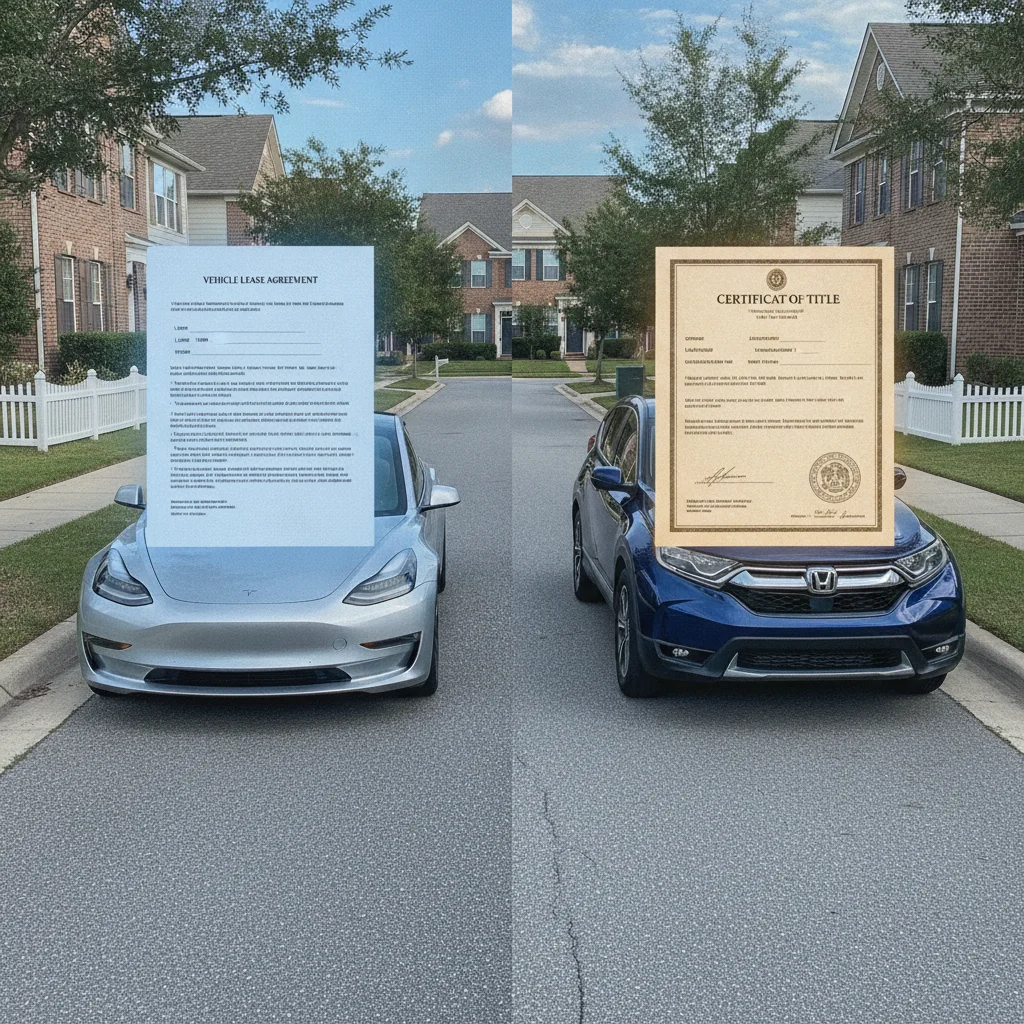
Strip away the marketing language and the distinction is simple: when you lease, you're paying to use a car. When you buy, you're paying to own one. That single difference creates a chain of financial consequences that shapes your monthly payment, your risk exposure, and your options three years down the road.
A lease payment is calculated on the depreciation the car experiences during your contract term — typically 24 to 39 months — plus a financing charge called the money factor (think of it as the lease equivalent of APR). You're not paying off the full vehicle price. That's why lease payments run 20–30% lower than loan payments on the same car.
A car loan payment, by contrast, covers the entire purchase price minus your down payment, spread over the loan term at a fixed APR. You're paying for the whole asset. When the loan clears, you own something that can be sold, traded, or driven payment-free.
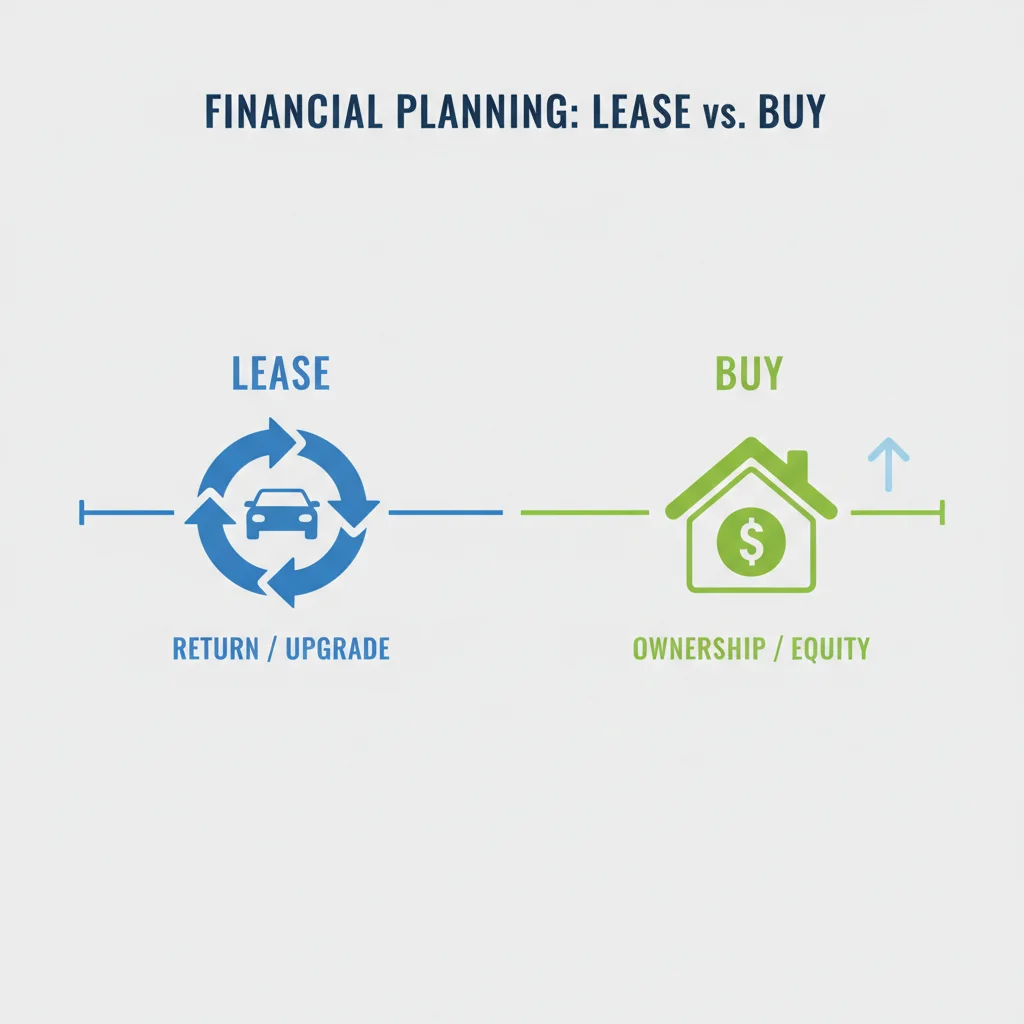
Neither structure is inherently better. The right answer depends on how many miles you drive, how long you hold vehicles, and how much you value flexibility versus equity. Let's build that comparison from the ground up.
Monthly Cost: What You Actually Pay
Here's a concrete example. Take a $42,000 midsize SUV with a residual value of 55% after 36 months — meaning the car is expected to be worth $23,100 at lease end.
- Lease payment (estimated): The depreciation you're financing is $42,000 − $23,100 = $18,900. Add money factor charges and fees, and you're typically looking at $430–$480/month with modest money down.
- Loan payment (estimated): Finance the full $42,000 at 6.5% APR over 60 months with $3,000 down and your payment lands around $755/month.
That $300 monthly gap is real money — roughly $10,800 over three years. But here's what the lease payment doesn't give you: any principal reduction, any equity position, or any residual value when the contract ends. The buyer has paid down a significant portion of a $42,000 asset. The lessee hands back the keys.
| Criterion | Leasing | Buying |
|---|---|---|
| Monthly payment | Lower (pay depreciation only) | Higher (pay full vehicle price) |
| Ownership at end of term | None — return or buy out | Full ownership, no lien |
| Mileage restrictions | Yes — typically 10–15K/yr | None |
| Depreciation risk | Borne by lessor | Fully on the buyer |
| Early exit flexibility | Costly — significant fees | Sell or trade anytime |
| Customization | Not permitted | Unlimited |
| Warranty coverage | Usually in-warranty full term | Expires mid-loan on long terms |
| Credit requirements | Typically stricter | More options across credit tiers |
| Long-term cost (7+ years) | Higher — perpetual payments | Lower — payment-free period |
| EV tax credit access | Often easier via commercial loophole | Subject to income/MSRP caps |
Down payment strategy differs fundamentally between leasing and financing — a capitalized cost reduction on a lease doesn't build equity the way a loan down payment does. It simply lowers your monthly payment, and if the car is totaled on day two, that money is gone.
~28%
Average payment gap: lease vs. loan
Experian's State of the Automotive Finance Market (Q4 2023) found average new car lease payments ran roughly 28% lower than new car loan payments on comparable vehicles.
$0.20
Typical per-mile overage charge
Most captive lenders charge $0.15–$0.25 per mile over contract limits; $0.20 is the industry midpoint and can add $1,500+ for moderate over-mileage drivers.
20–25%
Average new car first-year depreciation
iSeeCars research consistently shows new vehicles lose 20–25% of their original value within the first 12 months of ownership, representing the steepest part of the depreciation curve.
$7,500
Federal EV tax credit — lease advantage
Under the Inflation Reduction Act, leased EVs can qualify for the full $7,500 commercial vehicle credit with no income or MSRP restrictions that limit the purchase credit.
31%
Share of new vehicles leased in 2023
Experian reported that approximately 31% of new vehicle transactions in Q4 2023 were leases, up from historic lows during the inventory shortage years of 2021–2022.
The Depreciation Factor: Who Carries the Risk?
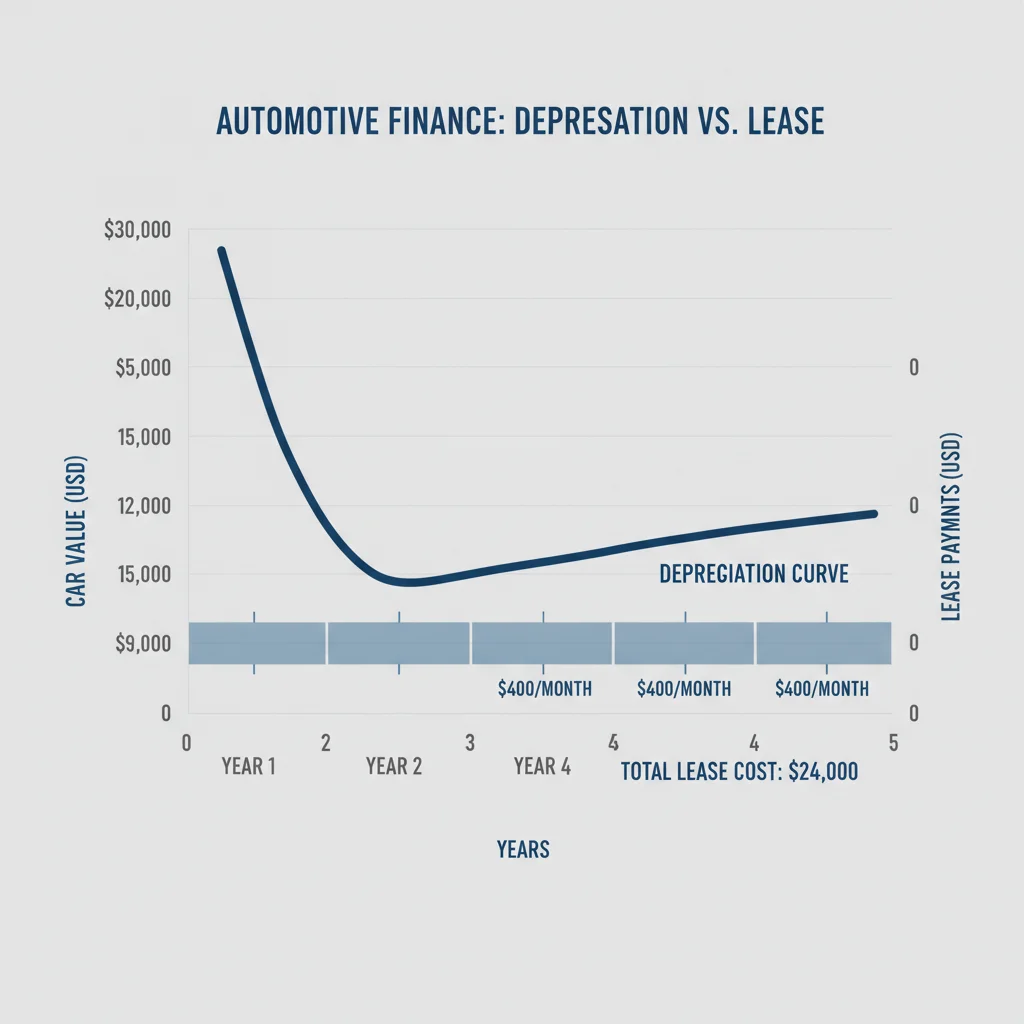
Depreciation is the single largest cost of new car ownership, and it's baked into both deals — just differently.
When you lease, the residual value is set at contract signing. If the market tanks and that $42,000 SUV is only worth $18,000 at lease end instead of the projected $23,100, that's the leasing company's problem — not yours. You walk away. If the car holds value better than expected — say it's worth $26,000 — you might have a buyout opportunity worth taking.
When you buy, you absorb every dollar of depreciation directly. New cars typically lose 15–25% of their value in the first year alone. That first-year depreciation hit is precisely why new vs. used is more than a price comparison — it's a different risk profile entirely.
Buyers who keep a car 8–10 years largely ride out the depreciation curve and reach a point of low-cost ownership. Buyers who trade in every 3–4 years are often stuck in a cycle where they owe more than the car is worth — especially if they financed with a long-term loan and put little down.
A deeper look at how depreciation plays out under each strategy shows that leasing doesn't eliminate depreciation cost — it just structures it into predictable monthly charges instead of leaving you exposed to market swings.
Hidden Costs That Change the Math
The sticker payment is only part of the picture. Both leasing and buying carry costs that don't show up in the headline number.
Leasing Hidden Costs
- Mileage overages: Most leases cap you at 10,000–12,000 miles per year. Go over and you'll pay $0.15–$0.25 per mile at return. A driver who runs 15,000 miles/year on a 12,000-mile lease will owe $900–$1,500 at the end of a 36-month contract — minimum.
- Excess wear and use: Dings, interior stains, and tire wear beyond normal limits trigger charges. Lessees often buy lease-return protection through the dealer or their insurer to cover this.
- Early termination: Breaking a lease 12 months early can cost as much as the remaining payments plus a termination fee. There's almost no cheap way out.
- Acquisition fees: Lenders charge $595–$1,095 at lease inception. This is often buried in the deal structure.
Buying Hidden Costs
- Loan interest: At 6.5% APR over 60 months on $39,000, you'll pay roughly $6,800 in interest alone. Extend to 72 months and that number climbs past $8,500.
- Depreciation exposure: Trade in after 36 months and you're absorbing that first depreciation cliff directly.
- Out-of-warranty repairs: After the manufacturer warranty expires (typically 36 months/36,000 miles for bumper-to-bumper), you own every repair bill.
For leased vehicles, certain insurance add-ons become especially relevant — gap coverage in particular. If a leased car is totaled, standard insurance pays the car's actual cash value, which can fall short of what you still owe on the lease.
Gap Insurance Is Not Optional on a Lease
If your leased vehicle is totaled in an accident, your insurance company pays actual cash value — not what you owe on the lease. The gap between those two numbers can easily reach $3,000–$6,000 on a newer vehicle. Many leasing companies bundle gap coverage into the contract automatically, but verify this before declining it through your insurer. Never assume it's included.
Money Factor Markups Are Legal and Common
Just as dealers can markup a loan's interest rate, they can markup the money factor on a lease — sometimes by 0.001 to 0.002 points. On a $40,000 vehicle over 36 months, a 0.001 money factor markup costs you roughly $700 in additional interest. Always ask for the buy rate money factor and confirm it matches manufacturer published rates before signing.
Lease Buyouts Have Changed Post-Pandemic
During 2021–2022, many lease buyouts were genuinely profitable because used car prices spiked above residual values. That window has largely closed. In today's market, residual values are more accurately priced, and buying out your lease at contract end is often no better or worse than buying a comparable used vehicle on the open market. Run the numbers — don't assume a buyout is a deal.
Credit, Financing, and Approval Differences
Both paths require creditworthiness, but the approval criteria and rate structures work differently.
Lease approvals are typically handled by captive finance arms — Toyota Financial, Ford Motor Credit, BMW Financial Services. These lenders set residual values and money factors internally, and they can be less transparent than traditional auto loans. A money factor of 0.00125 converts to approximately 3.0% APR (multiply by 2,400). Dealers are often allowed to mark up money factors by 0.001–0.002, just as they markup loan rates.
Auto loan rates are driven primarily by your credit score, the lender (bank, credit union, or captive), and loan term. As of 2024, borrowers with excellent credit (750+) are seeing new car loan rates from 5.5–7.5% APR through banks and credit unions. Subprime borrowers may face 15–20%+.
One important asymmetry: lease approvals are generally harder to get with bruised credit. Captive lenders are protective of their residual risk. If your score is below 680, you may find lease offers require a significant drive-off (multiple security deposits or cap cost reduction) or be declined entirely. A buy-here-pay-here dealer isn't going to offer you a lease — that's a purchase product.
Timing your purchase or lease application also matters — manufacturer lease incentives and loan rate subventions often run on quarterly or monthly schedules tied to sales targets.

The EV Exception and Long-Term Strategy
If the car you're considering is electric, the leasing-versus-buying calculation has an additional layer that most buyers miss entirely.
The Inflation Reduction Act restructured the $7,500 federal EV tax credit in ways that heavily favor leasing for many buyers. The credit now has income caps ($150,000 single/$300,000 joint) and MSRP limits ($80,000 for SUVs/trucks, $55,000 for sedans). Leased EVs, however, are classified as commercial vehicles — and the commercial credit has none of those caps. Dealers can pocket that credit or pass it through as a lower capitalized cost, effectively lowering your payment.
How the EV tax credit plays out differently for leased versus purchased vehicles is worth understanding in detail before you sign anything — particularly if your income or the vehicle's MSRP disqualifies you from the purchase credit.
Long-Term Financial Strategy
Looking beyond a single deal: perpetual leasing means perpetual payments. A buyer who finances a $42,000 car for 60 months and keeps it until 120,000 miles has years of payment-free driving ahead. A serial lessee never reaches that point.
That said, some drivers are better served by always being in warranty, never dealing with major repairs, and maintaining flexibility. Fleet managers and business owners who write off lease payments as expenses have a different calculus entirely.
Buying used is a third path worth considering — especially for buyers who want ownership economics without the brutal first-year depreciation hit of a new purchase.
Run your specific numbers before deciding. Take the total cost of each path over 60 months — including payments, insurance differences, expected repairs, and residual value — and compare them on a level playing field. The monthly payment alone will steer you wrong.
All claims are backed by peer-reviewed research. Sources on request.