Key Takeaways
Why EV Tax Credit Confusion Is Expensive
The federal EV tax credit was never simple, but the Inflation Reduction Act of 2022 turned it into something that requires a genuine checklist before you ever step into a dealership. The result: a growing number of buyers who assumed they'd save $7,500 on a new EV, then discovered at tax time — or worse, at the IRS — that the math didn't work out the way they expected.
These aren't edge-case scenarios. The misconceptions are widespread, and they're being reinforced by incomplete dealership explanations, social media takes, and general coverage that glosses over the fine print. This article lays out the most damaging myths, corrects them with what the rules actually say, and shows you how to position yourself to capture whatever savings you legitimately qualify for.
For a broader perspective on how the credit's structure can limit or help you, see EV Tax Credit Pros and Cons for First-Time Buyers before you negotiate a deal.

The Myths, Corrected
Below are the most consequential misconceptions — the ones that are directly costing buyers real money. Each one comes with an explanation of where the confusion originates and what you need to know instead.
Myth
Any electric vehicle you can buy today qualifies for the $7,500 federal tax credit.
Fact
Only vehicles that meet specific assembly, battery sourcing, price, and manufacturer requirements qualify — and the list changes regularly.
This is probably the single most expensive myth in the EV market. The $7,500 credit under IRC Section 30D applies only to vehicles that clear several simultaneous hurdles:
- Final assembly must occur in North America.
- Critical minerals in the battery must meet escalating domestic or free-trade-partner sourcing thresholds (40% in 2023, rising to 80% by 2027).
- Battery components must meet separate North America manufacturing thresholds (50% in 2023, rising to 100% by 2029).
- Manufacturer's suggested retail price caps apply: $80,000 for SUVs, vans, and pickup trucks; $55,000 for all other vehicles.
Fail any one of these and the vehicle either loses the credit entirely or qualifies for only half ($3,750 if it meets minerals but not components, or vice versa). Popular models have been knocked off or partially off the list mid-year as manufacturers adjust supply chains. Verify the current list at fueleconomy.gov using the specific VIN of the vehicle you're considering — not just the model name.
Myth
The EV tax credit means you'll get $7,500 back as a refund when you file your taxes.
Fact
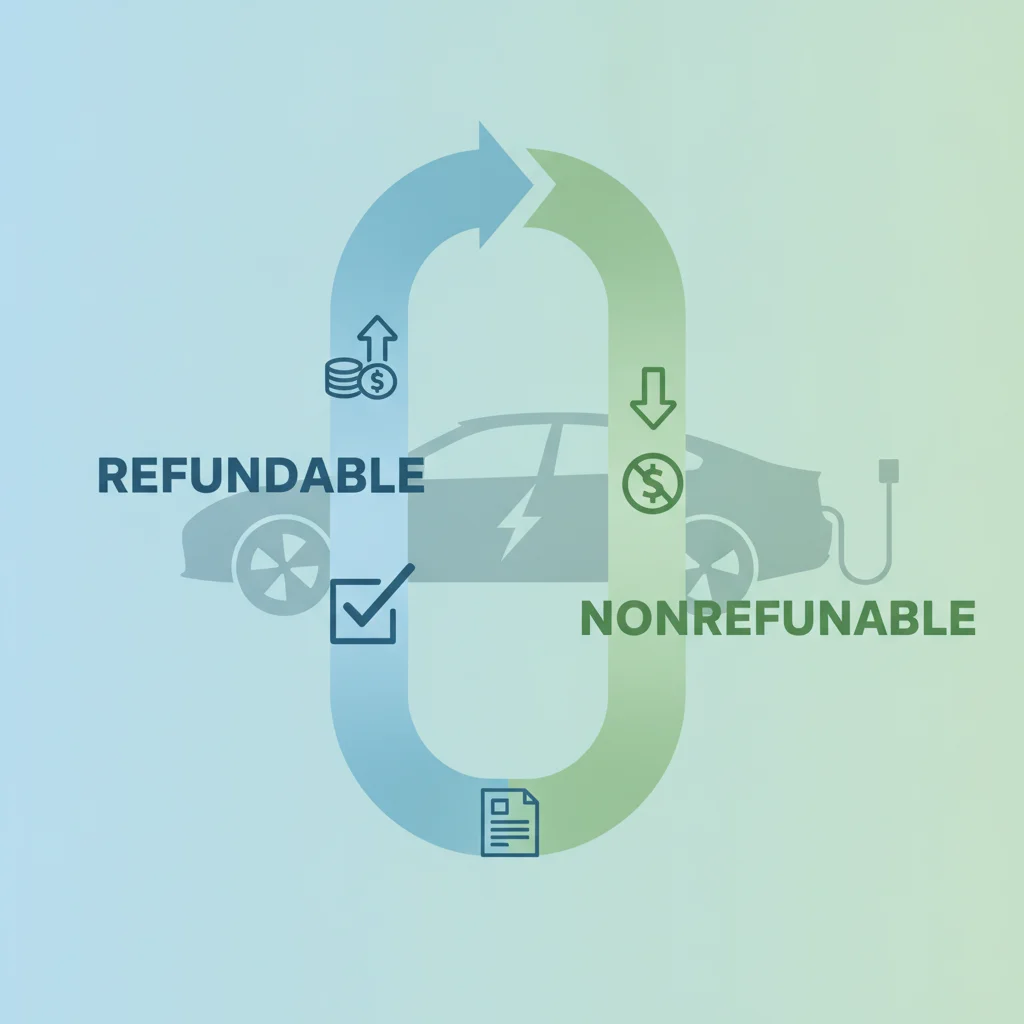
The federal EV credit is nonrefundable, meaning it can only reduce your tax bill to zero — it cannot generate a refund beyond what you've already paid in.
This is a structural misunderstanding of how tax credits work, and it catches a surprising number of buyers off guard. The credit offsets your federal income tax liability dollar-for-dollar, up to $7,500. If your total federal tax liability for the year is $4,000, the maximum value you can get from the credit is $4,000 — full stop. The remaining $3,500 doesn't carry forward to next year; it simply disappears.
The nonrefundable vs. refundable distinction is critical to understand before you factor the credit into your purchase budget. Buyers with modest incomes, significant deductions, or irregular earnings are most at risk of over-estimating the credit's real value to them.
The 2024 point-of-sale transfer option — where you transfer the credit to a participating dealer and get the value upfront — doesn't change this fundamental rule. It just moves when you interact with the limitation. If your actual tax liability is lower than the credit you transferred, the IRS will recapture the difference at filing.
Myth
Your income doesn't affect whether you can claim the EV tax credit.
Fact
Modified Adjusted Gross Income limits apply, and exceeding them by even a dollar eliminates the credit entirely — there's no phase-out.
The Inflation Reduction Act introduced hard income cutoffs with no graduated phase-out. Exceed the threshold and you get nothing — it's a cliff, not a slope.
| Filing Status | MAGI Limit (New EV) | MAGI Limit (Used EV) |
|---|---|---|
| Single / Married Filing Separately | $150,000 | $75,000 |
| Head of Household | $225,000 | $112,500 |
| Married Filing Jointly | $300,000 | $150,000 |
MAGI is not the same as gross salary. It includes capital gains distributions, rental income, Social Security benefits, foreign income, and other items that can push you over a threshold even when your W-2 looks fine. A year-end bonus, stock option exercise, or Roth conversion can disqualify you retroactively after you've already purchased the vehicle.
The IRS checks the lower of your MAGI in the year of purchase or the year prior, so if you were under the limit last year but over it this year, you can still qualify. But if you're over in the purchase year, there's no workaround through amended returns or credit allocation.
Myth
The $7,500 credit comes off the sticker price at the dealership — it's an instant discount.
Fact
The point-of-sale transfer option introduced in January 2024 allows this, but only at participating dealers and only if you meet all eligibility requirements.
Prior to 2024, the EV credit was strictly a tax-time benefit — you paid full price for the vehicle and claimed the credit when you filed your federal return. Beginning January 1, 2024, the IRS introduced a mechanism allowing buyers to transfer the credit to a registered dealer, effectively reducing the vehicle's purchase price by up to $7,500 at the point of sale.
This is a genuine improvement for buyers, but several conditions apply:
- The dealer must be registered with the IRS as a clean vehicle credit transfer participant.
- You must still meet all income and vehicle eligibility requirements at the time of purchase.
- The dealer submits a report to the IRS; any discrepancy between your actual tax liability and the credit amount transferred can result in recapture when you file.
- You cannot receive cash back if the credit exceeds your actual purchase price contribution.
Not all dealers have completed IRS registration. If a dealer claims to offer the point-of-sale discount but isn't registered, the transaction could create tax problems for you. Ask to see confirmation of their IRS registration before treating any discount as a guaranteed credit transfer.
[in_content_images:3]Myth
If you buy a used EV, you don't qualify for any federal tax credit.
Fact
There is a separate used clean vehicle credit worth up to $4,000, but it comes with stricter income limits and a $25,000 vehicle price cap.
The Used Clean Vehicle Credit (IRC Section 25E) was created by the Inflation Reduction Act and applies to qualifying used EVs and fuel cell vehicles purchased from a dealer. Key parameters:
- Credit amount: 30% of the sale price, up to a maximum of $4,000.
- Vehicle age: Must be at least two model years older than the calendar year of purchase.
- Sale price: Cannot exceed $25,000.
- Income limits: $75,000 MAGI for single filers, $150,000 for joint filers — lower than the new-vehicle thresholds.
- Prior credit: The same vehicle cannot have been claimed for this credit previously.
- Dealer sale only: Private party purchases don't qualify.
The used credit is also nonrefundable and can be transferred at point of sale starting in 2024 under the same mechanism as the new-vehicle credit. For buyers who are close to — but not over — the used-vehicle income limits, this credit can make a used EV substantially more financially attractive than a new one, especially given that many used EVs have already absorbed the steepest portion of first-year depreciation.
Myth
Once a vehicle qualifies for the credit, you're guaranteed to receive it as long as you buy that model.
Fact
Eligibility is determined at the time of purchase and can change mid-model-year if a manufacturer updates its battery supply chain or exceeds a sales threshold.
Vehicle eligibility under the current credit structure is not static. The IRS-required sourcing thresholds for critical minerals and battery components mean that a vehicle qualifying today may be reclassified if its manufacturer changes a supplier mid-year. This has already happened with several models since the IRA took effect.
Additionally, the IRS requires that a written binding contract exist before the purchase date for certain transitional protections. If you deposit on a vehicle today and take delivery three months from now, the eligibility rules that apply are those in effect at the time of delivery — not at the time of your deposit, unless you have a qualifying binding contract.
Practical steps to protect yourself: verify eligibility using the specific VIN at fueleconomy.gov at the time of final purchase decision, get written confirmation from the dealer that the vehicle is eligible, and check whether the manufacturer has any pending supply-chain changes that could affect your model. Don't rely on eligibility information that's more than a few weeks old.
Incorrect Claims Can Trigger IRS Recapture
If you claim the EV credit — either at tax time or through a point-of-sale transfer — and you didn't actually qualify, the IRS can require you to repay the full credit amount plus interest and potential penalties. This is called recapture, and it applies whether the error was intentional or a simple misunderstanding of the eligibility rules. Before you claim or transfer any credit, verify vehicle eligibility, confirm your MAGI, and estimate your actual tax liability for the year. For details on how recapture works and what the IRS process looks like, see <a href="/electric-vehicles/ev-ownership-costs/ev-tax-credits/what-happens-if-you-claim-the-ev-credit-but-didnt-actually-qualify">what happens if you claim the credit incorrectly</a>.
How to Actually Use the Credit to Your Advantage
Understanding the myths is only half the job. The other half is building a strategy that captures every dollar you legitimately qualify for.
$7,500
Maximum federal new EV tax credit
Under IRC Section 30D as amended by the Inflation Reduction Act of 2022, qualifying new EVs are eligible for up to $7,500 — but most buyers don't capture the full amount.
$4,000
Maximum used EV federal credit
The Section 25E used clean vehicle credit caps at $4,000 or 30% of sale price, whichever is less, for qualifying vehicles priced under $25,000.
$55,000 / $80,000
MSRP caps for new EV credit
Sedans and hatchbacks face a $55,000 price cap; SUVs, vans, and pickups face an $80,000 cap — vehicles priced above these thresholds are categorically ineligible.
50%+
Of new EV models failed full credit eligibility in 2023
According to IRS and DOE data, more than half of EV models available in 2023 did not meet all sourcing and assembly requirements for the full $7,500 credit at launch.
$300,000
MAGI ceiling for joint filers (new EV)
Married couples filing jointly must have a Modified Adjusted Gross Income at or below $300,000 to claim the new vehicle credit — a single-dollar excess eliminates the entire benefit.
Step 1: Verify Vehicle Eligibility Before You Negotiate
The IRS maintains an updated list of qualifying vehicles at fueleconomy.gov. Check it before you visit a dealership. Eligibility can change mid-model-year if a manufacturer hits a supply-chain sourcing threshold, so the list you checked three months ago may be outdated. Confirm the VIN-specific eligibility with the dealer in writing.
Step 2: Know Your Tax Liability Going In
Pull last year's tax return and look at line 24 (total tax). That number is roughly your ceiling for the nonrefundable credit. If it was less than $7,500, you won't capture the full credit. A tax professional can help you project this year's liability — which may differ significantly if your income, deductions, or filing status changed. See our deeper dive on how nonrefundability limits the credit for the mechanics.
Step 3: Decide: Point-of-Sale Transfer or Tax-Time Credit
Starting January 2024, you can transfer your credit to a registered dealer at the point of sale, effectively getting the discount upfront. This is advantageous if your tax liability is uncertain or if you want immediate cash impact. However, if your actual tax liability ends up lower than expected, the IRS can recapture the excess — so understand the recapture risk before you elect this option.
Step 4: Stack State and Utility Incentives
The federal credit doesn't prevent you from also claiming state rebates, utility bill credits, or local incentives. California's Clean Vehicle Rebate Project (now the Clean Cars 4 All program), Colorado's EV tax credit, and dozens of utility-level rebates can be layered on top of the federal credit. Research your state's current programs — many have their own income caps and vehicle eligibility rules that differ from the federal standard.

Step 5: Consider the Used EV Credit
If a new EV's sticker price or your income puts you out of range for the new-vehicle credit, a used EV purchase may qualify for a credit worth 30% of the sale price, up to $4,000. Income limits are lower (MAGI of $75,000 single / $150,000 joint), the vehicle must be at least two years old, and the purchase price cannot exceed $25,000. A qualifying used EV purchase can be a smarter financial move than stretching to buy new — especially given EV depreciation patterns.
Speaking of which, if you're weighing used vs. new, depreciation myths that affect EV values deserve a look too.
Common Situations Where Buyers Get Burned
Even buyers who've done some homework make predictable mistakes. Here are three real-world scenarios that illustrate where the wheels come off:
Scenario A: The Income Surprise
A buyer earns $148,000 in salary and confidently purchases a qualifying EV expecting the full credit. At tax time, they report a $15,000 bonus received in Q4, pushing their MAGI to $163,000 — $13,000 above the $150,000 joint filer limit. Result: zero credit, no recourse. The fix is projecting full-year income, not just salary, before committing.
Scenario B: The Dealer Assurance Problem
A buyer is told by a salesperson that the vehicle qualifies for the $7,500 credit. The dealer is wrong — the model's battery components fail the critical minerals sourcing test, making it eligible for only $3,750. The buyer discovers this when filing taxes. There's no legal obligation for the dealer to guarantee eligibility. Always verify via the IRS or fueleconomy.gov, not the sales floor.
Don't Trust Dealership Eligibility Assurances
Salespeople are not tax advisors, and dealerships are not legally required to guarantee EV tax credit eligibility. Verbal assurances that a vehicle qualifies carry no legal weight. Always verify eligibility yourself at fueleconomy.gov using the actual VIN of the vehicle you're buying, and consider consulting a tax professional before finalizing a purchase that depends on the credit.
Year-End Income Can Retroactively Disqualify You
Because eligibility is based on full-year MAGI, income events that occur after your EV purchase — a bonus, a capital gain, a Roth conversion — can push you over the income limit and eliminate the credit entirely. If your income is close to the threshold, model your full-year earnings before buying and consider the risk that a late-year income event could cost you the entire credit amount.
Scenario C: The Point-of-Sale Overclaim
A buyer transfers the full $7,500 credit to a dealer at purchase, reducing their out-of-pocket cost. But their actual federal tax liability for the year turns out to be $4,200. The IRS requires them to repay the $3,300 difference when they file. This is a real recapture scenario — and the IRS penalties can compound if not addressed promptly.
These scenarios aren't meant to scare you away from the credit. They're meant to push you toward doing the work upfront so you capture what you're owed without an unwelcome surprise from the IRS.
Other EV Cost Myths Worth Knowing
Tax credit confusion doesn't exist in isolation. Buyers who misunderstand the credit often also carry flawed assumptions about insurance, charging, and depreciation — each of which can compound the financial misstep.
On insurance: many buyers assume their standard policy covers an EV the same way it covers a gas car, or that EV insurance is always more expensive. Neither is reliably true. See EV insurance myths that cost owners money for a realistic breakdown.
On charging: the assumption that home charging is always cheap and public fast charging is always expensive or free doesn't hold up. Charging cost myths can affect your true cost-of-ownership calculations significantly. And for a broader picture of what it costs to power an EV, the Charging Costs & Savings hub is a useful starting point.
The point is this: a $7,500 credit is meaningful, but it's one component of a larger financial picture. Getting the tax credit right matters most when you're also getting the insurance, charging, and depreciation math right at the same time.

Bottom Line
The federal EV tax credit can save you real money — but only if you qualify, and only up to the amount of federal income tax you actually owe. The rules around vehicle eligibility, income limits, and credit structure are detailed enough that assumptions are dangerous. Every one of the myths in this article represents money left on the table or, worse, money paid back to the IRS.
Do the vehicle check. Estimate your tax liability. Project your full-year income. And if you plan to use the point-of-sale transfer option, understand the recapture risk before you sign. The credit rewards buyers who prepare — and penalizes those who assume.

All claims are backed by peer-reviewed research. Sources on request.