
Key Takeaways
EV Theft Risk
EV theft risk refers to how likely an electric vehicle is to be stolen, and how that likelihood compares to gas-powered vehicles. Unlike conventional cars, EVs use digital key systems, app-based access, and over-the-air software controls — meaning thieves must use different methods to steal them. Some of these digital features make EVs harder to steal; others introduce new vulnerabilities that traditional cars don't face.
Relay attacks, OBD port exploits, and keyless entry signal amplification are among the primary digital attack vectors relevant to modern EVs and their insurance risk profiles.
The Ignition Cylinder Problem — and Why EVs Don't Have One
Walk up to any gas-powered car from the past several decades and you'll find the same vulnerability: a mechanical ignition cylinder that a skilled thief can bypass with the right tools in under a minute. It's the reason "hot-wiring" became a cultural fixture in heist films and, more importantly, a reliable theft method in the real world.
Electric vehicles don't have one. There's no ignition cylinder to pick, no starter circuit to bridge. The absence of this single component eliminates one of the most time-tested vehicle theft techniques entirely. In that narrow sense, EVs are unambiguously harder to steal than most gas-powered cars built before the mid-2010s.
But the picture gets more complicated from there. Modern EVs are, at their core, networked computers on wheels. They authenticate drivers through digital key fobs, smartphone apps, and proximity sensors — and each of those access points carries its own set of vulnerabilities that didn't exist when cars ran on purely mechanical systems.
Understanding how EV theft actually works — and how it differs from traditional auto theft — is increasingly important for owners making insurance decisions. The coverage you need, and what you'll pay for it, depends partly on the actual risk profile of your specific vehicle.
How Thieves Actually Steal Electric Vehicles
Because the conventional hot-wire approach doesn't apply, thieves targeting EVs have shifted toward exploiting the digital systems that control vehicle access. The most prevalent methods fall into a few categories.
Relay Attacks on Keyless Entry
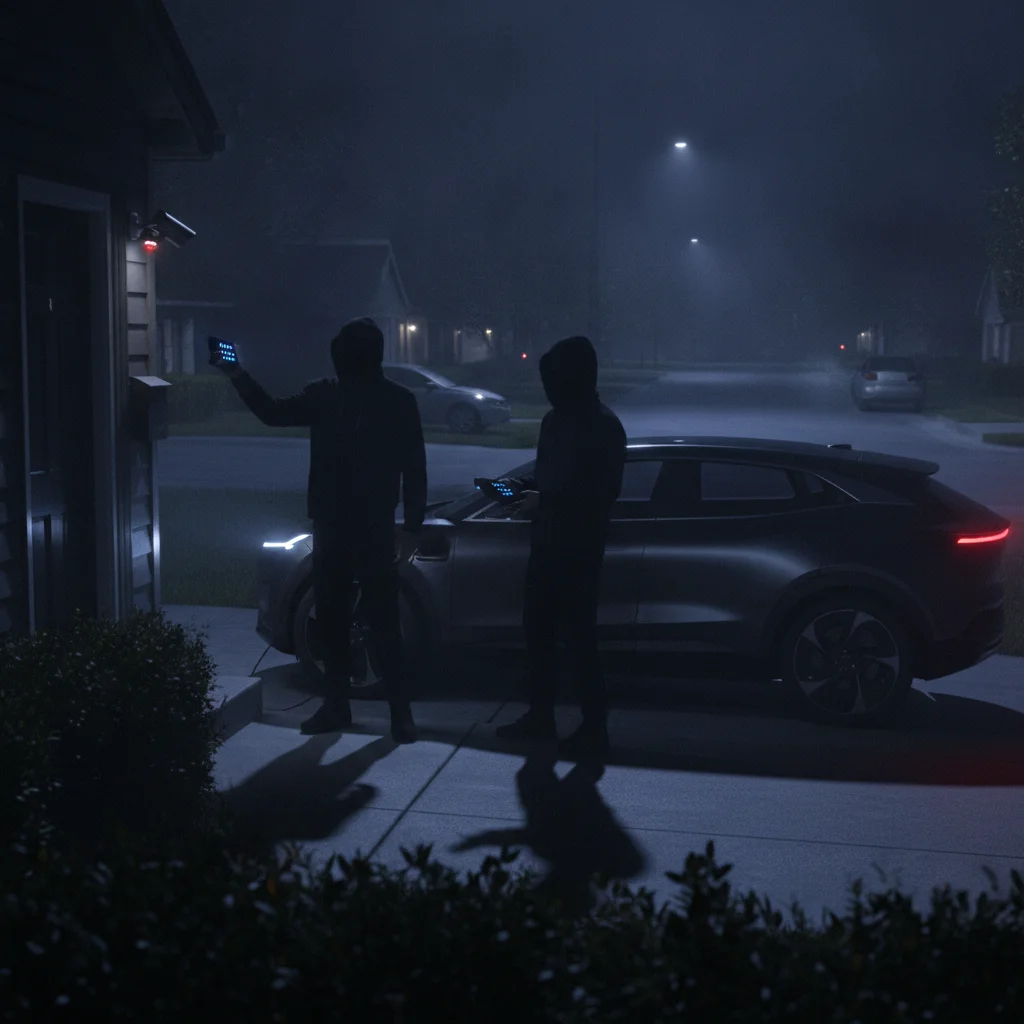
This is currently the most common method used against EVs and many modern keyless-entry gas vehicles alike. Two thieves work as a team: one stands near your home or pocket where the key fob is stored, using a signal amplifier to capture the fob's passive signal. The second stands near the car with a relay receiver. The car's passive entry system "thinks" the key is nearby, unlocks, and in some cases allows the vehicle to be moved.
The attack is fast, quiet, and requires no physical damage to the vehicle — which is part of what makes it attractive to organized theft rings. It also leaves less forensic evidence than a broken window or forced lock.
“The connected nature of electric vehicles is a double-edged sword for security. The same cellular and software infrastructure that lets a manufacturer push a theft-immobilization command also creates surfaces that sophisticated attackers can try to exploit. The net risk profile is still favorable compared to conventional vehicles, but it's not zero.”
— Frank Scafidi, Former spokesperson, National Insurance Crime Bureau (NICB)
OBD Port Programming
On vehicles where physical access to the cabin can be gained through other means (a broken window, a compromised door sensor), thieves can plug a device into the OBD-II diagnostic port and program a blank key fob to match the vehicle's system. This technique has been widely documented across multiple EV and non-EV models. Once a new key is programmed, the car treats it as legitimate.
Account and App Compromise
Several EV manufacturers — Tesla, Rivian, and others — allow vehicle access and even remote start via smartphone apps tied to owner accounts. If a thief gains access to an owner's email or manufacturer account through phishing or a data breach, they may be able to unlock and locate the vehicle remotely. This attack vector is less common than relay attacks but growing in reported frequency.
Physical Catalytic Converter and Component Theft
It's worth noting that not all EV-related theft involves driving the vehicle away. Battery modules and other high-value EV components have become targets for partial theft, particularly on models where these parts are accessible. This falls under comprehensive coverage just as whole-vehicle theft does.
~52%
Lower theft claim rate for Teslas vs. industry average
According to Highway Loss Data Institute (HLDI) data, Tesla models have posted theft claim frequencies approximately 52% below the industry average, attributed largely to GPS tracking and software lockdown capabilities.
1 in 5
Keyless-entry vehicles stolen via relay attack
UK-based vehicle security researchers estimate that the majority of modern keyless-entry vehicle thefts — including EVs — involve relay attack techniques rather than physical bypass methods.
$67,000+
Average EV transaction price (2024)
According to Kelley Blue Book data, the average new EV transaction price in 2024 exceeded $67,000 — a figure that directly elevates comprehensive insurance exposure in a theft event.
30–40%
Comprehensive premium increase for EVs vs. gas equivalents
Industry analysts estimate comprehensive coverage for EVs runs 30–40% higher than comparable gas vehicles on average, driven by higher replacement costs, battery exposure, and parts availability constraints.
$10–$20
Cost of a Faraday pouch for key fob protection
Signal-blocking Faraday bags — one of the most effective and affordable relay-attack countermeasures — are widely available at this price point, making them an accessible first line of defense for any keyless-entry vehicle owner.
EV Theft Rates: What the Data Actually Shows
Raw theft data for EVs is still catching up to the size of the EV fleet, but the numbers available paint a meaningful picture. According to data compiled by the Highway Loss Data Institute (HLDI), several popular EV models post significantly lower theft claim rates than the average for all vehicles. For example, Tesla models have historically had theft claim frequencies well below the industry average — a statistic Tesla has attributed in part to its GPS tracking infrastructure and over-the-air software lockdown capabilities.
That said, specific high-demand EV models — particularly those with resale value for individual components — have seen upticks in targeted theft attempts in certain metro areas. The Kia and Hyundai theft surge of 2022–2023, driven by a viral TikTok showing how to start certain models with a USB cable, was a gas-vehicle phenomenon, but it illustrated how quickly a single vulnerability can scale into a wave of claims that reshapes an insurer's risk model.
For EV buyers, the practical implication is that theft risk varies significantly by model, region, and even how you store your key fob. A Chevrolet Equinox EV parked in a high-crime urban neighborhood carries a different risk profile than a Tesla Model 3 in a gated suburban garage with PIN to Drive enabled.
Insurers are factoring these distinctions into their models, though unevenly. Some carriers have begun applying model-specific theft adjustments to comprehensive premiums; others still use broader EV category assumptions. That gap in actuarial sophistication is one reason shopping your comprehensive coverage is worth doing carefully. See our full breakdown of how insurers price EVs differently for a deeper look at these rating mechanics.
Theft Data for EVs Is Still Limited
The EV fleet in the U.S. has grown rapidly, but it still represents a relatively small share of total registered vehicles. This means theft rate data for many EV models is based on smaller sample sizes than equivalent gas-vehicle statistics. Insurers and researchers acknowledge this limitation and expect models to become more precise as fleet size and claims history accumulate over the next few years.
EV-Specific Security Features That Actually Reduce Theft Risk
The same digital architecture that creates new theft vulnerabilities also enables anti-theft tools that gas-powered cars can't easily replicate. Several of these features have demonstrated measurable impact on theft outcomes.
PIN to Drive
Popularized by Tesla and now appearing on other EVs, PIN to Drive requires the driver to enter a numeric code before the vehicle will move — even if the key fob or phone key has already unlocked the doors. Thieves who successfully execute a relay attack to gain cabin access are stopped cold at the drive stage. Tesla's own data has suggested this feature dramatically reduces completed thefts.
Over-the-Air Software Lockdown
If a theft is in progress or a vehicle is reported stolen, manufacturers like Tesla can push an immobilization command over cellular connection, preventing the motor from operating. Law enforcement can also work with manufacturers to track a stolen vehicle's GPS location in real time — something that's only possible because EVs are persistently connected to manufacturer networks.
Faraday Pouches for Key Fobs
Low-tech but highly effective. Storing your key fob in a signal-blocking pouch when at home prevents relay attack amplifiers from capturing its signal. At roughly $10–$20, a Faraday bag is among the most cost-effective theft deterrents available to any keyless-entry vehicle owner, EV or otherwise.
Use a Faraday Bag Every Night
Most relay attacks happen in residential driveways overnight, when the key fob is close enough to the vehicle for signal amplification to work through walls. Placing your key fob in a signal-blocking Faraday pouch before bed costs under $20 and eliminates this vulnerability entirely. Look for pouches that are RFID-certified and large enough to hold your specific fob.
Tell Your Insurer About Your Security Features
Don't assume your insurer has automatically applied discounts for PIN to Drive, factory GPS, or third-party tracking devices installed on your EV. Call your agent or log into your policy portal and specifically ask which anti-theft features qualify for a rate reduction. Insurers that haven't asked may not have accounted for them — and a brief conversation can sometimes yield a meaningful discount.
GPS and Tracking Integration
Many EVs come with factory-installed GPS and cellular connectivity, giving owners and insurers real-time location data. Third-party tracking devices can be added to vehicles that lack these features. Insurers frequently offer discounts for approved tracking devices — see how anti-theft devices affect your insurance premium for a breakdown of which features tend to earn meaningful rate reductions.
How EV Theft Risk Flows Into Your Insurance Premium
Comprehensive coverage — the portion of your auto policy that covers theft — is priced based on the likelihood and severity of a claim on your specific vehicle. For EVs, that calculation involves several overlapping factors that don't apply to gas cars.
Vehicle Replacement Value
EVs are generally more expensive than their gas-powered equivalents, and their replacement cost is a significant driver of comprehensive premium. A stolen EV represents a larger dollar exposure for the insurer than a stolen economy sedan, even if theft probability is equal or lower.
Model-Specific Theft History
Insurers increasingly apply model-level loss data to comprehensive pricing. Models with established low theft rates — particularly those with robust GPS tracking and PIN-to-drive features — may receive favorable adjustments. Newer models without much claims history get priced more conservatively until data accumulates.
Battery Exposure
Component theft, including stripped battery modules, adds a dimension to comprehensive exposure that doesn't have a gas-vehicle parallel. Some insurers offer specific battery replacement coverage as an add-on. Our complete EV insurance guide covers how battery protection clauses typically work and what to look for in a policy.
For context on how this compares to other insurance cost drivers, repair costs and parts availability tend to push premiums higher than theft risk alone — but theft is a meaningful component that shouldn't be overlooked when shopping coverage.
The bottom line for premium impact: owning an EV with strong built-in anti-theft features may partially offset the higher vehicle-value component of your comprehensive rate, but it's unlikely to make EV comprehensive coverage cheaper than a comparable gas vehicle overall. The math usually runs in the other direction — see our EV vs. traditional insurance comparison for a side-by-side look.
Practical Steps EV Owners Should Take Now
The theft landscape for EVs is evolving faster than most insurance policies are being updated. Taking proactive steps to reduce your risk — and document those steps with your insurer — is the most effective way to manage both your exposure and your premium.
- Enable every manufacturer security feature available. PIN to Drive, app-based alerts, and remote immobilization are typically free and require only a settings change. There's no meaningful reason to leave them disabled.
- Use a Faraday pouch for your key fob at home. Most relay attacks happen in residential driveways where the fob is within amplifiable range. A signal-blocking pouch eliminates this exposure.
- Verify your comprehensive coverage includes the full replacement value of your EV. Given the vehicle's cost, a gap between actual cash value and replacement cost could be significant. Agreed-value or gap coverage may be worth exploring.
- Ask your insurer specifically about EV theft discounts. Not all insurers proactively apply discounts for factory GPS, PIN-to-drive, or third-party tracking devices. Asking directly often yields results that passive enrollment doesn't.
- Shop your comprehensive coverage periodically. Insurers are still calibrating EV-specific risk models, and rates across carriers can vary significantly for the same vehicle. What one company charges for comprehensive on a Model Y may differ substantially from a competitor's rate.
Use a Faraday Bag Every Night
Most relay attacks happen in residential driveways overnight, when the key fob is close enough to the vehicle for signal amplification to work through walls. Placing your key fob in a signal-blocking Faraday pouch before bed costs under $20 and eliminates this vulnerability entirely. Look for pouches that are RFID-certified and large enough to hold your specific fob.
Tell Your Insurer About Your Security Features
Don't assume your insurer has automatically applied discounts for PIN to Drive, factory GPS, or third-party tracking devices installed on your EV. Call your agent or log into your policy portal and specifically ask which anti-theft features qualify for a rate reduction. Insurers that haven't asked may not have accounted for them — and a brief conversation can sometimes yield a meaningful discount.
For a broader view of how EV ownership costs — including insurance — compare to gas vehicles, the EV maintenance basics hub provides useful context on total cost of ownership. And if you're weighing the full picture of EV insurance tradeoffs, our pros and cons of EV insurance relative to gas policies covers both sides of the ledger.
All claims are backed by peer-reviewed research. Sources on request.