| Energy in one gallon of gasoline | 33.7 kWh (EPA standard conversion factor) |
| MPGe definition | Miles traveled on 33.7 kWh of electricity (U.S. Environmental Protection Agency) |
| Most efficient BEV (2024 MY) | ~140 MPGe combined (EPA fueleconomy.gov, 2024 model year data) |
| Typical large EV truck MPGe | 60–80 MPGe combined (EPA fueleconomy.gov, 2024 model year data) |
| kWh/100 mi range for BEVs | ~24–45 kWh/100 miles (EPA fueleconomy.gov, 2024 model year data) |
| PHEV electric-only range (typical) | 20–50 miles (Manufacturer specifications, 2023–2024 models) |
| EPA sticker annual mileage assumption | 15,000 miles/year (U.S. Environmental Protection Agency) |
| City/highway weighting (combined MPG) | 55% city / 45% highway (EPA testing methodology) |
Why Electrified Cars Use Different Efficiency Metrics
Walk the lot at any modern dealership and you'll encounter window stickers carrying three completely different efficiency units: MPG, MPGe, and kWh per 100 miles. They're not interchangeable, and they're not measuring exactly the same thing. The EPA assigns each unit to specific powertrain types, and knowing which one applies — and what it actually tells you — is essential before you can compare vehicles fairly.
The core problem is energy. Gasoline, electricity, and hybrid combinations store and deliver energy in fundamentally different ways. One gallon of gasoline contains roughly 33.7 kilowatt-hours of energy — a number the EPA uses as its conversion anchor. From that anchor, the agency constructs metrics that let a buyer ask: how efficiently is this vehicle using its energy source?
This article is a field reference. It defines each metric, explains which vehicle types carry it, and shows you how to use the numbers when you're comparing cars across powertrain categories. For a deeper look at how EPA testing conditions affect every one of these figures, see how EPA estimates translate to real-world driving.
| Energy in one gallon of gasoline | 33.7 kWh (EPA standard conversion factor) |
| MPGe definition | Miles traveled on 33.7 kWh of electricity (U.S. Environmental Protection Agency) |
| Most efficient BEV (2024 MY) | ~140 MPGe combined (EPA fueleconomy.gov, 2024 model year data) |
| Typical large EV truck MPGe | 60–80 MPGe combined (EPA fueleconomy.gov, 2024 model year data) |
| kWh/100 mi range for BEVs | ~24–45 kWh/100 miles (EPA fueleconomy.gov, 2024 model year data) |
| PHEV electric-only range (typical) | 20–50 miles (Manufacturer specifications, 2023–2024 models) |
| EPA sticker annual mileage assumption | 15,000 miles/year (U.S. Environmental Protection Agency) |
| City/highway weighting (combined MPG) | 55% city / 45% highway (EPA testing methodology) |
MPG: The Baseline for Conventional and Mild-Hybrid Vehicles
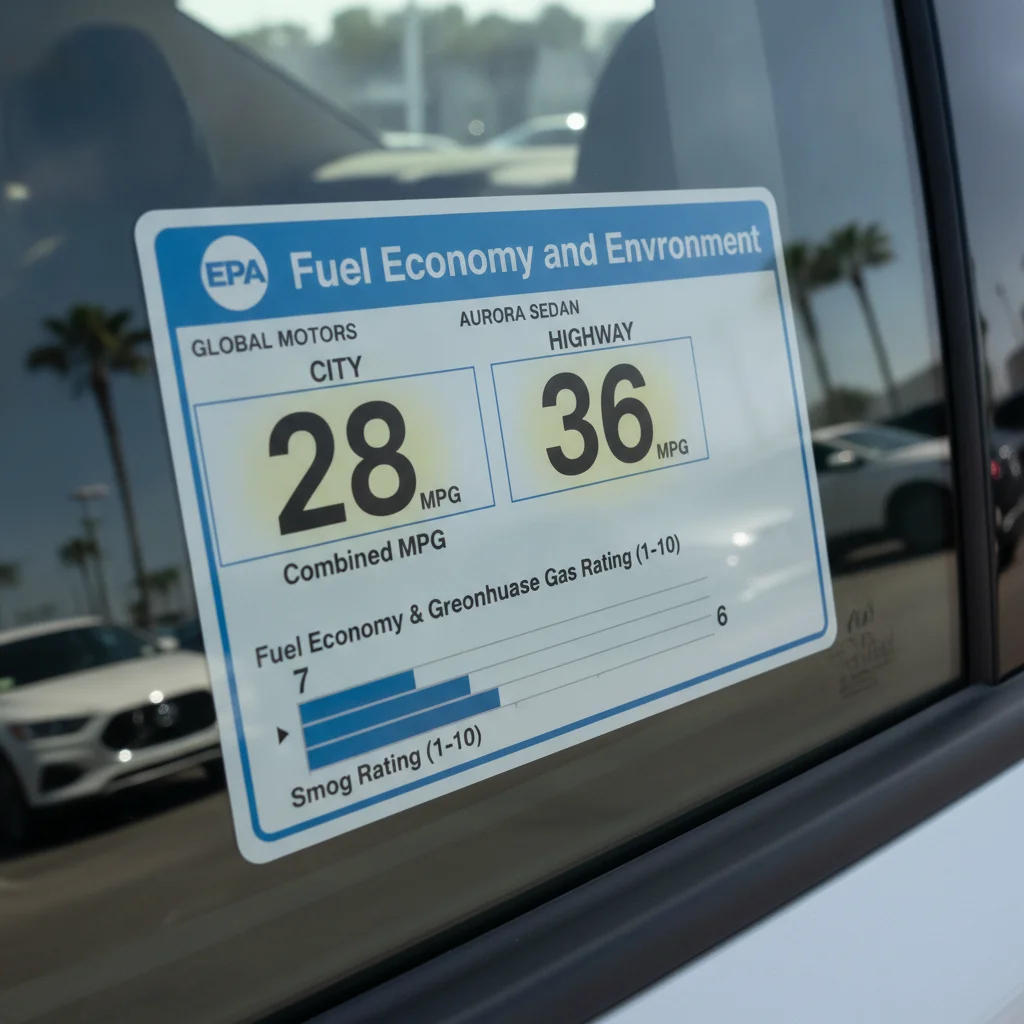
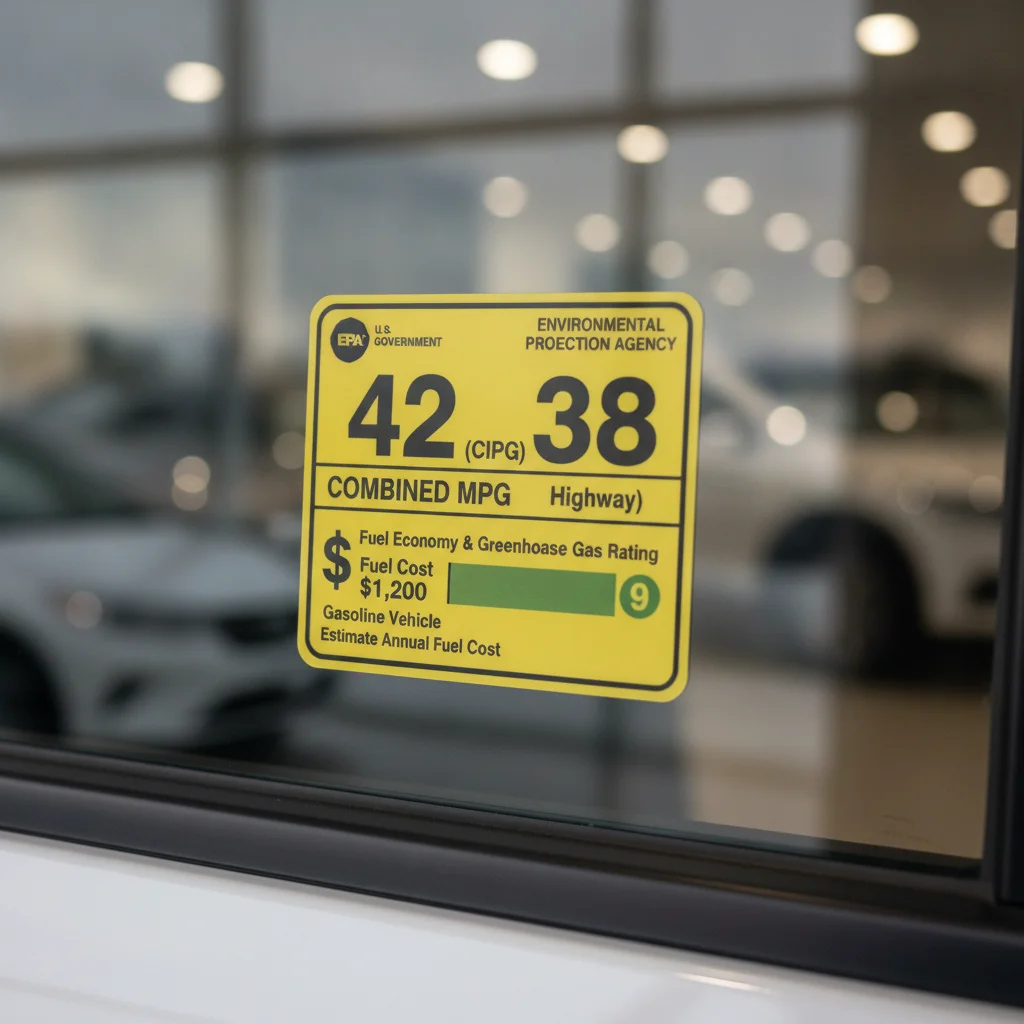
Miles per gallon (MPG) is the oldest and most familiar fuel economy metric. It measures how many miles a vehicle travels per gallon of liquid fuel consumed. Higher is better. The EPA publishes separate city and highway figures, plus a combined rating weighted 55% city / 45% highway — the combined figure is the one printed largest on the sticker.
Which vehicles use MPG?
- Conventional gasoline and diesel vehicles — the standard rating
- Mild hybrids (MHEV) — vehicles with a small battery that assists but cannot drive the car on electricity alone; rated in MPG only
- Full hybrids (HEV) such as the Toyota Camry Hybrid or Honda Accord Hybrid — rated in MPG; the battery is charged entirely by the engine and regenerative braking, so no plug-in charging occurs
Hybrids that cannot plug in are still rated purely in MPG because gasoline remains the only energy source you pay for externally. The electric assist is a closed loop — energy in equals energy captured from braking or the engine. There's no separate fuel cost to account for.
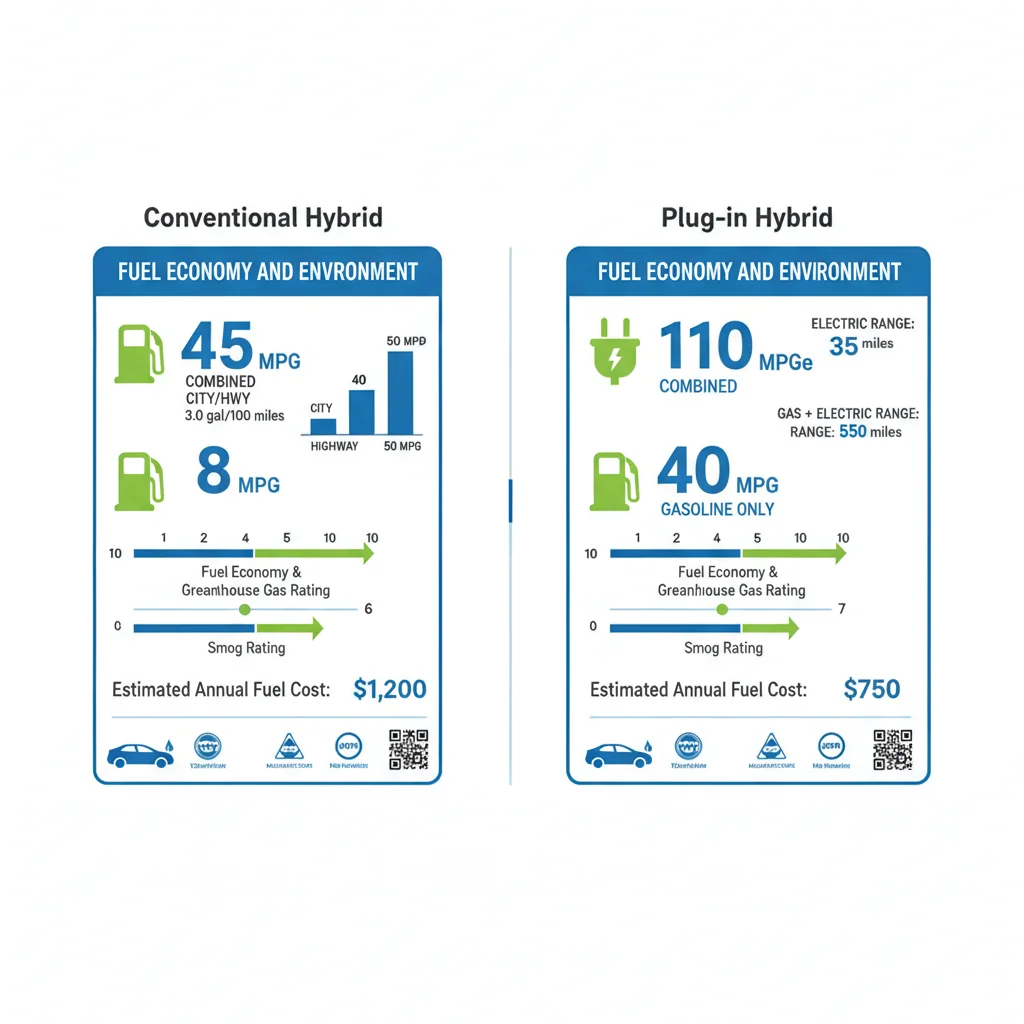
Interpreting MPG on the sticker
The sticker also shows an estimated annual fuel cost (based on 15,000 miles/year and the national average gas price at time of printing) and a range showing the spread of real-world results from actual owners. Pay attention to that range — a vehicle rated 35 MPG combined may realistically deliver anywhere from 29 to 41 MPG depending on driving style, climate, and load. See what every number on the fuel economy sticker means for a full breakdown of the label's fields.
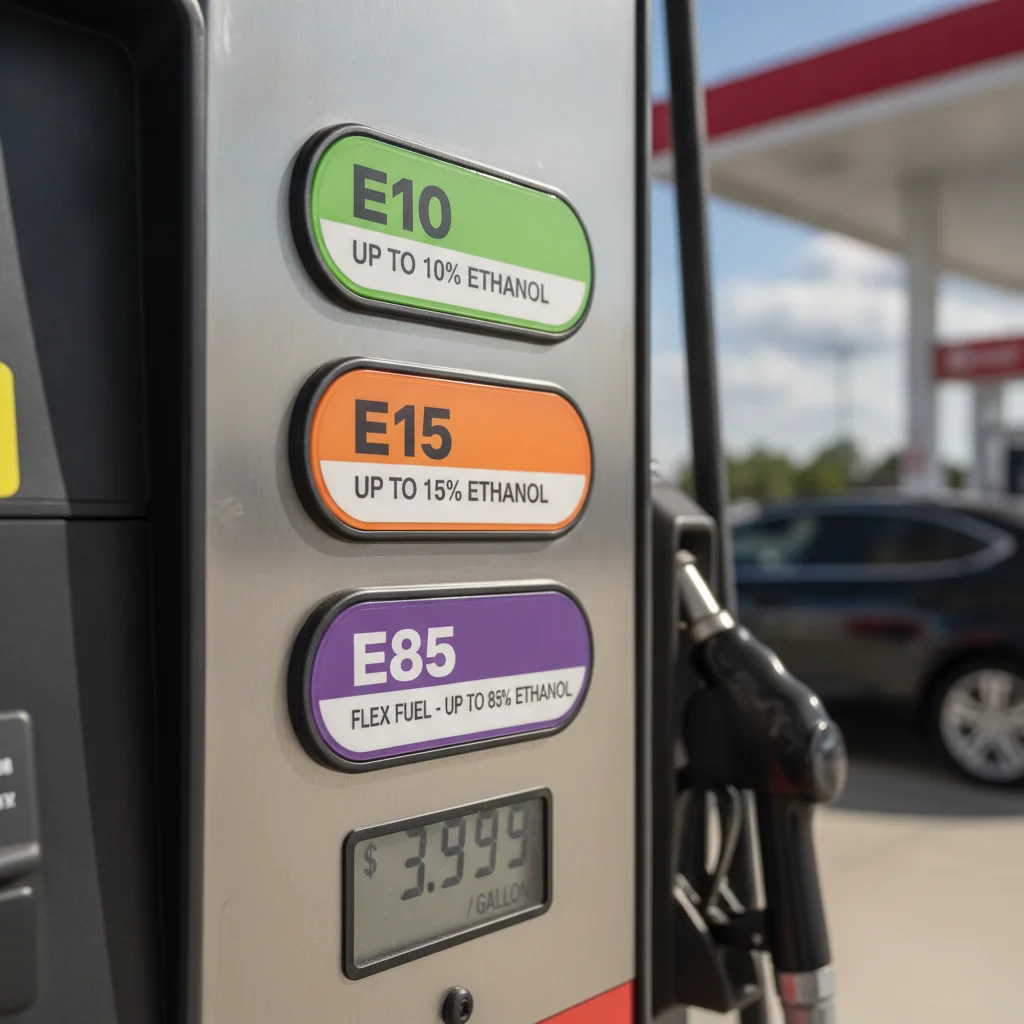
One nuance worth knowing: if your vehicle runs on E85 flex fuel, the MPG drops significantly compared to the gasoline rating. Ethanol blends reduce fuel economy because ethanol contains less energy per gallon than gasoline — about 30% less for pure ethanol.
MPGe: The Efficiency Metric for Plug-In and Battery Electric Vehicles
Miles per gallon equivalent (MPGe) was introduced by the EPA in 2011 specifically to give buyers an apples-to-apples comparison between electric-mode driving and gasoline consumption. The formula is straightforward: if one gallon of gasoline contains 33.7 kWh of energy, how many miles does the vehicle travel on that same 33.7 kWh of electricity?
MPGe = miles traveled on 33.7 kWh of electricity
A vehicle with a 100 MPGe rating, for example, travels 100 miles on the electrical energy equivalent of one gallon of gas. For context, the most efficient battery EVs on the market (2024 model year) post MPGe ratings between 120 and 140, while less aerodynamic EV trucks and large SUVs often land in the 60–80 MPGe range.
33.7 kWh
Energy equivalent of one gallon of gasoline
This EPA conversion factor is the foundation of the MPGe metric used on every electrified vehicle label.
~140 MPGe
Highest combined MPGe rating (2024 model year)
According to EPA fueleconomy.gov data, the most efficient compact battery EVs achieve ratings near this level.
10–25%
Typical real-world efficiency shortfall vs. EPA estimate
Cold weather, highway speeds, and HVAC use are the primary drivers of below-sticker real-world EV consumption.
$3–$5
Estimated cost to travel 100 miles in an efficient BEV (home charging)
Based on an average U.S. residential electricity rate of roughly $0.13–$0.16/kWh and a 28 kWh/100 mi consumption figure.
2011
Year EPA introduced MPGe rating
The EPA created MPGe for the debut of mass-market EVs and PHEVs to enable direct comparison with gasoline vehicles.
Which vehicles use MPGe?
- Battery electric vehicles (BEVs) — rated solely in MPGe and kWh/100 miles; no MPG figure appears
- Plug-in hybrid electric vehicles (PHEVs) — show both MPGe (electric mode) and MPG (gasoline mode) on the same label
- Fuel cell electric vehicles (FCEVs) — rated in MPGe using hydrogen as the energy input; the 33.7 kWh equivalent still applies
MPGe limitations you need to understand
MPGe is useful for comparisons but imperfect for cost calculations. Electricity and gasoline are priced completely differently, and rates vary far more than pump prices do — a driver paying 8¢/kWh overnight charges far less per mile than one paying 30¢/kWh at a public fast charger. MPGe tells you nothing about those cost differences. For actual cost-per-mile math, you need the companion metric: kWh per 100 miles.
For a deeper dive into how MPGe compares to other efficiency units used in EV circles, see MPGe, Wh/mi, and miles per kWh decoded.
Fuel Cell Vehicles Also Use MPGe
Hydrogen fuel cell vehicles (FCEVs) like the Toyota Mirai and Hyundai Nexo are rated in MPGe on their EPA labels, using the same 33.7 kWh/gallon conversion. They also display a separate metric for hydrogen consumption in kilograms per 100 miles. Since hydrogen is priced per kilogram rather than per kWh, MPGe comparisons between FCEVs and BEVs require a separate cost-per-mile calculation using local hydrogen pump prices.
EPA Estimates Are Lab Results, Not Guarantees
All EPA fuel economy figures — MPG, MPGe, and kWh/100 miles — are generated in controlled laboratory testing conditions. Real-world results vary based on ambient temperature, driving speed, HVAC use, payload, and terrain. Cold weather is especially impactful for BEVs, where range and efficiency can drop 20–40% in freezing conditions. Always treat the sticker number as a benchmark, not a floor.
The Blended PHEV Rating Can Be Misleading
The EPA's combined MPGe for PHEVs assumes a specific mix of electric and gasoline driving that may not match your real patterns. A driver who never plugs in will experience fuel economy much closer to the gasoline-only MPG. The blended number looks attractive on a sticker but only reflects real savings if you consistently charge the vehicle.
kWh per 100 Miles: The Most Useful Cost Metric for EV Buyers
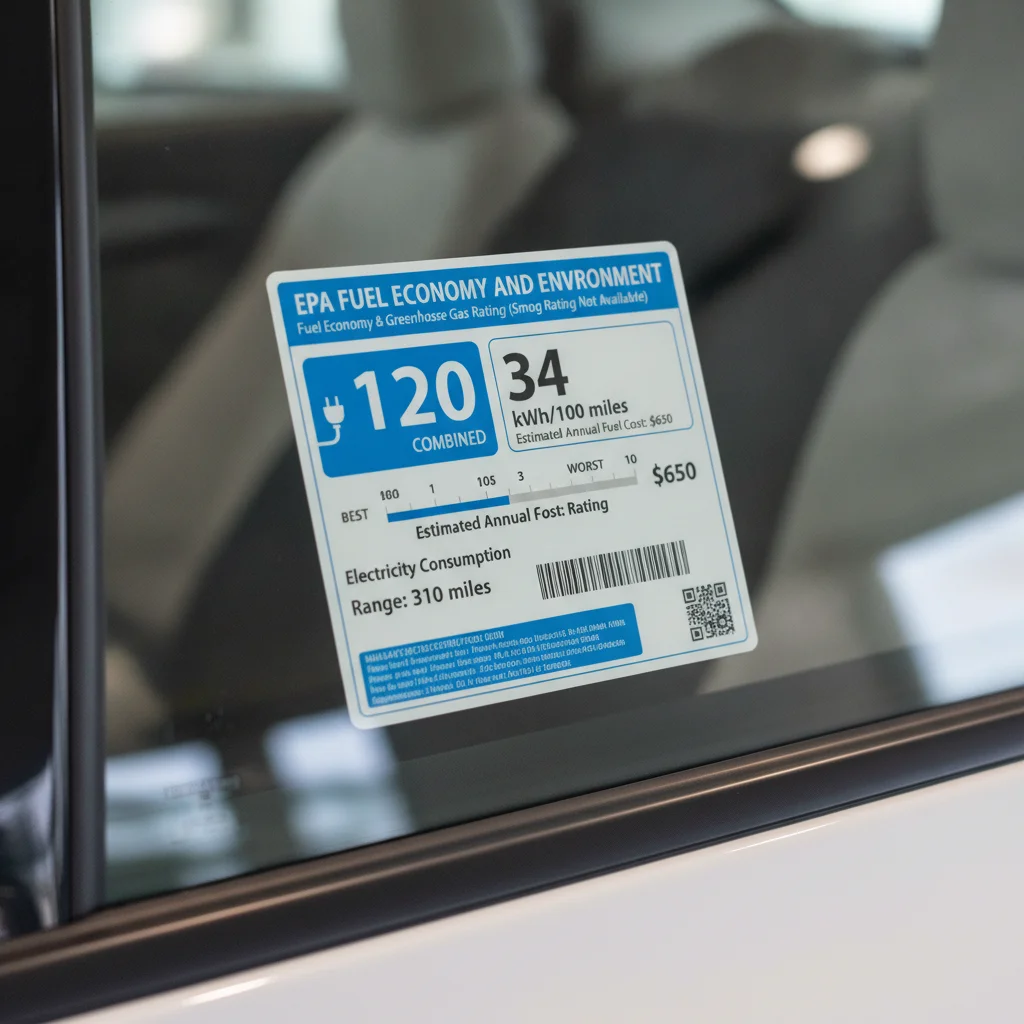
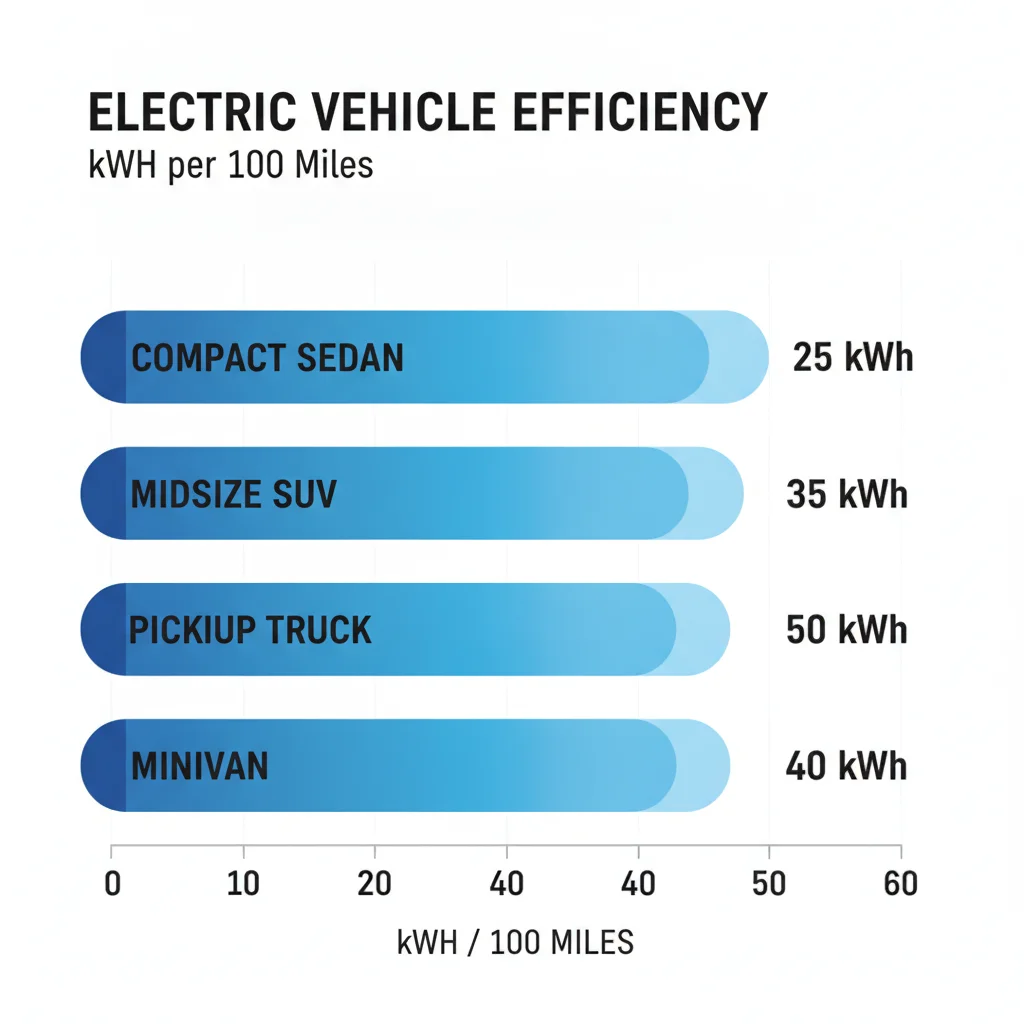
kWh per 100 miles is the EPA's direct energy consumption metric for battery electric vehicles. It answers the question: how many kilowatt-hours does this vehicle actually draw from the grid to travel 100 miles? Lower is better — a vehicle consuming 25 kWh/100 miles is more efficient than one consuming 40 kWh/100 miles.
This number is printed on every BEV and PHEV label alongside MPGe, and it's the figure you should use when calculating real charging costs. The math is simple:
Cost per 100 miles = (kWh/100 mi) × (your electricity rate in $/kWh)
If your vehicle uses 28 kWh/100 miles and you pay $0.14/kWh at home, you're spending $3.92 per 100 miles on fuel — far below what most gasoline vehicles cost at current pump prices. Use this figure alongside the resources at charging costs and savings to model your real annual fuel spend.
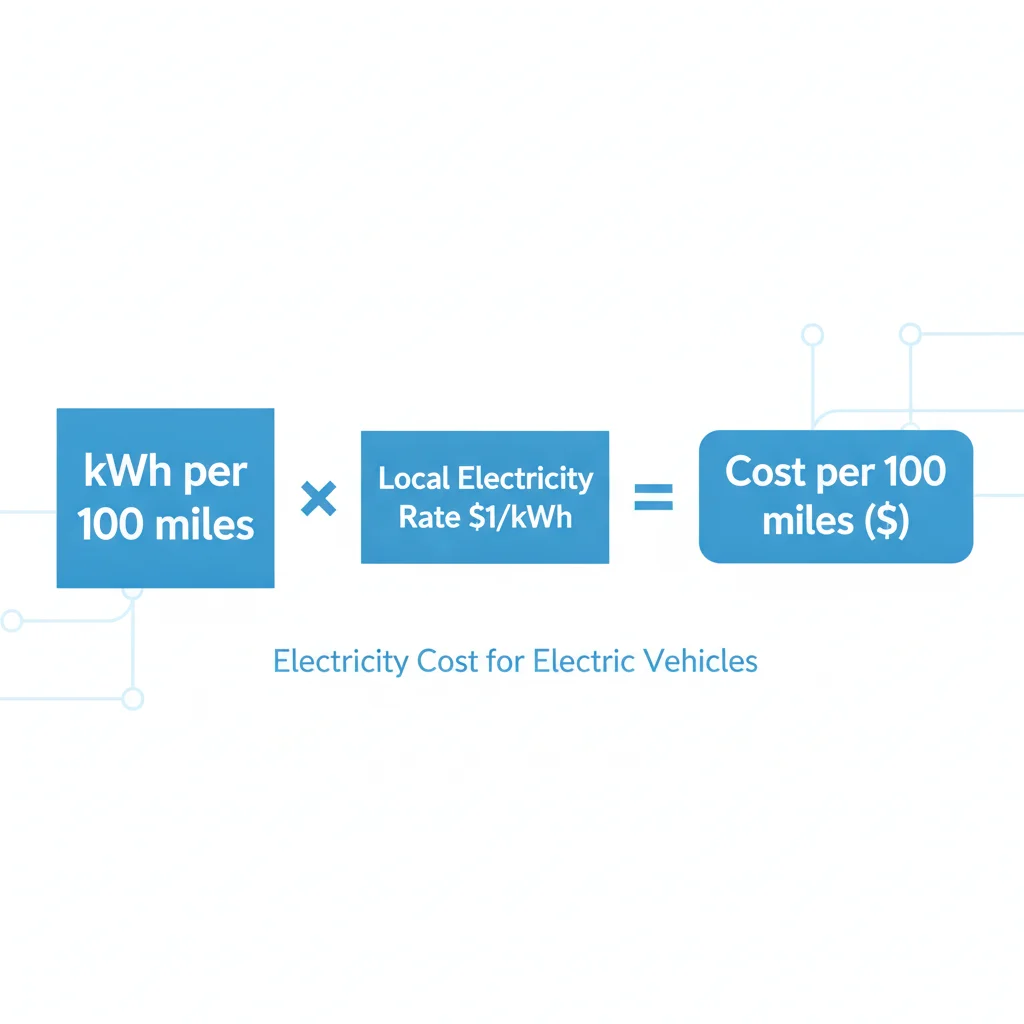
Why kWh per 100 miles beats MPGe for budgeting
MPGe anchors the comparison to a gallon of gas — helpful for benchmarking, but disconnected from how electricity is actually priced. kWh/100 miles connects directly to your utility bill. Once you know your home electricity rate and your vehicle's EPA consumption figure, you can calculate monthly charging costs with a simple multiplication — no conversion factors required.
It also exposes efficiency differences that MPGe can obscure. Two vehicles might be rated at 90 MPGe each, but one might draw 37.4 kWh/100 miles while the other draws 37.3 — the difference in real energy cost is negligible. More meaningful gaps emerge when you compare a 25 kWh/100 mi compact sedan against a 45 kWh/100 mi large truck. See how those gaps play out across vehicle classes in EV efficiency across sedans, SUVs, and trucks.
Understanding kWh/100 miles also requires knowing the difference between kilowatts and kilowatt-hours. If those terms still blur together, this primer on EV specs clears up the confusion quickly.
PHEVs: Reading a Label That Shows Both MPGe and MPG
Plug-in hybrid electric vehicles are the most complex label to parse because they carry two efficiency modes — electric-only and gasoline-only — and the sticker shows figures for both. The EPA also publishes a combined MPGe that blends both modes based on a standard assumption about how often drivers plug in. This blended number often looks impressive but can be misleading if you rarely charge.
How to read a PHEV sticker correctly
- Electric range (miles) — how far the vehicle travels on battery power alone before the gasoline engine activates
- MPGe (electric mode) — efficiency while running on battery; comparable to a BEV's MPGe
- MPG (gasoline mode) — efficiency once the battery is depleted; comparable to a conventional hybrid
- Combined MPGe — a weighted blend the EPA calculates assuming some driving on each mode; use with caution
The key practical question for a PHEV buyer is: what percentage of my daily driving falls within the electric range? A driver who commutes 20 miles round-trip in a PHEV with 30 miles of electric range will operate almost entirely on electricity — the gasoline MPG number barely matters. A driver who routinely drives 80-mile days will spend most of their time burning gas, making the gasoline MPG the more relevant figure.
MPG (Miles Per Gallon)
The standard U.S. fuel economy metric measuring how many miles a vehicle travels per gallon of liquid fuel. Higher numbers indicate better efficiency. Used for conventional gasoline, diesel, and non-plug-in hybrid vehicles.
MPGe (Miles Per Gallon Equivalent)
An EPA metric that expresses electric-mode efficiency in terms of the gasoline energy equivalent. One MPGe equals the distance a vehicle travels on 33.7 kWh of electricity — the energy content of one gallon of gasoline.
kWh per 100 Miles
A direct energy consumption metric showing how many kilowatt-hours a battery electric vehicle draws from the grid per 100 miles traveled. Lower values indicate better efficiency and lower charging costs.
BEV (Battery Electric Vehicle)
A vehicle powered exclusively by an onboard battery charged from an external electricity source. BEVs have no combustion engine and produce zero tailpipe emissions.
PHEV (Plug-In Hybrid Electric Vehicle)
A hybrid vehicle with a battery large enough to provide meaningful electric-only driving range, rechargeable via an external plug. PHEVs also carry a gasoline engine for extended range.
HEV (Hybrid Electric Vehicle)
A hybrid that uses a battery and electric motor to assist the gasoline engine but cannot be plugged in. The battery charges through regenerative braking and engine output only.
FCEV (Fuel Cell Electric Vehicle)
A vehicle that generates electricity onboard by combining hydrogen with oxygen in a fuel cell stack. FCEVs are rated in MPGe and refueled with compressed hydrogen rather than charged from the grid.
Combined MPGe
The EPA's blended efficiency rating for PHEVs that weights electric-mode and gasoline-mode driving. Useful as a benchmark but may not reflect individual driving patterns accurately.
PHEVs and the annual fuel cost estimate
The EPA prints two annual cost estimates on PHEV stickers: one assuming all driving is electric, one assuming all driving is on gasoline. Neither scenario reflects how most people actually drive. Use the individual MPGe and MPG figures with your own mileage breakdown to build a realistic fuel cost estimate.
To track actual real-world efficiency once you own a vehicle, tools and methods for tracking fuel economy cover everything from manual fill-up logs to OBD-II apps that read consumption data directly from the car's computer.
Comparing Across Categories: A Practical Framework
Once you understand which metric applies to which powertrain, you can build fair comparisons across vehicle types. The table below summarizes which units appear on each powertrain's EPA label.
| Powertrain Type | EPA Metric(s) on Label | Primary Comparison Unit |
|---|---|---|
| Conventional gasoline / diesel | MPG (city / hwy / combined) | MPG combined |
| Mild hybrid (MHEV) | MPG (city / hwy / combined) | MPG combined |
| Full hybrid (HEV) | MPG (city / hwy / combined) | MPG combined |
| Plug-in hybrid (PHEV) | MPGe (electric), MPG (gas), combined MPGe | MPGe + MPG (use both) |
| Battery electric (BEV) | MPGe, kWh/100 miles | kWh/100 mi for cost; MPGe for comparison |
| Fuel cell electric (FCEV) | MPGe, kg of hydrogen/100 miles | MPGe combined |
The fairest cross-category comparison
If you're deciding between a full hybrid, a PHEV, and a BEV, the cleanest comparison is cost per mile using real local fuel prices — not the EPA's assumed national averages. Here's a quick framework:
- Hybrid: Cost per mile = (1 ÷ MPG combined) × local gas price
- BEV: Cost per mile = (kWh/100 mi ÷ 100) × your electricity rate
- PHEV: Blend the above two formulas weighted by how much of your driving falls in each mode
Keep in mind that EPA figures are generated under controlled lab conditions. Real-world numbers — especially for EVs in cold climates — routinely run 10–25% below the sticker. The EV range and efficiency hub covers the variables that affect real-world consumption in detail.
EPA fueleconomy.gov Vehicle Search
The official EPA database lets you look up MPG, MPGe, and kWh/100 miles for any model year vehicle. Use it to compare efficiency across powertrain types before you visit a dealership.
EV Efficiency Units Decoded: MPGe, Wh/mi, and Miles per kWh
Goes deeper on the three efficiency units used in EV enthusiast and manufacturer data — helpful if you encounter Wh/mi figures in spec sheets or third-party reviews.
Charging Costs & Savings Hub
Use the kWh/100 miles figure from the EPA sticker alongside local electricity rate data to estimate real annual charging costs versus gasoline spending.
Fuel Economy Tracking Tools and Methods
Once you own an electrified vehicle, OBD-II apps and built-in consumption displays let you verify whether your real-world efficiency matches the EPA estimate.
PlugStar Efficiency Calculator
An independent tool for estimating total cost of ownership across EV and PHEV models, incorporating local electricity rates, gas prices, and charging patterns.

All claims are backed by peer-reviewed research. Sources on request.