Key Takeaways
Our Verdict
For most drivers, E10 is a non-issue — the MPG penalty is small enough that you'll rarely notice it. E15 is a reasonable option for compatible vehicles when the price discount justifies the slight efficiency loss. E85 makes financial sense only when its pump price is roughly 25–30% lower than regular gasoline, and only in a flex-fuel vehicle. Run the numbers before assuming cheaper per-gallon means cheaper per-mile.
| Best for | Recommended |
|---|---|
| Most everyday drivers with conventional gasoline vehicles | E10 |
| Drivers of compatible 2001+ vehicles seeking a modest cost advantage | E15 |
| Flex-fuel vehicle owners when E85 is priced 25–30%+ below regular gas | E85 |
| Drivers prioritizing maximum miles per dollar on any vehicle | E10 |
Why Ethanol Changes Your Fuel Economy
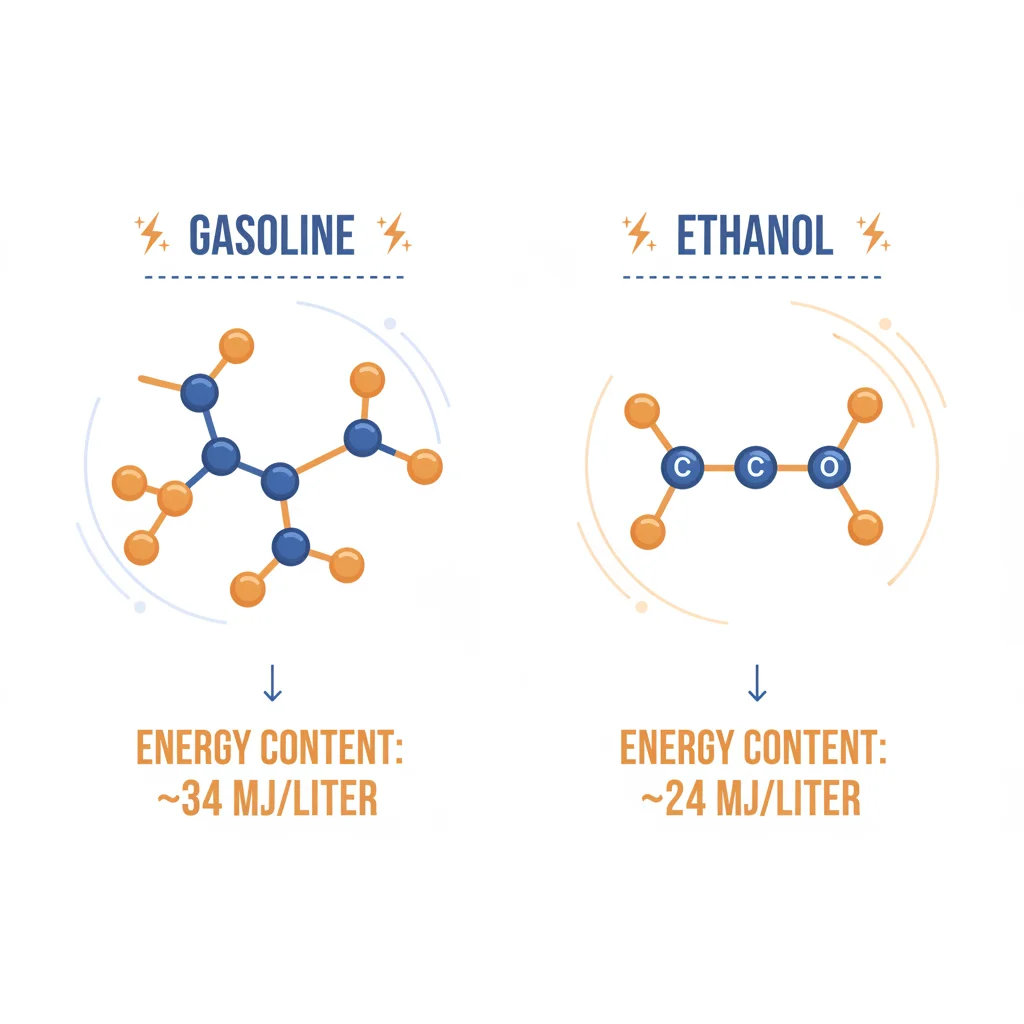
Every gallon of ethanol contains about 76,100 BTUs of energy. A gallon of pure gasoline holds around 114,000 BTUs. That's a difference of roughly 33% — and it's the root cause of every MPG conversation around ethanol blends.
When you mix ethanol into gasoline, you're diluting the energy density of the fuel. Your engine burns through volume at roughly the same rate regardless of what's in the tank, so lower energy density translates directly into fewer miles per gallon. The more ethanol in the blend, the more pronounced the effect.
That said, ethanol isn't all downside. It has a higher octane rating than gasoline (around 113 AKI), which is why high-performance and turbocharged engines can sometimes benefit from ethanol-blended fuels. It also burns cleaner in certain emission categories and is domestically produced, which affects pump pricing. But for the average commuter asking "why am I filling up more often?" — energy content is the answer.
Understanding what's actually happening in your tank helps you make smarter choices at the pump. If you've ever wondered why your real-world MPG never quite matches the sticker number, ethanol blends are one contributing factor — though not the only one. See our article on why your MPG is lower than the EPA sticker says for a fuller picture of the gap between rated and real-world efficiency.
E10: The Everyday Standard
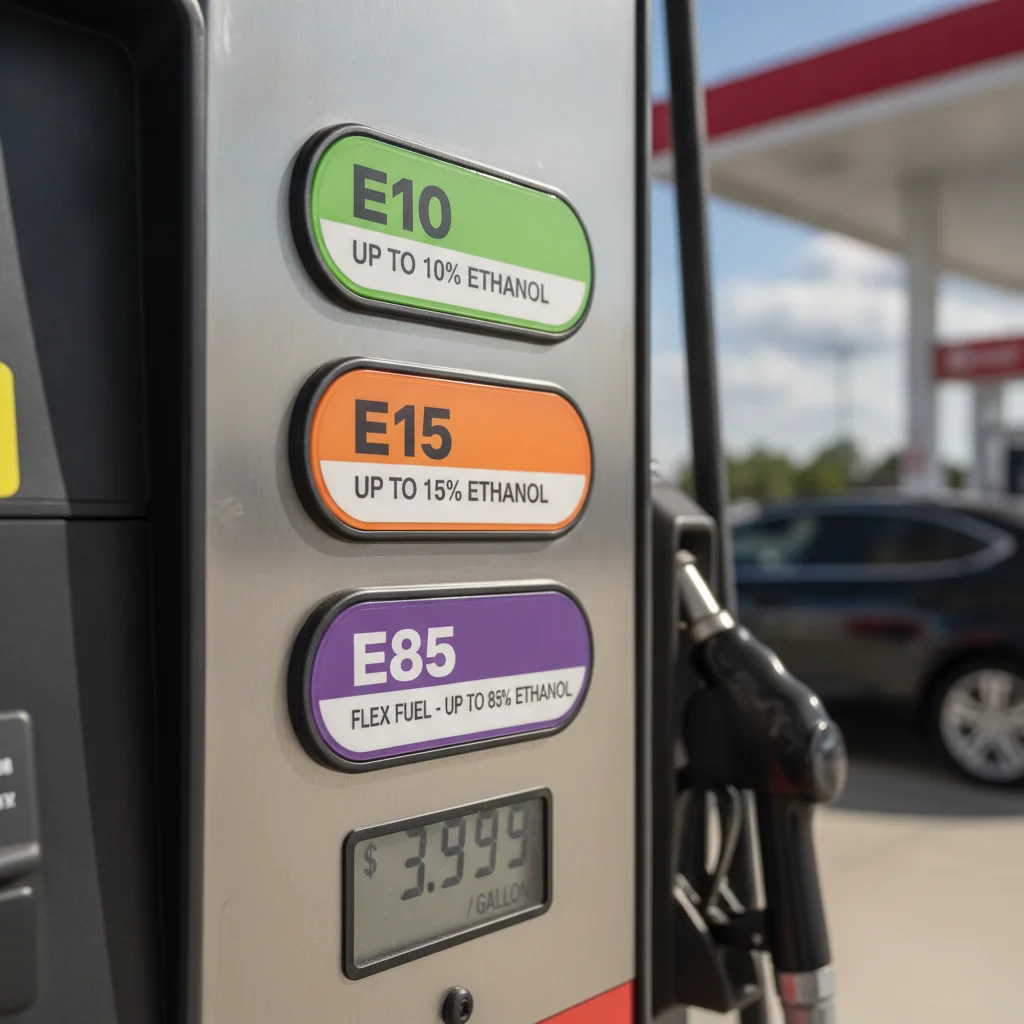
If you've pumped gas in the United States in the last decade, you've almost certainly used E10 — a blend of 90% gasoline and 10% ethanol. The Renewable Fuel Standard effectively made E10 the baseline fuel across most of the country, and it's what the EPA uses as its reference point for fuel economy testing.
At 10% ethanol content, the energy density penalty is mild. Most drivers can expect a 3–4% reduction in MPG compared to pure gasoline. On a vehicle rated at 30 MPG, that works out to roughly 28.8–29.1 MPG in practice. For most people, that difference is imperceptible in daily driving.
E10 Is Already in the EPA Test
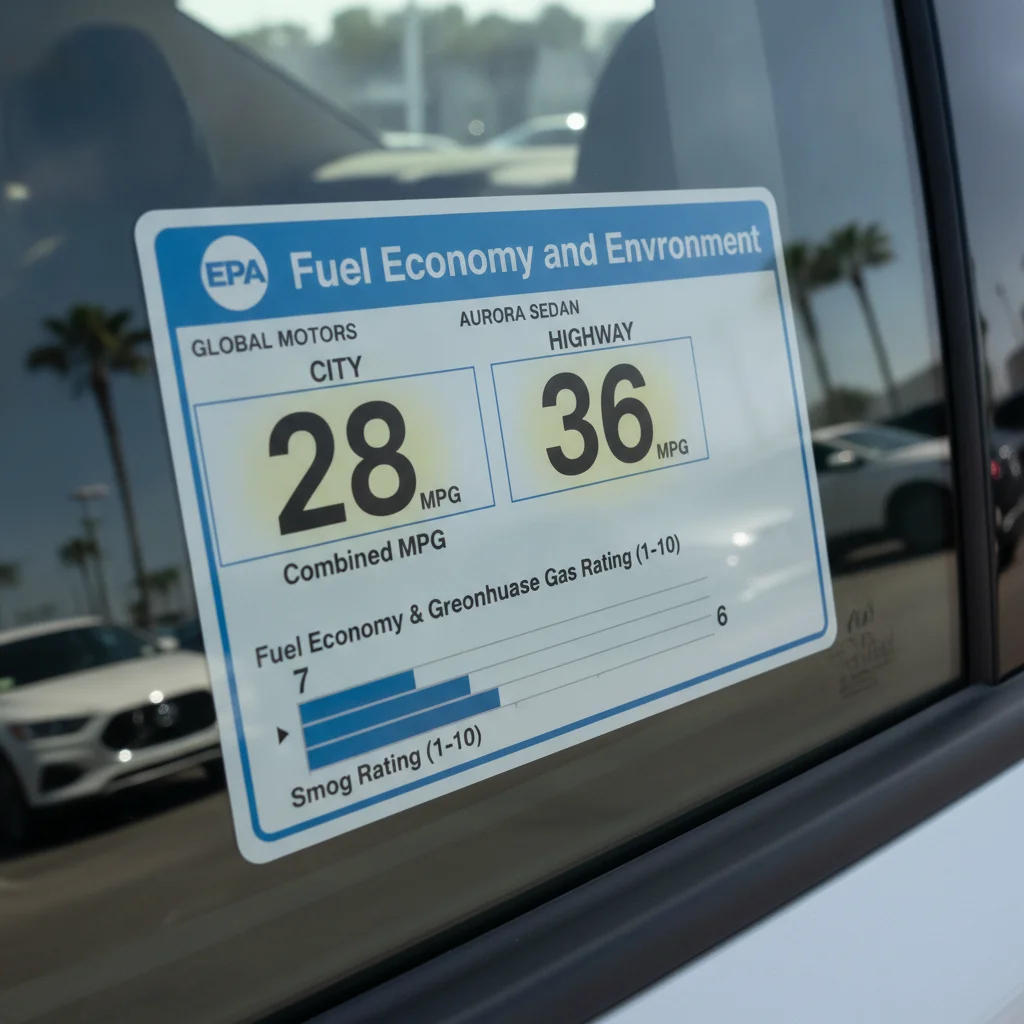
The MPG ratings you see on a new vehicle's window sticker are measured using E10 as the test fuel — not pure gasoline. This means you're not losing extra MPG beyond the EPA estimate by using standard pump gas. The estimate and your everyday fuel are already aligned.
Track Real MPG Before Judging a Blend
Seasonal temperature swings, driving patterns, and even tire pressure can move your MPG numbers by several percent — easily masking or mimicking the effect of a fuel blend change. If you switch from E10 to E15, give it at least three to four full tanks before drawing conclusions. Consistent tracking methods, not one-off observations, give you reliable data.
E10 is compatible with virtually all gasoline-powered vehicles manufactured since the early 1980s, and most modern vehicles are explicitly designed for it. Your fuel system seals, fuel lines, and injectors are engineered to handle 10% ethanol without degradation.
One nuance worth knowing: because E10 is the EPA test fuel, the MPG ratings you see on a new car's window sticker already reflect E10's energy content. You're not losing additional MPG on top of the EPA estimate — the estimate was made with E10 in the tank. For a deeper look at how those numbers are generated and what they actually mean, our guide to EPA fuel economy ratings is worth a read.
33%
Less energy in ethanol vs. gasoline per gallon
Ethanol contains approximately 76,100 BTU per gallon versus gasoline's 114,000 BTU — a gap that directly drives MPG losses in higher blends.
3–4%
Average MPG reduction from E10 vs. pure gasoline
The U.S. Department of Energy estimates a 3–4% fuel economy penalty when comparing E10 to ethanol-free gasoline under typical driving conditions.
25–30%
MPG drop when switching from E10 to E85
The U.S. Department of Energy reports flex-fuel vehicles typically see a 25–30% reduction in fuel economy running E85 compared to regular gasoline blends.
16M+
Flex-fuel vehicles on U.S. roads
The U.S. Energy Information Administration estimates over 16 million flex-fuel vehicles are registered in the United States, though many owners never use E85.
~25%
Price discount needed for E85 to break even per mile
For E85 to match the cost-per-mile of regular E10, its pump price must be approximately 25–30% lower, a threshold not always met outside corn-belt states.
E15: Slightly Higher Blend, Slightly More Complexity
E15 — 85% gasoline, 15% ethanol — has been available at select pumps since 2012, though it's expanded significantly in recent years. It typically prices a few cents to dime or more below E10, which is where its appeal lies. But there are two things to verify before you pull up to that pump.
Vehicle Compatibility
The EPA has approved E15 for use in model year 2001 and newer light-duty vehicles, but that approval doesn't mean every manufacturer has blessed it for their specific engines. Some automakers explicitly state in their owner's manuals that using E15 voids fuel system warranties. Motorcycles, small engines (lawn equipment, generators), and vehicles manufactured before 2001 are not approved for E15. Always check your owner's manual before using it.
MPG Impact
The additional 5% ethanol content over E10 translates to roughly a 1–2% further reduction in fuel economy. If E10 gives you 29 MPG, E15 might yield around 28.5 MPG. That's a narrow gap — but it matters when you're deciding whether the price discount at the pump actually saves you money.
E15 Can Void Fuel System Warranties
Even if your vehicle falls within the EPA's approved model-year range for E15, your automaker may have issued a stricter restriction in the owner's manual. Using E15 in a vehicle the manufacturer hasn't approved can void warranty coverage on fuel system components. Check the manual first — not just the model year.
Never Use E85 in a Non-Flex-Fuel Vehicle
Running E85 in a standard gasoline vehicle can damage fuel injectors, degrade rubber fuel system components, and cause persistent engine misfires or check engine lights. The fuel management system is not calibrated for high ethanol concentrations. The fix can be expensive — don't assume it's interchangeable with regular gas.
Here's the straightforward math: if E15 is priced 3 cents per gallon lower than E10, but costs you an extra 0.5 MPG, you'll use more gallons over any given distance. Whether you come out ahead depends on the price differential and your specific vehicle's efficiency penalty. Tracking your actual MPG across several tanks is the most reliable way to know for certain. Fuel economy tracking tools and methods can help you gather that data without guesswork.
E85: High Ethanol, High Impact
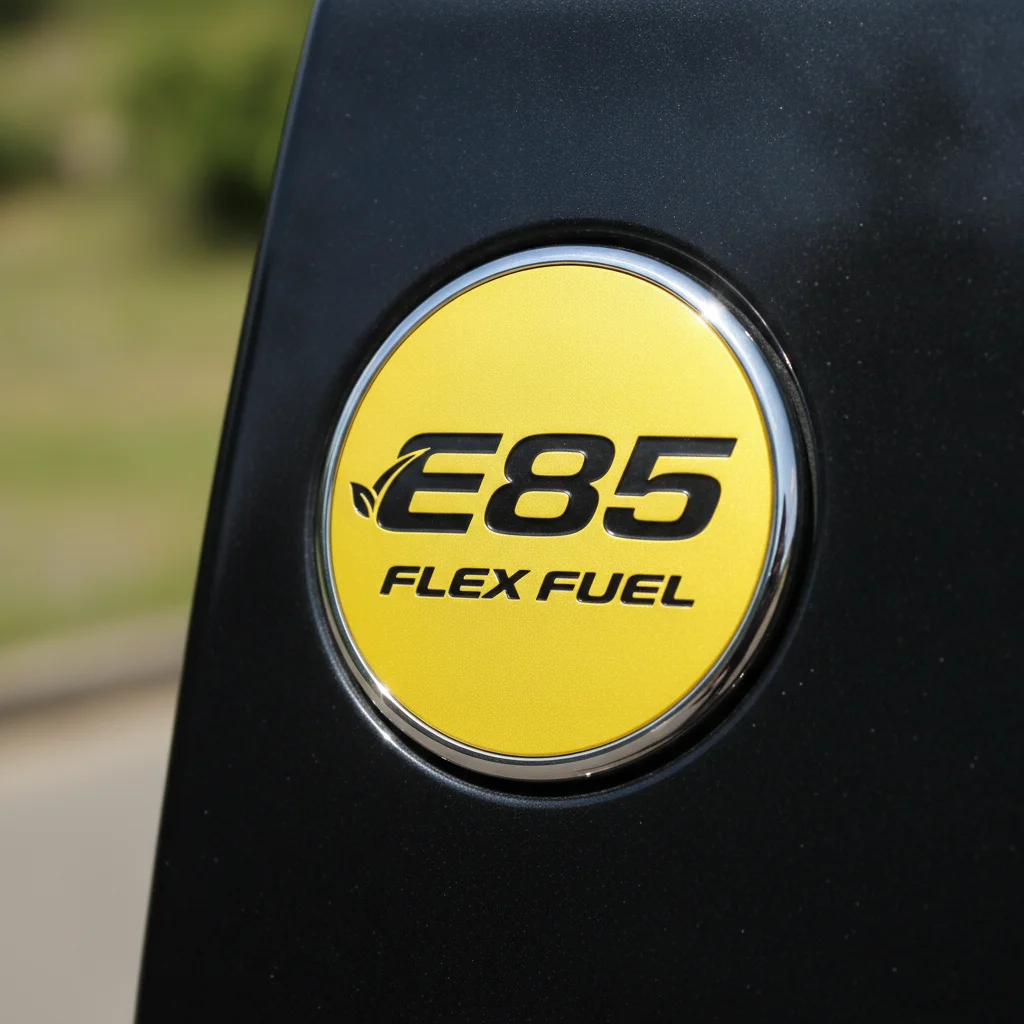
E85 contains between 51% and 83% ethanol (the exact percentage varies by season and region), with the remainder being gasoline. It's only sold at select stations and is exclusively designed for flex-fuel vehicles (FFVs) — vehicles with specially designed fuel systems, sensors, and engine management software that can adapt to a wide range of ethanol concentrations.
If your vehicle doesn't have a yellow gas cap or an "FFV" or "FlexFuel" badge, do not use E85. Doing so can damage fuel system components, foul injectors, and trigger persistent check engine lights.
The Real MPG Cost of E85
This is where the numbers get serious. Because E85's ethanol content is so much higher, its energy density is significantly lower than regular gasoline. Drivers switching from E10 to E85 typically see a 25–30% drop in fuel economy. A flex-fuel SUV rated at 20 MPG on gasoline might return only 14–15 MPG on E85.
That means you're filling up more often — sometimes dramatically more often. For E85 to save you money over E10, its price per gallon needs to be roughly 25–30% lower than regular gasoline. If regular unleaded is $3.50 per gallon, E85 would need to be around $2.45–$2.63 per gallon to break even on a cost-per-mile basis.
| E10 | E15 | E85 | |
|---|---|---|---|
| Ethanol content | 10% | 15% | 51–83% |
| MPG vs. pure gasoline | ~3–4% lower | ~4–5% lower | ~25–30% lower |
| Vehicle compatibility | All modern gasoline vehicles | Most 2001+ vehicles (check manual) | Flex-fuel vehicles only |
| Typical pump availability | Universal | Select stations, growing | Limited, regional |
| Relative pump price | Baseline | Slightly lower | Significantly lower per gallon |
| Cost-per-mile advantage | Consistent baseline | Marginal when discount exists | Only when 25–30%+ cheaper/gallon |
| Cold-weather performance | Good | Good | Variable — blend changes seasonally |
| Recommended for most drivers | Yes | With compatibility check | FFV owners only |
Regional E85 pricing varies considerably, and in many markets the discount isn't deep enough to offset the efficiency loss. In corn-belt states like Iowa, Illinois, and Minnesota, the economics tend to be more favorable. In coastal markets, E85 is rarely the better deal per mile.
Seasonal Variability and Blend Drift
One detail that surprises many drivers: the ethanol content of E85 isn't fixed. Federal rules allow E85 to range from 51% to 83% ethanol, and fuel retailers adjust the blend seasonally. In colder months, the ethanol percentage is reduced to improve cold-start performance — a fuel that's heavy on ethanol doesn't vaporize as readily in freezing temperatures. In warmer months, the ethanol content rises.
This means your E85 fuel economy will drift across the year, even in the same vehicle at the same station. Your flex-fuel vehicle's engine management system is designed to compensate — oxygen sensors detect the fuel composition and adjust fuel delivery accordingly — but the MPG variation is real.
E10 and E15 are more consistent year-round, though winter blends of any fuel can affect performance. Cold weather hits fuel economy harder than most drivers expect across all fuel types, not just ethanol blends. For a detailed look at how temperature affects your numbers, fuel economy across every season covers the full picture.
E10 Is Already in the EPA Test
The MPG ratings you see on a new vehicle's window sticker are measured using E10 as the test fuel — not pure gasoline. This means you're not losing extra MPG beyond the EPA estimate by using standard pump gas. The estimate and your everyday fuel are already aligned.
Track Real MPG Before Judging a Blend
Seasonal temperature swings, driving patterns, and even tire pressure can move your MPG numbers by several percent — easily masking or mimicking the effect of a fuel blend change. If you switch from E10 to E15, give it at least three to four full tanks before drawing conclusions. Consistent tracking methods, not one-off observations, give you reliable data.
Cost Per Mile: The Calculation That Actually Matters
Sticker price per gallon is the least useful number at the pump. What matters is how much you're spending to travel a given distance — cost per mile. Here's the simple formula:
Cost per mile = Price per gallon ÷ MPG
Walk through a quick example. Say regular E10 is $3.50/gallon and your car gets 30 MPG on it:
- E10 cost per mile: $3.50 ÷ 30 = $0.117
- E15 at $3.40/gallon, 29.5 MPG: $3.40 ÷ 29.5 = $0.115 — marginally cheaper
- E85 at $2.80/gallon (flex-fuel vehicle, 22 MPG): $2.80 ÷ 22 = $0.127 — more expensive per mile
The numbers shift constantly with local fuel pricing, and your actual MPG penalty on any given blend depends on your specific vehicle and driving conditions. That's why tracking real MPG — not relying on the dashboard average — gives you the clearest picture. For context on how EPA estimates compare to what you'll actually see, understanding EPA fuel economy ratings is a useful reference alongside this comparison.

Practical Guidance for Everyday Drivers
The good news: for the vast majority of drivers, none of this requires complicated decisions. Here's the straightforward guidance by situation.
If You Drive a Standard Gasoline Vehicle
Use E10 without concern. The EPA already accounts for it in fuel economy ratings, compatibility is universal for modern vehicles, and the MPG difference versus pure gasoline is negligible in daily use. Unless E15 offers a meaningful price discount in your market and your owner's manual gives it a green light, there's no compelling reason to seek it out.
If You're Considering E15
Verify compatibility in your owner's manual first — not just the model year, but the specific manufacturer guidance. If you get the all-clear, treat it like any new variable: track your MPG over several full tanks before drawing conclusions. Small sample sizes mislead. Fuel economy tracking methods can help you do this accurately.
If You Own a Flex-Fuel Vehicle
Check E85 pricing relative to E10 in your area. Use the cost-per-mile formula. If E85 isn't at least 25% cheaper per gallon, E10 is the better deal per mile. Many flex-fuel owners default to regular gasoline for exactly this reason — the FFV capability is there for situations where the economics line up, not as a mandate to always use E85.
E15 Can Void Fuel System Warranties
Even if your vehicle falls within the EPA's approved model-year range for E15, your automaker may have issued a stricter restriction in the owner's manual. Using E15 in a vehicle the manufacturer hasn't approved can void warranty coverage on fuel system components. Check the manual first — not just the model year.
Never Use E85 in a Non-Flex-Fuel Vehicle
Running E85 in a standard gasoline vehicle can damage fuel injectors, degrade rubber fuel system components, and cause persistent engine misfires or check engine lights. The fuel management system is not calibrated for high ethanol concentrations. The fix can be expensive — don't assume it's interchangeable with regular gas.
One final note on older vehicles and small engines: ethanol is a solvent and can degrade rubber fuel lines, seals, and gaskets that predate ethanol-compatible materials. If you drive a pre-1990s vehicle or use gasoline in outdoor power equipment, look for ethanol-free fuel at marinas and specialty fuel stations. The compatibility rules that apply to modern cars don't extend to every engine on the property.

All claims are backed by peer-reviewed research. Sources on request.