Key Takeaways
Our Verdict
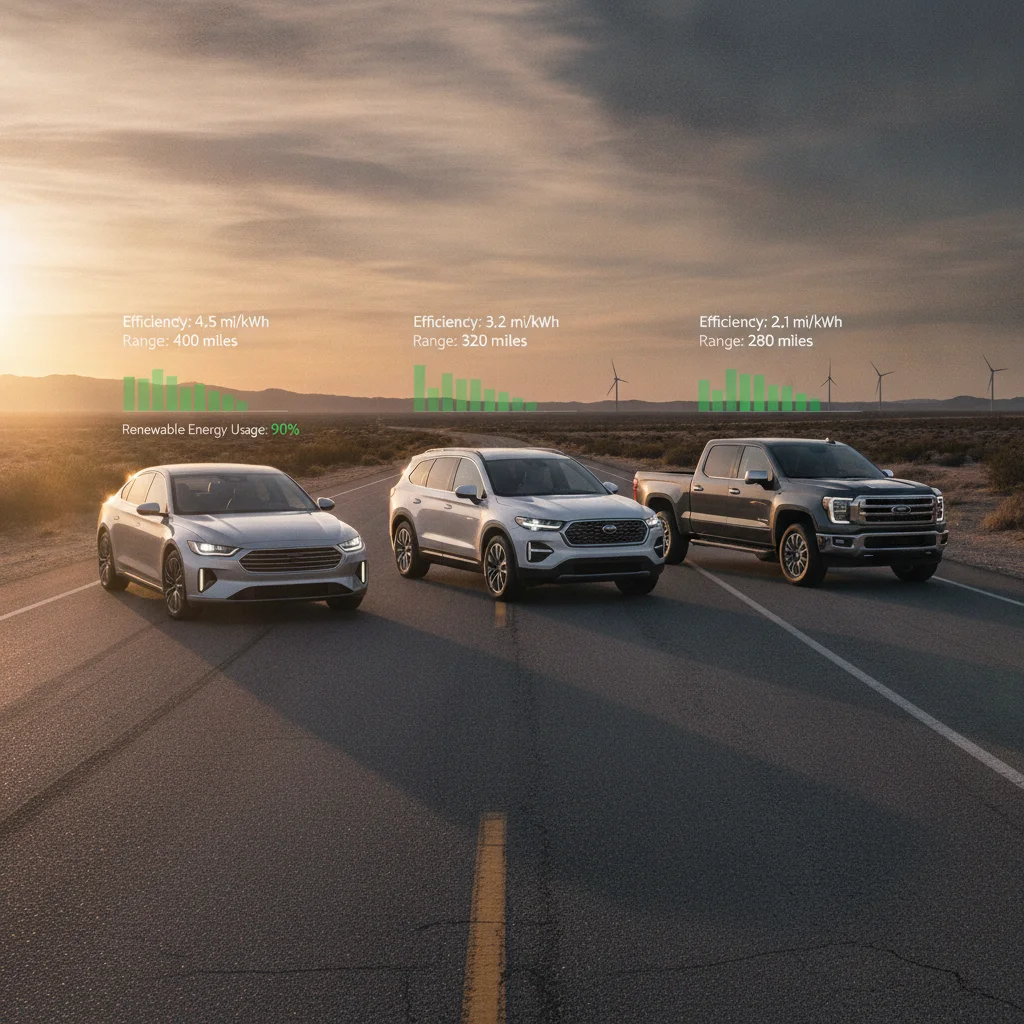
When efficiency is the primary goal, compact and midsize EV sedans remain the clear leaders — their low drag coefficients and lighter curb weights translate directly into more miles per kilowatt-hour. EV SUVs strike a practical compromise between cargo utility and acceptable range loss, while electric trucks pay the steepest efficiency penalty but continue to improve with each generation. Matching the right vehicle segment to your actual driving patterns is more important than chasing a headline range number.
| Best for | Recommended |
|---|---|
| Maximum efficiency and lowest energy cost per mile | EV Sedans |
| Families needing cargo room with reasonable range | Electric SUVs |
| Heavy towing, hauling, or work-site use | Electric Trucks |
| Urban commuters prioritizing low charging costs | EV Sedans |
Why Vehicle Segment Matters So Much for EV Efficiency
In the gasoline world, a Chevy Tahoe and a Honda Civic both pump fuel through an internal combustion engine, and their efficiency difference — while real — is partly masked by decades of engineering refinements across all segments. In the electric world, that gap is starker because the physics are more transparent. Every watt-hour pulled from the battery pack has one job: move the vehicle forward. Anything that resists that motion — aerodynamic drag, rolling resistance, gravitational load on hills — shows up immediately and honestly in your efficiency figure.
Body style shapes all three of those resistance factors simultaneously. A tall, boxy truck profile creates far more aerodynamic drag than a low, tapered sedan. A 7,000-pound electric pickup exerts far more rolling resistance than a 4,200-pound electric compact. These aren't marginal differences — they compound over every mile you drive.
To understand why segment matters so deeply, it helps to know how efficiency is measured. The standard metric in EV analysis is miles per kilowatt-hour (mi/kWh), or alternatively watt-hours per mile (Wh/mi), which is the inverse. A vehicle consuming 250 Wh/mi is using 4.0 mi/kWh. A vehicle consuming 400 Wh/mi gets only 2.5 mi/kWh — and if both carry a 100 kWh usable pack, the first travels 400 miles while the second manages only 250. The battery size is identical; the physics of the body shape and mass are not.
For a deeper look at how EPA labels are constructed and where they can mislead, see our comprehensive EV range reference. This article focuses specifically on how segment — sedans, SUVs, and trucks — predicts where on that efficiency spectrum you will land.
EV Sedans: The Efficiency Benchmark
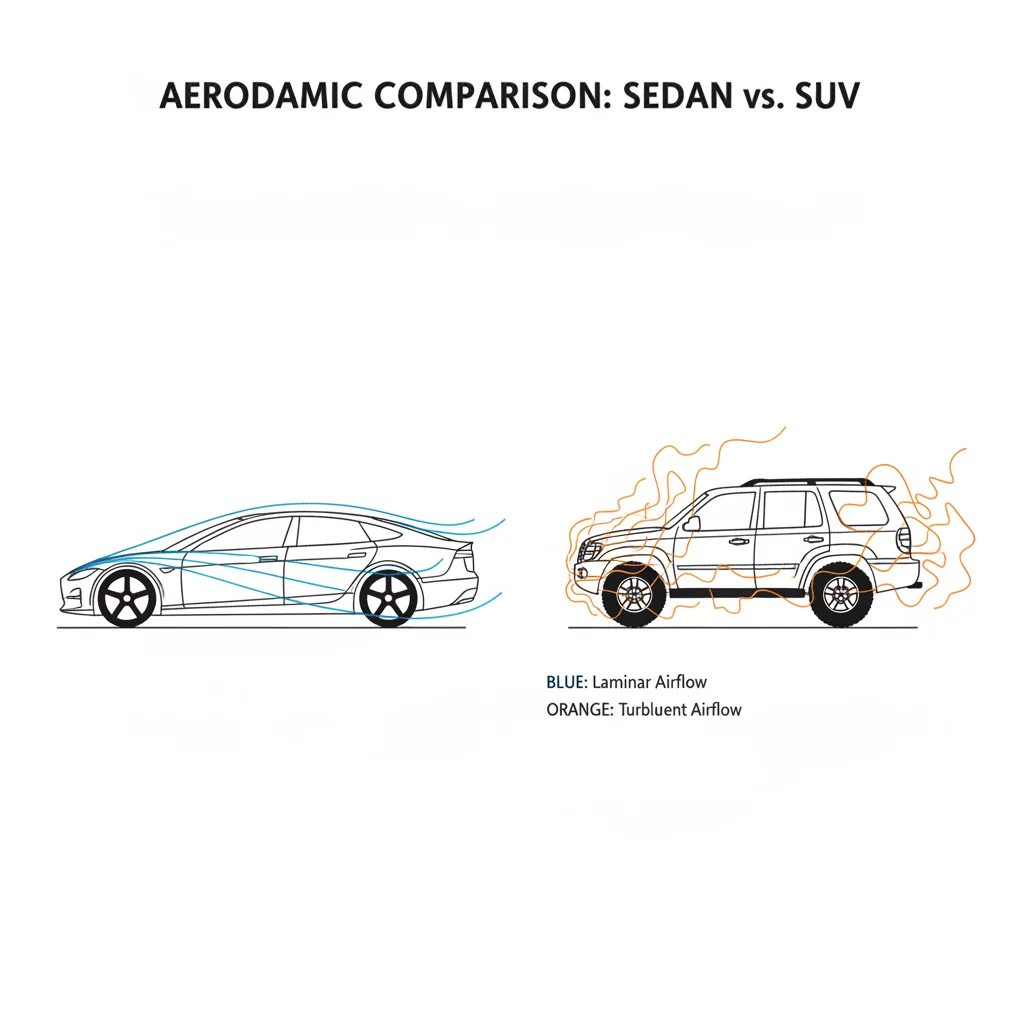
Compact and midsize electric sedans consistently set the efficiency ceiling for production EVs. The physics reason is straightforward: a sedan's low roofline produces a drag coefficient (Cd) typically in the range of 0.20–0.24, compared with 0.28–0.36 for most SUVs and crossovers. At 70 mph, aerodynamic drag is the dominant energy load, and a lower Cd can translate to a 15–25% reduction in energy consumption at highway speeds compared with a taller vehicle of similar mass.
Representative efficiency figures from EPA ratings for current-generation electric sedans:
- Tesla Model 3 Long Range AWD: approximately 4.0 mi/kWh (25 kWh/100 mi)
- Hyundai IONIQ 6 RWD Long Range: approximately 4.6 mi/kWh (21 kWh/100 mi) — one of the highest EPA-rated efficiencies of any production EV
- BMW i4 eDrive40: approximately 3.5 mi/kWh (29 kWh/100 mi)
- Mercedes EQS 450+: approximately 3.7 mi/kWh (27 kWh/100 mi)
The Hyundai IONIQ 6's figures illustrate how aggressive aerodynamic design — its Cd of 0.21 is among the lowest of any production car — can push a mass-market sedan into territory previously reserved for purpose-built efficiency vehicles. The lesson: a manufacturer willing to prioritize aerodynamics over styling drama can extract dramatically more range from an identically sized battery pack.
Use Wh/mi, Not Just Miles of Range
When comparing EVs across segments, look at the EPA's Wh/mi figure rather than just the range number. A truck with 300 miles of range from a 130 kWh pack is far less efficient than a sedan achieving the same distance from 75 kWh. The Wh/mi figure tells you the true energy cost of each mile, independent of how large a battery the manufacturer installed to compensate.
Match Your Driving Profile to the Segment
Before defaulting to the largest vehicle you can afford, map your actual weekly driving. If 90% of your trips are under 40 miles and you charge at home, even the least efficient EV truck covers those miles cheaply. The efficiency penalty becomes financially significant primarily for high-mileage drivers, frequent highway travelers, and those relying on public charging at higher per-kWh rates.
Check Real-World Data, Not Just EPA Figures
Third-party resources that aggregate owner-reported efficiency data — such as Edmunds' real-world range tests and the EPA's own Beyond the Label tool — give a more honest picture of what to expect. EPA figures are useful for cross-model comparison, but planning a road trip requires real-world derating estimates, particularly for trucks and large SUVs.
Sedans also benefit from lower curb weights relative to their battery capacity. A 77.4 kWh battery pack in a 4,400-pound sedan carries a very different weight-to-energy ratio than the same pack in a 5,800-pound crossover, and that difference translates to lower energy-per-mile figures on every trip.
City driving further advantages sedans. Because EVs recapture energy through regenerative braking, stop-and-go traffic is less punishing than it is for gas cars. Sedans generally weigh less, which means more of the kinetic energy at each stop is recoverable as a percentage of energy invested. Our deep-dive on city vs. highway EV efficiency explores this dynamic in granular detail.
Electric SUVs and Crossovers: The Efficiency Compromise
The electric SUV and crossover segment is now the largest slice of the EV market by sales volume, which means it also represents the efficiency range most buyers will actually experience. That range is wide — a compact crossover like the Chevrolet Equinox EV behaves very differently from a three-row, seven-passenger SUV like the Kia EV9.
Representative EPA figures for electric SUVs and crossovers:
- Tesla Model Y Long Range AWD: approximately 3.5 mi/kWh (29 kWh/100 mi)
- Chevrolet Equinox EV FWD: approximately 3.7 mi/kWh (27 kWh/100 mi)
- Hyundai IONIQ 5 Long Range RWD: approximately 3.4 mi/kWh (29 kWh/100 mi)
- Kia EV9 Long Range RWD: approximately 3.0 mi/kWh (33 kWh/100 mi)
- Ford Mustang Mach-E Standard Range RWD: approximately 3.2 mi/kWh (31 kWh/100 mi)
- Rivian R1S Quad-Motor: approximately 2.5 mi/kWh (40 kWh/100 mi)
The Rivian R1S figure stands out because the R1S occupies an unusual position: it is sized and weighted more like a truck than a crossover, carrying a curb weight exceeding 7,000 pounds. That number underscores how mass — even when distributed in an SUV body — punishes efficiency at the same rate it does in a truck.
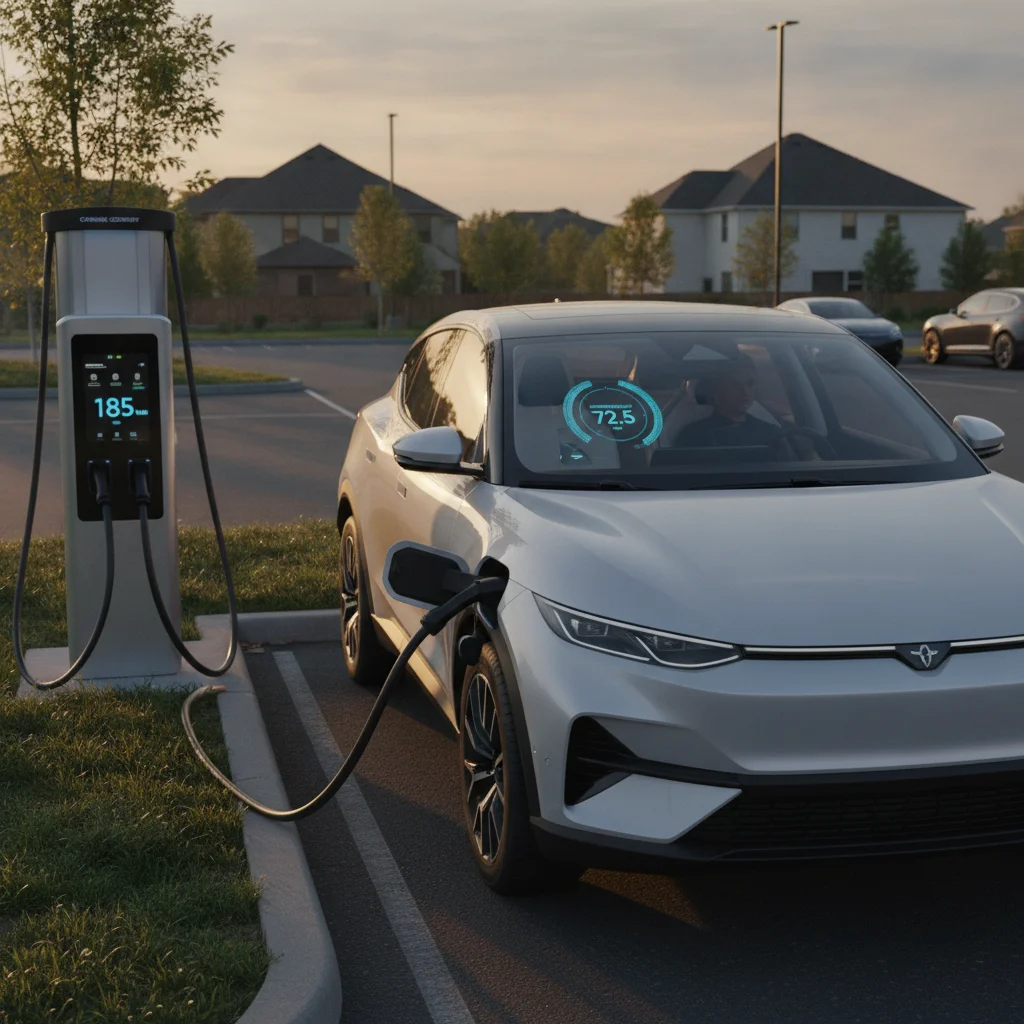
A key variable within the SUV segment is drivetrain configuration. AWD models, which add a second motor and distribute torque to all four wheels, typically consume 3–8% more energy than equivalent RWD configurations at highway cruising speeds. The penalty is smaller in city driving, where the rear motor can often handle propulsion alone while the front motor idles. Many modern dual-motor EVs use exactly this strategy — decoupling one motor during steady-state cruising — but the efficiency gap at highway speed remains real and measurable.
AWD Is Not Always Worth the Efficiency Cost
AWD electric SUVs carry a real efficiency penalty — typically 3–8% at highway speeds — compared with RWD equivalents. In regions with mild winters and no off-road use, that penalty is paid every single mile without delivering proportional benefit. Check whether your state's winter conditions and driving routes genuinely require AWD before accepting the long-term energy cost premium.
EPA Range Ratings Can Mislead Truck Buyers
Electric truck range ratings are generated under unloaded, mixed-cycle conditions. If you plan to tow — even occasionally — the rated range is not a reliable planning number. Industry testing consistently demonstrates 40–60% range reductions under towing loads at highway speed. Build your route planning and charging stop strategy around towing range, not the sticker figure.
Buyers who genuinely need AWD for winter traction or light off-road use will find the efficiency penalty acceptable. Buyers purchasing AWD for performance feel should at minimum run the numbers: the additional energy cost over 50,000 miles of ownership is non-trivial.
Electric Trucks: Capability vs. Consumption
Full-size electric pickup trucks represent the fastest-growing EV segment by new entrants, and they carry the steepest efficiency penalties. The combination of large frontal area, blunt aerodynamic profiles, and extraordinary curb weights creates a compounding disadvantage that no powertrain refinement has yet overcome.
Representative EPA figures for electric trucks:
- Ford F-150 Lightning Standard Range RWD: approximately 2.8 mi/kWh (36 kWh/100 mi)
- Ford F-150 Lightning Extended Range AWD: approximately 2.5 mi/kWh (40 kWh/100 mi)
- Chevrolet Silverado EV Work Truck: approximately 2.7 mi/kWh (37 kWh/100 mi)
- Rivian R1T Quad-Motor: approximately 2.5 mi/kWh (40 kWh/100 mi)
- GMC Hummer EV Pickup: approximately 1.9 mi/kWh (53 kWh/100 mi)
The GMC Hummer EV's figures deserve specific attention. At over 9,000 pounds curb weight, it is the heaviest production EV ever sold in the United States, and its energy consumption reflects that mass honestly. Carrying a usable battery pack of approximately 200 kWh, the Hummer achieves roughly 329 miles of EPA-rated range — but does so by brute-forcing the problem with an enormous battery rather than by achieving any aerodynamic or efficiency breakthrough.
Towing compounds the efficiency problem dramatically. An electric truck rated at 2.5 mi/kWh unloaded may achieve only 1.2–1.6 mi/kWh while towing at its maximum rated payload. The aerodynamic drag introduced by a trailer — especially a tall one — can increase energy consumption by 40–60% at 65 mph. Prospective electric truck buyers who plan to tow regularly should size their battery pack around towing range, not unloaded range. See our full EV range reference for towing derating data.
4.6 mi/kWh
Best production sedan EPA efficiency
The Hyundai IONIQ 6 Long Range RWD achieves one of the highest EPA efficiency ratings of any production EV sold in the United States as of 2024.
1.9 mi/kWh
Least efficient production EV rating
The GMC Hummer EV Pickup's EPA efficiency rating reflects its 9,000+ pound curb weight and large frontal profile — the lowest figure in production EV history.
~50%
Typical range loss while towing
Real-world testing by outlets including Edmunds and MotorTrend consistently shows electric trucks losing 40–60% of unloaded range when towing at highway speeds.
15–25%
Energy saved by lower Cd at 70 mph
Aerodynamic modeling and real-world data suggest that moving from a Cd of 0.34 to 0.21 reduces aerodynamic drag energy load by 15–25% at sustained highway speeds.
$2,250+
Lifetime energy cost premium for trucks vs. sedans
At $0.15/kWh and 100,000 miles of driving, the efficiency gap between a top sedan (~25 kWh/100 mi) and a typical electric truck (~40 kWh/100 mi) accumulates to over $2,250 in additional electricity costs.
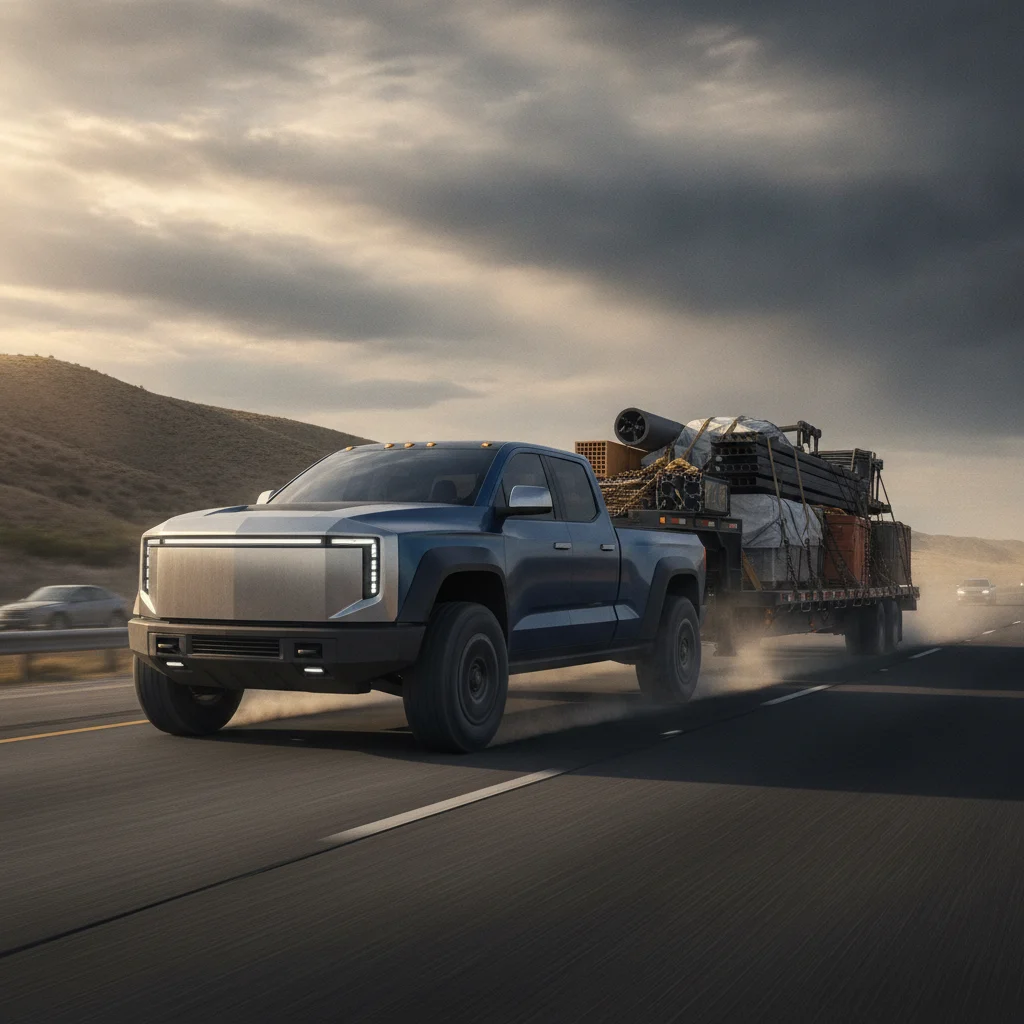
Despite the efficiency gap, electric trucks do offer genuine advantages that no efficiency comparison fully captures: instant torque delivery produces class-leading acceleration under load, fuel and maintenance costs are lower than diesel alternatives even at higher energy consumption rates, and vehicle-to-load (V2L) and vehicle-to-home (V2H) capabilities add utility no gas truck can match.
Head-to-Head: Segment Efficiency Comparison
The table below compares representative models across the three segments on five criteria that directly affect real-world EV ownership experience. All efficiency figures are EPA-rated; real-world results will vary with speed, temperature, and load.
| EV Sedan (IONIQ 6 LR RWD) | Compact EV SUV (Model Y LR AWD) | Large EV SUV (Kia EV9 LR RWD) | EV Truck (F-150 Lightning ER AWD) | |
|---|---|---|---|---|
| EPA Efficiency (mi/kWh) | 4.6 mi/kWh | 3.5 mi/kWh | 3.0 mi/kWh | 2.5 mi/kWh |
| EPA Range (miles) | 361 miles | 330 miles | 304 miles | 320 miles |
| Usable Battery (kWh approx.) | 77.4 kWh | 75 kWh | 99.8 kWh | 131 kWh |
| Curb Weight (approx.) | 4,235 lb | 4,379 lb | 5,512 lb | 6,590 lb |
| Drag Coefficient (Cd) | 0.21 | 0.23 | 0.28 | ~0.34 |
| Real-World Highway Range (est.) | 295–315 miles | 265–290 miles | 230–260 miles | 220–255 miles |
| Estimated Towing Efficiency Loss | N/A — not rated for towing | ~35–45% reduction | ~35–45% reduction | ~45–60% reduction |
| Energy Cost Per Mile at $0.15/kWh | ~$0.033/mile | ~$0.043/mile | ~$0.050/mile | ~$0.060/mile |
| Best Use Case | Max efficiency, commuting | Family utility, daily driving | Three-row capacity, long trips | Hauling, towing, work use |
Several patterns emerge from a direct comparison. First, the efficiency gap between the best sedan and the worst truck is not a matter of marginal differences — a 4.6 mi/kWh IONIQ 6 consumes less than half the energy per mile of a 1.9 mi/kWh Hummer EV. Second, pack size broadly compensates for poor efficiency at the top of each segment: manufacturers stuff larger batteries into heavier vehicles to maintain competitive range figures. This strategy inflates vehicle cost, adds charging time, and increases the mining footprint of the vehicle — none of which appear in a range comparison. Third, real-world range derating is consistently more severe for trucks and large SUVs than for sedans, particularly at highway speeds where drag is the dominant load.
Understanding how to read efficiency data from your own vehicle's display is a practical complement to these segment-level figures. Our guide to reading your EV's energy consumption display explains how to interpret the trip-average and instantaneous consumption readouts that modern EVs provide.
The Physical Forces Behind the Numbers
Understanding why these segment differences exist makes range estimates more intuitive and helps buyers anticipate real-world performance rather than relying solely on EPA labels.
Aerodynamic Drag
Aerodynamic drag force scales with the square of velocity and with a vehicle's drag coefficient (Cd) multiplied by its frontal area (A). A vehicle with twice the frontal area and a worse Cd can experience three to four times the drag force at the same speed compared with an optimized sedan. Trucks, with their upright windshields, open bed profiles, and large frontal areas, are aerodynamically expensive in ways that careful engineering can reduce but not eliminate. The F-150 Lightning's active grille shutters and smooth underbody panels are genuine improvements, but they cannot overcome the fundamental geometry of a full-size truck body.
Curb Weight and Rolling Resistance
Rolling resistance increases linearly with vehicle mass. A vehicle that weighs 40% more than a comparably equipped sedan will experience approximately 40% more rolling resistance force on flat ground — and exponentially more energy demand on grades. This is why a 7,000-pound electric truck climbing a mountain pass can deplete its pack at two to three times the rate it would on flat highway driving. Understanding how EV drivetrains manage this load provides useful context on motor and battery management systems.
Battery-to-Weight Ratio
The ratio of usable battery capacity to curb weight is a useful efficiency predictor. A sedan with 77 kWh usable and 4,300 lb curb weight carries about 17.9 kWh per 1,000 lb. A truck with 130 kWh usable and 7,200 lb curb weight carries about 18.1 kWh per 1,000 lb — nearly identical, yet the truck achieves far worse efficiency because it must overcome far greater drag and rolling resistance. The battery-to-weight ratio tells you how much energy is available; the physics of the body tell you how fast you will spend it.
Use Wh/mi, Not Just Miles of Range
When comparing EVs across segments, look at the EPA's Wh/mi figure rather than just the range number. A truck with 300 miles of range from a 130 kWh pack is far less efficient than a sedan achieving the same distance from 75 kWh. The Wh/mi figure tells you the true energy cost of each mile, independent of how large a battery the manufacturer installed to compensate.
Match Your Driving Profile to the Segment
Before defaulting to the largest vehicle you can afford, map your actual weekly driving. If 90% of your trips are under 40 miles and you charge at home, even the least efficient EV truck covers those miles cheaply. The efficiency penalty becomes financially significant primarily for high-mileage drivers, frequent highway travelers, and those relying on public charging at higher per-kWh rates.
Check Real-World Data, Not Just EPA Figures
Third-party resources that aggregate owner-reported efficiency data — such as Edmunds' real-world range tests and the EPA's own Beyond the Label tool — give a more honest picture of what to expect. EPA figures are useful for cross-model comparison, but planning a road trip requires real-world derating estimates, particularly for trucks and large SUVs.
Setting Realistic Range Expectations by Segment
EPA range ratings are derived from a controlled testing cycle that does not replicate all real-world conditions. Understanding segment-specific derating patterns helps buyers set expectations before purchase rather than after.
Sedan Real-World Derating
EV sedans typically achieve 85–95% of their EPA rated range under normal mixed driving conditions. At sustained 75–80 mph highway speeds, that figure drops to 75–85% of EPA range. Cold weather (sub-40°F) can reduce range a further 20–30% on top of the speed penalty. The IONIQ 6, for example, is EPA-rated at 361 miles in its best configuration; real-world highway users at 75 mph in moderate weather typically report 290–310 miles.
SUV Real-World Derating
Electric SUVs and crossovers typically achieve 80–90% of EPA range in mixed driving. Highway-dominant routes at 70+ mph push many into the 70–80% range. Three-row, heavier SUVs see the most aggressive derating. The Model Y Long Range, EPA-rated at 330 miles, commonly returns 270–295 miles in real-world highway use.
Truck Real-World Derating
Electric trucks face the harshest real-world derating of any segment. Unloaded highway driving typically returns 65–80% of EPA range. Towing can reduce this to 40–55% of rated range depending on trailer size and highway speed. An F-150 Lightning Extended Range rated at 320 miles may achieve 200–230 miles towing a mid-size travel trailer at 65 mph. Buyers planning regular towing should plan charging stops on routes they would not need in a gas truck.
These derating patterns also affect charging economics. A truck consuming 40 kWh/100 mi costs roughly 60% more per mile in electricity than a sedan consuming 25 kWh/100 mi at the same electricity rate. Over 100,000 miles at $0.15/kWh, that difference accumulates to approximately $2,250 — a meaningful ownership cost distinction that complements the segment depreciation analysis in our segment depreciation comparison.
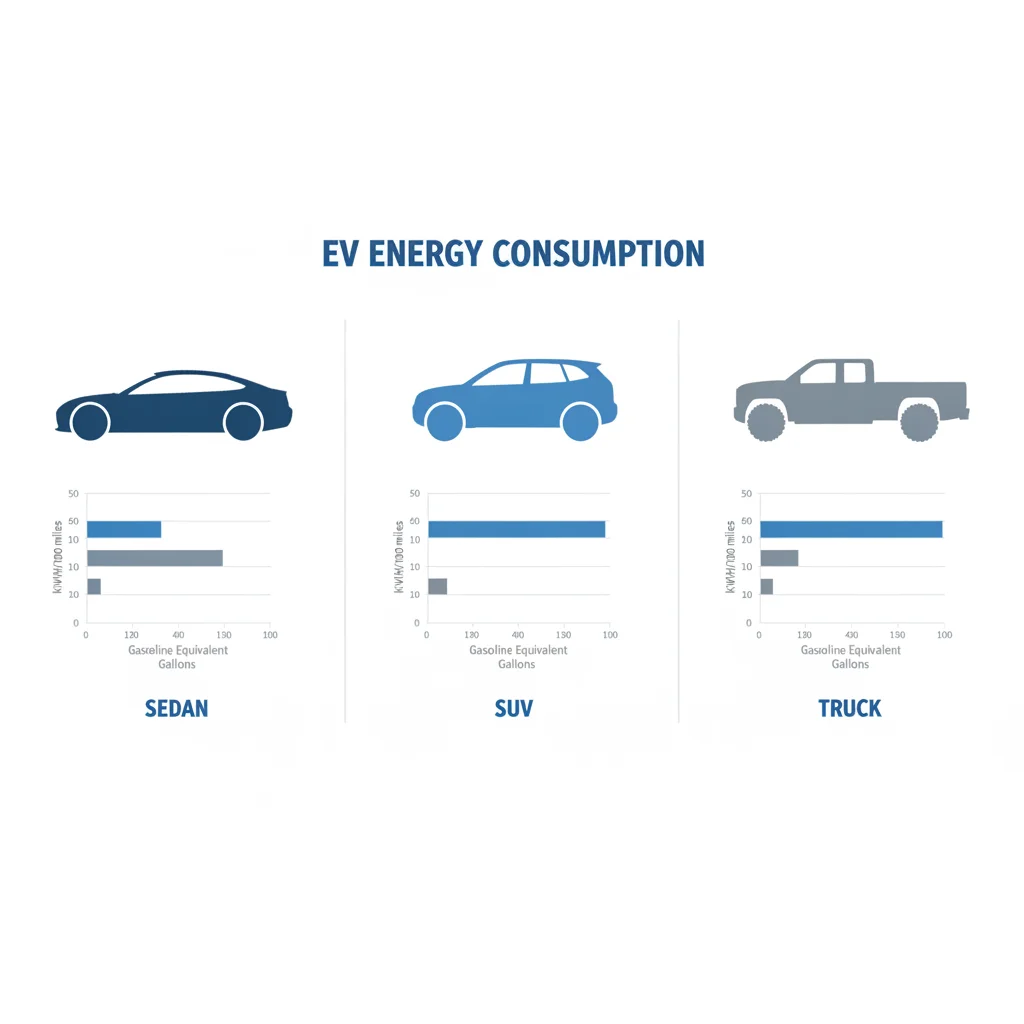
Finally, consider how your specific driving profile maps onto these segment realities. If you commute 30 miles daily, charge at home overnight, and never tow, an electric truck's efficiency penalty costs you relatively little in dollar terms — you will simply spend more per mile, but those miles are few enough that the premium is manageable. If you drive 20,000+ miles per year, frequently travel at highway speed, or live somewhere without home charging access, efficiency differences between segments become a dominant financial and logistical variable that deserves careful weight in the purchase decision.
For buyers still deciding between EV types before narrowing to a segment, our EV types explainer comparing BEV, PHEV, and HEV options provides a useful starting framework.
All claims are backed by peer-reviewed research. Sources on request.