| What kWh measures | Energy storage capacity (battery "tank size") |
| What kW measures | Power — rate of energy flow (motor output or charging speed) |
| Conversion: kW to horsepower | 1 kW ≈ 1.34 hp |
| Typical Level 2 home charger speed | 7.2–19.2 kW (20–60 miles of range per hour) |
| Real-world range vs. EPA estimate | Plan for 70–80% of EPA in mixed conditions (Based on industry testing and owner data) |
| Cold-weather range penalty | 20–40% reduction below 40°F (AAA and NREL cold-weather EV studies) |
| Usable vs. total battery capacity | Typically 93–97% of listed capacity is accessible |
| DC fast charge speed range | 50 kW (older CHAdeMO) to 350 kW (ultra-fast CCS) |
Why These Three Numbers Matter More Than Anything Else on the Spec Sheet
When you're shopping for an electric vehicle, the spec sheet throws a lot of numbers at you: horsepower, torque, 0–60 times, cargo volume. But three units — kilowatts (kW), kilowatt-hours (kWh), and miles of range — determine how the car fits into your actual life. Get a handle on those three and you can cut through the rest of the noise.
Here's the short version before we go deeper:
- kWh tells you how big the fuel tank is (how much energy the battery can store).
- kW tells you how fast energy moves — either out of the battery as power to the motor, or into the battery during charging.
- Miles of range tells you how far the car can go on a full charge under EPA test conditions.
These three numbers interact constantly. A large kWh pack doesn't guarantee long range if the car is heavy or inefficient. A high charging kW rating doesn't help you if your home charger or the public station is slower. Understanding the relationships — not just the individual specs — is what makes you a smarter buyer.
| What kWh measures | Energy storage capacity (battery "tank size") |
| What kW measures | Power — rate of energy flow (motor output or charging speed) |
| Conversion: kW to horsepower | 1 kW ≈ 1.34 hp |
| Typical Level 2 home charger speed | 7.2–19.2 kW (20–60 miles of range per hour) |
| Real-world range vs. EPA estimate | Plan for 70–80% of EPA in mixed conditions (Based on industry testing and owner data) |
| Cold-weather range penalty | 20–40% reduction below 40°F (AAA and NREL cold-weather EV studies) |
| Usable vs. total battery capacity | Typically 93–97% of listed capacity is accessible |
| DC fast charge speed range | 50 kW (older CHAdeMO) to 350 kW (ultra-fast CCS) |
For a deeper look at how efficiency ratings connect to these fundamentals, see our guide on EV efficiency units like MPGe and Wh/mi.
Kilowatt-Hours (kWh): The Battery's Tank Size
A kilowatt-hour is a unit of energy — specifically, the amount of energy used when one kilowatt of power runs for one hour. In EV terms, the battery's kWh rating is its storage capacity, directly analogous to the gallon capacity of a gas tank.
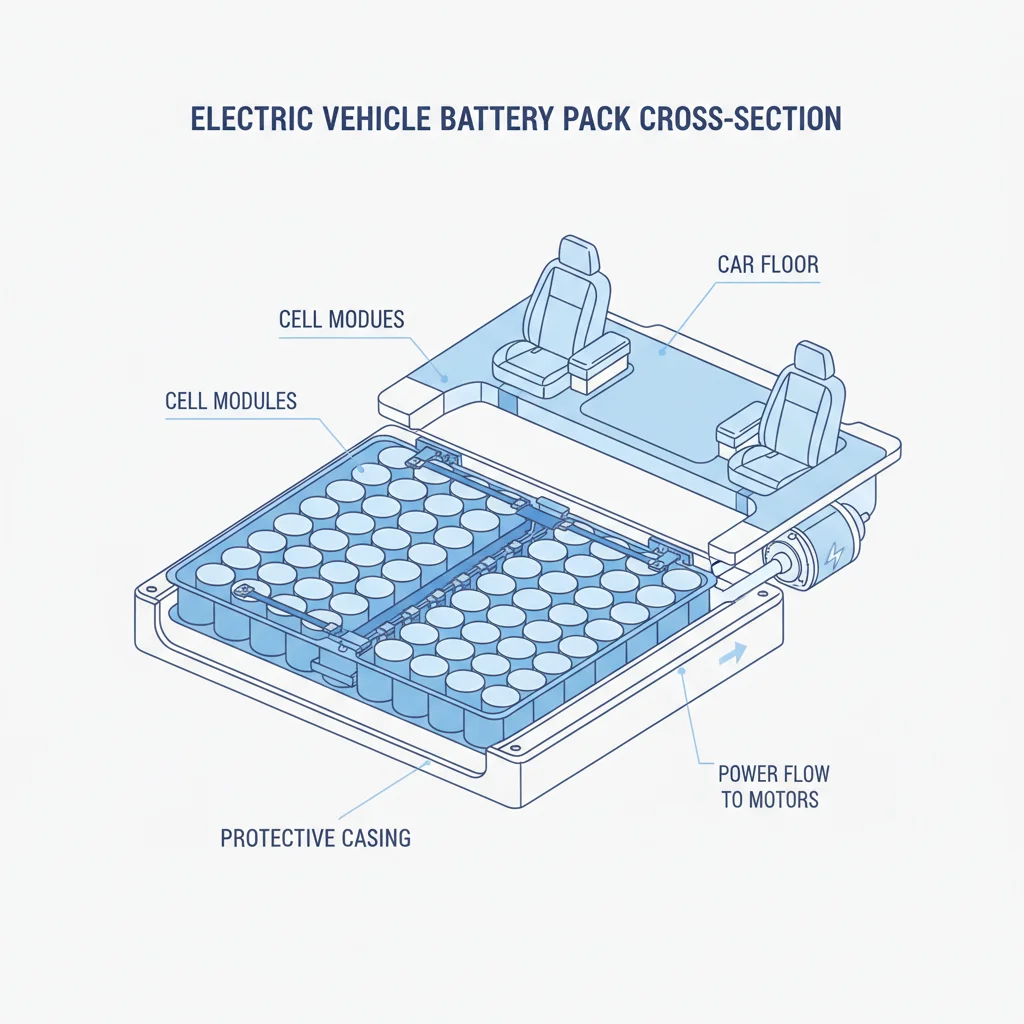
Here's what that means in practice:
- A 40 kWh pack (like the base Nissan Leaf) is a compact-car tank. Fine for urban and suburban driving, limiting on long trips.
- A 75–82 kWh pack (like the standard Tesla Model Y Long Range or Ford Mustang Mach-E) is a mid-size tank — comfortable for most drivers' weekly needs and most road trips.
- A 100+ kWh pack (Rivian R1T, GMC Hummer EV, Tesla Model S Plaid) is a large-truck tank — maximum range, but also maximum weight and charging time to fill.
Two important nuances buyers often miss:
- Usable vs. total capacity. Manufacturers protect the battery by not letting you access the full rated capacity. A battery listed at 82 kWh might only offer about 78–79 kWh of usable energy. The EPA range rating is based on usable capacity, so official range numbers already account for this buffer — but it's worth knowing when you're comparing raw specs from different sources.
- Bigger isn't always better for your use case. A larger pack costs more, weighs more (reducing efficiency), and takes longer to charge. If you drive 40 miles a day and charge at home nightly, a 60 kWh pack might serve you better than a 100 kWh pack — and save you thousands upfront.
Kilowatt (kW)
A unit of power measuring the rate of energy use or transfer. In EVs, kW describes both motor output (how much power drives the wheels) and charging speed (how fast energy enters the battery). One kilowatt equals 1,000 watts.
Kilowatt-hour (kWh)
A unit of energy equal to one kilowatt of power sustained for one hour. In EVs, kWh describes battery storage capacity — the larger the kWh rating, the more energy the battery can hold, analogous to gallons in a gas tank.
Usable capacity
The portion of a battery's total energy storage that the vehicle's software actually allows you to access. Manufacturers reserve 3–7% at each end of the charge range to protect battery longevity and safety.
Onboard charger
A component inside the EV that converts AC power from a Level 1 or Level 2 station into the DC power the battery stores. Its kW rating caps how fast AC charging can proceed, regardless of the station's output capacity.
DC fast charging (DCFC)
A charging method that bypasses the onboard charger and pushes DC power directly into the battery. Because it skips the conversion step, it can deliver far higher power levels — up to 350 kW on current networks — dramatically reducing charge times.
EPA range rating
The official estimated driving range published by the U.S. Environmental Protection Agency, measured under standardized lab test conditions. It provides a consistent comparison baseline but typically exceeds real-world range in highway or cold-weather use.
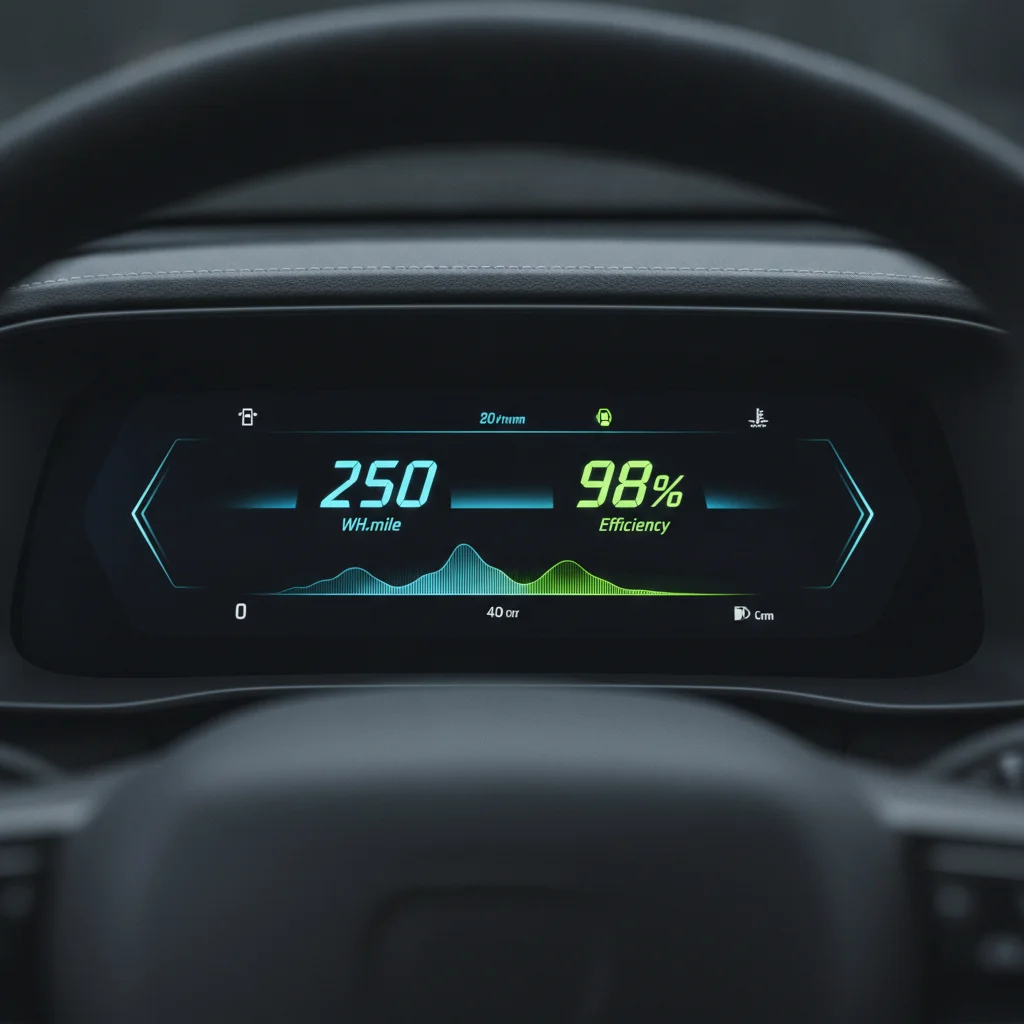
Energy consumption (Wh/mi)
How many watt-hours of electricity the vehicle uses to travel one mile. Lower Wh/mi means greater efficiency. Dividing usable battery capacity (in Wh) by this figure gives approximate range.
Regenerative braking
A system that recovers kinetic energy during deceleration and converts it back into electricity stored in the battery. It improves city driving efficiency significantly, which is why EVs often achieve better city range than highway range — the opposite of most gas cars.
Want to understand how the different EV types — BEV, PHEV, and HEV use battery capacity differently? Our hub breaks down what each architecture means for range and charging.
Kilowatts (kW): The Rate of Energy Flow — Motor Power and Charging Speed
Kilowatts measure power — the rate at which energy is used or transferred. In an EV context, kW shows up in two very different places, and confusing them is one of the most common mistakes buyers make.
Motor Output: kW as Horsepower's Equivalent
Electric motors are rated in kW just as gasoline engines are rated in horsepower. The conversion is straightforward: 1 kW ≈ 1.34 horsepower. A 150 kW motor puts out roughly 201 hp. A 300 kW dual-motor setup approaches 400 hp. This kW figure tells you how quickly the car can move energy from the battery to the wheels — which translates to acceleration performance.
Unlike a gas engine, an electric motor delivers peak torque immediately from zero RPM, so even a modest kW rating tends to feel quicker off the line than an equivalent horsepower gasoline engine.
Charging Power: kW as Charging Speed
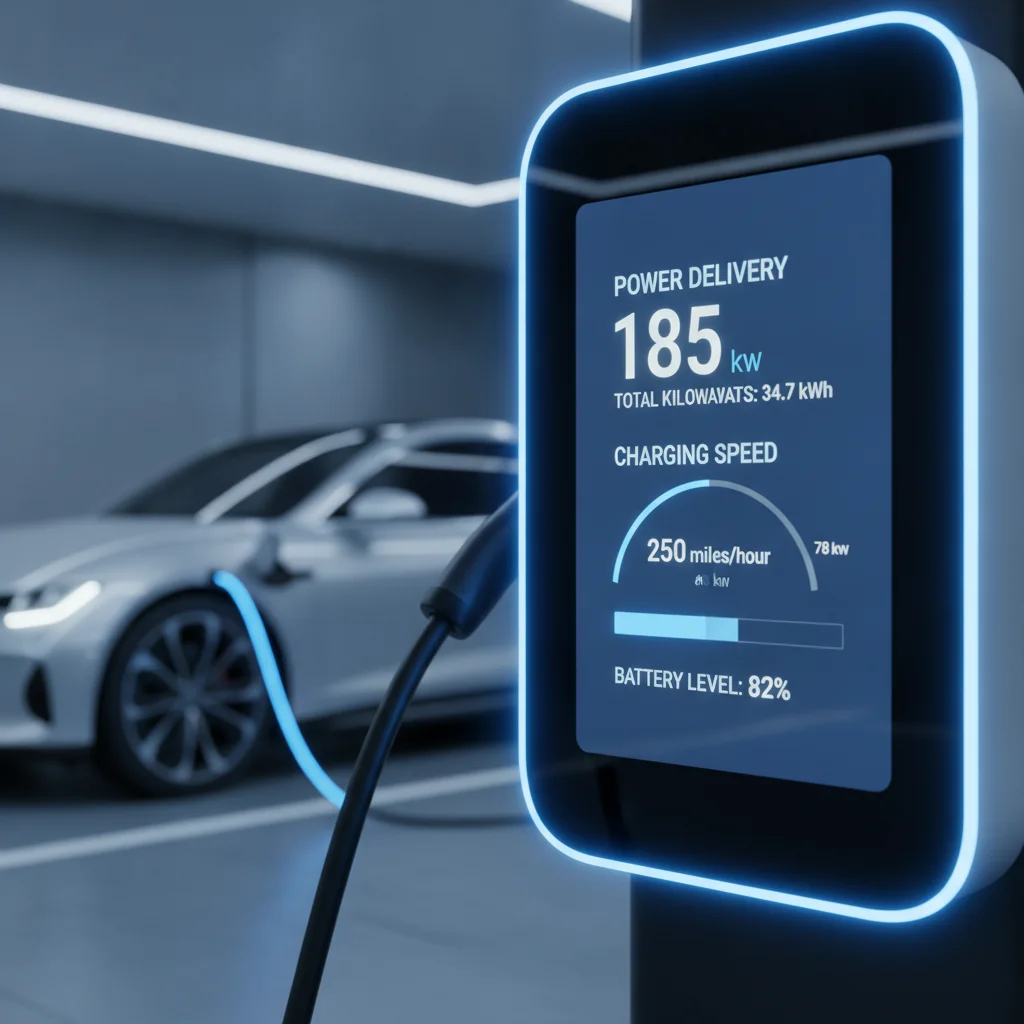
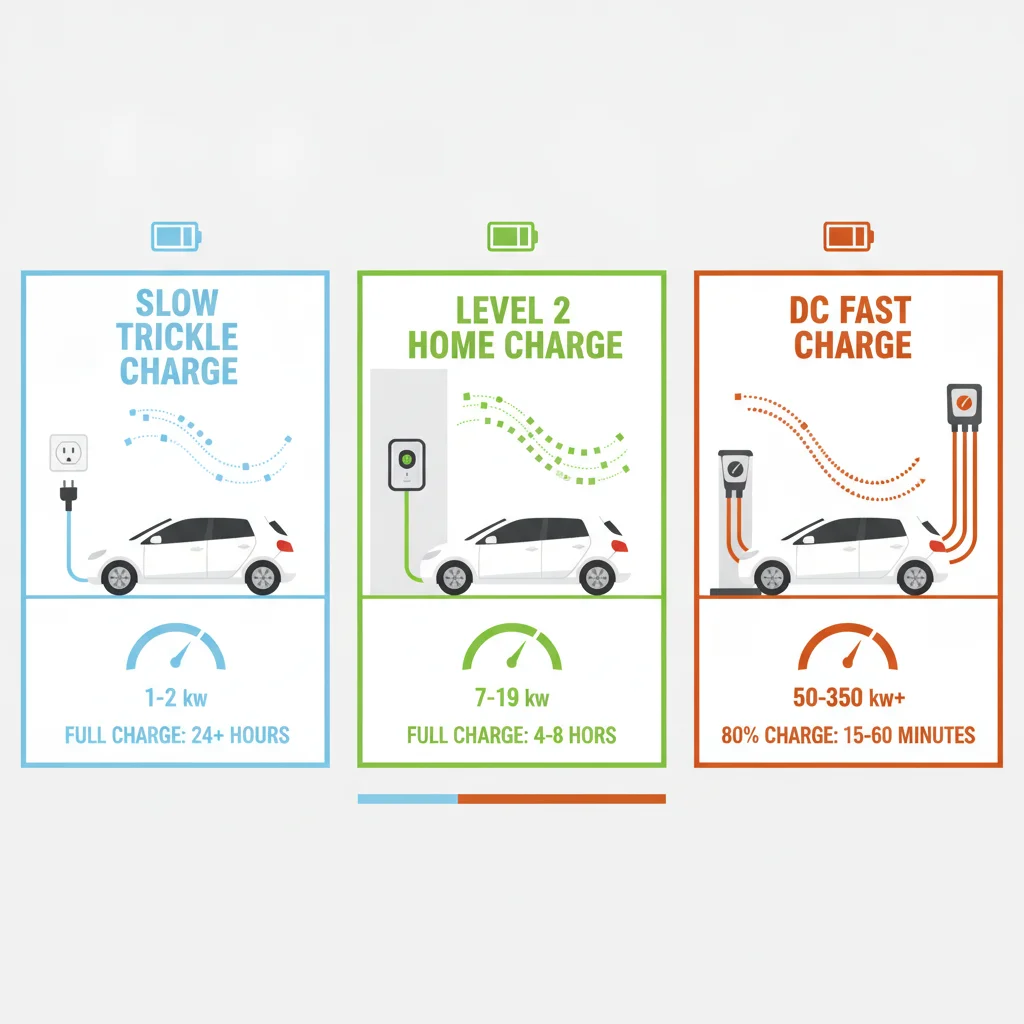
When a spec sheet lists a charging rate — say, 11 kW AC onboard charger or 250 kW DC fast charging — it's telling you how quickly energy can flow into the battery. Higher kW charging = faster fill-up. Here's a practical reference:
| Charging Level | Typical Power (kW) | Approx. Range Added per Hour |
|---|---|---|
| Level 1 (120V outlet) | 1.2–1.9 kW | 3–5 miles |
| Level 2 (240V home/public) | 7.2–19.2 kW | 20–60 miles |
| DC Fast Charge (public) | 50–350 kW | 100–900 miles (theoretical max) |
There's a critical ceiling to understand: your car's onboard charger limits Level 2 charging speed, regardless of how powerful the charging station is. If your car accepts only 7.2 kW on AC, plugging into an 11 kW or 19 kW station won't speed things up — you'll cap at 7.2 kW. DC fast charging bypasses the onboard charger entirely, which is why those numbers can be much higher.
Peak Charging Rates Only Apply in a Narrow Window
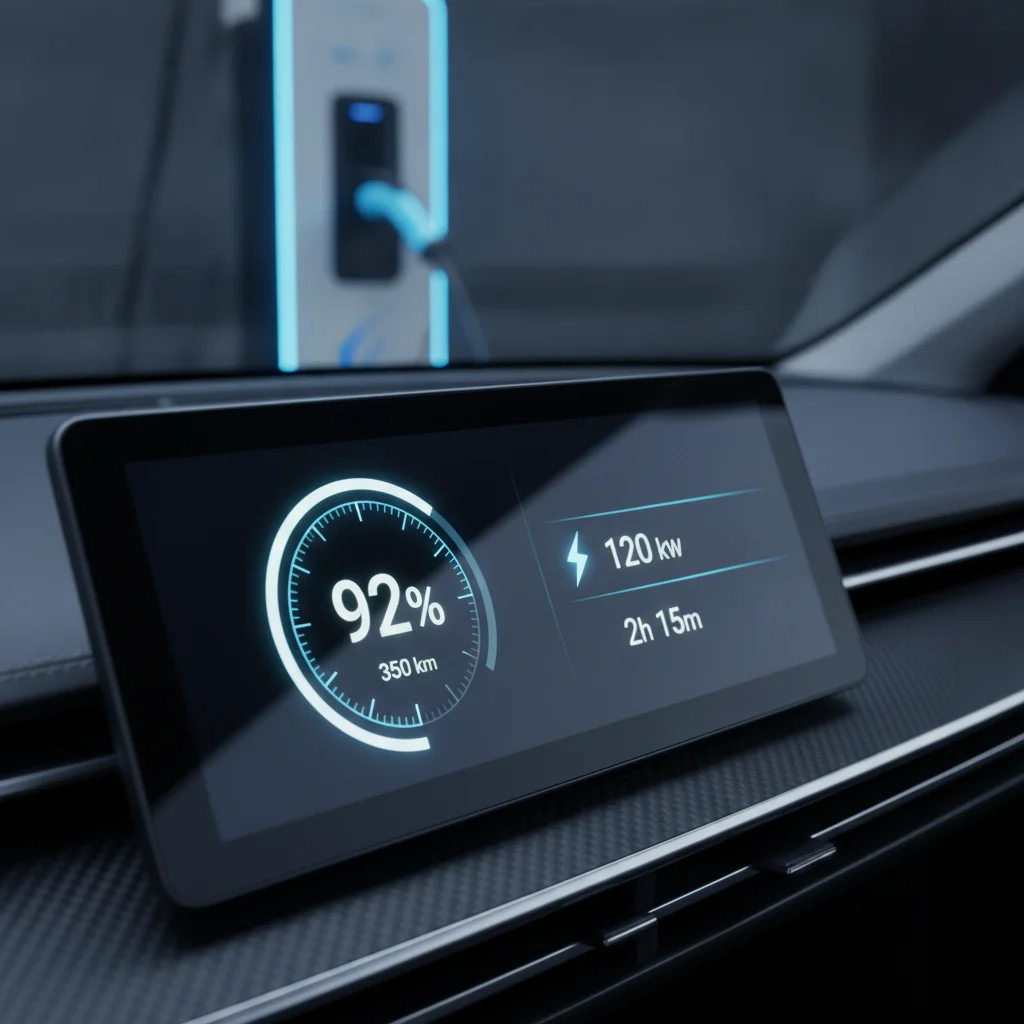
When a manufacturer advertises a 250 kW or 350 kW DC fast charging capability, that peak rate typically only applies when the battery is between roughly 10% and 30% state of charge. As the battery fills above 80%, the car's battery management system deliberately throttles the charge rate to protect cell chemistry. Don't plan a road trip assuming peak kW rates from 20% to 100% — real charge curves taper significantly in the upper half of the battery.
Charger Output vs. Car Acceptance Rate
A common mistake: assuming a faster charging station always means faster charging. Your EV's onboard charger rating (for AC Level 2) or its peak DC acceptance rate sets the ceiling — the station cannot push more power than the car can accept. Plugging a 7.2 kW onboard-charger car into a 19.2 kW station still charges at 7.2 kW. Match the charger to the car's actual capability to avoid paying for speed you can't use.
Highway vs. City Range: EVs Work Differently
Unlike gas vehicles, which typically get better highway fuel economy, most EVs are more efficient in city driving. Regenerative braking recaptures energy during stop-and-go that would otherwise be lost as heat in a gas car. At sustained highway speeds above 65 mph, aerodynamic drag increases exponentially and regeneration opportunities are minimal. This means the EPA city range estimate is often more achievable day-to-day than the highway figure for urban drivers.
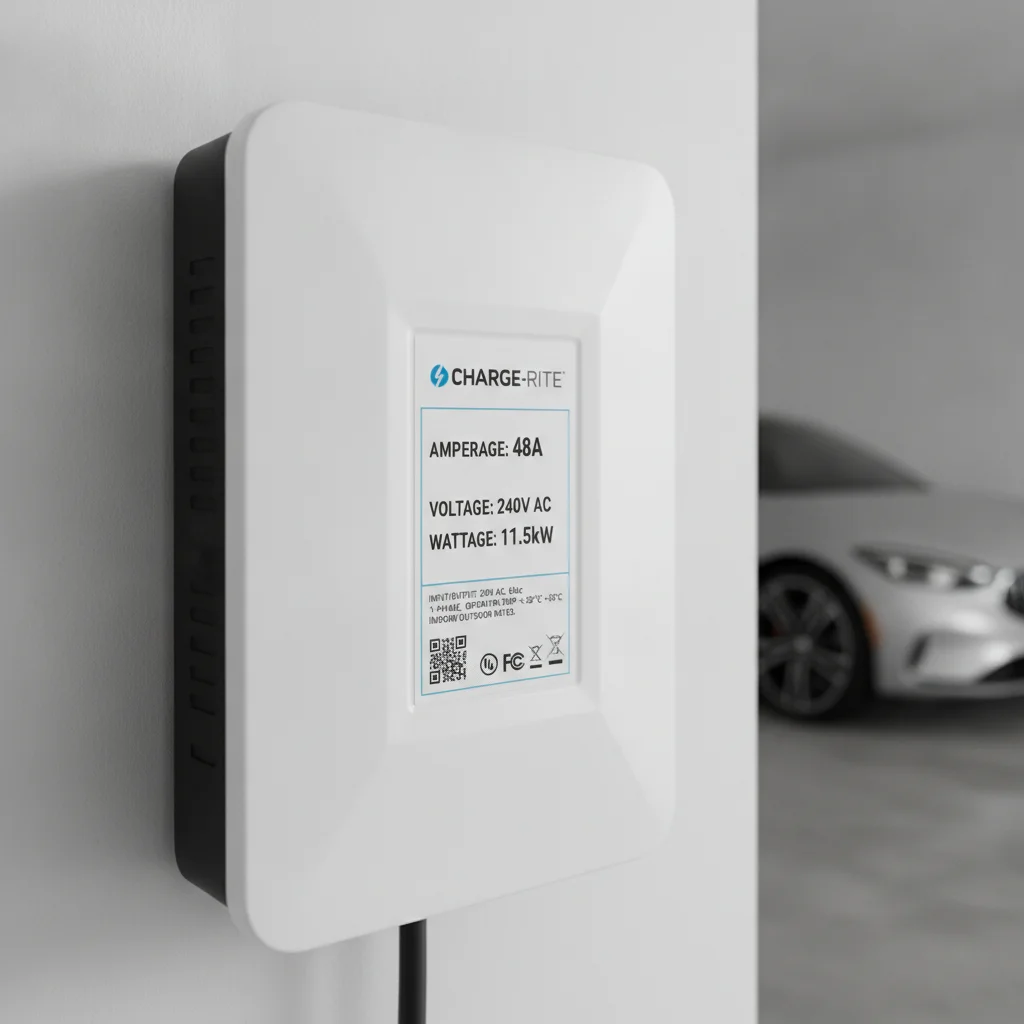
For a detailed breakdown of how these numbers appear on actual charger spec sheets, see our guide on reading an EV charger spec sheet. And if you want to fully decode charging speed ratings including miles-per-hour-of-charge calculations, check out our reference on charging speed ratings demystified.
Miles of Range: What the EPA Number Actually Tells You (and What It Doesn't)
The EPA range figure is the number plastered on the window sticker and every car comparison site. It's the most buyer-facing spec of all — and the most misunderstood.
20–40%
Range lost in cold weather below 40°F
According to AAA testing and NREL research, EV range drops significantly in winter conditions due to battery chemistry and cabin heating demands.
70–80%
Realistic real-world range vs. EPA rating
Industry analysts and EV owner data consistently show real-world range falls short of the EPA figure, particularly at highway speeds above 70 mph.
350 kW
Peak DC fast charging speed on current networks
Ultra-fast charging stations like Electrify America's 350 kW stalls can theoretically add over 100 miles of range in 10–15 minutes on compatible vehicles.
1.34 hp
Horsepower equivalent per kilowatt
This fixed conversion lets buyers translate electric motor kW ratings directly into the horsepower figures they may be more familiar with from gas vehicle shopping.
~93–97%
Usable share of total battery capacity
Manufacturers deliberately limit access to the full battery to protect cell longevity and prevent overcharge or deep discharge damage.
How the EPA Tests Range
The EPA uses a standardized drive cycle conducted in a lab, not on an open road. The test simulates a mix of city and highway driving, runs at moderate temperatures (around 75°F), and measures how far the car travels on a full usable charge. The result is reported in miles.
This is a controlled baseline, not a guarantee. Real-world range varies based on:
- Speed: Highway driving above 70 mph significantly increases aerodynamic drag, reducing range — sometimes by 20–30% compared to the EPA figure.
- Temperature: Cold weather (below 40°F) can reduce range by 20–40% due to battery chemistry and cabin heating demands. Heat above 95°F has a smaller but real effect.
- HVAC use: Running the heater is especially taxing. Heat pumps (now standard on many EVs) reduce this penalty significantly compared to resistive heating.
- Payload and cargo: More weight means more energy to move — straightforward physics.
- Driving style: Aggressive acceleration burns range faster; smooth, anticipatory driving extends it.
A Practical Rule of Thumb
Plan for roughly 70–80% of the EPA rating as your real-world working range in mixed conditions. In cold winter weather on a highway run, you might see 60% or less. On a mild spring day at moderate speeds, you might match or slightly exceed the EPA number.
What this means for buying: if you have a 250-mile weekly commute and want comfortable buffer, look for an EPA rating of at least 300 miles — not 250. Margin matters.
Our data-driven reference on EV range goes deeper on derating factors, EPA methodology, and how to compare vehicles honestly across segments.
Putting It All Together: How kW, kWh, and Range Interact
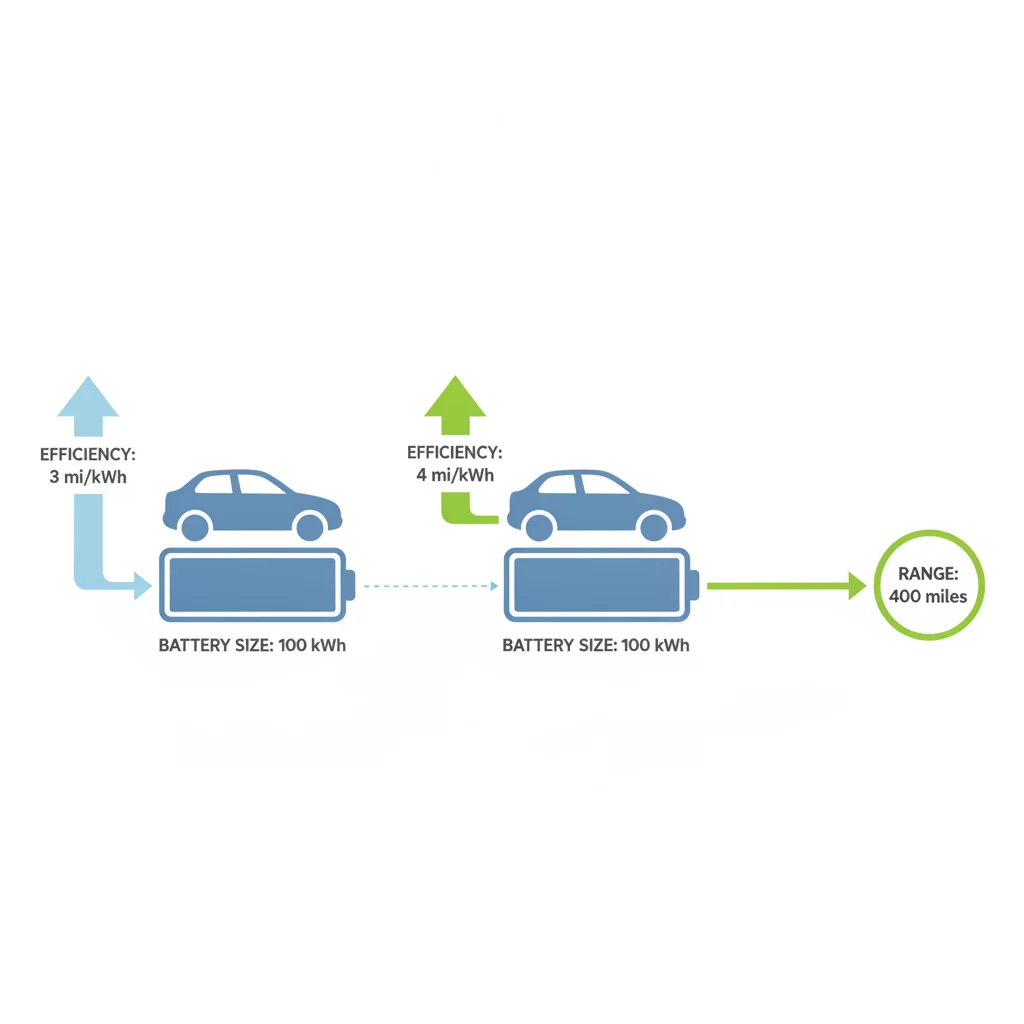
These three specs don't exist in isolation — they're tied together by a simple relationship:
Range (miles) ≈ Usable Battery Capacity (kWh) ÷ Energy Consumption (kWh per mile)
Energy consumption is the efficiency figure — how many kWh the car burns to travel one mile. A vehicle that uses 0.30 kWh/mile with a 75 kWh usable pack gets about 250 miles of range. One that uses 0.25 kWh/mile with the same pack gets 300 miles. Bigger pack or better efficiency — both paths lead to more range, but they have different cost, weight, and charging-time implications.
A Quick Comparison Across Real Vehicles
| Vehicle | Battery (kWh, usable est.) | Peak DC Charge (kW) | EPA Range (mi) | Efficiency (Wh/mi, approx.) |
|---|---|---|---|---|
| Chevrolet Bolt EV | ~65 | 55 | 259 | ~251 |
| Tesla Model 3 RWD | ~57.5 | 170 | 272 | ~211 |
| Ford Mustang Mach-E AWD | ~88 | 150 | 270 | ~326 |
| Rivian R1T Standard | ~135 | 200 | 410 | ~329 |
The table makes a key point visible: the Model 3 achieves nearly the same range as the Mach-E AWD with a battery that's about 35% smaller — because it's significantly more efficient. The Rivian's massive pack delivers impressive range despite relatively high consumption due to its size and weight.
When shopping, look at efficiency (Wh/mi or miles per kWh) alongside pack size and range. A highly efficient car with a smaller battery may be a better value — lower purchase price, lighter weight, quicker Level 2 charge times, and lower electricity cost per mile.
Peak Charging Rates Only Apply in a Narrow Window
When a manufacturer advertises a 250 kW or 350 kW DC fast charging capability, that peak rate typically only applies when the battery is between roughly 10% and 30% state of charge. As the battery fills above 80%, the car's battery management system deliberately throttles the charge rate to protect cell chemistry. Don't plan a road trip assuming peak kW rates from 20% to 100% — real charge curves taper significantly in the upper half of the battery.
Charger Output vs. Car Acceptance Rate
A common mistake: assuming a faster charging station always means faster charging. Your EV's onboard charger rating (for AC Level 2) or its peak DC acceptance rate sets the ceiling — the station cannot push more power than the car can accept. Plugging a 7.2 kW onboard-charger car into a 19.2 kW station still charges at 7.2 kW. Match the charger to the car's actual capability to avoid paying for speed you can't use.
Highway vs. City Range: EVs Work Differently
Unlike gas vehicles, which typically get better highway fuel economy, most EVs are more efficient in city driving. Regenerative braking recaptures energy during stop-and-go that would otherwise be lost as heat in a gas car. At sustained highway speeds above 65 mph, aerodynamic drag increases exponentially and regeneration opportunities are minimal. This means the EPA city range estimate is often more achievable day-to-day than the highway figure for urban drivers.
See the EV Range & Efficiency hub for a curated set of guides covering everything from EPA ratings to real-world derating, all in one place.
Quick Reference: EV Spec Sheet Cheat Sheet
Use this section as a lookup when you're staring at a spec sheet and want straight answers.
When You See kWh on the Spec Sheet...
- Battery capacity listed (e.g., "82 kWh battery"): This is total pack size. Usable capacity is typically 3–7% less.
- If no usable figure is given: Assume 93–97% of the listed number is accessible during normal use.
- Compare apples to apples: Some manufacturers list usable capacity; others list gross. Check which figure you're looking at.
When You See kW on the Spec Sheet...
- Motor output (e.g., "220 kW"): Multiply by 1.34 to convert to horsepower. Focus on this for performance comparisons.
- Onboard charger (e.g., "11.5 kW AC"): This caps your home Level 2 charging speed. Higher is better if you have a fast Level 2 charger.
- DC fast charging (e.g., "250 kW peak"): This is the maximum rate at an ultra-fast public charger. Actual rates vary by state of charge and temperature — peak rates typically apply only between 10–30% battery.
When You See Miles of Range...
- EPA-rated range: A lab-tested baseline. Budget for 70–80% in mixed real-world conditions.
- "Estimated range" from manufacturer: Often more optimistic than EPA. Weight this less heavily.
- Highway range vs. city range: Some manufacturers publish both. City is almost always higher for EVs (regenerative braking helps); highway is the more conservative and realistic planning number for road trips.
EV Range & Efficiency Hub
A curated collection of guides covering EPA range methodology, real-world derating factors, and how to compare EVs on efficiency. The right starting point for deeper range research.
Charging Speed Ratings Demystified
Breaks down kW, kWh, and miles-per-hour-of-charge so you understand exactly what each charging spec means for your actual fill-up time at home and on the road.
How to Read an EV Charger Spec Sheet
Decodes amps, voltage, connector types, and power ratings on home and public charger spec sheets — the practical companion to understanding EV charging specs.
The Full Picture on EV Range: A Data-Driven Reference
Comprehensive reference covering EPA ratings, seasonal derating, efficiency metrics, and honest vehicle-to-vehicle range comparisons backed by real data.
U.S. Department of Energy — fueleconomy.gov
The official EPA EV range and efficiency database. Look up any EV's rated range, MPGe, and energy consumption figure in one searchable tool — no marketing spin.
PlugShare
Real-time public charging station map with user check-ins and reviews. Useful for understanding what charging speeds are actually available along your regular routes.
Armed with these definitions, you're equipped to cut through the marketing language and evaluate any EV spec sheet on its merits. The numbers aren't complicated once you understand what each one is actually measuring.

All claims are backed by peer-reviewed research. Sources on request.