| Energy per gallon of gasoline (EPA standard) | 33.7 kWh (U.S. EPA) |
| MPGe formula | Miles traveled on 33.7 kWh of electricity (U.S. EPA) |
| Highest EPA MPGe (2024 model year) | 149 MPGe — Tesla Model 3 RWD (U.S. EPA fueleconomy.gov, 2024) |
| Typical compact EV efficiency | 250–300 Wh/mi (3.3–4.0 mi/kWh) (EPA combined ratings, 2024 model year) |
| Cold-weather efficiency penalty | Up to 40% reduction at 20°F (AAA EV Range Testing, 2023) |
| Highway speed efficiency loss | 15–25% below combined EPA rating at 75–80 mph (Recurrent Auto fleet data, 2023) |
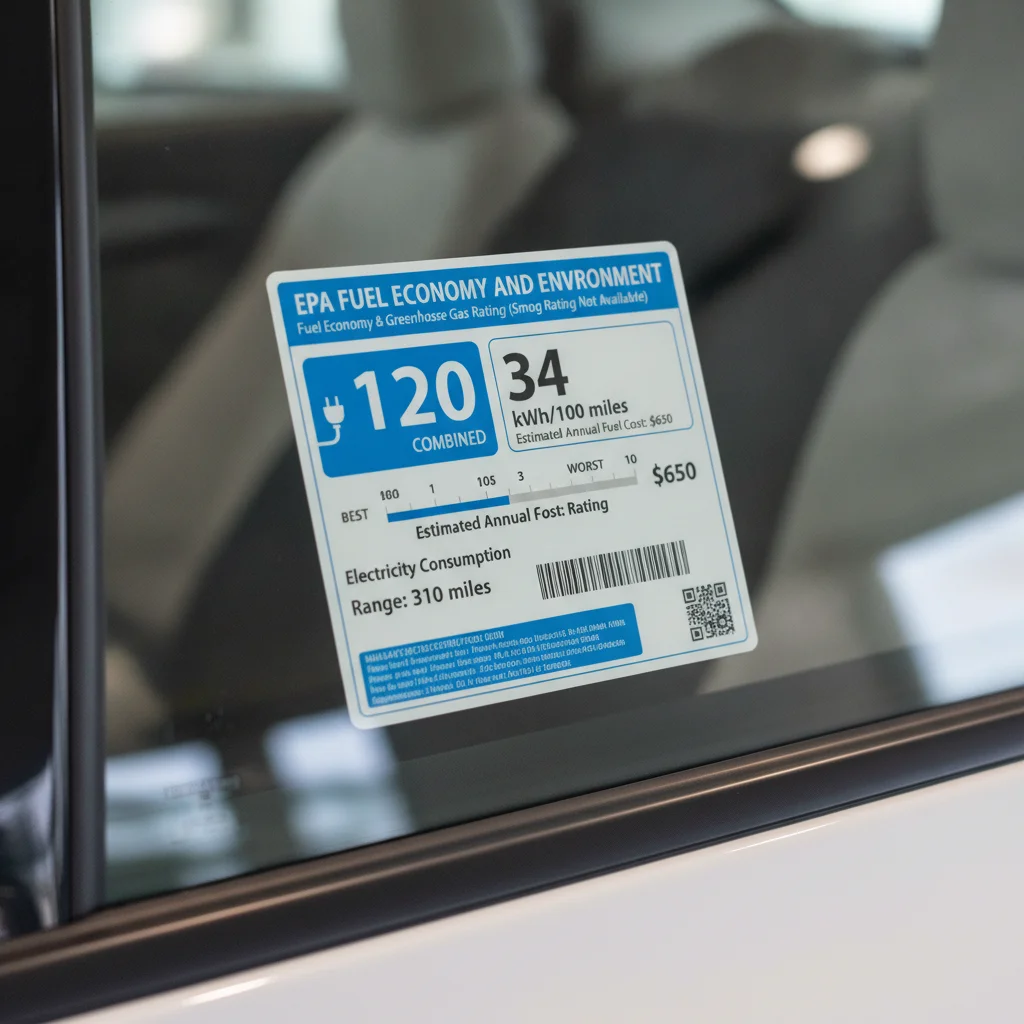
| Unit used on U.S. EPA window sticker | MPGe (combined, city, highway) (U.S. EPA) |
| kWh/100 mi to Wh/mi conversion | Multiply kWh/100 mi by 10 |
Why EV Efficiency Has Three Different Units
Open any EV window sticker and you'll find MPGe printed in large type. Pull up a forum thread about real-world range, and someone will quote Wh/mi. Look at your car's trip computer and it might show miles per kWh. All three describe how efficiently an electric vehicle uses energy — yet they express that efficiency in fundamentally different ways, which creates constant confusion for buyers and owners alike.
The reason three units coexist is partly historical and partly practical. MPGe was created by the EPA to give consumers a familiar reference point when comparing EVs to gasoline cars. Wh/mi is the engineer's unit: precise, additive, and easy to use in energy-budget math. Miles per kWh is the inverse of Wh/mi and maps intuitively to the familiar concept of miles per gallon. Each unit has a home turf where it is most useful, and understanding that turf is how you translate a spec-sheet number into a real-world range estimate.
For a broader look at how the EPA structures efficiency labels across electrified vehicle types, see Fuel Economy Labels for Electrified Cars.
| Energy per gallon of gasoline (EPA standard) | 33.7 kWh (U.S. EPA) |
| MPGe formula | Miles traveled on 33.7 kWh of electricity (U.S. EPA) |
| Highest EPA MPGe (2024 model year) | 149 MPGe — Tesla Model 3 RWD (U.S. EPA fueleconomy.gov, 2024) |
| Typical compact EV efficiency | 250–300 Wh/mi (3.3–4.0 mi/kWh) (EPA combined ratings, 2024 model year) |
| Cold-weather efficiency penalty | Up to 40% reduction at 20°F (AAA EV Range Testing, 2023) |
| Highway speed efficiency loss | 15–25% below combined EPA rating at 75–80 mph (Recurrent Auto fleet data, 2023) |
| Unit used on U.S. EPA window sticker | MPGe (combined, city, highway) (U.S. EPA) |
| kWh/100 mi to Wh/mi conversion | Multiply kWh/100 mi by 10 |
MPGe: The EPA's Comparison Tool
Miles per gallon equivalent (MPGe) was introduced by the EPA in 2010 specifically to give consumers a way to compare electric vehicles to the gas cars they already understood. The math starts with a fixed conversion: one gallon of gasoline contains 33.7 kilowatt-hours of energy. The EPA then calculates how many miles the vehicle travels on that amount of electrical energy, and reports the result as MPGe.
A 2024 Tesla Model 3 Long Range AWD earns an EPA rating of 119 MPGe combined. That means the car travels 119 miles on 33.7 kWh of electrical energy — roughly the same energy stored in one gallon of gasoline. For context, the most fuel-efficient non-hybrid gasoline sedan on sale today barely cracks 40 MPG, which illustrates just how much more efficiently electric motors convert stored energy into motion.
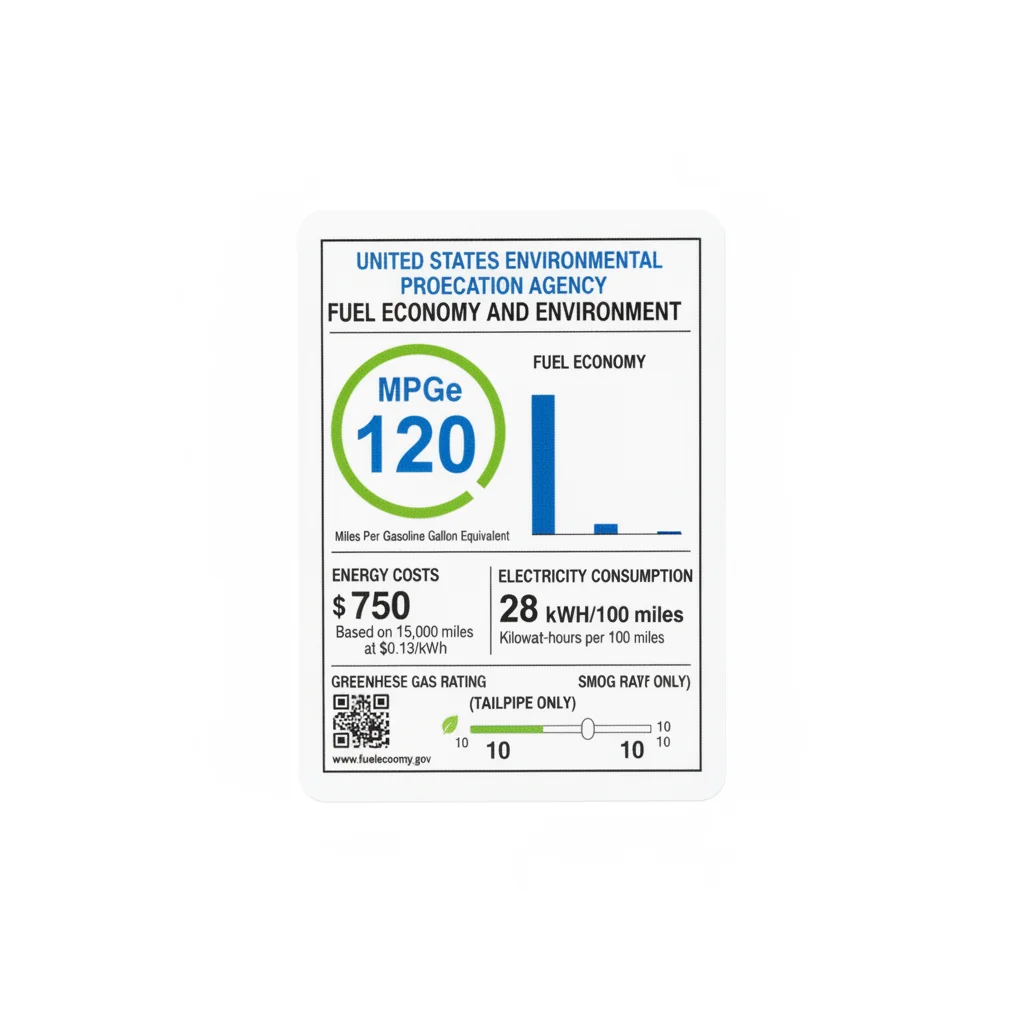
MPGe is most useful at the purchase decision stage. It lets you compare the efficiency of an EV against a hybrid or a conventional car using a single scale. It also feeds directly into the EPA's annual fuel cost estimate printed on the window sticker, making it a practical tool for projecting annual energy spending. However, MPGe is almost never shown on in-car displays, and it is not the unit you'll use when calculating whether you have enough charge to reach the next fast-charger.
Because MPGe uses the 33.7 kWh/gallon conversion, you can reverse-engineer kWh consumption from any MPGe rating: divide 33,700 Wh by the MPGe figure to get watt-hours per mile. A 119 MPGe rating equals roughly 283 Wh/mi — which is exactly the figure the EPA also prints on the label, just in smaller type.
Wh/mi and Miles per kWh: Two Sides of the Same Coin
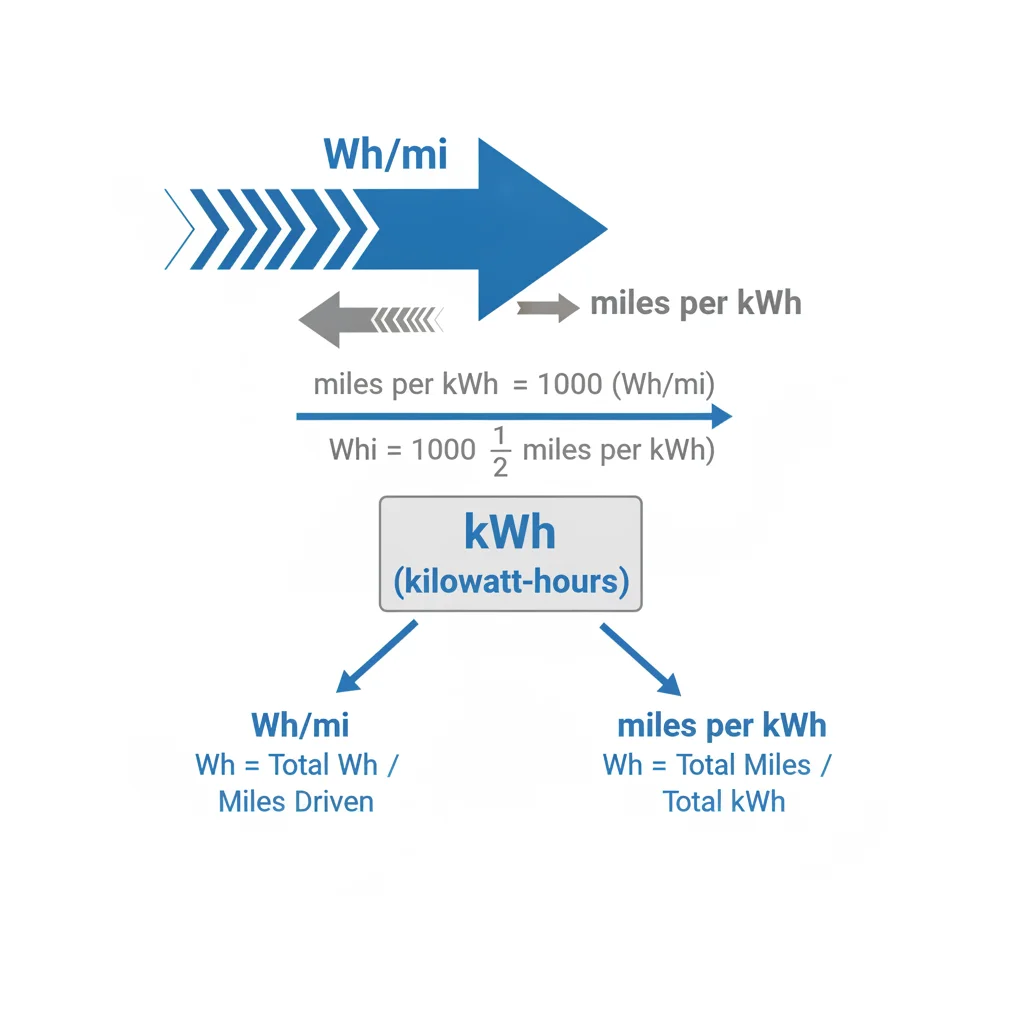
While MPGe bridges EVs to the gasoline world, watt-hours per mile (Wh/mi) and miles per kWh live entirely in the electric domain. They are mathematical inverses of each other, and which one you use is largely a matter of preference and context.
Wh/mi: The Engineer's Unit
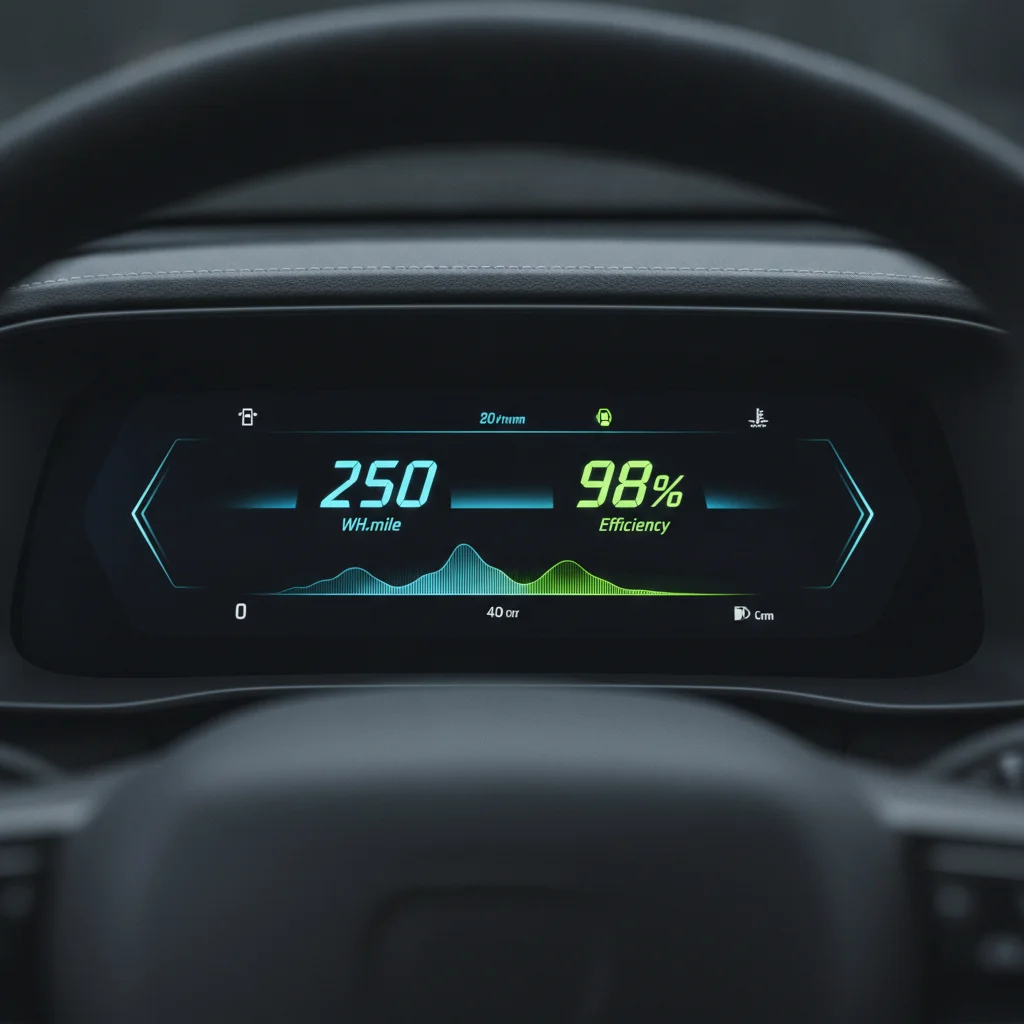
Watt-hours per mile expresses how many watt-hours of electrical energy the vehicle consumes for each mile traveled. Lower is more efficient. A compact EV like the 2024 Chevrolet Equinox EV uses approximately 28 kWh per 100 miles in EPA testing — equivalent to 280 Wh/mi. A large electric truck like the Rivian R1T uses around 35 kWh per 100 miles, or 350 Wh/mi.
The reason engineers and data-focused EV owners prefer Wh/mi is that it is additive: you can multiply it directly by distance to calculate total energy consumed. Planning a 200-mile trip in a vehicle that averages 280 Wh/mi? Multiply 280 × 200 = 56,000 Wh, or 56 kWh. If your battery holds 82 kWh usable, you have comfortable margin. That kind of calculation is impossible to do quickly with MPGe.
Miles per kWh: The Driver's Unit
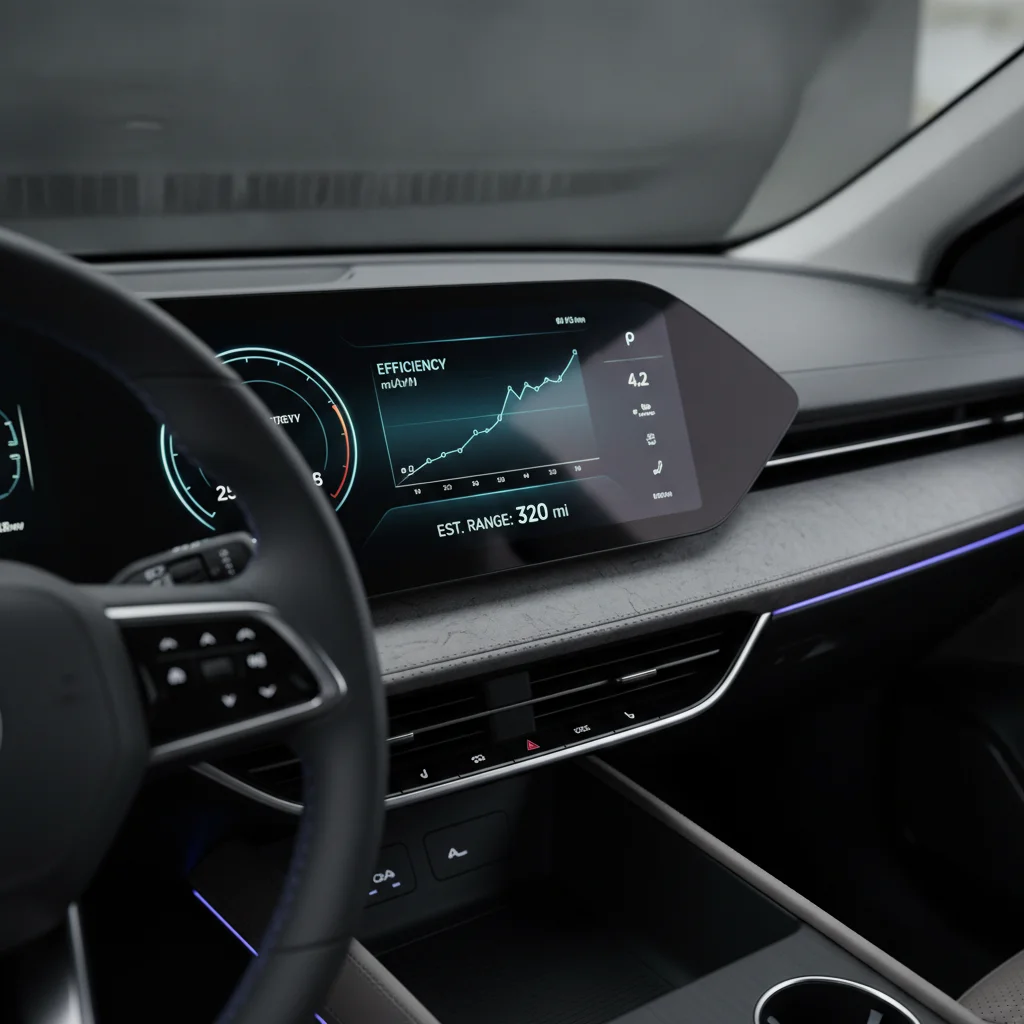
Miles per kWh is the inverse: divide miles traveled by kilowatt-hours consumed. If your EV travels 4 miles on every kWh, your efficiency is 4 mi/kWh. This unit maps psychologically to miles per gallon — higher numbers mean better efficiency — which makes it the preferred display format for many automakers' trip computers and range estimates.
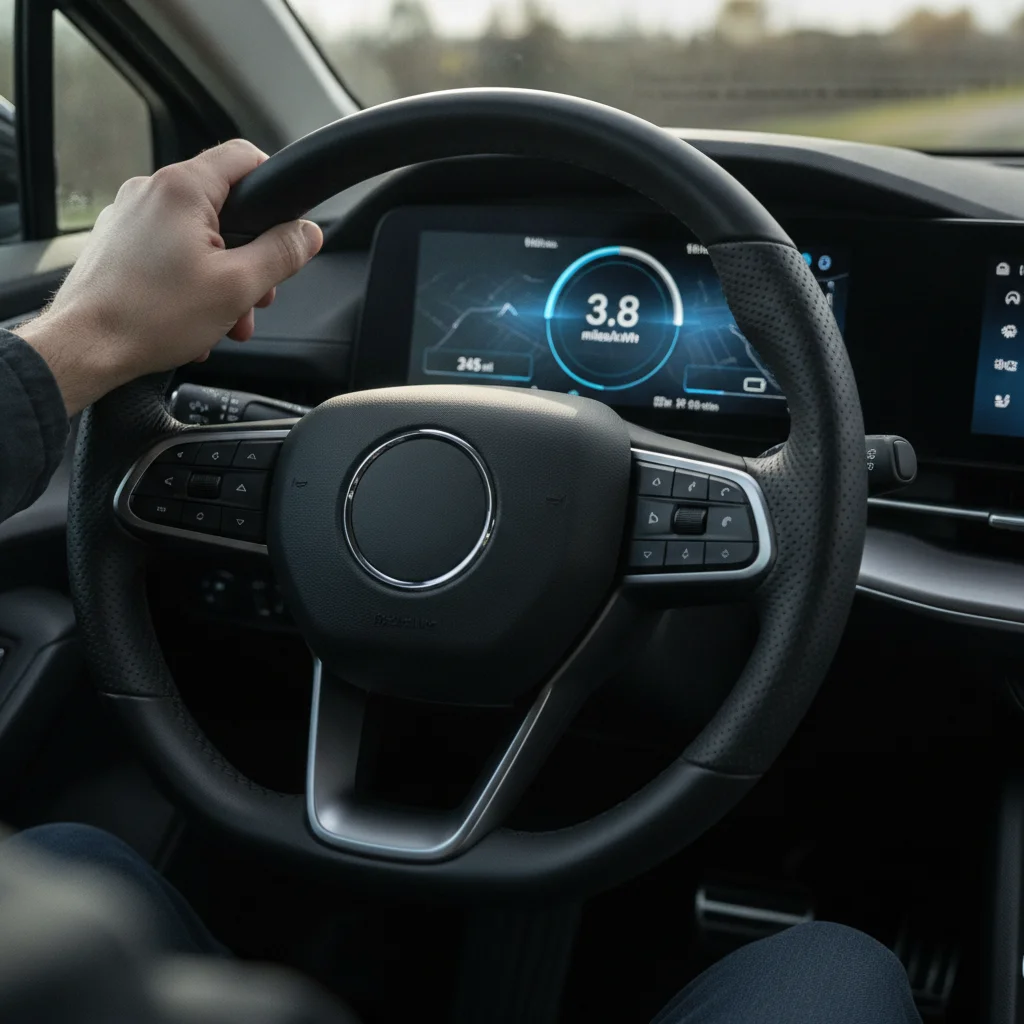
To estimate remaining range from a miles-per-kWh figure, multiply your current efficiency by the kWh remaining in the battery. If your trip computer shows 3.8 mi/kWh and your battery has 40 kWh left, your estimated range is 3.8 × 40 = 152 miles. That is the core calculation your vehicle's range estimator is performing in real time. See Reading Your EV's Energy Consumption Display Accurately for a detailed walkthrough of how to interpret these live dashboard readings.
33.7 kWh
Energy equivalent of one gallon of gasoline
This is the EPA's fixed conversion factor used to calculate MPGe for all electric vehicles sold in the U.S.
40%
Range reduction at 20°F vs. rated range
AAA's 2023 EV range testing found average range dropped by up to 40% in 20°F conditions with cabin heat running.
149 MPGe
Highest EPA efficiency rating for a 2024 EV
The Tesla Model 3 RWD leads the 2024 model year in EPA combined MPGe, according to fueleconomy.gov.
19–25%
Typical highway range loss at 75+ mph
Real-world data from Recurrent Auto's fleet monitoring shows sustained high-speed driving is the second-largest range penalty after cold temperature.
Converting Between Units
| Known Value | To Get | Formula |
|---|---|---|
| MPGe | Wh/mi | 33,700 ÷ MPGe |
| MPGe | mi/kWh | MPGe ÷ 33.7 |
| Wh/mi | mi/kWh | 1,000 ÷ Wh/mi |
| mi/kWh | Wh/mi | 1,000 ÷ mi/kWh |
| kWh/100 mi | Wh/mi | kWh/100 mi × 10 |
For a deeper look at the underlying energy concepts — kilowatts versus kilowatt-hours, and how battery capacity translates to range — see Kilowatts, Kilowatt-Hours, and Miles of Range.
What Actually Changes Your Efficiency Number
EPA ratings are tested under controlled laboratory conditions — a fixed temperature, a standardized drive cycle, and no accessories running. Real-world efficiency routinely diverges from those numbers, and understanding the variables that cause that divergence is the practical payoff of learning these units.
MPGe
Miles per gallon equivalent. An EPA metric expressing how many miles an EV travels on the energy equivalent of one gallon of gasoline (33.7 kWh). Used primarily for cross-vehicle comparison on window stickers.
Wh/mi
Watt-hours per mile. The amount of electrical energy consumed per mile driven. Lower values indicate better efficiency. Useful for calculating total trip energy consumption.
mi/kWh
Miles per kilowatt-hour. The inverse of Wh/mi, expressing how far the vehicle travels on each kilowatt-hour of energy. Higher values indicate better efficiency, analogous to miles per gallon.
kWh/100 mi
Kilowatt-hours per 100 miles. The EPA's secondary efficiency metric printed on window stickers, common in Europe as kWh/100 km. Multiply by 10 to convert to Wh/mi.
Usable battery capacity
The portion of a battery's total capacity that the vehicle's management system allows to be used in normal operation. Typically 85–95% of the rated capacity, retained to protect cell longevity.
Regenerative braking
A system that recovers kinetic energy during deceleration by running the electric motor in reverse as a generator, converting motion back into stored electrical energy in the battery.
EPA combined rating
The weighted average of city and highway efficiency test results: 55% city and 45% highway. The combined figure is the large number displayed prominently on the window sticker.
Aerodynamic drag coefficient (Cd)
A dimensionless number expressing how aerodynamically efficient a vehicle's shape is. Lower Cd values reduce the energy penalty at high speeds, directly improving highway-range efficiency.
Temperature
Cold weather is the single largest real-world efficiency penalty. At 20°F, many EVs see energy consumption rise by 30–45% compared to their EPA rating, driven primarily by cabin heating demand and reduced battery chemistry performance. A vehicle rated at 280 Wh/mi may consume 380–400 Wh/mi in winter commute conditions. At high temperatures above 95°F, air conditioning adds a smaller but meaningful penalty of roughly 10–15%.
Speed
Aerodynamic drag scales with the square of speed, which means efficiency drops sharply at highway speeds. Most EVs are optimized for the EPA's city/highway test cycles. Sustained driving at 75–80 mph can reduce range by 15–25% versus the combined EPA estimate. If you primarily drive highways at high speed, the highway MPGe figure on the window sticker is a more honest reference than the combined number.
Payload and Terrain
Every additional 100 lbs of cargo increases rolling resistance, though this effect is smaller than temperature or speed. Grade changes matter significantly: a vehicle consuming 300 Wh/mi on flat ground may use 500+ Wh/mi climbing a sustained 6% grade. Regenerative braking recovers some of that energy on descents, but the recovery rate is never 100%.

HVAC and Accessories
Seat heaters are far more efficient than resistive cabin heating — a practical tip for cold-weather range preservation. Heated steering wheels similarly consume far less energy per degree of warmth than blasting the cabin heater at full power. Precondition the cabin while still plugged in to avoid drawing heating or cooling energy from the battery during your drive.
For comparison, gasoline fuel economy ratings face similar real-world gaps. The EPA's methodology for conventional cars is explored in Fuel Economy Ratings: What the EPA Numbers Mean in Real-World Driving.
Applying Efficiency Units to Real Decisions
Knowing the formulas is useful. Knowing which unit to reach for in a given situation is more useful.
When Shopping: Use MPGe for Cross-Vehicle Comparison
MPGe is designed for this exact purpose. Comparing a 133 MPGe compact EV to a 108 MPGe midsize EV tells you the compact uses roughly 19% less energy per mile. Paired with the window sticker's annual fuel cost estimate (calculated at the national average electricity rate), MPGe gives you a fast read on long-term energy economics before you ever test drive. Note that PHEVs report separate MPGe for electric-only operation and MPG for gasoline operation — understanding EV types like BEV and PHEV helps you interpret those dual ratings correctly.
When Charging Cost Matters: Use kWh and Wh/mi
Your electricity bill charges you in cents per kWh, not per mile or per gallon-equivalent. To calculate what it costs to charge at home, multiply the kWh you add by your electricity rate. If you add 50 kWh at $0.14/kWh, you spend $7.00. Wh/mi then tells you how far that $7.00 takes you: at 280 Wh/mi (0.28 kWh/mi), 50 kWh covers about 179 miles. That is roughly $0.039 per mile in fuel cost — a useful number when comparing total cost of ownership. For a full glossary of charging cost terminology, see Key Terms Every EV Owner Needs to Understand Charging Costs.
On a Road Trip: Use mi/kWh for Live Range Management
Your trip computer's real-time mi/kWh readout is your most actionable number when you're managing range between chargers. Watch for it to drop — signaling headwinds, a grade, or a heavier HVAC load — and adjust speed or climate settings accordingly. If your efficiency drops from 3.5 mi/kWh to 2.9 mi/kWh on a cold, windy stretch of interstate, your effective remaining range has dropped by about 17%, even though the battery charge percentage hasn't changed.
Setting realistic expectations before departure matters as much as monitoring during the trip. Apply a conservative real-world adjustment factor — typically 80–85% of the EPA combined rating in moderate conditions, lower in cold weather or at sustained high speeds — and plan charging stops based on that adjusted figure rather than the window sticker number.
EPA fueleconomy.gov EV Comparison Tool
The official EPA database lets you compare MPGe, kWh/100 mi, and annual fuel cost estimates for every EPA-rated EV side by side. Essential for pre-purchase efficiency comparisons.
ABRP (A Better Route Planner)
A route-planning tool that adjusts estimated range based on weather, elevation, vehicle load, and speed, giving a far more accurate charging-stop plan than EPA figures alone.
Recurrent Auto Range Report
Recurrent aggregates real-world range data from tens of thousands of EVs on the road, reporting average real-world efficiency by vehicle, season, and temperature band.
EV Efficiency Unit Converter
Simple calculators that convert between MPGe, Wh/mi, mi/kWh, and kWh/100 mi instantly — useful when comparing spec sheets that use different unit conventions.
All claims are backed by peer-reviewed research. Sources on request.