Key Takeaways
Option A
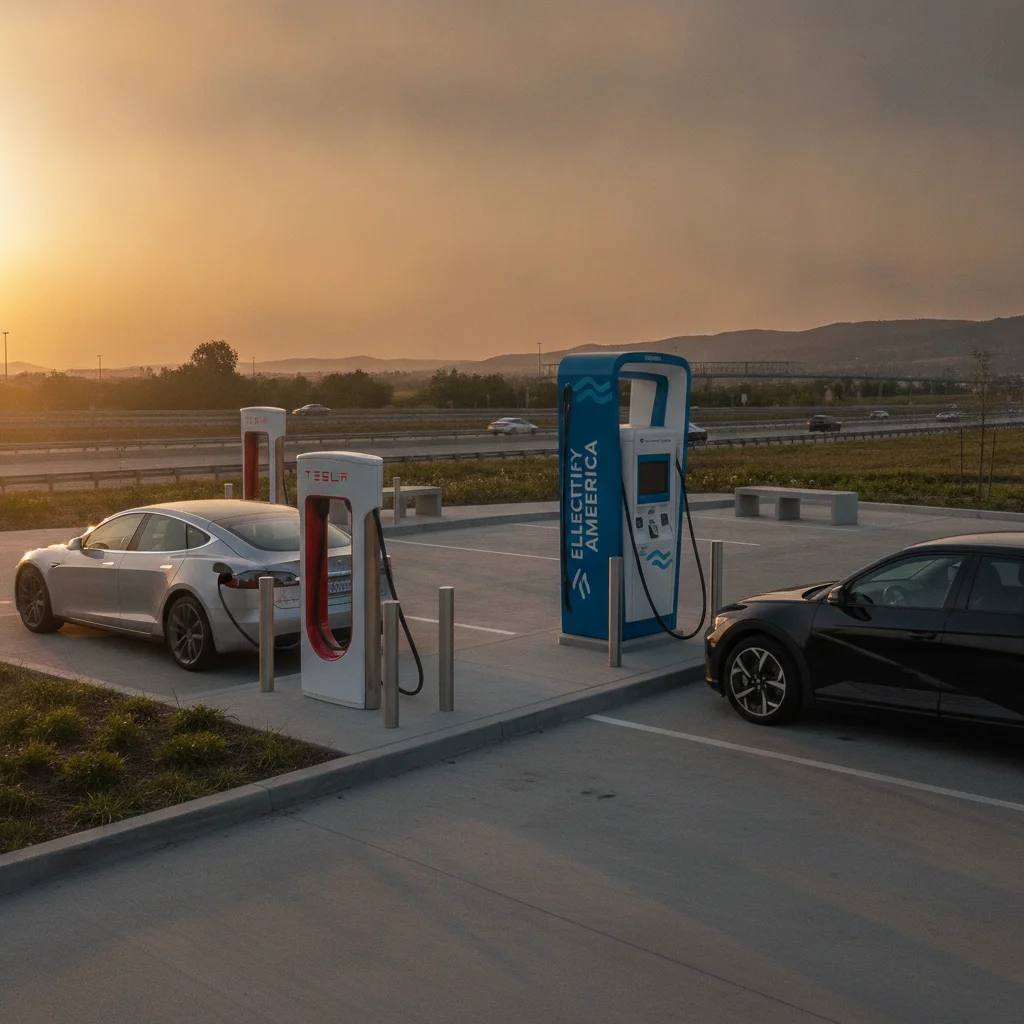
Tesla Supercharger
The gold standard in reliability and seamless EV integration.
Best for: Tesla owners and NACS-compatible EV drivers who want a plug-and-charge experience with a proven, high-density highway network.
Option B
Electrify America
The most accessible open network for non-Tesla long-distance travel.
Best for: Non-Tesla EV drivers—particularly those in CCS-equipped vehicles—seeking fast highway charging across major US corridors.
If you own a Tesla and prioritize seamless plug-and-charge convenience
Tesla Supercharger
Supercharger integrates natively with Tesla navigation, billing, and vehicle software. No app, no RFID card—just plug in and charge.
If you drive a non-Tesla EV and need the fastest available DC charge on the highway
Electrify America
Electrify America's 350 kW peak stations can push compatible vehicles—like the Hyundai IONIQ 6 and Porsche Taycan—to their maximum charge rates, something no other open network consistently matches.
If you frequently road trip across rural or less-traveled US routes
Tesla Supercharger
Supercharger's sheer station density and rural coverage still outpaces Electrify America, particularly west of the Mississippi and on secondary highways.
If you want predictable monthly charging costs with a subscription plan
Electrify America
Electrify America's Pass+ membership at $4/month locks in a flat per-kWh rate that, for frequent public charger users, typically beats Supercharger pay-as-you-go pricing for non-Tesla drivers.
If you own a NACS-native non-Tesla (Ford, GM, Rivian model year 2025+)
Tesla Supercharger
With native NACS ports becoming standard across major automakers, Supercharger is increasingly accessible without adapters, combining its reliability advantage with broader compatibility.
Network Scale and Geographic Coverage
Raw numbers matter when you're stranded with 15 miles of range remaining. As of mid-2024, the Tesla Supercharger network spans more than 1,900 stations across the United States, encompassing approximately 17,000 individual connectors. Electrify America operates over 900 US stations with around 4,000 connectors. On paper, Tesla dominates by a wide margin—but that gap is less decisive in practice than it appears.
Tesla built its network strategically along interstates first, then expanded into urban cores. The result is a web that blankets most of the contiguous US with remarkable density, including coverage along US-2 through Montana and I-40 across New Mexico—routes where other networks remain spotty. For a full picture of how Supercharger fits among all major US charging options, see our complete overview of public EV charging networks.
Electrify America's strategy leans differently: fewer total stations, but a clear focus on high-power corridors. The network has prioritized Interstate 95, I-10, I-80, and other heavily trafficked arteries, placing stations—often eight to twelve stalls—at Walmart locations and highway travel centers. In densely populated corridors like the Northeast and California, the practical gap between the two networks narrows considerably.
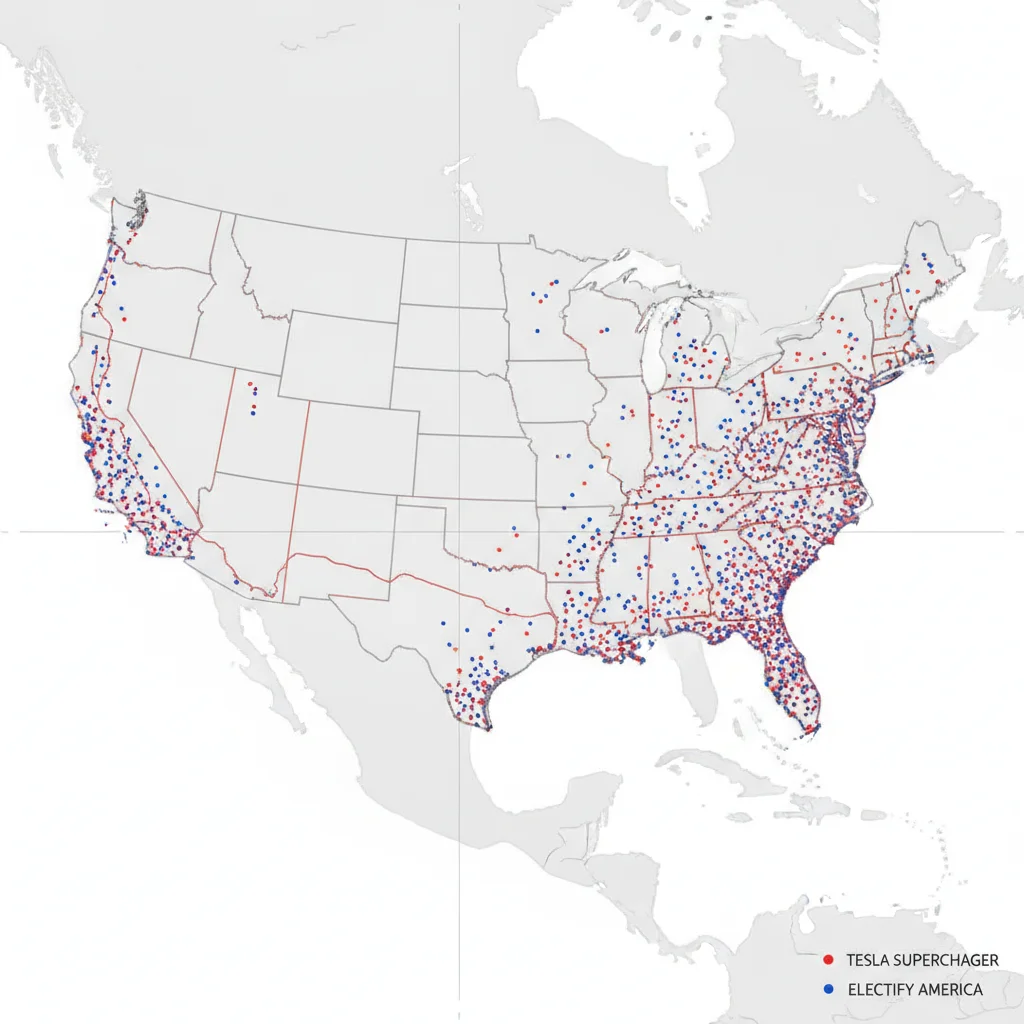
For drivers venturing into Alaska, Hawaii, or deeply rural corridors, Supercharger's edge is real. For the majority of US road trips—east-west interstate runs, mid-Atlantic corridors, Pacific Coast Highway—both networks can technically get you there. The question becomes which does it faster, more reliably, and at what cost.
It's also worth noting that smaller networks are filling specific coverage gaps that neither Supercharger nor Electrify America has fully addressed. Our piece on charging stations beyond the big five networks covers options like Francis Energy and Rivian Adventure Network for off-the-beaten-path routes.
Charging Speed: Peak Power and Real-World Delivery
Advertised peak kilowatts are a starting point, not a guarantee. Understanding what each network actually delivers to your vehicle requires digging into hardware generations, power-sharing configurations, and vehicle acceptance rates.
| Criterion | Tesla Supercharger | Electrify America |
|---|---|---|
| US Stations (mid-2024) | 1,900+ | 900+ |
| US Connectors | ~17,000 | ~4,000 |
| Peak Charging Speed | 250 kW (V3) | 350 kW |
| Standard Connector | NACS (Magic Dock for CCS) | CCS + CHAdeMO (NACS rolling out) |
| Open to Non-Tesla | Yes (2023+) | Yes (always) |
| Base Rate (per kWh) | $0.25–$0.50 | $0.48 (Pass) / $0.36 (Pass+) |
| Membership Option | None (Tesla account required) | Pass+ at $4/month |
| Plug-and-Charge | Yes (Tesla vehicles) | Limited (select vehicles) |
| Rural Coverage | Excellent | Moderate |
| Reliability (J.D. Power 2023) | Ranked #1 | Below average historically |
Tesla Supercharger V3 stations, which now make up the majority of active US stalls, deliver up to 250 kW per vehicle. That's sufficient to charge a Tesla Model 3 Long Range from 10% to 80% in roughly 25–30 minutes under ideal conditions. The V3 architecture eliminated the power-sharing limitation of V2, meaning a full bank of occupied stalls doesn't throttle your session the way it once did.
Electrify America's 350 kW stations represent the highest publicly available DC fast-charging speed in the US as of 2024. Vehicles capable of accepting 350 kW—including the Porsche Taycan, Hyundai IONIQ 6, and Audi e-tron GT—can add 200 miles of range in under 20 minutes at these stalls. However, many popular EVs cap out well below 350 kW: the Chevrolet Equinox EV accepts up to 150 kW, and the Ford F-150 Lightning maxes at 131 kW regardless of what the station provides.
1,900+
Tesla Supercharger US stations
As of mid-2024, Tesla operates the largest single DC fast-charging network in the United States by station and connector count.
350 kW
Electrify America peak charge rate
Electrify America's highest-power stalls are the fastest publicly available DC fast chargers in the US, compatible with vehicles like the Porsche Taycan and Hyundai IONIQ 6.
#1
Supercharger J.D. Power satisfaction rank
Tesla Supercharger ranked highest in overall customer satisfaction in J.D. Power's 2023 Electric Vehicle Experience Public Charging Study for the third consecutive year.
$4/mo
Electrify America Pass+ membership cost
Pass+ reduces the per-kWh rate from $0.48 to $0.36, which can pay for itself after roughly two average charging sessions per month.
7+
Automakers adopting NACS by 2025
Ford, GM, Rivian, Mercedes, Nissan, Honda, and others have committed to NACS ports, expanding Supercharger access to non-Tesla vehicles without adapters.
In practice, Electrify America's ultra-high-power advantage is vehicle-dependent. If your EV tops out at 150 kW, a 250 kW Supercharger and a 350 kW EA station deliver the same real-world session time. But as more vehicles arrive with higher acceptance rates—particularly models from Hyundai Motor Group and next-generation GM platforms—Electrify America's hardware ceiling becomes genuinely useful.
For a thorough explanation of how DC fast charging compares to Level 1 and Level 2 options—and when each makes financial sense—our guide on Level 1, Level 2, and DC fast charging costs and speeds is a useful companion read.
Reliability, Uptime, and the Charging Experience
Speed is irrelevant if the station is offline when you need it. Reliability has long been Supercharger's most durable competitive advantage—and the data bears that out.
A 2023 J.D. Power Electric Vehicle Experience Public Charging Study found that Tesla Supercharger ranked highest in overall customer satisfaction among DC fast-charging networks for the third consecutive year. Critically, Supercharger reported the lowest rate of non-working chargers encountered per session—a metric that directly affects driver anxiety on long trips.
Electrify America's reliability record has historically been its Achilles heel. Early network deployments between 2018 and 2021 suffered from significant uptime issues, with third-party monitoring tools like PlugShare frequently flagging broken or offline stalls. The network has invested substantially in hardware upgrades and remote monitoring since 2022, and reliability has improved meaningfully—but driver perception, shaped by earlier experiences, remains a headwind.
State Pricing Regulations Affect What You Pay
Some US states prohibit per-kWh billing by non-utility entities, forcing both Tesla Supercharger and Electrify America to charge by the minute instead. Per-minute billing can significantly inflate costs for vehicles with lower charge acceptance rates, since they occupy the stall longer per kWh added. Always verify the billing structure at your planned charging location before departure, as it varies by state and sometimes by station.
NACS Expansion Is Ongoing, Not Complete
As of mid-2024, NACS adoption by non-Tesla automakers is confirmed but still rolling out. Not all Supercharger stations have Magic Dock adapters for CCS vehicles, and most non-Tesla vehicles still ship with CCS ports. Drivers should verify adapter availability for specific stations before planning a Supercharger-dependent route. Electrify America's NACS connector installation timeline is also subject to change based on hardware supply and regulatory approvals.
PlugShare Uptime Data Is Your Best Real-World Source
Official uptime statistics from both networks are self-reported and may not reflect real-world driver experience at specific stations. PlugShare's crowdsourced check-in system provides recent, station-level reliability data from actual drivers. Before any long trip, reviewing recent check-ins for your planned charging stops—particularly at Electrify America locations—takes less than five minutes and can prevent significant route disruptions.
The charging experience workflow also differs considerably. Tesla Supercharger offers plug-and-charge functionality for Tesla vehicles: pull up, plug in, billing happens automatically via your Tesla account. No app launch required, no RFID tap, no payment terminal fumbling. For non-Tesla drivers using Magic Dock adapters or NACS-native vehicles, the process is similar but requires the Tesla app and account setup ahead of time.
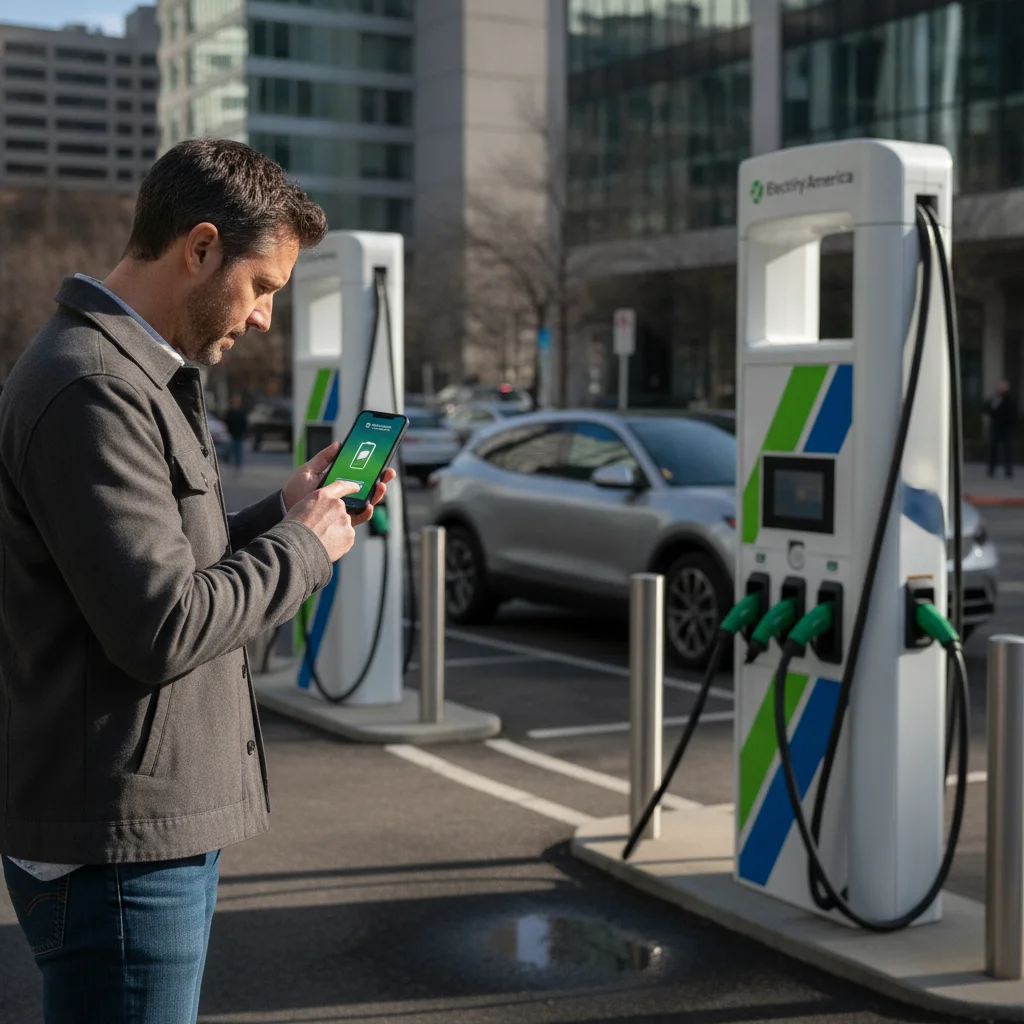
Electrify America requires the EA app or a compatible third-party app (such as the VW ID. Charging interface or Volkswagen's in-car integration for ID.4 owners). Payment can be made via app, credit card at the station, or through automaker-specific charging packages. The experience is functional but involves more friction than Supercharger's seamless Tesla integration—a gap that matters when you're tired, it's raining, and you just want to charge and get back on the road.
Pricing and Cost Transparency
Public DC fast charging costs money—sometimes a lot of it—and both networks use structures that reward frequent users while penalizing occasional ones. Understanding the pricing models helps estimate your actual per-trip cost rather than relying on per-kWh headlines.
Tesla Supercharger pricing for Tesla owners is billed per kWh in most states (a handful still use per-minute billing due to state utility regulations). Rates vary by location, typically ranging from $0.25 to $0.50 per kWh for Tesla owners. Non-Tesla drivers using the open network pay a premium—often 10–25% above the standard rate—because Tesla's reduced pricing is linked to vehicle account verification. Tesla owners with certain subscription plans or who purchased specific vehicle configurations receive complimentary Supercharger credits, though unlimited free Supercharging has largely been phased out.
Electrify America charges $0.48 per kWh as its standard (Pass) rate, or $0.36 per kWh under Pass+ membership, which costs $4 per month. In states where per-kWh billing isn't permitted by utility regulators, EA bills per minute at different power tiers—a structure that can produce surprisingly high effective costs for slower-charging vehicles occupying a high-power stall. EA also offers automaker-specific charging packages: Volkswagen, Audi, Porsche, Ford, and other brands have negotiated bundled charging allowances that can significantly reduce per-session costs for their customers.
For context on how public charging costs compare to home charging and gasoline, our charging costs and savings hub provides calculators and cost-per-mile benchmarks. If you're evaluating whether a home charging setup might reduce your dependence on public networks altogether, that's worth modeling before your next road trip.
Open Access and NACS: A Shifting Landscape
Perhaps no development has reshaped this comparison more than Tesla's 2023 decision to open its Supercharger network to non-Tesla vehicles and the broader industry adoption of the North American Charging Standard (NACS) connector.
Tesla began allowing non-Tesla EVs to use Superchargers in select locations in late 2022, and by 2024 the program had expanded to hundreds of US stations equipped with Magic Dock CCS-to-NACS adapters. Simultaneously, Ford, General Motors, Rivian, Mercedes, Nissan, and Honda all announced plans to adopt NACS ports on future models, eliminating the need for an adapter entirely. The first wave of NACS-native non-Tesla vehicles reached consumers in 2024 model years.
This shift has meaningful implications for the Supercharger vs. Electrify America comparison. Non-Tesla drivers who previously had no practical access to Superchargers now do—and as NACS becomes the de facto US standard, Supercharger access will approach universal for new EV buyers. Our explainer on what NACS adoption means for all EV drivers details which automakers have committed and what existing CCS owners need to know about adapters.
Electrify America, meanwhile, has announced plans to add NACS connectors to new and existing stations, with the rollout beginning in 2024. This means future EA stations will serve both CCS and NACS vehicles natively—a necessary evolution to remain competitive as the connector landscape consolidates.
State Pricing Regulations Affect What You Pay
Some US states prohibit per-kWh billing by non-utility entities, forcing both Tesla Supercharger and Electrify America to charge by the minute instead. Per-minute billing can significantly inflate costs for vehicles with lower charge acceptance rates, since they occupy the stall longer per kWh added. Always verify the billing structure at your planned charging location before departure, as it varies by state and sometimes by station.
NACS Expansion Is Ongoing, Not Complete
As of mid-2024, NACS adoption by non-Tesla automakers is confirmed but still rolling out. Not all Supercharger stations have Magic Dock adapters for CCS vehicles, and most non-Tesla vehicles still ship with CCS ports. Drivers should verify adapter availability for specific stations before planning a Supercharger-dependent route. Electrify America's NACS connector installation timeline is also subject to change based on hardware supply and regulatory approvals.
PlugShare Uptime Data Is Your Best Real-World Source
Official uptime statistics from both networks are self-reported and may not reflect real-world driver experience at specific stations. PlugShare's crowdsourced check-in system provides recent, station-level reliability data from actual drivers. Before any long trip, reviewing recent check-ins for your planned charging stops—particularly at Electrify America locations—takes less than five minutes and can prevent significant route disruptions.
The competitive stakes here are high. If Supercharger becomes as accessible to non-Tesla drivers as Electrify America—with its reliability advantage intact—EA's primary differentiation narrows to raw charging speed for high-acceptance-rate vehicles. That's a meaningful niche, but a smaller one than EA currently occupies in the non-Tesla charging ecosystem.
For a broader comparison that also benchmarks EVgo, ChargePoint, and Blink against both networks, see our major public charging networks side-by-side comparison. And if you're specifically evaluating third-party DC fast-charging options, our EVgo vs. Electrify America comparison is a direct supplement to this article.
Which Network Should You Plan Your Route Around?
The honest answer is: it depends on your vehicle, your route, and how you weigh speed against coverage against cost. Neither network is universally superior—but each is clearly better in specific scenarios.
Choose Supercharger as your primary network if:
- You own a Tesla and value the seamless plug-and-charge experience.
- You frequently travel rural or secondary highway routes where Electrify America has limited presence.
- You own a NACS-native non-Tesla vehicle (2025+ Ford, GM, or Rivian) and want the broadest geographic coverage.
- Reliability and uptime consistency are non-negotiable on your trips.
Choose Electrify America as your primary network if:
- You drive a CCS vehicle with a high charge acceptance rate (150 kW or above) and want maximum speed.
- Your route follows major Interstate corridors where EA coverage is competitive.
- You're enrolled in an automaker charging package (VW, Audi, Porsche, Ford Blue Oval Charge Network) that makes EA sessions cost-effective or free.
- You charge publicly often enough that the Pass+ membership at $4/month pays for itself quickly.
In practice, most non-Tesla drivers should plan routes using both networks as fallbacks rather than committing exclusively to one. Apps like PlugShare, A Better Route Planner (ABRP), and the native navigation in many EVs can identify the optimal charging stops regardless of network, balancing speed, cost, and detour time simultaneously.
State Pricing Regulations Affect What You Pay
Some US states prohibit per-kWh billing by non-utility entities, forcing both Tesla Supercharger and Electrify America to charge by the minute instead. Per-minute billing can significantly inflate costs for vehicles with lower charge acceptance rates, since they occupy the stall longer per kWh added. Always verify the billing structure at your planned charging location before departure, as it varies by state and sometimes by station.
NACS Expansion Is Ongoing, Not Complete
As of mid-2024, NACS adoption by non-Tesla automakers is confirmed but still rolling out. Not all Supercharger stations have Magic Dock adapters for CCS vehicles, and most non-Tesla vehicles still ship with CCS ports. Drivers should verify adapter availability for specific stations before planning a Supercharger-dependent route. Electrify America's NACS connector installation timeline is also subject to change based on hardware supply and regulatory approvals.
PlugShare Uptime Data Is Your Best Real-World Source
Official uptime statistics from both networks are self-reported and may not reflect real-world driver experience at specific stations. PlugShare's crowdsourced check-in system provides recent, station-level reliability data from actual drivers. Before any long trip, reviewing recent check-ins for your planned charging stops—particularly at Electrify America locations—takes less than five minutes and can prevent significant route disruptions.
As NACS becomes universal and both networks add connectors for all vehicle types, the practical distinction between them will increasingly come down to station locations, hardware quality, and per-session pricing—not connector compatibility. Checking current uptime reports on PlugShare before a trip remains good practice for any public charging network, regardless of brand reputation.
All claims are backed by peer-reviewed research. Sources on request.