Key Takeaways
Charging Pricing Model
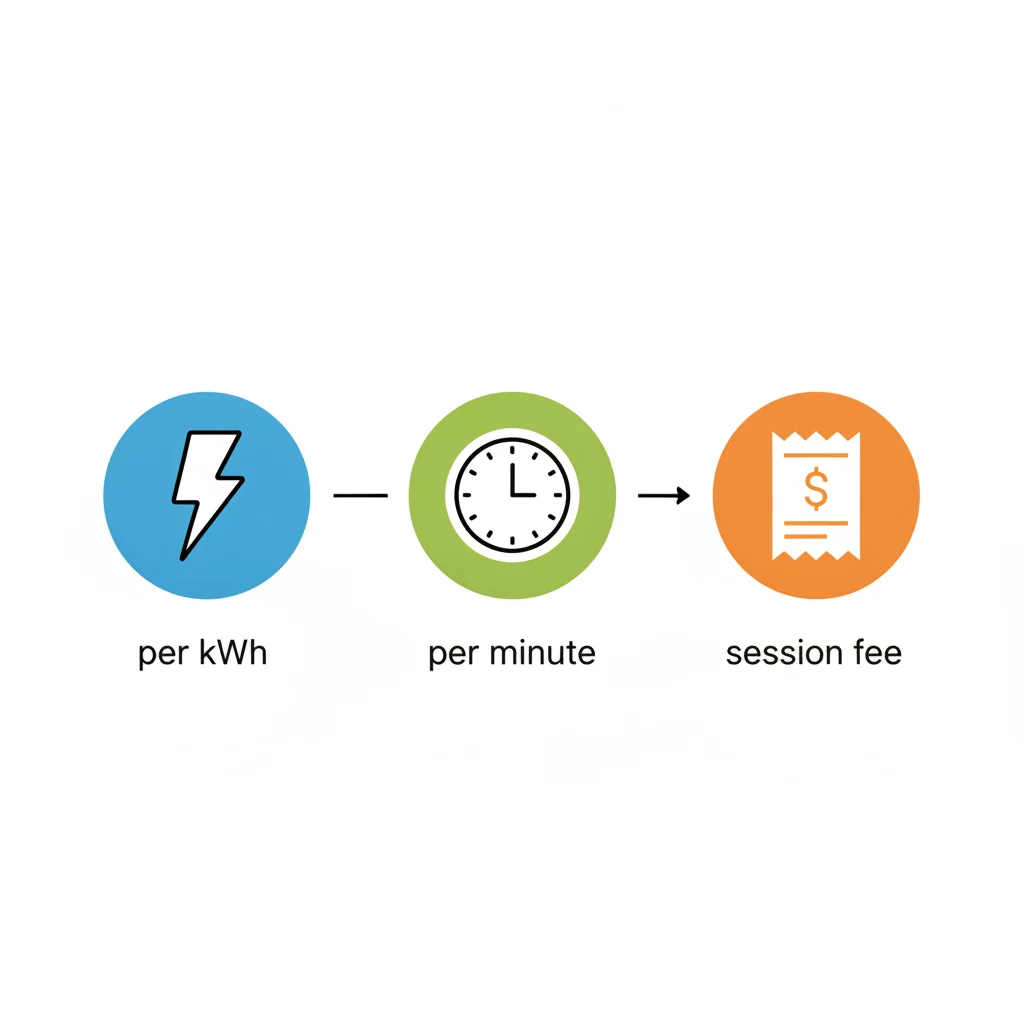
A charging pricing model is the method a public EV charging network uses to calculate what you owe for a session. The three primary models are per-kilowatt-hour (energy delivered), per-minute (time connected), and flat session fees. Networks may combine these approaches or layer in membership discounts that change the effective rate.
State utility regulations in some jurisdictions prohibit non-utilities from selling electricity by the kWh, which is why per-minute billing persists even when it disadvantages drivers with slower-charging vehicles.
The Three Core Models That Power Public Charging Bills
Walk up to a public EV charger in the United States and you might pay in three fundamentally different ways depending on the network, the state, and even the specific station. Understanding each model is the starting point for any smart charging decision — whether you're a daily commuter filling up at a Level 2 station or a road tripper hammering kilowatts at a 350-kW DC fast charger.
Per-Kilowatt-Hour (Energy-Based) Pricing
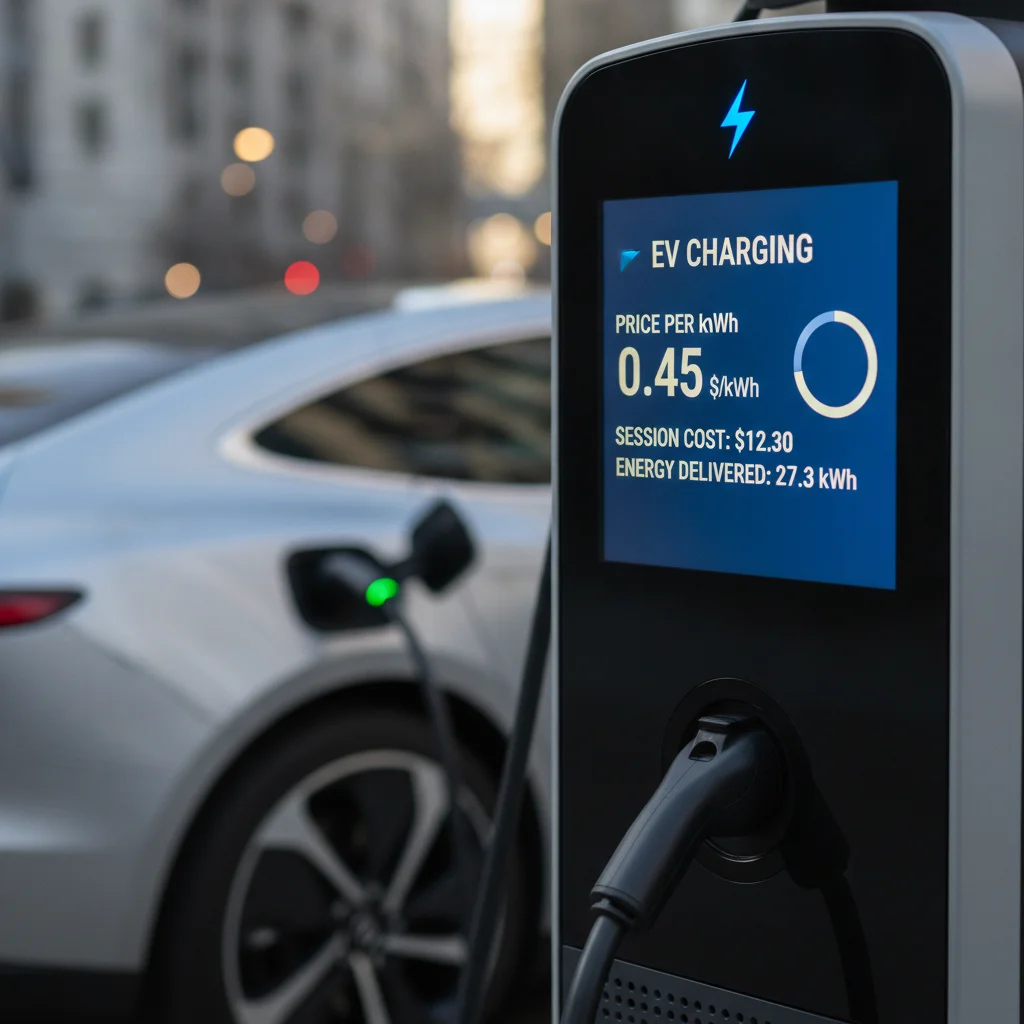
Per-kWh billing is the closest equivalent to paying for a gallon of gas. You pay for the energy your battery actually receives, expressed in kilowatt-hours. If your car accepts 20 kWh during a session and the rate is $0.35/kWh, you owe $7.00 — full stop. This model is the most intuitive and the most equitable because the cost is directly tied to the fuel you get.
Networks including Electrify America, EVgo, and Tesla Supercharger use per-kWh pricing in states where it is legally permitted. Rates vary considerably by location — Electrify America's non-member rate has ranged from roughly $0.43 to $0.48/kWh at DC fast chargers in recent data, while Tesla's Supercharger rates hover between $0.25 and $0.50/kWh depending on site and time of day.
For context on how these energy costs translate to real driving expenses, see our comparison of home versus public charging costs.
Per-Minute (Time-Based) Pricing
Per-minute billing charges you for the duration of your session, not the energy delivered. On the surface this seems straightforward, but it creates a significant equity problem: two cars plugged into the same 50-kW charger may charge at very different rates. A vehicle that accepts the full 50 kW gets about 50 kWh in an hour. One that's limited to 25 kW by its onboard charger gets only 25 kWh in the same time — yet both pay the same per-minute rate. The slower-charging vehicle effectively pays twice as much per kWh.
Some networks address this by tiering their per-minute rates based on the charger's power level. Blink, for example, has offered different minute-rates for Level 2 versus DC fast chargers. But even tiered time pricing doesn't account for variation within a power tier — or for the inevitable charge-rate taper that all lithium batteries experience as they approach full capacity.
$0.43–$0.48
Electrify America non-member DC fast-charge rate (per kWh)
Based on Electrify America's published 2024 pricing for pass customers at DC fast-charge stations in per-kWh states.
20–40%
Typical savings with a network membership vs. pay-as-you-go
Calculated by comparing member and non-member per-kWh rates across Electrify America, EVgo, and ChargePoint published rate cards.
~30 states
U.S. states now permitting per-kWh billing for charging networks
According to NCSL tracking data, the majority of states have updated or are updating statutes to allow energy-based EV charging billing as of 2024.
50%+
Charge rate reduction during battery taper above 80% SOC
Most lithium-ion EV batteries reduce peak DC fast-charge acceptance rate by at least half between 80% and 100% state of charge, significantly affecting per-minute billing efficiency.
3x
Public fast-charge cost vs. home charging (typical ratio)
Comparing average U.S. residential electricity rates (~$0.13/kWh) to average DC fast-charge network rates (~$0.40/kWh) in 2024.
Session Fees and Hybrid Models
A flat session fee — a fixed charge simply for initiating a connection — rarely stands alone as the primary billing model. More often, it's layered on top of per-kWh or per-minute rates as a connection or access fee. ChargePoint, which operates a large network of Level 2 workplace and public chargers, historically allowed station hosts to set their own pricing, including session fees. This host-controlled model means two ChargePoint stations a mile apart can charge very differently for the same energy.
Hybrid models — most commonly a combination of a session fee plus per-kWh or per-minute rates — are growing. They let networks recoup fixed station costs regardless of how much energy is dispensed, which matters at low-utilization sites where a driver might plug in for hours on a slow Level 2 charger. Travelers planning routes around charger availability should review a side-by-side breakdown of major networks' pricing structures before departure.
Why State Regulations Shape What You Pay
One of the most confusing aspects of U.S. public charging pricing is that the same network can bill you differently depending on which state you're in — not because of business choice alone, but because of utility law. In states that classify retail electricity sales as a regulated utility activity, charging networks cannot legally sell electricity by the kilowatt-hour without holding a utility license. The practical result: those networks bill for time instead of energy, even when energy-based billing would serve drivers better.
State Utility Laws Still Dictate Billing in Some Markets
In states that classify electricity sales as a regulated utility activity, charging networks may be legally prohibited from billing per kilowatt-hour without a utility license. As a result, some network stations in those states default to per-minute billing regardless of what the network uses elsewhere. Before a trip, verify the billing method for your specific stop in the network's app — it will display the local rate structure, not just the national default.
States that have historically required time-based billing include Texas, which has since updated its statutes to permit per-kWh sales by charging providers, and several others that are still working through the legislative process. The National Conference of State Legislatures tracks this evolving patchwork, and the result is that a driver using Electrify America might pay per-kWh in California and per-minute in a neighboring state — for the same hardware, the same vehicle, and a nearly identical amount of energy.
The practical implication for drivers: if you're crossing state lines on a road trip, your charging cost assumptions from home may not hold. Always check the network's app for location-specific rates before plugging in. For a deeper look at how these regulatory differences affect real costs at DC fast chargers, see what DC fast charging actually costs.
Membership Plans: When Paying to Save Actually Makes Sense
Every major U.S. charging network offers some form of membership or subscription that reduces per-session costs. The math works only if you use public charging often enough to recoup the monthly fee — but for regular public charger users, that threshold arrives quickly.
How the Numbers Stack Up
Electrify America's Pass+ membership costs $4/month and drops the DC fast-charge rate from roughly $0.48/kWh to $0.31/kWh as of recent pricing. A driver who adds 200 kWh per month at Electrify America stations saves about $34 in energy costs — more than $30 net after the membership fee. At just 100 kWh per month, savings still exceed $13 net. The break-even point is roughly 24 kWh of monthly fast-charge use — less than a single full charge on most mid-range EVs.
EVgo's membership structure works similarly, offering reduced per-minute or per-kWh rates (depending on state) for a monthly subscription. Tesla's approach differs: Supercharger rates are effectively a built-in benefit tiered by whether you drive a Tesla or a non-Tesla vehicle, with no explicit membership layer for most drivers.
Match Your Membership to Your Actual Charging Habits
Before subscribing to any network's paid plan, export your last 90 days of charging session history and tally kWh by network. Most drivers cluster 80% or more of their public charging on one or two networks. A targeted single-network membership almost always beats hedging across multiple subscriptions. Review your network app's account history — this data is typically available under session logs or billing history.
Stop at 80% to Minimize Per-Minute Costs
If you're on a per-minute-billed network, ending your session at 80% state of charge rather than 100% can dramatically reduce your effective cost per kWh. Battery charge rates taper sharply above 80%, meaning you spend proportionally more time (and money) gaining smaller increments of range. The last 20% of charge on a DC fast charger can cost two to three times more per kWh than the first 60%.
Beware of Overlapping Memberships
A common mistake is subscribing to multiple network memberships simultaneously. If you primarily use one network's corridor for highway travel but occasionally use another, the second membership may cost more than it saves. Map your actual charging locations over 60–90 days before committing to any subscription. Network apps make this straightforward — most show your session history with per-kWh breakdowns. The top charging network app comparison is worth reviewing to understand which apps surface this data most clearly.
Idle Fees, Demand Charges, and the Costs You Don't See at the Pump
Beyond the headline per-kWh or per-minute rate, two additional cost mechanisms shape public charging economics — one affecting individual drivers directly, the other embedded in network pricing more broadly.
Idle Fees
Idle fees are per-minute charges that activate after your vehicle reaches full charge but remains connected to the station. Their purpose is practical: at busy stations, a fully charged car blocking a charger imposes a real cost on the next driver in queue. Most major networks trigger idle fees only when the station is at capacity, not when it's empty — so parking overnight on a dead charger at 2 a.m. typically won't cost you extra on a quiet network. At peak highway rest stops on a holiday weekend, however, idle fees of $0.40–$1.00 per minute can accumulate quickly.
The operational fix is simple: set a charge-complete notification in your vehicle or network app and return to the car promptly when it alerts you. Understanding these fees is part of the broader literacy covered in key EV charging cost terms every owner should know.
Demand Charges: The Hidden Infrastructure Cost
Demand charges are the fees commercial electricity customers pay for their peak power draw in a billing period, and they're a significant — often dominant — cost for DC fast-charging station operators. A single 350-kW charger pulling maximum power even briefly can trigger a substantial demand charge from the utility. Networks absorb this cost in their per-kWh or per-minute rates, meaning that the apparent simplicity of a $0.40/kWh rate hides a complex cost structure underneath.
This is one reason why DC fast-charge rates at public networks are substantially higher than residential electricity rates. A driver paying $0.40/kWh at a public fast charger versus $0.13/kWh at home isn't just paying for convenience — they're paying for the charger hardware, the network infrastructure, the network operator's margin, and a portion of the demand charges their charger incurs. The comparison between home charging infrastructure and public networks becomes clearer when these embedded costs are factored in.
“The complexity of public charging pricing isn't accidental — it reflects a genuine tension between utility regulation, network economics, and what's fairest to the driver. Until state laws uniformly allow per-kWh sales, no single model will be equitable everywhere.”
— Levi Tillemann, EV policy researcher and author on electric vehicle infrastructure
How to Calculate Your True Cost Per Mile at Any Charger
The most useful single metric for comparing charging options across different pricing models is cost per mile. It cuts through the complexity of different billing structures and gives you a number directly comparable to gasoline's cost per mile.
The Formula
The calculation requires two inputs: the cost per kWh (converted from time-based billing if necessary) and your vehicle's efficiency in miles per kWh.
- For per-kWh billing: Divide the rate by your vehicle's efficiency. At $0.40/kWh with a vehicle rated at 3.5 miles/kWh: $0.40 ÷ 3.5 = $0.114 per mile.
- For per-minute billing: Estimate your vehicle's actual charge rate in kW at that station type, calculate kWh per hour, then divide the per-minute rate accordingly. A vehicle charging at 50 kW on a 50 kW charger gets 50 kWh/hour. At $0.20/min ($12/hour), effective rate is $12 ÷ 50 kWh = $0.24/kWh — then apply the efficiency formula above.
- Adjust for charge rate taper: If you're charging from 10% to 80%, your vehicle likely holds near peak rate. From 80% to 100%, the rate may drop by 50% or more — making per-minute billing in that range significantly more expensive per kWh delivered.
Match Your Membership to Your Actual Charging Habits
Before subscribing to any network's paid plan, export your last 90 days of charging session history and tally kWh by network. Most drivers cluster 80% or more of their public charging on one or two networks. A targeted single-network membership almost always beats hedging across multiple subscriptions. Review your network app's account history — this data is typically available under session logs or billing history.
Stop at 80% to Minimize Per-Minute Costs
If you're on a per-minute-billed network, ending your session at 80% state of charge rather than 100% can dramatically reduce your effective cost per kWh. Battery charge rates taper sharply above 80%, meaning you spend proportionally more time (and money) gaining smaller increments of range. The last 20% of charge on a DC fast charger can cost two to three times more per kWh than the first 60%.
Most current-generation EVs display real-time charge rate in kW in their instrument cluster or companion app, giving you the data to perform this calculation in the field. For strategies on using off-peak pricing windows to drive this number down further, see how off-peak charging practices lower your bills. A full exploration of charging cost and savings strategies is also available for drivers looking to optimize their entire charging routine.
A Quick Comparison Across Models
| Pricing Model | Typical Rate | Effective kWh Rate* | Cost Per Mile* |
|---|---|---|---|
| Per-kWh (Electrify America, member) | $0.31/kWh | $0.31/kWh | ~$0.089 |
| Per-kWh (Electrify America, non-member) | $0.48/kWh | $0.48/kWh | ~$0.137 |
| Per-minute (50 kW station, vehicle at full rate) | $0.16/min | ~$0.19/kWh | ~$0.054 |
| Per-minute (50 kW station, vehicle at half rate) | $0.16/min | ~$0.38/kWh | ~$0.109 |
| Session fee + per-kWh (hybrid model) | $1.00 + $0.25/kWh | Varies by session size | Varies |
All claims are backed by peer-reviewed research. Sources on request.