| Energy unit for charging bills | Kilowatt-hour (kWh) |
| Typical home electricity rate | $0.10–$0.20/kWh (U.S. Energy Information Administration, 2024) |
| Typical public DC fast charger rate | $0.28–$0.50/kWh (AFDC / network operator pricing, 2024) |
| Energy equivalent of 1 gallon of gas | 33.7 kWh (EPA MPGe standard) |
| Average BEV efficiency range | 2.5–4.5 mi/kWh (EPA fuel economy data, 2023–2024 model year) |
| Recommended daily charge ceiling | 80% SOC (Standard automaker guidance for battery longevity) |
| Level 2 home charger power output | 7–19.2 kW |
| DC fast charger range | 50–400 kW |
| Off-peak TOU rate savings vs. flat rate | Up to 50% (Based on utility TOU tariff comparisons, multiple states) |
| Typical idle fee range | $0.40–$1.00/min (ChargePoint, Electrify America, EVgo published rates) |
Why Charging Terminology Directly Affects Your Wallet
Most EV owners discover the hard way that plugging in is not as simple as filling a tank. The cost of a single charging session depends on at least half a dozen variables — and most of them have names that mean nothing to someone who has spent decades buying gasoline by the gallon. A network charges by the minute at a DC fast charger. Your utility bills you in kilowatt-hours. Your lease contract references EPA-rated efficiency. Each of those systems uses its own vocabulary, and when you do not speak the language, you cannot comparison-shop effectively.
This reference glossary covers the terms that directly govern what you pay to charge, whether you are topping off at home overnight or paying per minute at a highway corridor charger. Definitions are organized by concept cluster — energy and power, efficiency, billing structures, and charging hardware — so you can quickly find what you need.
For a broader introduction to how EVs work before diving into cost terms, see our plain-language EV primer. If you want a fuller 40-term glossary that also covers drivetrain and battery hardware language, EV Terminology Glossary: 40 Terms Every Buyer Should Know is a useful companion reference.
| Energy unit for charging bills | Kilowatt-hour (kWh) |
| Typical home electricity rate | $0.10–$0.20/kWh (U.S. Energy Information Administration, 2024) |
| Typical public DC fast charger rate | $0.28–$0.50/kWh (AFDC / network operator pricing, 2024) |
| Energy equivalent of 1 gallon of gas | 33.7 kWh (EPA MPGe standard) |
| Average BEV efficiency range | 2.5–4.5 mi/kWh (EPA fuel economy data, 2023–2024 model year) |
| Recommended daily charge ceiling | 80% SOC (Standard automaker guidance for battery longevity) |
| Level 2 home charger power output | 7–19.2 kW |
| DC fast charger range | 50–400 kW |
| Off-peak TOU rate savings vs. flat rate | Up to 50% (Based on utility TOU tariff comparisons, multiple states) |
| Typical idle fee range | $0.40–$1.00/min (ChargePoint, Electrify America, EVgo published rates) |
Energy and Power: The Foundation of Every Charging Bill
The single most common source of confusion for new EV owners is conflating energy with power. They are related but distinct concepts, and the units attached to each — kilowatt-hours versus kilowatts — appear on almost every charging invoice and utility statement you will ever receive.
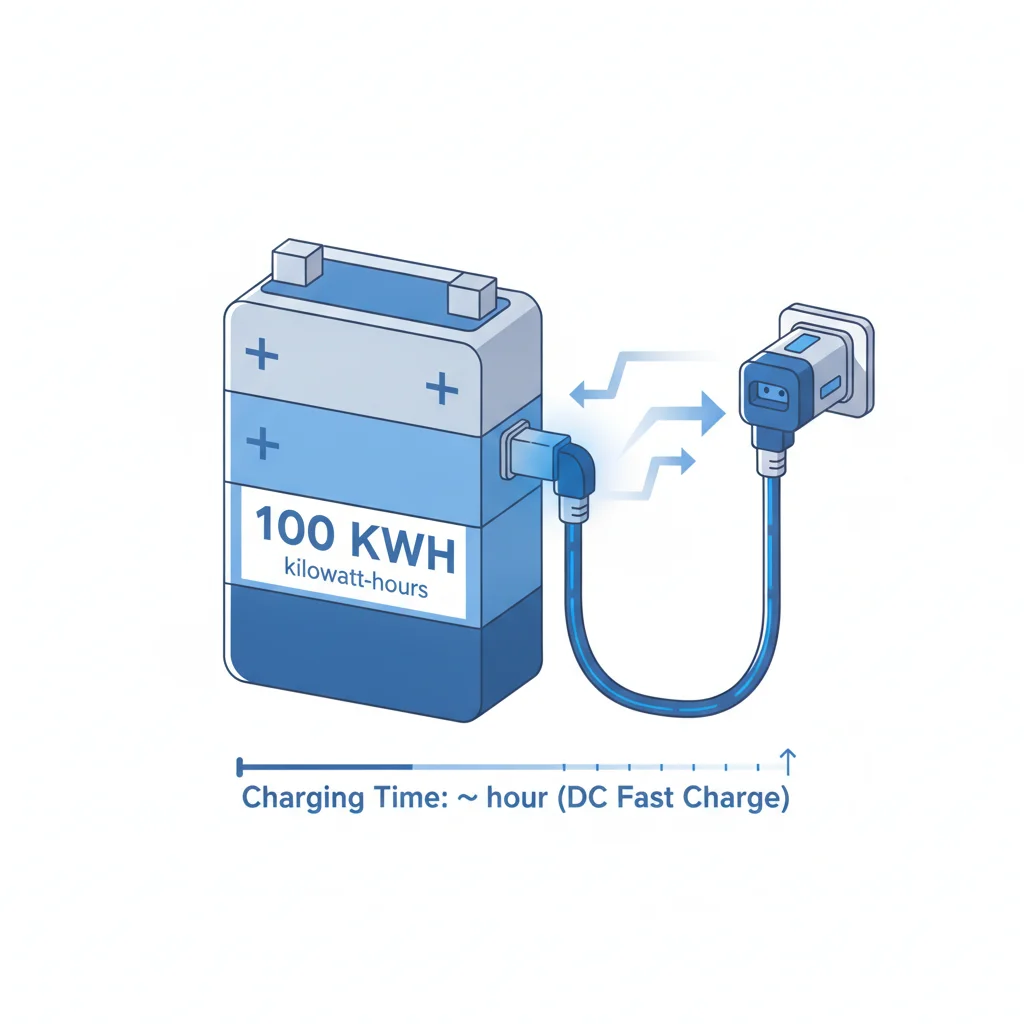
Kilowatt-Hour (kWh)
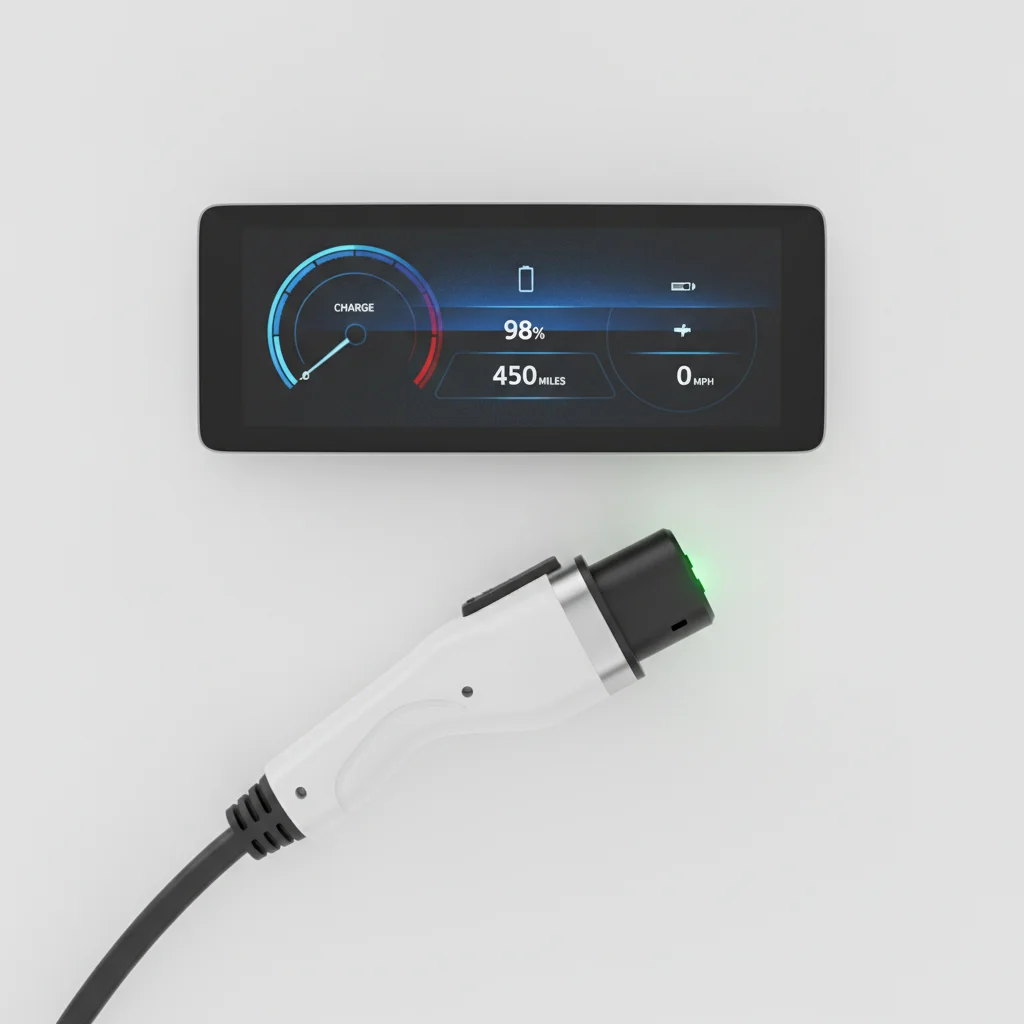
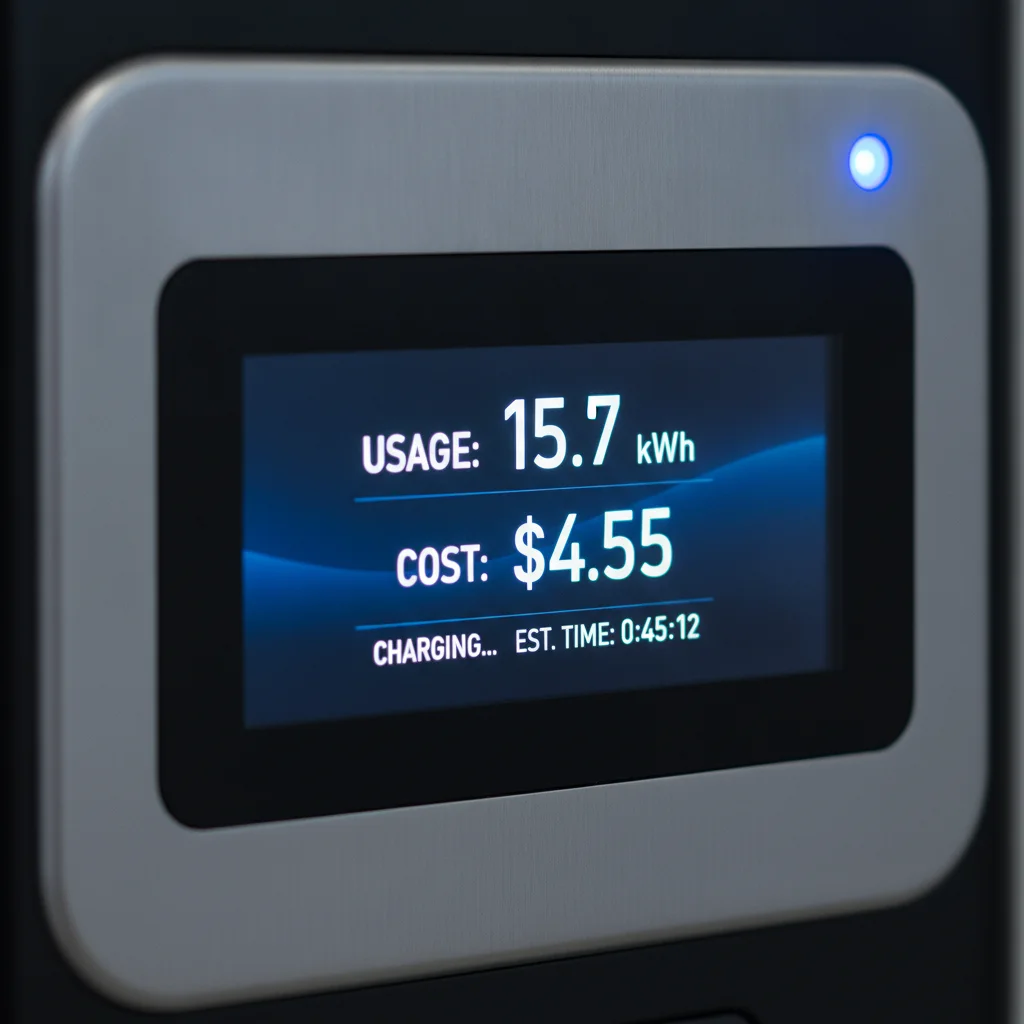
A kilowatt-hour is a unit of energy equal to the work done by one kilowatt of power sustained for one hour. When your utility bill says you consumed 350 kWh last month, it means you used 350 units of electrical energy. When an EV's battery pack is described as having an 82 kWh capacity, that is the total energy it can store — roughly analogous to the gallon capacity of a gas tank. Home charging is almost universally billed in kWh, typically at a flat rate between $0.10 and $0.20 per kWh depending on your state and utility.
Kilowatt (kW)
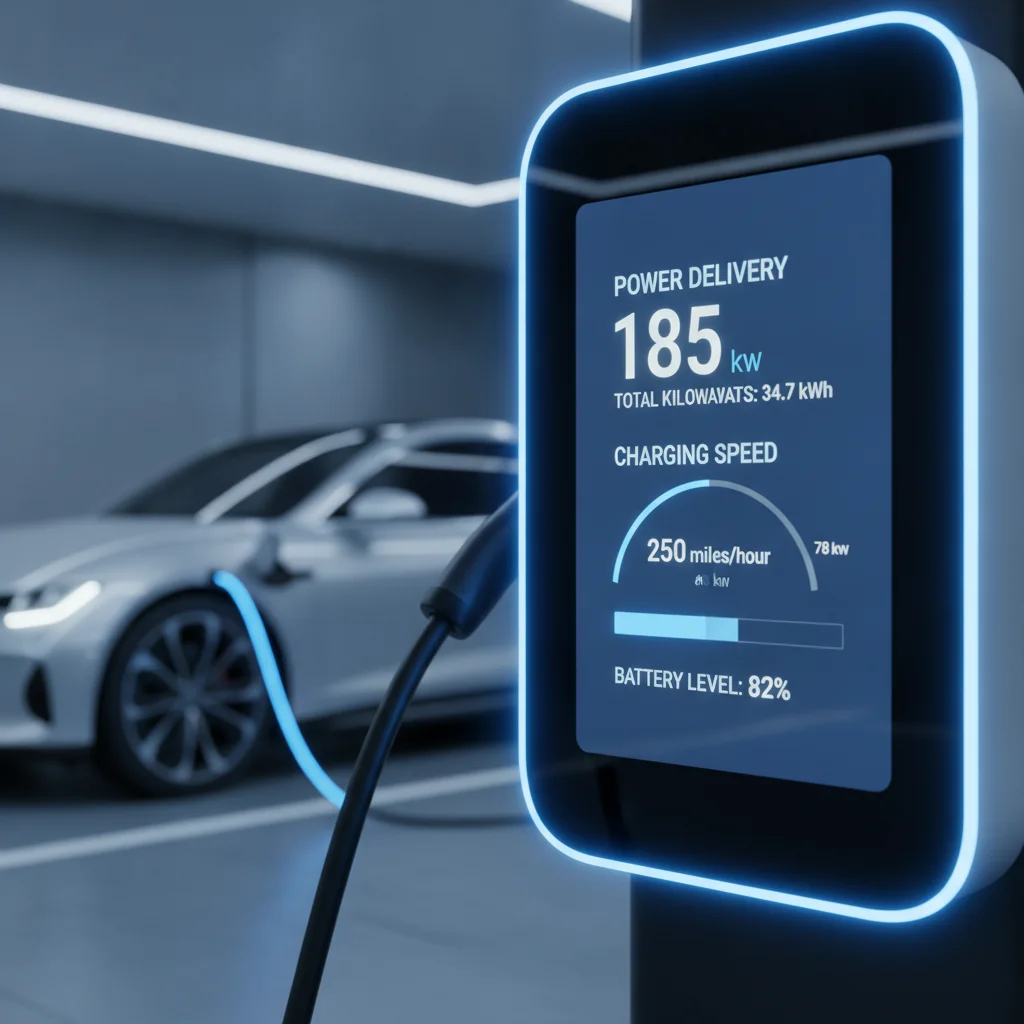
A kilowatt is a unit of power — the rate at which energy is transferred at any given moment. Your home Level 2 charger may deliver 7.2 kW continuously. A highway DC fast charger might peak at 150 kW or 350 kW. Higher kilowatt ratings mean faster charging, but they do not change the total energy delivered — they just deliver it more quickly. Think of kW as the pipe diameter and kWh as the total volume of water that flows through.
State of Charge (SOC)
State of charge is the battery's current energy level expressed as a percentage of its total capacity. An SOC of 80% on an 82 kWh pack means approximately 65.6 kWh of usable energy remains. Most automakers recommend charging to 80% SOC for daily use to preserve long-term battery health, reserving 100% charges for long trips. Charging speed — especially at DC fast chargers — slows significantly above 80% SOC because the battery management system throttles input to protect cells.
Usable vs. Total Battery Capacity
Automakers do not allow access to 100% of a battery's rated capacity. A portion — typically 5–15% — is held in reserve at both the top and bottom of the charge curve to prevent the electrochemical stress that degrades cells. A vehicle marketed with a 100 kWh battery may have only 87–95 kWh of usable capacity. EPA range ratings are based on usable capacity, so range estimates are internally consistent, but comparing raw battery size numbers across models can be misleading without knowing each model's buffer.
Kilowatt-Hour (kWh)
A unit of energy equal to one kilowatt of power sustained for one hour. Used to measure both battery capacity and the amount of electricity consumed during a charging session. Home charging is billed in kWh.
Kilowatt (kW)
A unit of power measuring the rate of energy transfer. Charging station power ratings are expressed in kW — higher kW means faster charging. Not to be confused with kWh, which measures total energy delivered.
MPGe
Miles Per Gallon Equivalent — the EPA's metric for comparing EV efficiency to gasoline vehicles. Based on 33.7 kWh being energetically equivalent to one gallon of gasoline. Useful for window-sticker comparisons but not for calculating actual charging costs.
Miles Per kWh (mi/kWh)
The most practical EV efficiency metric for calculating per-mile fuel costs. Dividing your electricity rate by your vehicle's mi/kWh rating yields your cost per mile driven.
State of Charge (SOC)
The battery's current energy level as a percentage of total capacity. DC fast charging speed slows significantly above 80% SOC as the battery management system throttles input to protect cells.
Demand Charge
A utility billing component based on peak power draw in kilowatts during a billing period, separate from total energy consumed. Demand charges significantly affect public fast charger operating costs and are often passed to consumers through higher session rates.
Time-of-Use (TOU) Rate
A utility pricing structure where electricity rates vary by time of day. Off-peak overnight rates are lowest and represent the optimal window for home EV charging, often reducing annual charging costs by 30–50%.
Onboard Charger (OBC)
The converter built into an EV that transforms AC power from Level 1 and Level 2 sources into DC power for the battery. Its kilowatt rating sets the maximum Level 2 charging speed regardless of what the external EVSE can deliver.
EVSE
Electric Vehicle Supply Equipment — the technically correct term for what is commonly called a charger or charging station. The EVSE manages safe power delivery; the actual AC-to-DC conversion happens inside the vehicle's onboard charger.
Charge Rate Taper
The intentional reduction in charging speed as a battery approaches full capacity, especially above 80% SOC. Taper protects battery cells from heat and stress and is why DC fast charging sessions slow dramatically in the final portion of a charge.
Idle Fee
A per-minute charge applied when a vehicle remains connected to a charging station after the session completes. Designed to free up stalls for other drivers, not generate significant revenue. Typically $0.40–$1.00 per minute.
Usable Battery Capacity
The portion of a battery's total rated capacity that is accessible to the driver. Automakers reserve 5–15% at both ends of the charge curve to protect battery health, so usable capacity is always less than the marketed total capacity figure.
Efficiency Ratings: Translating Energy Into Miles
Efficiency determines how far a given amount of energy takes you, which in turn determines your real-world per-mile fuel cost. Three different units are in common use, and each tells a slightly different story.
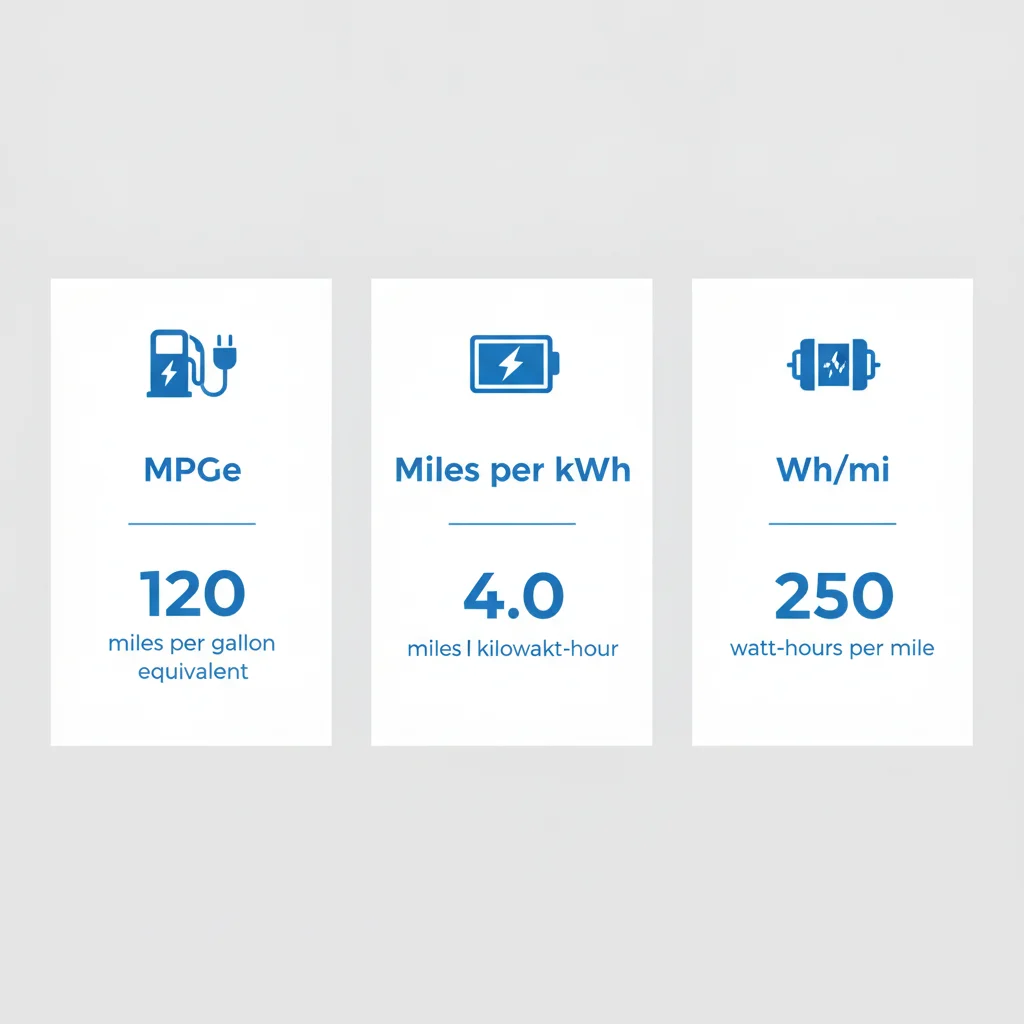
MPGe (Miles Per Gallon Equivalent)
MPGe is the EPA's standardized efficiency metric for electrified vehicles. It converts electrical energy consumption into a gasoline-equivalent number using the energy content of one gallon of gasoline — 33.7 kWh. An EV rated at 100 MPGe consumes roughly 33.7 kWh to travel 100 miles. The metric exists primarily to give consumers a familiar reference point for comparing EVs to conventional vehicles on the window sticker. It is less useful for calculating actual charging costs than miles per kWh. See EV Efficiency Units Decoded for a detailed breakdown of when each unit is most practical.
Miles Per kWh (mi/kWh)
Miles per kWh is the most direct way to calculate what you pay per mile driven. If your EV averages 4 mi/kWh and your home electricity rate is $0.14/kWh, your fuel cost is $0.035 per mile — about $3.50 per 100 miles. The EPA publishes miles-per-kWh ratings for every EV; combined ratings typically range from about 2.5 mi/kWh for heavier SUVs and performance variants to over 4.5 mi/kWh for efficiency-optimized sedans.
Wh/mi (Watt-Hours Per Mile)
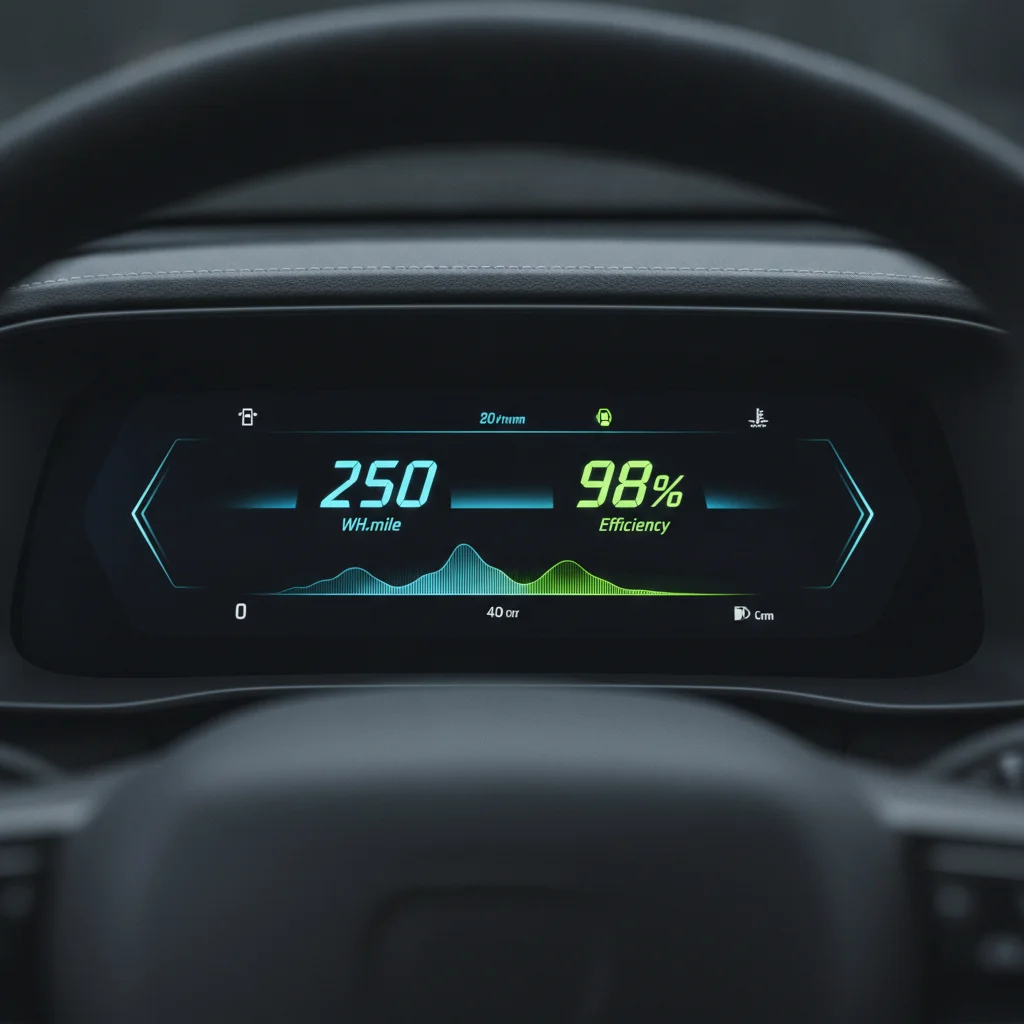
Watt-hours per mile is the inverse of miles per kWh and is the unit most commonly used in engineering contexts and on some in-vehicle efficiency displays. A vehicle consuming 250 Wh/mi is using a quarter of a kilowatt-hour for every mile — equivalent to 4 mi/kWh. Lower Wh/mi numbers indicate better efficiency. Many EV dashboards display real-time Wh/mi so you can see how driving style, climate, and terrain affect consumption instantaneously.
EPA Range Rating
The EPA range rating is the official estimated range on a full charge under a standardized drive cycle. It is derived from the combined city/highway efficiency rating multiplied by usable battery capacity. Real-world range routinely deviates from the EPA figure — cold weather, highway speeds, and heavy climate control use can reduce range by 15–40%. The EPA rating is a useful comparative benchmark, not a guarantee. For a deeper look at vehicle classifications that affect range expectations, visit EV Types Explained.
~$0.035
Cost per mile charging at home (off-peak)
Based on 4 mi/kWh efficiency and a $0.14/kWh average residential rate — roughly one-third the per-mile cost of a 30 MPG gasoline vehicle at $3.50/gallon.
15–40%
Real-world range reduction vs. EPA rating
Cold weather, highway speeds, and heavy HVAC use routinely reduce range below the EPA estimate, according to data from AAA and Consumer Reports testing.
30–70%
Share of commercial charging costs from demand charges
Rocky Mountain Institute and NRDC analyses show demand charges constitute the majority of electricity costs for public fast charging operators, driving up consumer rates.
5x
Cost multiplier: DC fast charging vs. home off-peak
Charging exclusively at public DC fast chargers at $0.45/kWh versus overnight at $0.09/kWh can increase per-mile fuel costs by up to five times for the same vehicle.
80%
SOC threshold where DC fast charge speed begins to taper
Most EV battery management systems begin throttling DC fast charge input at 80% SOC, making the 80–100% segment significantly slower and less cost-efficient per mile added.
Charging Levels, Speeds, and Hardware Terms
The physical infrastructure you use to charge carries its own vocabulary. Understanding it helps you interpret charging network pricing, plan road trips accurately, and make smarter decisions about home charging equipment.
Level 1, Level 2, and DC Fast Charging (DCFC)
These three designations describe the voltage and power tier of a charging session. Level 1 uses a standard 120V household outlet and delivers roughly 1.2–1.8 kW — enough to add 3–5 miles of range per hour, suited only for PHEVs or short daily-use BEVs. Level 2 uses 240V and a dedicated circuit, delivering 7–19.2 kW and adding 20–60 miles per hour depending on the vehicle's onboard charger capacity. DC fast charging bypasses the onboard AC-to-DC converter and delivers direct current at 50–400 kW, adding 100–200+ miles in 20–30 minutes on compatible vehicles. See Charging Speed Ratings Demystified for a complete breakdown of what kilowatt ratings mean for real-world charging time.
Onboard Charger (OBC)
The onboard charger is the converter built into the vehicle that transforms AC power from Level 1 and Level 2 sources into the DC power the battery stores. It is rated in kilowatts — a vehicle with a 7.2 kW onboard charger cannot charge faster than 7.2 kW even if it is connected to a 19.2 kW Level 2 station. Onboard charger capacity is a frequently overlooked spec that determines your practical maximum Level 2 charging speed at home and at public AC stations.
EVSE (Electric Vehicle Supply Equipment)
EVSE is the technically precise term for what most people call a charger or charging station. The EVSE is the equipment that delivers power safely to the vehicle — it is not itself a charger in the electrical sense; the onboard charger does the actual conversion. Distinguishing between the EVSE and the onboard charger matters when troubleshooting charging speed issues. What Is an EVSE and Why Does the Terminology Matter? covers this distinction in depth.
Charge Rate Taper
Charge rate taper refers to the intentional reduction in charging speed as a battery approaches full capacity, particularly above 80% SOC. The battery management system reduces current input to prevent overheating and electrochemical stress. Taper is why DC fast charging sessions that begin at 150 kW may slow to 50 kW or less in the final 20% of charge. Planning to charge to 80% on road trips rather than 100% keeps you in the fast part of the charge curve and reduces total stop time.
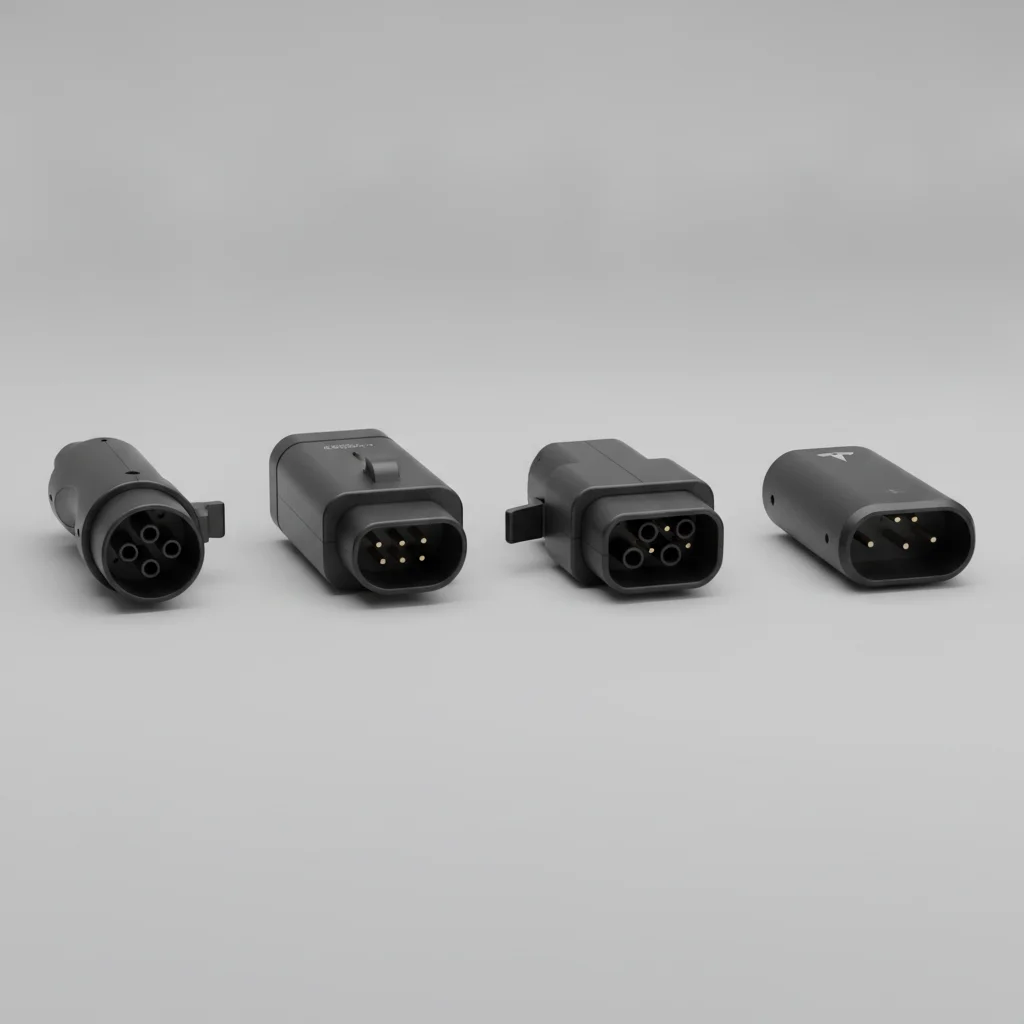
Plug Standards: CCS, CHAdeMO, NACS, J1772
North America currently uses several plug standards. J1772 (also called the J-plug) is the universal AC connector for Level 1 and Level 2 charging and is compatible with nearly all non-Tesla EVs. CCS (Combined Charging System) adds DC fast-charging pins to the J1772 connector and has been the dominant DC standard for non-Tesla vehicles. CHAdeMO is an older DC standard used primarily by Nissan and Mitsubishi. NACS (North American Charging Standard), originally developed by Tesla, is now being adopted as the industry-wide standard by most major automakers, with physical adapters available for transitional models. Knowing your vehicle's connector type determines which public networks and charge speeds are available to you.
NACS Transition Is Still in Progress
As of 2024–2025, the industry transition from CCS to NACS (North American Charging Standard) is underway but not complete. Many new model year vehicles ship with NACS ports, while older EVs use CCS and require an adapter for NACS-equipped stations. Before a road trip, confirm your vehicle's connector type and whether your planned charging network supports it natively or via adapter.
Per-Minute vs. Per-kWh Laws Vary by State
Several states — including California, Colorado, and Illinois — have enacted laws requiring public charging stations to offer per-kWh pricing, arguing it is more transparent and fair. Other states allow per-minute billing. When evaluating session costs across networks, check your state's regulations, as the billing model you encounter at a highway fast charger may be legally mandated rather than a network choice.
Efficiency Ratings Are Based on Temperate Conditions
EPA efficiency and range ratings are conducted at approximately 75°F (24°C). In cold climates, lithium-ion batteries lose both capacity and charge acceptance rate, and cabin heating draws significant energy. Some automakers publish cold-weather range estimates; where they do not, independent testing by organizations like AAA provides useful real-world cold-weather benchmarks.
Billing Structures: How Charging Networks and Utilities Charge You
The same physical charging session can be priced in three entirely different ways depending on where you charge and who is billing you. Understanding each billing model is essential to comparing the true cost across locations.
Per-kWh Pricing
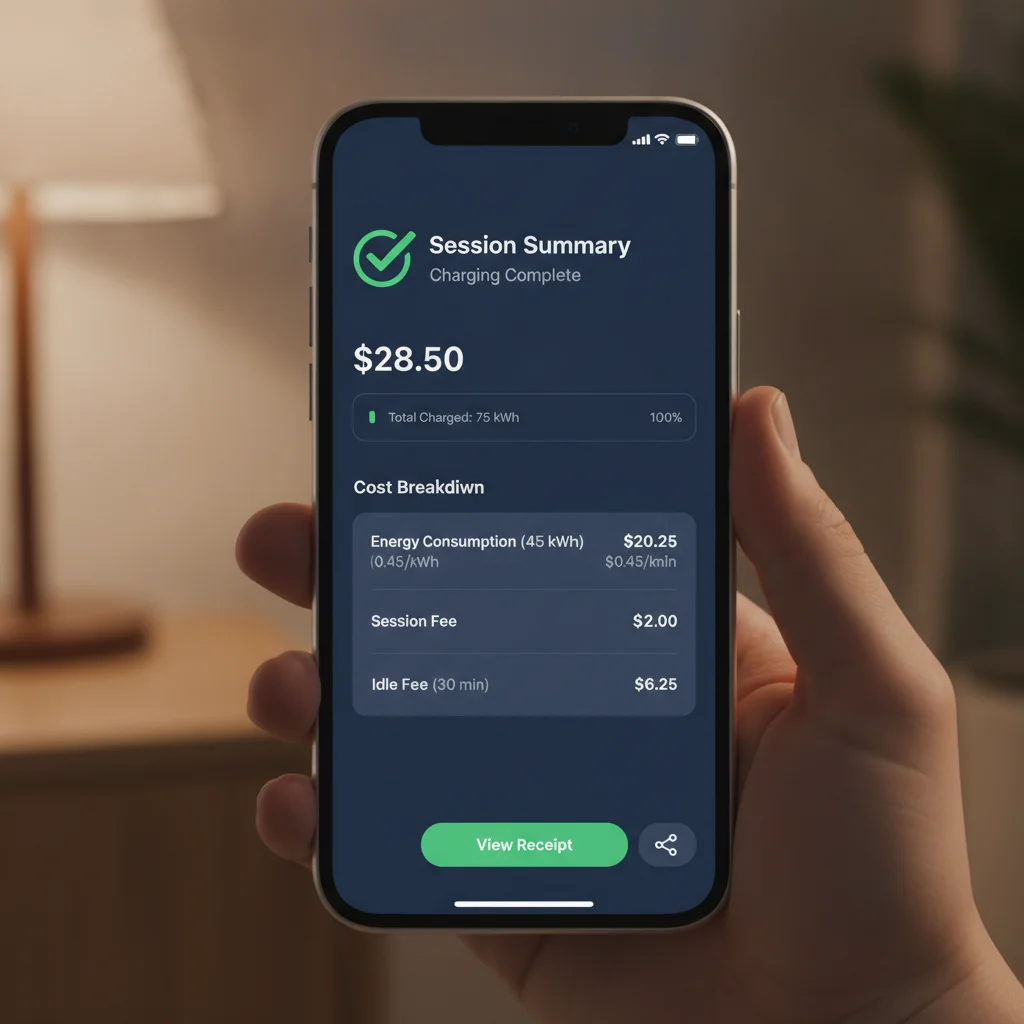
Per-kWh pricing charges you for the actual energy delivered, measured in kilowatt-hours. This is the most transparent billing model because it directly reflects consumption — you pay for what you use, just like a gasoline pump charges by the gallon. Many states require public charging networks to bill per kWh; others do not, which is why networks sometimes use alternative models. Per-kWh rates at public DC fast chargers typically range from $0.28 to $0.50/kWh — significantly higher than home rates, but still often cheaper per mile than gasoline for most vehicles.
Per-Minute Pricing
Per-minute pricing charges based on time connected, regardless of how much energy is delivered. This model penalizes vehicles with slower onboard chargers or those in the slow upper portion of the charge curve. A vehicle charging at 250 kW pays the same per minute as one charging at 50 kW at the same station. Per-minute pricing typically uses tiered rates — a lower rate below 60 kW and a higher rate above — to partially account for speed differences. Always check whether a network uses per-kWh or per-minute billing before comparing session costs.
Session Fee
A session fee is a flat charge applied per charging session, independent of energy consumed or time spent. Some networks add a small session fee (typically $0.99–$2.00) on top of per-kWh or per-minute rates. Others use session fees as the sole billing mechanism at lower-power Level 2 stations where metering is impractical. Session fees favor high-consumption users and penalize those who only need a small top-off.
Demand Charge
A demand charge is a utility billing component based on your peak power draw during a billing period, measured in kilowatts, rather than total energy consumed. Commercial charging station operators frequently face demand charges that can constitute 30–70% of their electricity bill, and many pass those costs through to consumers via higher per-kWh rates or session fees. Residential demand charges are rare but are being piloted by some utilities in states with high grid stress. Understanding demand charges is central to interpreting why public fast charging costs what it does. For a full walkthrough of how demand charges appear on utility statements, see The EV Owner's Guide to Reading an Electricity Bill.
Time-of-Use (TOU) Rate
A time-of-use rate is a utility pricing structure in which electricity costs vary by time of day, reflecting grid demand. Off-peak hours — typically overnight between 9 p.m. and 6 a.m. — carry lower rates, sometimes as low as $0.05–$0.09/kWh. On-peak hours in afternoon and early evening can reach $0.30–$0.45/kWh in high-cost states. Most EV owners on TOU plans schedule overnight charging to capture the lowest rates, which can reduce annual home charging costs by 30–50% compared to a flat rate. Many utilities offer EV-specific TOU tariffs with even lower off-peak rates.
Idle Fee
An idle fee — sometimes called an overstay fee — is charged when a vehicle remains connected to a charging station after the session is complete, occupying the stall without actively charging. Most major networks begin idle fees when the vehicle reaches 90–100% SOC or after a brief grace period. Rates typically range from $0.40 to $1.00 per minute. Idle fees are designed to encourage turnover at busy stations, not to generate revenue. Monitoring your charge via a mobile app and unplugging promptly avoids these charges.
Network Membership / Subscription Fee
Many public charging networks offer membership plans that reduce per-kWh or per-minute rates in exchange for a monthly subscription fee. Evaluating whether a membership pays off requires estimating your monthly session count and energy consumption at that network's stations. For frequent long-distance travelers who use one network heavily, memberships can yield meaningful savings. For occasional users, the break-even point may require more sessions per month than is realistic.
U.S. DOE Alternative Fuels Station Locator
The AFDC's interactive map lets you search public charging stations by connector type, network, and charge level. Useful for planning routes and identifying which billing models and connectors you will encounter.
EPA Fuel Economy Guide — EVs
The EPA's official fuel economy database lists MPGe, miles per kWh, and estimated annual fuel cost for every certified EV and PHEV. The primary authoritative source for efficiency comparisons.
PlugShare
A crowdsourced charging station database with user check-ins, real-world speed reports, and pricing updates. Particularly valuable for identifying current session costs that may differ from network-published rates.
Home Charging Cost Calculator (AFDC)
The Alternative Fuels Data Center's calculator estimates annual home charging costs based on your vehicle, local electricity rate, and daily mileage. Useful for projecting TOU rate savings.
Electrify America Pricing Page
A current reference for per-kWh and per-minute pricing tiers, membership plan rates, and idle fees at one of the largest public DC fast charging networks in the U.S.
EV Efficiency Units Decoded
<a href="/electric-vehicles/ev-basics/ev-range-efficiency/ev-efficiency-units-decoded-mpge-whmi-and-miles-per-kwh">This companion article</a> explains when to use MPGe, Wh/mi, and mi/kWh and walks through the math for converting between all three units.
Putting It All Together: Calculating Your True Cost Per Mile
Armed with these definitions, you can now calculate a per-mile fuel cost for any charging scenario — home, workplace, or public fast charger — and compare them directly. The formula is straightforward:
Cost per mile = (Rate per kWh) ÷ (Vehicle efficiency in mi/kWh)
For example: A vehicle rated at 3.8 mi/kWh charged at home on a TOU off-peak rate of $0.09/kWh costs $0.09 ÷ 3.8 = $0.024 per mile. The same vehicle charged at a DC fast charger billing $0.45/kWh costs $0.45 ÷ 3.8 = $0.118 per mile — nearly five times higher. For context, a 30 MPG gasoline vehicle at $3.50/gallon costs $0.117 per mile. That means leaning heavily on DC fast charging rather than home charging can eliminate the per-mile fuel cost advantage of owning an EV entirely.
Per-minute billing requires an extra step. If a network charges $0.26/min and your vehicle charges at an average of 100 kW during the session, you are paying $0.26/min × 60 min/hr ÷ 100 kW = $0.156/kWh equivalent. Plug that into the formula above to get cost per mile.
Real-world efficiency deviates from EPA ratings based on temperature, speed, and driving style — so treat any cost-per-mile figure as an estimate rather than a guarantee. Building a simple spreadsheet with your actual average efficiency and the rates at your most-used charging locations gives you a personalized and accurate picture of what you actually spend.
For other ownership cost vocabulary — including tax credit eligibility terms — see EV Tax Credit Glossary: Key Terms Every Buyer Should Know. And if you want to understand how automakers classify the different types of electrified vehicles — which affects which charging infrastructure applies to your specific model — How Automakers Classify Their Electrified Lineups is a useful next read.
All claims are backed by peer-reviewed research. Sources on request.