
Key Takeaways
Summary
28 items · 45–90 minutes to complete, spread across your first few weeks of ownership
Why Year One Is the Financial Make-or-Break Period
Switching to an electric vehicle promises lower operating costs — but that promise only materializes if you take deliberate steps in the first twelve months. Miss the window to enroll in a time-of-use rate plan, forget to claim a state rebate with a 90-day deadline, or skip the utility's EV charger incentive, and thousands of dollars evaporate quietly. The good news: every item on this checklist is within reach of any new EV owner willing to spend an afternoon on paperwork and settings.
This isn't a feel-good overview of EV savings. It's a working financial audit built around real deadlines, real dollar amounts, and real decisions you need to make before habits calcify. Think of it as the onboarding process your dealership never gave you.

Before diving into the checklist itself, two orientation points. First, the savings here are cumulative — no single item transforms your budget, but together they routinely add up to $1,500–$4,000 in year-one value for the average owner. Second, the checklist is organized by urgency: Act within 30 days, Set up within 90 days, and Optimize throughout year one. Work through them in that order.
For a broader map of available incentives before you start, our EV incentives primer lays out the federal, state, and utility landscape clearly. Return here once you know what programs exist in your area.
Tools and Accounts You'll Need
Running through this checklist requires a handful of accounts and documents. Gather them before you start so you're not hunting mid-task. Your utility account login is the single most important item — a surprising number of EV owners never set up online access, which means they miss rate-plan enrollment deadlines entirely.
Utility Company Online Account
Required to enroll in time-of-use rate plans, access EV rebate applications, and download monthly usage data for cost tracking.
EV Manufacturer App
Enables charge scheduling, battery state monitoring, remote pre-conditioning, and charging session cost history.
IRS Form 8936
The federal tax form required to claim the Clean Vehicle Credit; download from IRS.gov or confirm your tax software includes the latest version.
PlugShare or ABRP (A Better Route Planner)
Tracks public charging locations, real-world charging costs by network, and helps plan road trips to minimize fast-charging expenses.
Recurrent Auto
Provides free battery health reports for many EV models, giving you a documented baseline for warranty claims and eventual resale.
Google Sheets or Excel Spreadsheet
Simple tracking tool for logging monthly home charging costs, public charging spend, miles driven, and cost-per-mile calculations.
State DMV or Energy Office Website
Primary source for state EV rebate applications, eligibility requirements, and submission deadlines specific to your state.
MileIQ or TripLog
Automatically tracks business mileage if you use your EV for work, ensuring IRS-compliant records for deduction purposes.
A note on the EV manufacturer's app: beyond remote climate control, most automaker apps now show real-time charging costs, session history, and battery state-of-charge logs. That data is genuinely useful when you're trying to determine whether your rate plan is performing as expected. Get comfortable with the app early.
The Checklist
Work through each group sequentially. Items marked must have direct financial consequences if skipped. Items marked should are strongly recommended but allow some flexibility. Nice-to-have items add polish and long-term value without urgency.
Act Within 30 Days
Set Up Within 90 Days
Optimize Throughout Year One
End-of-Year Financial Review
TOU Plans Can Backfire Without a Schedule
Enrolling in a time-of-use rate plan raises your peak-hour electricity rate — sometimes to $0.35–$0.55/kWh — while making off-peak rates attractive. If your vehicle charges unscheduled during the day, you may end up paying significantly more than you would on a flat rate. Always configure your vehicle's built-in charge timer immediately after enrollment, and verify the schedule held after the first full billing cycle by checking your bill's usage breakdown.
State Rebate Deadlines Are Strict and Funds Are Limited
Most state EV rebate programs operate on first-come, first-served funding pools that exhaust mid-year. California's Clean Vehicle Rebate Project, for example, closed to new applications in 2023 when funds ran out. Check your state program's current funding status immediately after purchase, and submit applications before the 30- or 90-day purchase window closes. Extensions are rarely granted.
Complimentary Charging Credits Expire — Read the Fine Print
Manufacturer charging credits (such as Hyundai's three years of complimentary charging or Ford's included charging sessions) often require activation within 30–60 days of delivery and may expire if unused by a fixed calendar date. Review the terms in your purchase documentation or the manufacturer app before assuming credits are accumulating automatically.
Once you've completed the first two groups, shift your attention to the optimization tasks that play out across the full twelve months. These are less about paperwork and more about behavior — when you charge, how full you charge, and how you track the data that informs next year's decisions.
The Federal Tax Credit Is Not a Rebate
The federal Clean Vehicle Tax Credit (up to $7,500) is a non-refundable credit — it reduces your tax liability dollar-for-dollar but does not generate a refund if your tax bill is lower than the credit amount. If you owe $4,000 in federal taxes for the year, you receive $4,000 in value, not $7,500. Starting January 2024, you can transfer the credit to the dealer at point of sale to effectively receive it as a discount regardless of your tax situation — but you must confirm your dealer is enrolled in the IRS transfer program at the time of purchase. Consult a tax professional before assuming the full credit applies to your situation.
Decoding Your Electricity Bill After Going Electric
One of the most disorienting parts of early EV ownership is watching your electricity bill jump — sometimes by $50–$120 per month — without being sure whether that's expected or a sign something is wrong. Spoiler: it's usually expected, and it's still cheaper than gasoline. But you need to be able to read the bill to confirm that.

The key line items to monitor are: energy charges (kilowatt-hours consumed multiplied by your rate), demand charges (a fee based on your peak usage in a 15- or 30-minute window, common in commercial accounts but increasingly appearing in residential ones), delivery fees, and fixed monthly charges. Our guide to reading your electricity bill breaks down each line item and explains how demand charges can quietly undermine EV savings even when energy rates look attractive.
For time-of-use accounts specifically, pull your bill for the first full month after switching rate plans and compare the off-peak versus on-peak consumption breakdown. If your car is charging during peak hours — even occasionally — the savings projection from your utility's calculator won't hold. Adjust your charging schedule via the car's onboard timer or the manufacturer app, not just the charger's schedule, since some vehicles override charger-level settings.
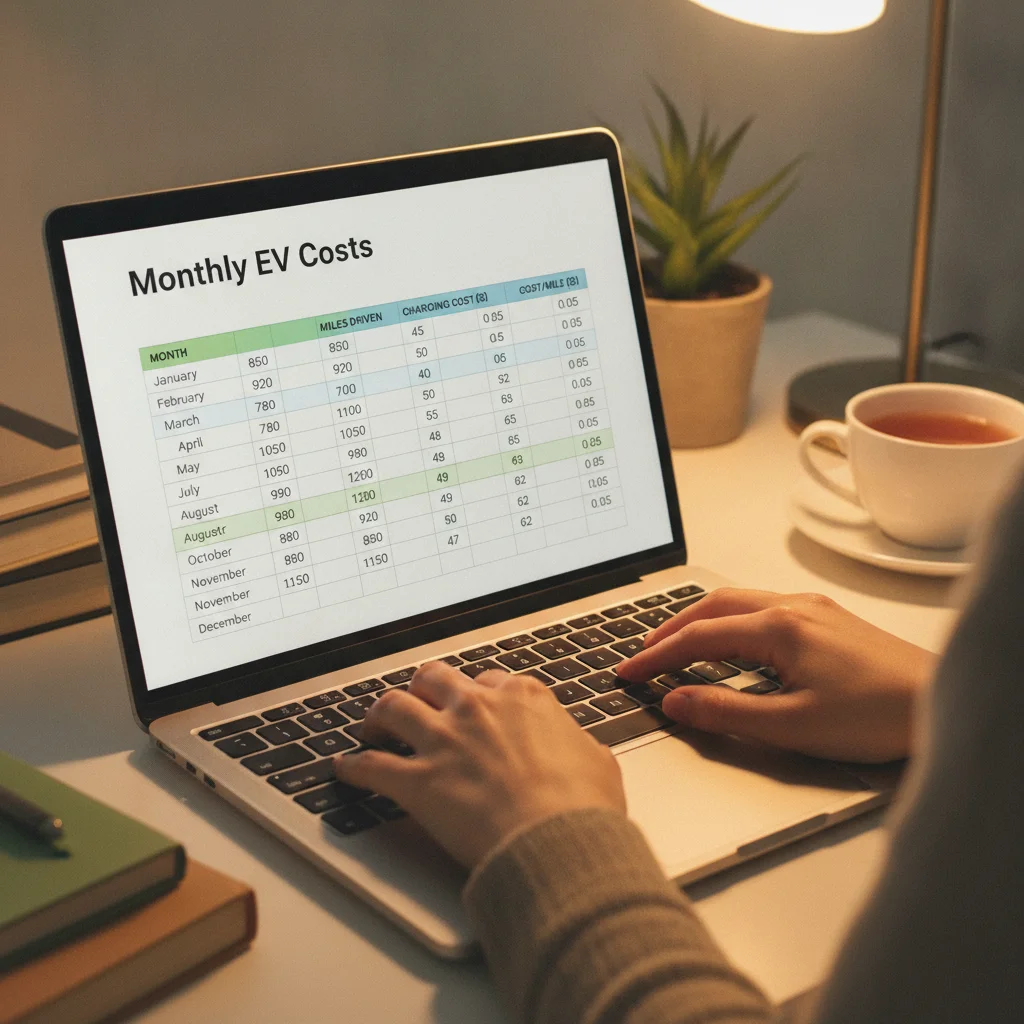
Track your cost-per-mile monthly using this simple formula: (Monthly charging cost in $) ÷ (Miles driven that month). For most EVs in 2024–2025, a well-optimized home charging setup produces a cost-per-mile between $0.03 and $0.05. If you're consistently above $0.07, something in your rate plan, charging schedule, or driving pattern needs adjustment.
Insurance, Financing, and the Hidden Cost Levers
EV insurance deserves its own financial audit. Premiums for electric vehicles run 10–25% higher than equivalent gas models on average, driven by higher repair costs, specialty parts availability, and battery replacement exposure. But that average masks enormous variation between insurers — some carriers have aggressively priced EV-specific products while others are still pricing EVs conservatively based on incomplete loss data.
Our complete EV insurance guide covers coverage types, battery protection clauses, and how to evaluate whether your current insurer is actually competitive on EV pricing. The EV Insurance hub is a good starting point if you want to browse related topics first. The short version: get at least three quotes specifically for your EV model before your first renewal, and make sure at least one quote comes from an insurer with a demonstrated EV specialty book.

On the financing side, if you financed your EV through a dealership, check whether your lender charges a prepayment penalty — many don't, and if interest rates have moved since your purchase, refinancing may lower your monthly payment meaningfully. Some credit unions and online lenders have introduced EV-specific loan products with rates 0.25–0.75 percentage points below standard auto loan rates as of 2024.
If you're self-employed or have variable income, the federal tax credit calculation gets considerably more complicated. Our guide for self-employed EV buyers walks through Modified Adjusted Gross Income calculations and strategies for maximizing credit value when your income fluctuates year to year.
Finally, don't overlook the maintenance cost side of the ledger. EVs have significantly lower scheduled maintenance costs than internal combustion vehicles — no oil changes, fewer brake jobs due to regenerative braking, no transmission service — but they're not zero-cost. Our seasonal EV maintenance checklist documents what actually needs attention and when, so you can build an accurate total cost of ownership picture for year two and beyond.
Building Your Year-One Financial Baseline
The single most valuable financial habit you can build in year one has nothing to do with charging schedules or tax credits: it's documentation. Owners who track their actual charging costs, public charging spending, and maintenance expenses month by month enter year two with a genuine cost-of-ownership number — not an estimate from a manufacturer's marketing calculator.
Set up a simple monthly log — a spreadsheet works fine — with these columns: miles driven, home charging kWh consumed, home charging cost, public charging spend, and any maintenance or tire costs. At the end of twelve months, divide total cost by total miles. That's your true cost-per-mile for year one, and it's the benchmark against which every future financial decision about this vehicle should be measured.
Compare that number against what you were spending per mile with your previous gas vehicle. For most owners who complete this checklist, the all-in EV cost-per-mile — including charging, insurance premium differential, and amortized home charger installation cost — lands 20–40% below what they paid with gasoline. But the owners who don't do this work often end up spending more than they expected because they missed rate plan enrollment, are paying peak-rate electricity, and never claimed their utility rebate.
Year one is the year to get the financial infrastructure right. The home charging setup guide and the Home Charging Setup hub can help if you're still evaluating Level 1 versus Level 2 options or considering an upgrade. Get the hardware right, get the rate plan right, and claim every incentive on this checklist — that's how EV ownership actually delivers on its financial promise.
All claims are backed by peer-reviewed research. Sources on request.