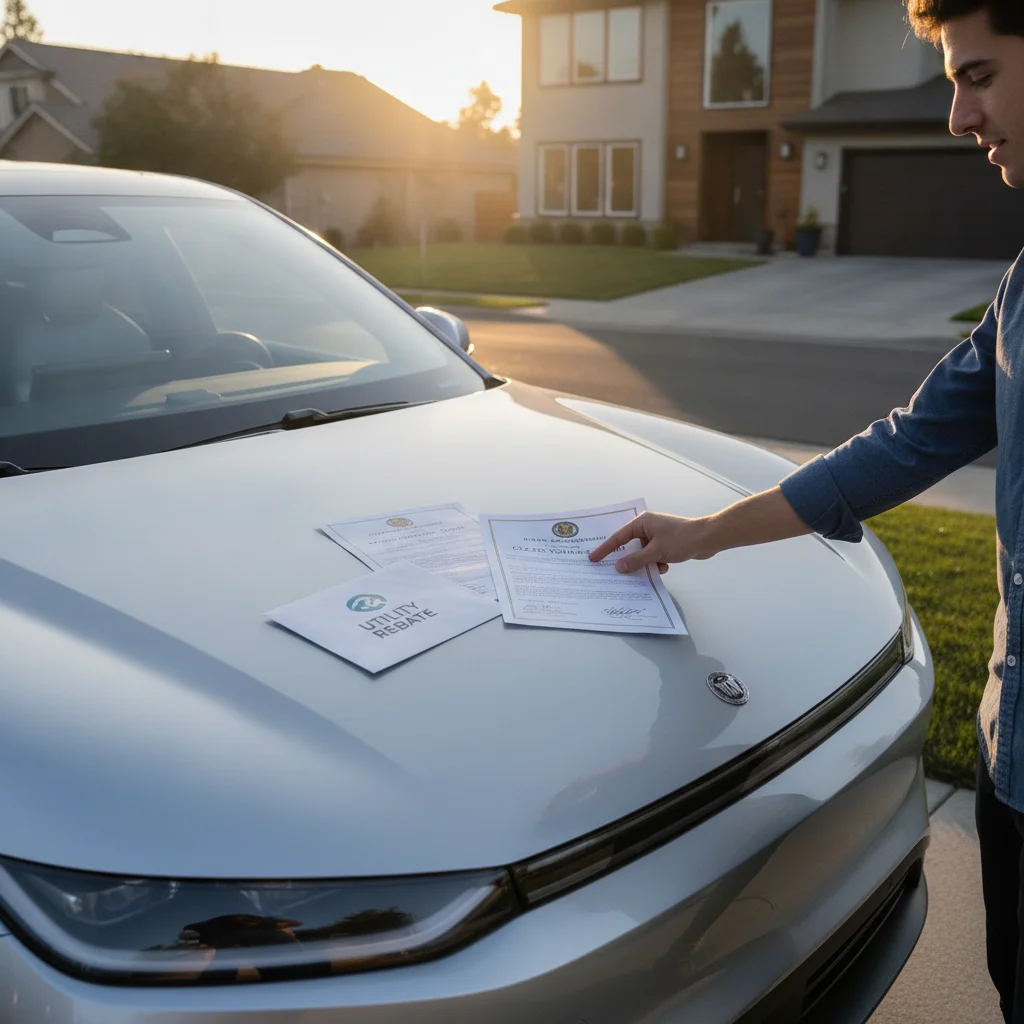
Key Takeaways
Start here
Why EV Incentives Exist — and Why They're Complicated
Core knowledge
The Federal Tax Credit: The Basics You Need First
Know your limits
Income Limits, Vehicle Caps, and MSRP Rules
Expand your savings
State Rebates and Local Utility Incentives
Maximize your deal
How to Stack Incentives — and What You Can't Combine
Take action
Your Step-by-Step Action Plan Before You Buy
Why EV Incentives Exist — and Why They're Complicated
Electric vehicle incentives aren't a gift from automakers. They're policy tools — federal, state, and local governments use them to accelerate EV adoption, reduce carbon emissions, and help domestic manufacturers compete globally. That policy origin is exactly why the rules can feel Byzantine: multiple agencies, legislative compromises, and ever-changing eligibility criteria all pile on top of each other.
If you're new to EVs, it's worth understanding the landscape before diving into specific credits. Before you even look at incentive amounts, make sure you have a basic handle on how EVs work — our plain-language EV explainer covers the fundamentals without the jargon.
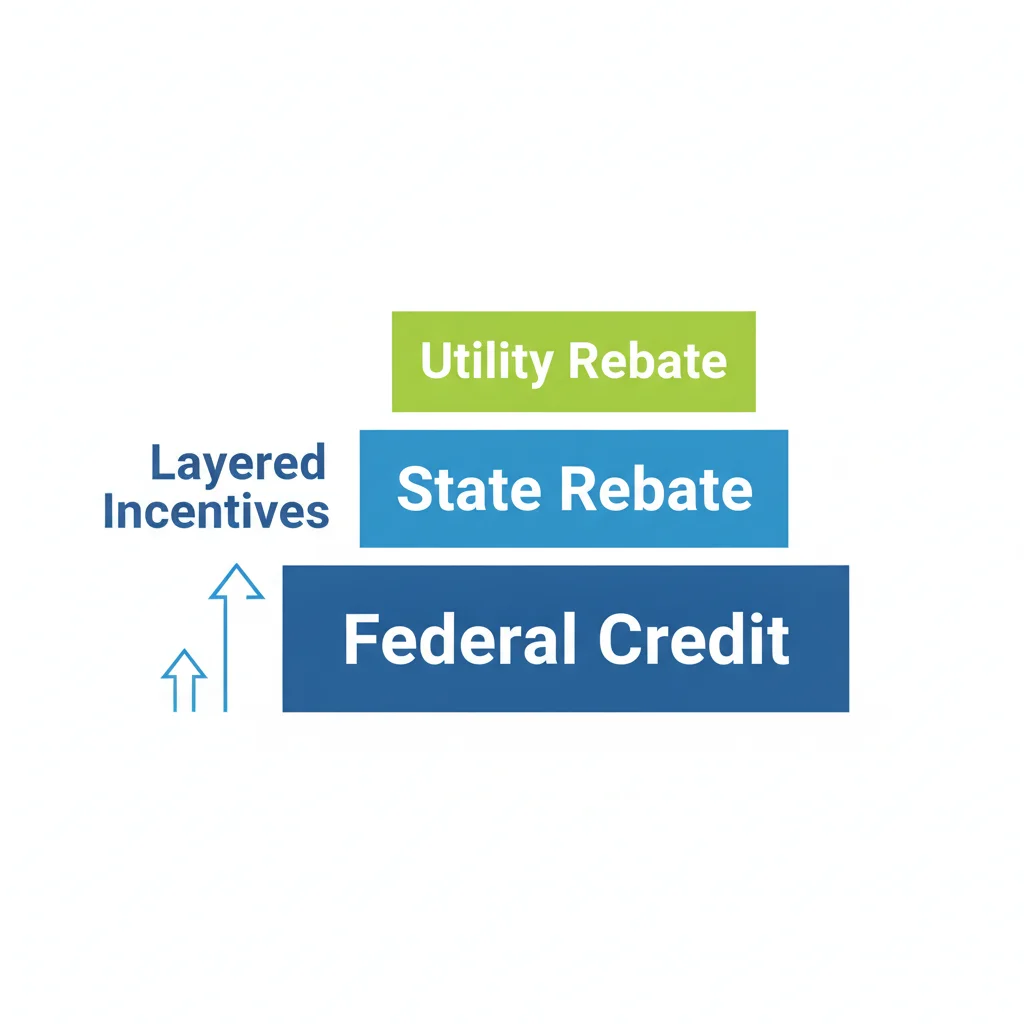
Here's the big picture of what's available in the U.S. as of 2024:
- Federal tax credits — up to $7,500 for new EVs, up to $4,000 for used EVs, administered by the IRS under the Inflation Reduction Act (IRA)
- State rebates and tax credits — offered by roughly 30 states, ranging from a few hundred dollars to several thousand
- Utility company rebates — offered by many electric utilities, often for both the vehicle and home charging equipment
- Manufacturer incentives — APR deals, cash-back offers, and lease support that operate separately from government programs
The complexity comes from the fact that each layer has its own eligibility rules, income limits, and vehicle restrictions. Understanding one doesn't automatically mean you understand the others. This guide walks you through each layer methodically so you can approach a dealership — or an online EV purchase — knowing exactly what you're entitled to.
Nonrefundable tax credit
A tax credit that reduces what you owe the IRS dollar-for-dollar, but cannot reduce your tax liability below zero — meaning you don't get a refund for any unused portion.
Modified Adjusted Gross Income (MAGI)
Your gross income minus certain deductions, then adjusted by adding back specific items like IRA contributions. For most people, it's very close to the AGI on your tax return.
Point-of-sale credit transfer
An IRS program (starting 2024) that lets you assign your federal EV tax credit to a participating dealer at the time of purchase, reducing your out-of-pocket cost immediately.
Critical minerals requirement
One of two battery-related tests for the federal EV credit — it requires that a minimum percentage of the battery's key minerals be sourced from the U.S. or qualifying trade partners.
Stacking incentives
Combining multiple incentive programs — such as a federal tax credit, a state rebate, and a utility discount — on the same vehicle purchase to maximize total savings.
MSRP cap
The maximum manufacturer's suggested retail price a vehicle can have and still qualify for the federal EV credit — currently $55,000 for most cars and $80,000 for SUVs, vans, and trucks.
Section 30D credit
The IRS code section that defines the federal new clean vehicle tax credit — up to $7,500 for qualifying new battery electric and plug-in hybrid vehicles.
Utility rebate
A cash incentive offered by your electric company when you buy an EV or install home charging equipment. These are separate from government programs and are often stackable.
The Federal Tax Credit: The Basics You Need First
The federal clean vehicle credit, established under the Inflation Reduction Act and codified in IRS Section 30D, is the single largest incentive most buyers will encounter. For new battery electric vehicles (BEVs) and qualifying plug-in hybrids (PHEVs), it's worth up to $7,500. For used EVs purchased from a dealer, there's a separate credit worth up to $4,000 under Section 25E.
How the credit is structured
The $7,500 for new vehicles is actually split into two equal halves of $3,750 each:
- Critical minerals requirement: A percentage of the battery's critical minerals must be extracted or processed in the U.S. or in a country with a qualifying free trade agreement.
- Battery components requirement: A percentage of battery components must be manufactured or assembled in North America.
A vehicle that meets both criteria gets the full $7,500. A vehicle that meets only one gets $3,750. A vehicle that meets neither gets zero — regardless of how much you want to buy it.
The 2024 point-of-sale transfer — a game-changer
Before 2024, the federal credit worked as a nonrefundable tax credit: you bought the car, filed your return the following spring, and then reduced your tax liability by the credit amount. If your tax bill was less than the credit, you lost the difference.
Starting January 1, 2024, the IRS introduced a point-of-sale transfer option. If you qualify for the credit, you can sign it over to a participating dealer at the time of purchase. The dealer reduces your purchase price — or your required down payment — by the credit amount immediately. You don't wait. You don't need to worry about whether your tax bill is large enough to absorb it. The dealer later reclaims that amount from the IRS directly.
The used EV credit (Section 25E) works differently: it's 30% of the sale price, capped at $4,000, and the vehicle must be at least two model years old, purchased from a licensed dealer, and priced at $25,000 or less. Income limits apply here too, but they're lower — more on that shortly.
Income Limits, Vehicle Caps, and MSRP Rules
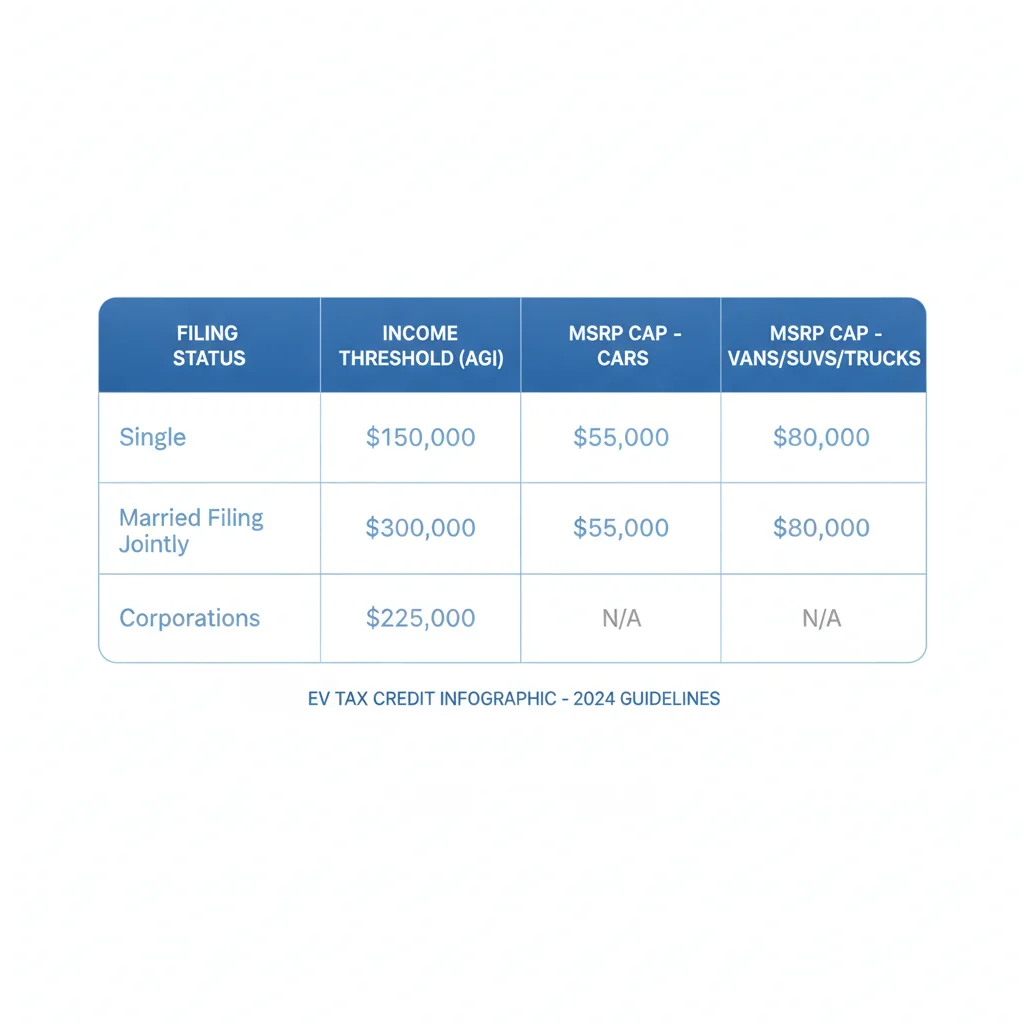
The federal credit is not universal. There are three filters every buyer must pass — and failing any one of them can reduce or eliminate your benefit entirely.
1. Income limits (MAGI thresholds)
The IRS uses your Modified Adjusted Gross Income (MAGI) — which for most people is close to your AGI from line 11 of Form 1040. If your income exceeds these thresholds, the credit is eliminated completely (there's no gradual phase-out):
| Filing Status | MAGI Limit (New EV) | MAGI Limit (Used EV) |
|---|---|---|
| Single / Married Filing Separately | $150,000 | $75,000 |
| Head of Household | $225,000 | $112,500 |
| Married Filing Jointly | $300,000 | $150,000 |
The IRS allows you to use either the current year's MAGI or the prior year's MAGI — whichever is lower — when claiming the credit. This gives buyers who had a lower income last year a potential path to the credit even if this year's income is elevated.
2. MSRP caps
Not every vehicle price is eligible, even if the buyer qualifies:
- Vans, SUVs, and pickup trucks: MSRP must be $80,000 or less
- Sedans, wagons, and other passenger cars: MSRP must be $55,000 or less
These caps are based on the manufacturer's suggested retail price — not the price you negotiate. So if a dealer marks up a hot EV above MSRP, and the base MSRP is $54,000 but you're paying $62,000, the vehicle may still qualify based on MSRP. But verify directly — the IRS uses the MSRP as defined by the manufacturer.
3. Vehicle eligibility — assembly and battery sourcing
Final assembly must occur in North America (U.S., Canada, or Mexico). Vehicles assembled overseas — including some popular models from Asian brands — do not qualify for the federal credit regardless of how much you want them.
The IRS maintains an updated list of qualifying vehicles at fueleconomy.gov. Before you fall in love with a specific trim or model year, check that list. Battery sourcing rules tighten over time, and a vehicle that qualified last year may not qualify this year.
State Rebates and Local Utility Incentives
State and local incentives are where many buyers leave money on the table — simply because they don't know to look. Roughly 30 U.S. states offer some form of EV purchase incentive, and many are not income-tested at all.
State programs worth knowing
While state programs change frequently, a few examples illustrate the range of what's available:
- California CVRP (Clean Vehicle Rebate Project): Up to $7,500 for lower-income buyers; standard rebates up to $2,000–$4,500 depending on vehicle type. Income limits apply at higher tiers.
- New York Drive Clean Rebate: Point-of-sale rebate of up to $2,000 for qualifying EVs, administered through dealers.
- Colorado EV Tax Credit: State income tax credit of up to $5,000 for new EV purchases, with income and price caps separate from federal rules.
- Texas: Currently has a Light-Duty Motor Vehicle Purchase or Lease Incentive Program — worth checking for the latest eligibility.
To find your state's current programs, the Department of Energy's Alternative Fuels Station Locator and AFDC (Alternative Fuels Data Center) website are the most reliable sources. Many state programs are first-come, first-served with limited annual funding, so timing matters.
Utility company rebates
This is the most consistently overlooked layer. Many electric utilities — both investor-owned and public — offer rebates for EV purchases, Level 2 charger installation, or both. These rebates don't go through the IRS or your state tax return; they're typically direct checks or bill credits.
Examples include utilities like Pacific Gas & Electric (PG&E), National Grid, and Xcel Energy offering EV-related rebates ranging from $200 to $1,000 or more. Some utilities also offer discounted off-peak electricity rates specifically for EV charging, which reduces your ongoing fueling cost significantly.
For buyers who don't qualify for the federal tax credit due to income — or who are purchasing a vehicle that doesn't meet the federal requirements — these non-IRS incentives become even more valuable. Our article on EV incentives that bypass the tax return entirely covers this category in depth.
How to Stack Incentives — and What You Can't Combine
"Stacking" refers to combining multiple incentives on a single vehicle purchase. Done right, it can reduce your net cost dramatically. Done wrong — or overlooked — you leave real money behind.
What you can typically stack
- Federal credit + state rebate: In most states, these are independent programs and can be combined. A California buyer purchasing an eligible EV could theoretically combine a $7,500 federal point-of-sale credit with a state rebate, cutting the effective price by $9,500–$15,000.
- Federal or state incentives + utility rebate: Utility rebates are almost always stackable because they're separate programs run by private companies.
- Manufacturer lease support + federal credit: When you lease an EV, the leasing company (often the automaker's captive finance arm) receives the federal credit and can — but isn't required to — pass it to you through a lower capitalized cost. Ask explicitly whether the lease price reflects the credit.
What you generally cannot combine
- Federal new EV credit + federal used EV credit: You can only claim one per transaction — one vehicle, one credit type.
- Some state programs explicitly exclude vehicles already receiving federal credits — always read the fine print of your state program before assuming you can stack.
- Manufacturer cash-back offers vs. low-APR deals: These are typically mutually exclusive, though they're dealer/manufacturer incentives rather than government programs. Our piece on how manufacturer incentives and rebates actually work explains how to choose between cash-back and rate offers.
One important nuance: when you take the federal credit as a point-of-sale transfer through the dealer, the IRS still expects you to report the transaction on your tax return (Form 8936). If your income actually exceeded the limit in that tax year, you may owe the credit back. The system relies on your good-faith eligibility estimate at point of sale.
IRS Clean Vehicle Credit Eligibility List (fueleconomy.gov)
The official, regularly updated list of vehicles that qualify for the federal Section 30D credit. Check this within days of your planned purchase to confirm current eligibility.
DOE Alternative Fuels Data Center (AFDC)
The Department of Energy's comprehensive database of state and local EV incentives, searchable by state, vehicle type, and incentive category. An essential first stop for non-federal savings.
PlugStar (by Plug In America)
A free consumer tool that helps you research EV models, compare incentives by location, and find certified EV-knowledgeable dealers in your area.
IRS Form 8936 Instructions
The official IRS instructions for claiming the clean vehicle credit on your tax return, including how to report a point-of-sale transfer. Required reading if your income is close to the threshold.
Your Step-by-Step Action Plan Before You Buy
The incentive landscape rewards buyers who do their homework before they set foot in a dealership or click "purchase" on a direct-sale manufacturer site. Here's a practical sequence to follow:
- Confirm your MAGI for this year and last year. Gather your last two tax returns. Determine which year gives you the lower MAGI — you can use either for the federal credit.
- Check the IRS vehicle eligibility list. Go to fueleconomy.gov and search your specific make, model, trim, and model year. Eligibility varies by configuration.
- Identify your state's current EV programs. Search your state DMV or energy office website, or use the DOE's AFDC tool. Note application deadlines and funding caps.
- Contact your electric utility. Call the customer service line or check your utility's website for EV rebate programs — both for the vehicle and for home charging equipment. If you're setting up home charging, our guide on home charging options for new EV owners explains what equipment you'll need.
- Ask the dealer about point-of-sale credit transfer. Confirm the dealer is registered with the IRS to facilitate the transfer (not all are). Get confirmation in writing of the credit amount being applied.
- Compare total cost of ownership, not just sticker price. Factor in insurance costs — EVs can carry higher premiums due to repair costs; see our EV insurance guide for what to expect. Then compare fuel savings over your expected ownership period.
- Don't negotiate incentives away. Some dealers attempt to factor expected incentives into their negotiation, implying the price is fair because of the credit. The credit is yours — it's not a dealer concession. Negotiate the vehicle price independently of any incentive you're entitled to.
The EV market moves fast — new models gain eligibility, others lose it as battery sourcing rules evolve. The information in this guide reflects the rules as of mid-2024, but the IRS and state agencies update their lists regularly. Verify eligibility immediately before purchase, not weeks in advance.
Getting the full picture on EV ownership costs — including insurance, maintenance, and charging — will help you make a truly informed decision. Understanding how an all-electric powertrain differs from a gas vehicle is also worth your time before you commit, so there are no surprises about what you're buying.

All claims are backed by peer-reviewed research. Sources on request.