| Federal EV Tax Credit (max) | $7,500 for eligible new BEVs/PHEVs (IRS Clean Vehicle Credit, Inflation Reduction Act 2022) |
| Used EV Tax Credit (max) | $4,000 or 30% of sale price (IRS, 2023 IRA implementation) |
| Standard battery warranty | 8 years / 100,000 miles (federal minimum) (U.S. federal mandate for EV battery warranties) |
| Typical battery degradation | ~80% SoH after 8–10 years (Various industry studies, Recurrent Auto 2023) |
| MSRP cap (SUVs/trucks) | $80,000 (IRA Clean Vehicle Credit rules) |
| MSRP cap (sedans/hatchbacks) | $55,000 (IRA Clean Vehicle Credit rules) |
| Energy in one gallon of gasoline | 33.7 kWh (MPGe baseline) (U.S. Department of Energy) |
| Max DC fast-charge speed (2024) | Up to 350 kW (some stations) (CharIN CCS standard; Electrify America network) |
Why EV Jargon Matters Before You Buy
Walk into a dealership or browse any EV spec sheet and you'll encounter a wall of acronyms and technical terms: BEV, DCFC, kWh, MPGe, OBC, V2G. Manufacturers didn't invent this language to confuse you — much of it reflects genuinely distinct engineering concepts — but without a working vocabulary, it's nearly impossible to compare vehicles fairly or spot a misleading marketing claim.
This glossary covers 40 of the most important EV terms grouped by topic: battery and energy basics, charging and connectors, range and efficiency, drivetrain and performance, and EV types and incentives. For each term you'll find a plain-English definition and, where it matters, a practical note on why the term affects your buying decision.
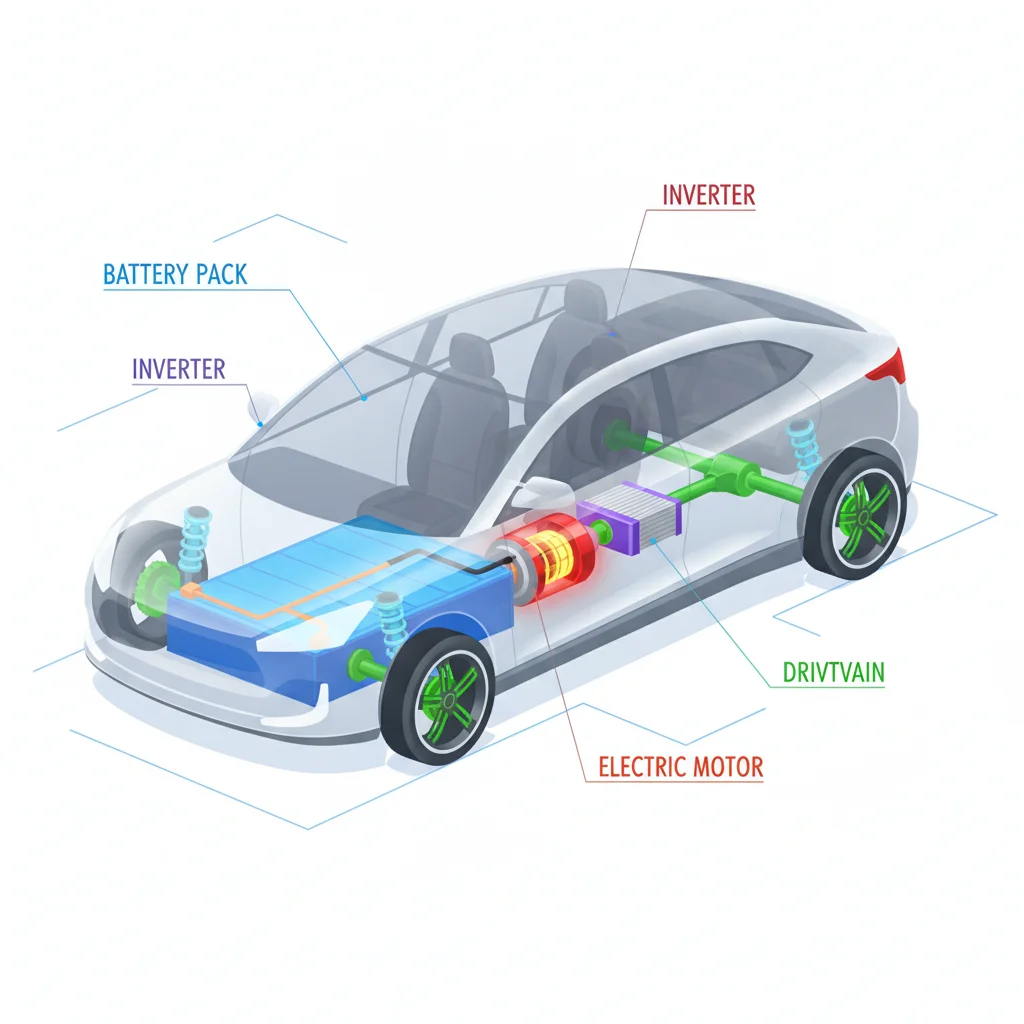
If you want to go deeper on how the mechanical systems fit together, our EV Mechanics 101 guide walks through every major component before you visit a dealership. For cost-specific charging vocabulary, see our guide to EV charging cost terms.
| Federal EV Tax Credit (max) | $7,500 for eligible new BEVs/PHEVs (IRS Clean Vehicle Credit, Inflation Reduction Act 2022) |
| Used EV Tax Credit (max) | $4,000 or 30% of sale price (IRS, 2023 IRA implementation) |
| Standard battery warranty | 8 years / 100,000 miles (federal minimum) (U.S. federal mandate for EV battery warranties) |
| Typical battery degradation | ~80% SoH after 8–10 years (Various industry studies, Recurrent Auto 2023) |
| MSRP cap (SUVs/trucks) | $80,000 (IRA Clean Vehicle Credit rules) |
| MSRP cap (sedans/hatchbacks) | $55,000 (IRA Clean Vehicle Credit rules) |
| Energy in one gallon of gasoline | 33.7 kWh (MPGe baseline) (U.S. Department of Energy) |
| Max DC fast-charge speed (2024) | Up to 350 kW (some stations) (CharIN CCS standard; Electrify America network) |
Battery and Energy Basics
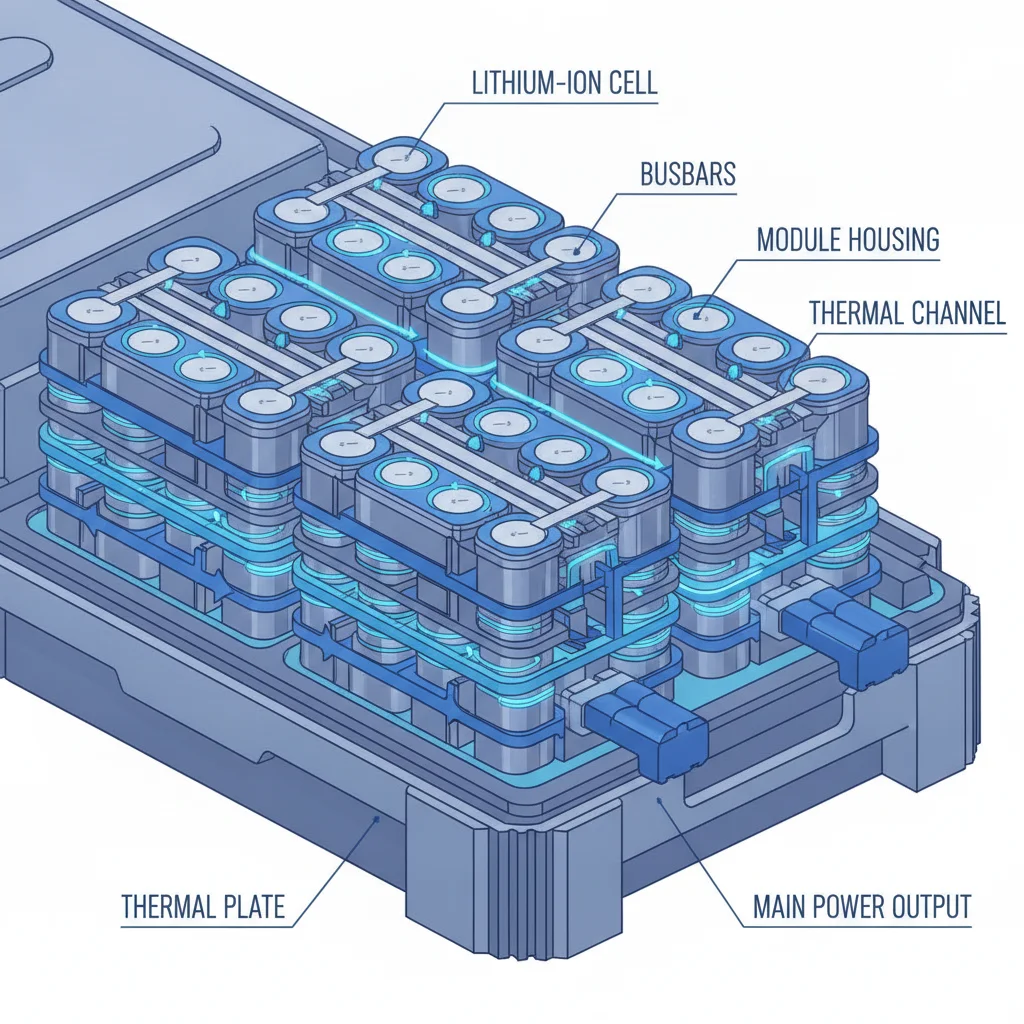
The battery pack is the most expensive component in any EV — often 30–40% of the vehicle's total cost — so understanding battery terminology directly affects how you evaluate price, warranty, and long-term ownership value.
kWh (Kilowatt-hour)
The standard unit of energy used to measure battery capacity in EVs. A 75 kWh battery can theoretically deliver 75 kilowatts of power for one hour. Larger kWh generally means longer range, but efficiency also matters.
kW (Kilowatt)
A unit of power — the rate at which energy is used or delivered. In EV contexts, kW measures both motor output and charging speed. A 150 kW DC fast charger delivers power roughly ten times faster than a typical 15 kW Level 2 home charger.
SoC (State of Charge)
The current charge level of the battery expressed as a percentage, equivalent to the fuel gauge on a gas car. SoC affects both available range and the speed at which the battery accepts a charge — fast charging slows significantly above 80% SoC.
DC Fast Charging (DCFC)
High-power charging that delivers direct current (DC) electricity straight to the battery, bypassing the vehicle's on-board charger. DCFC stations (50–350 kW) can add significant range in 20–40 minutes, making them the primary option for long-distance travel.
Regenerative Braking
A system that converts the kinetic energy of deceleration into electrical energy and feeds it back into the battery. It simultaneously slows the vehicle and partially recharges the battery, extending range — particularly in stop-and-go traffic.
MPGe (Miles Per Gallon Equivalent)
An EPA metric that translates EV energy consumption into a miles-per-gallon figure for easy comparison with gas vehicles. It uses 33.7 kWh as the energy equivalent of one gallon of gasoline. Higher MPGe means lower energy cost per mile.
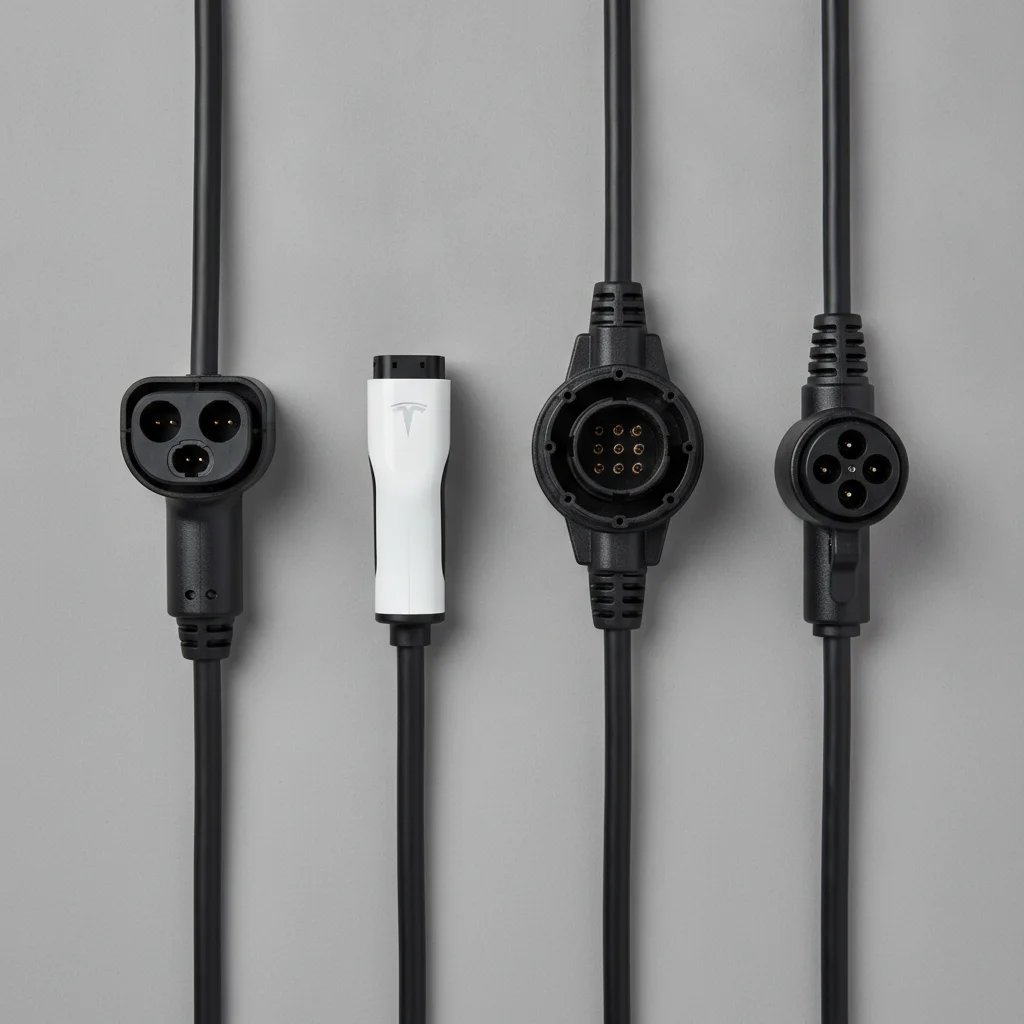
CCS (Combined Charging System)
The dominant DC fast-charging connector standard in North America and Europe. CCS1 (used in the U.S.) adds two DC pins to a standard J1772 AC port. It supports both AC and DC charging through a single inlet.
NACS (North American Charging Standard)
Tesla's original connector format, now an SAE-certified open standard. Adopted by Ford, GM, Rivian, and others, NACS is on track to become the default U.S. EV connector by 2025–2026, with the largest charging network (Tesla Supercharger) built around it.
BEV (Battery Electric Vehicle)
A vehicle powered entirely by an electric motor and battery pack with no combustion engine. BEVs produce zero direct tailpipe emissions and are the only vehicle type eligible for the full $7,500 federal Clean Vehicle Credit under current IRA rules.
PHEV (Plug-In Hybrid Electric Vehicle)
A vehicle with both a plug-in battery pack and a gasoline engine. PHEVs can operate on electricity alone for a limited range (typically 15–50 miles), then switch to hybrid mode. They qualify for a partial federal tax credit.
On-Board Charger (OBC)
The internal component that converts AC electricity from Level 1 and Level 2 charging sources into the DC power the battery stores. OBC capacity (in kW) sets the maximum Level 2 charging speed; the charger's output cannot exceed it.
Torque Vectoring
A drivetrain technology that independently controls torque delivery to individual wheels, improving handling, stability, and traction. Common on dual- and tri-motor EV setups; it allows the vehicle to rotate predictably in corners by sending more torque to the outside wheels.
Additional Battery Terms Worth Knowing
- Cell chemistry (NMC vs. LFP): Nickel Manganese Cobalt (NMC) cells offer higher energy density; Lithium Iron Phosphate (LFP) cells are cheaper, more thermally stable, and can charge to 100% daily without accelerating degradation. Many entry-level and Chinese-market EVs now use LFP.
- Thermal management system: Active heating and cooling keeps the battery within its optimal temperature range. Liquid-cooled systems (found on most premium EVs) outperform passive air-cooled systems in cold weather and fast-charging scenarios. Verify which system a vehicle uses before buying — it significantly affects real-world range consistency.
- Battery degradation: All lithium-ion batteries lose capacity over time and charge cycles. Industry benchmarks suggest most EV batteries retain roughly 80% of original capacity after 8–10 years. Most manufacturer warranties guarantee that threshold for 8 years or 100,000 miles.
- State of Health (SoH): A percentage figure (often visible in the vehicle's app or display) representing current usable battery capacity relative to its original capacity. When buying used, always check SoH — it's the single most important battery metric on a pre-owned EV.
Cold Weather and Real-World Range
EPA range ratings are conducted at approximately 75°F. Real-world range can drop 20–40% in freezing temperatures as the battery both loses electrochemical efficiency and must power cabin heating. If you live in a cold climate, factor this into your range requirements when comparing vehicles with similar EPA ratings. Vehicles with heat pump HVAC systems (rather than resistive heating) handle cold-weather efficiency significantly better.
EV Insurance Requires Specific Coverage Language
Standard auto insurance policies were written for combustion vehicles and may not explicitly cover high-voltage battery systems, software-related failures, or OTA update damage. When getting EV insurance quotes, ask specifically about battery coverage, OEM parts requirements, and how the insurer handles total-loss valuation on a vehicle whose battery degrades over time. Our <a href="/electric-vehicles/ev-ownership-costs/ev-insurance-guide/ev-insurance-terms-every-owner-should-know">EV insurance terms guide</a> covers these nuances in depth.
Understanding battery technology also helps you navigate EV types — BEV, PHEV, and HEV use very different battery architectures with different capacity, warranty, and ownership implications.
Charging and Connector Terms
Charging terminology is probably where confusion runs highest among first-time EV buyers, because the connector standards, power levels, and speed measurements all use different units and vary by vehicle and network.
Charging Levels Explained
| Level | Voltage | Typical Power | Miles Added per Hour | Best Use |
|---|---|---|---|---|
| Level 1 | 120V AC | 1.2–1.8 kW | 3–5 miles | Overnight top-up, low-mileage drivers |
| Level 2 | 240V AC | 7–19.2 kW | 20–35 miles | Home charging, workplace, public lots |
| DC Fast Charge | 400–800V DC | 50–350 kW | 100–300+ miles | Road trips, quick top-ups |
Connector Standards
- CCS (Combined Charging System): The dominant DC fast-charging standard in North America and Europe. CCS1 (North America) combines a standard J1772 AC port with two DC pins below it. Most non-Tesla EVs sold in the U.S. use CCS.
- NACS (North American Charging Standard): Originally Tesla's proprietary connector, now adopted by Ford, GM, Rivian, and others — and designated a SAE standard. By 2025, NACS is expected to become the default U.S. connector. Many new non-Tesla EVs will ship with NACS natively; adapters bridge the gap.
- CHAdeMO: An older DC fast-charging standard primarily used by Nissan and some Japanese-market vehicles. It's being phased out in North America; Nissan's next-generation EVs are moving to NACS.
- J1772: The universal AC charging connector used by all non-Tesla EVs for Level 1 and Level 2 charging in North America. Tesla vehicles use an adapter to connect to J1772 stations.
- On-Board Charger (OBC): The component inside the vehicle that converts AC power (from Level 1 or Level 2 sources) into DC power the battery can store. OBC capacity (rated in kW) sets your maximum Level 2 charging speed — a 7.2 kW OBC on a 48-amp circuit won't charge faster than 7.2 kW regardless of the charger's output capability.
- Vehicle-to-Grid (V2G) / Vehicle-to-Home (V2H) / Vehicle-to-Load (V2L): Bidirectional charging technologies that allow the EV battery to export power back to the electrical grid, to your home, or to external devices. V2H requires a compatible home inverter; V2L is available on vehicles like the Hyundai Ioniq 5 and Ford F-150 Lightning via a built-in outlet.
80%
Battery capacity retained after ~8–10 years
According to a 2023 Recurrent Auto analysis of over 15,000 EVs, most batteries retain roughly 80% of original capacity within the warranty period.
350 kW
Maximum current DC fast-charge rate
High-power CCS and NACS stations can deliver up to 350 kW, though most production EVs are limited to 150–350 kW by their battery architecture.
30–40%
Share of total EV cost attributed to the battery pack
BloombergNEF and various OEM disclosures indicate battery packs represent roughly 30–40% of total EV manufacturing cost as of 2023–2024.
$7,500
Maximum federal clean vehicle tax credit
Under the Inflation Reduction Act, qualifying BEV and PHEV buyers can claim up to $7,500 as a point-of-sale discount starting in 2024.
10–20%
Range difference between EPA and WLTP ratings
European WLTP test cycles consistently produce range estimates 10–20% higher than EPA ratings for the same vehicle — a critical distinction when reading international reviews.
Range, Efficiency, and Performance Terms
Range anxiety drives more EV purchase hesitation than any other factor. Understanding how range is measured — and why real-world numbers differ from the window sticker — is essential to setting accurate expectations.
Range Metrics
- EPA-rated range: The official U.S. range estimate, derived from a standardized test cycle conducted by the Environmental Protection Agency. EPA ratings are more conservative (and more accurate to real-world driving) than the European WLTP cycle or the older NEDC standard. When comparing EVs, always use EPA figures.
- WLTP range: The Worldwide Harmonised Light Vehicles Test Procedure, used in Europe and often cited in manufacturer press materials. WLTP ratings run 10–20% higher than equivalent EPA ratings for the same vehicle. Don't use WLTP numbers to set U.S. driving expectations.
- Usable vs. total battery capacity: Manufacturers reserve a buffer at the top and bottom of the battery's charge range to protect cell longevity. A vehicle with a 82 kWh total pack might have 79 kWh of usable capacity. Range ratings are based on usable capacity — but buffer size varies by automaker, so two 75 kWh vehicles may not have the same real-world range.
- Regenerative braking (regen): A system that recovers kinetic energy during deceleration and feeds it back into the battery. More aggressive regen settings (sometimes called one-pedal driving) can extend range by 10–20% in city driving. Look for adjustable regen levels when test-driving.
Efficiency Metrics
- MPGe (Miles Per Gallon Equivalent): An EPA metric that expresses EV efficiency in terms comparable to gasoline MPG, using 33.7 kWh as the energy equivalent of one gallon of gasoline. Higher MPGe = lower operating cost per mile. It's useful for cross-shopping EVs and gas vehicles but doesn't directly tell you how many miles per kWh the car achieves.
- Miles per kWh (mi/kWh): The most direct EV efficiency metric — how many miles the vehicle travels on one kilowatt-hour of energy. A 4 mi/kWh vehicle is more efficient than a 3 mi/kWh vehicle. Multiply your battery's usable kWh by this figure to estimate real-world range.
- Wh/mi (Watt-hours per mile): The inverse of mi/kWh, used by some manufacturers and most third-party reviewers. Lower is better. 250 Wh/mi is highly efficient; 400+ Wh/mi indicates a heavy, aerodynamically challenged vehicle.
Performance Terms
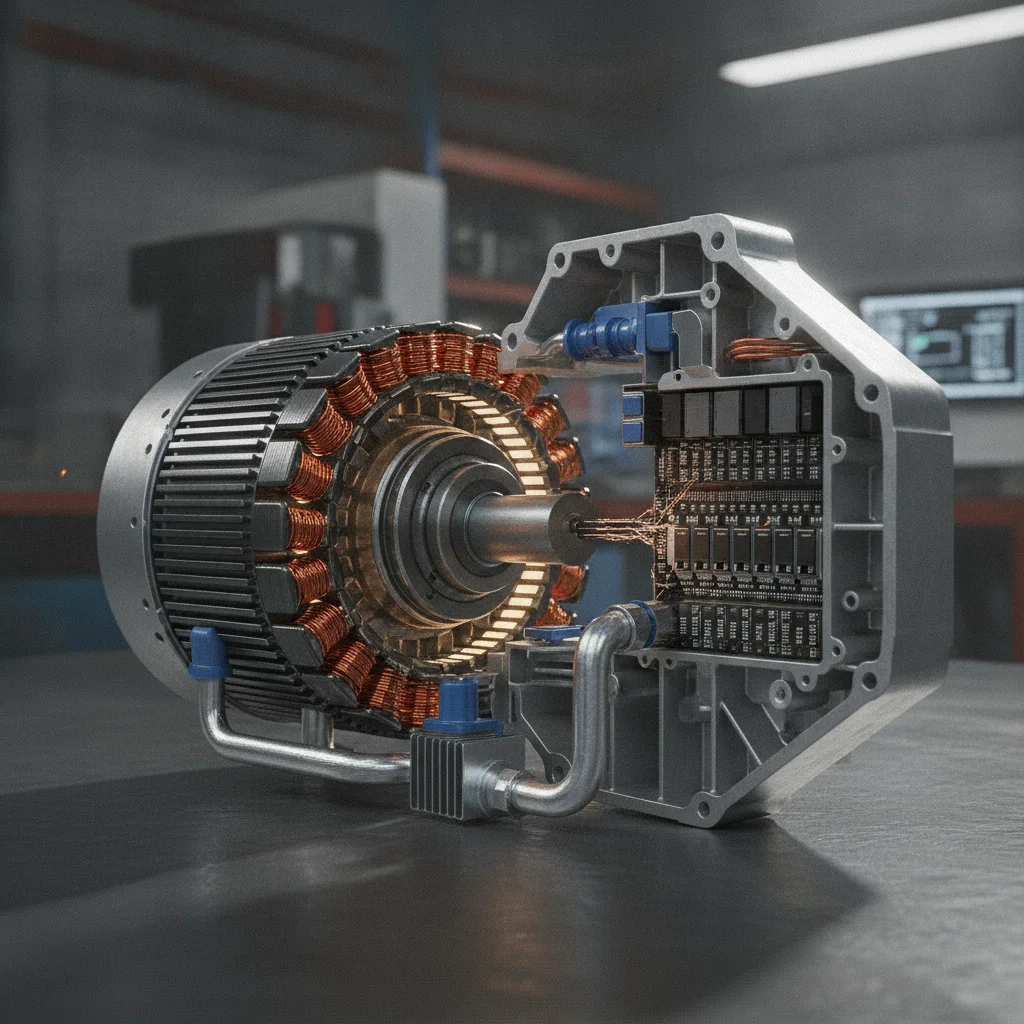
- Torque: The rotational force an electric motor produces. EVs deliver peak torque instantly from zero RPM, which is why even modestly powered EVs feel quick off the line. Manufacturers typically list torque in lb-ft (pound-feet).
- Torque vectoring: A system that precisely distributes torque between wheels — or between left and right wheels on the same axle — to improve cornering stability and traction. Common on dual-motor AWD EVs; some systems use dedicated motors per wheel (as in the GMC Hummer EV).
- 0–60 mph time: Standard acceleration benchmark. Electric motors allow some EVs to achieve sub-3-second 0–60 times; budget EVs typically run 6–9 seconds. Note that 0–60 performance is less relevant to daily driving comfort than mid-range acceleration (e.g., 30–70 mph highway passing).
- Power (kW vs. hp): Electric motor output is rated in kilowatts (kW) in most markets and converted to horsepower (hp) for U.S. consumers. 1 hp ≈ 0.746 kW. A 150 kW motor produces approximately 201 hp.
For a complete breakdown of how motors, inverters, and drivetrains interact, see our EV Mechanics 101 guide.
EV Types, Incentives, and Insurance Terms
The acronyms describing EV types and the incentive landscape are some of the most consequential vocabulary in the buying process — they determine which vehicles qualify for federal tax credits and how you insure them.
Vehicle Type Acronyms
- BEV (Battery Electric Vehicle): A fully electric vehicle with no internal combustion engine. Powered entirely by a battery pack. Examples: Tesla Model Y, Chevrolet Equinox EV, Hyundai Ioniq 6. Only BEVs qualify for the full federal EV tax credit under current IRA rules.
- PHEV (Plug-In Hybrid Electric Vehicle): Has both a battery pack (typically 8–50 miles of electric range) and a gasoline engine. Can be plugged in to charge electrically. PHEVs qualify for a partial federal tax credit. Examples: Ford Escape PHEV, Jeep Wrangler 4xe, Toyota RAV4 Prime.
- HEV (Hybrid Electric Vehicle): Uses a small battery and electric motor to assist a gasoline engine, but cannot be plugged in. Charges only through regenerative braking and engine operation. HEVs do not qualify for the federal EV tax credit. Examples: Toyota Camry Hybrid, Honda CR-V Hybrid.
- FCEV (Fuel Cell Electric Vehicle): Generates electricity onboard from hydrogen fuel using a fuel cell. Emits only water vapor. Currently limited to California due to hydrogen fueling infrastructure. Examples: Toyota Mirai, Hyundai Nexo.
- EREV (Extended-Range Electric Vehicle): An EV-first architecture where a gasoline engine acts solely as a generator to recharge the battery rather than directly driving the wheels. The Chevrolet Volt was the canonical example; the Ram 1500 Ramcharger uses this approach.
Not sure which type fits your driving pattern? Our EV types comparison hub walks through the tradeoffs between BEV, PHEV, and HEV ownership in detail.
Incentive and Financial Terms
- Federal EV Tax Credit (Clean Vehicle Credit): Up to $7,500 for eligible new BEVs and PHEVs under the Inflation Reduction Act (IRA). Eligibility depends on vehicle MSRP, buyer income (MAGI), final assembly location, and battery mineral sourcing. The credit is now transferable at the point of sale — meaning dealers can apply it as an upfront discount rather than a year-end tax filing.
- MSRP cap: IRA rules cap eligible vehicle prices at $80,000 for trucks, SUVs, and vans, and $55,000 for sedans and hatchbacks. Vehicles above these thresholds don't qualify regardless of other factors.
- MAGI (Modified Adjusted Gross Income): The income threshold used to determine buyer eligibility for the federal EV credit. For 2024, individual filers must be under $150,000; joint filers under $300,000. See our EV tax credit glossary for the full set of credit eligibility terms.
- Used EV Tax Credit: A separate credit of up to $4,000 (or 30% of sale price, whichever is less) for qualifying used EVs sold by a licensed dealer. Vehicle must be priced at $25,000 or less and be at least two model years old.
Insurance Terms
- Battery replacement coverage: A specialized endorsement or separate policy provision covering battery pack replacement outside the manufacturer warranty window. Standard auto insurance does not cover battery degradation — this requires specific language in your policy. Our EV insurance terms guide covers this and related endorsements in detail.
- OEM parts clause: A policy provision requiring that original manufacturer parts be used in repairs. Relevant for EVs because third-party battery modules and high-voltage components may not meet safety or compatibility standards.
- Gap insurance: Covers the difference between what you owe on an EV loan and the vehicle's actual cash value if it's totaled. EVs can depreciate faster than financing balances in the first few years, making gap coverage particularly worth evaluating.
Cold Weather and Real-World Range
EPA range ratings are conducted at approximately 75°F. Real-world range can drop 20–40% in freezing temperatures as the battery both loses electrochemical efficiency and must power cabin heating. If you live in a cold climate, factor this into your range requirements when comparing vehicles with similar EPA ratings. Vehicles with heat pump HVAC systems (rather than resistive heating) handle cold-weather efficiency significantly better.
EV Insurance Requires Specific Coverage Language
Standard auto insurance policies were written for combustion vehicles and may not explicitly cover high-voltage battery systems, software-related failures, or OTA update damage. When getting EV insurance quotes, ask specifically about battery coverage, OEM parts requirements, and how the insurer handles total-loss valuation on a vehicle whose battery degrades over time. Our <a href="/electric-vehicles/ev-ownership-costs/ev-insurance-guide/ev-insurance-terms-every-owner-should-know">EV insurance terms guide</a> covers these nuances in depth.
For EV maintenance vocabulary — including terms like frunk, thermal runaway, and contactor — our EV maintenance basics hub is the right next stop.
U.S. Department of Energy: Fuel Economy Guide
The official fueleconomy.gov site lets you compare EPA-rated range, MPGe, and annual energy costs for every EV and hybrid sold in the U.S. — the most reliable source for apples-to-apples comparisons.
Recurrent Auto Battery Report Tool
Enter a used EV's VIN to see its reported battery health and range data sourced from real-world owner data — essential when evaluating any pre-owned EV purchase.
PlugShare Charging Map
A crowd-sourced map of over 600,000 charging locations worldwide, filterable by connector type (CCS, NACS, CHAdeMO, J1772). Useful for evaluating charging infrastructure along your regular routes before committing to a vehicle.
IRS Clean Vehicle Credit FAQ
The IRS's official guidance on federal EV tax credit eligibility, including income limits, MSRP caps, and qualifying vehicle lists — the authoritative source for incentive verification.
SAE International EV Standards Directory
SAE's public-facing standards index covers J1772, CCS, and NACS connector specifications — useful if you want to understand the technical underpinnings of charging compatibility claims.

All claims are backed by peer-reviewed research. Sources on request.