Key Takeaways
Electrified Vehicle Classification
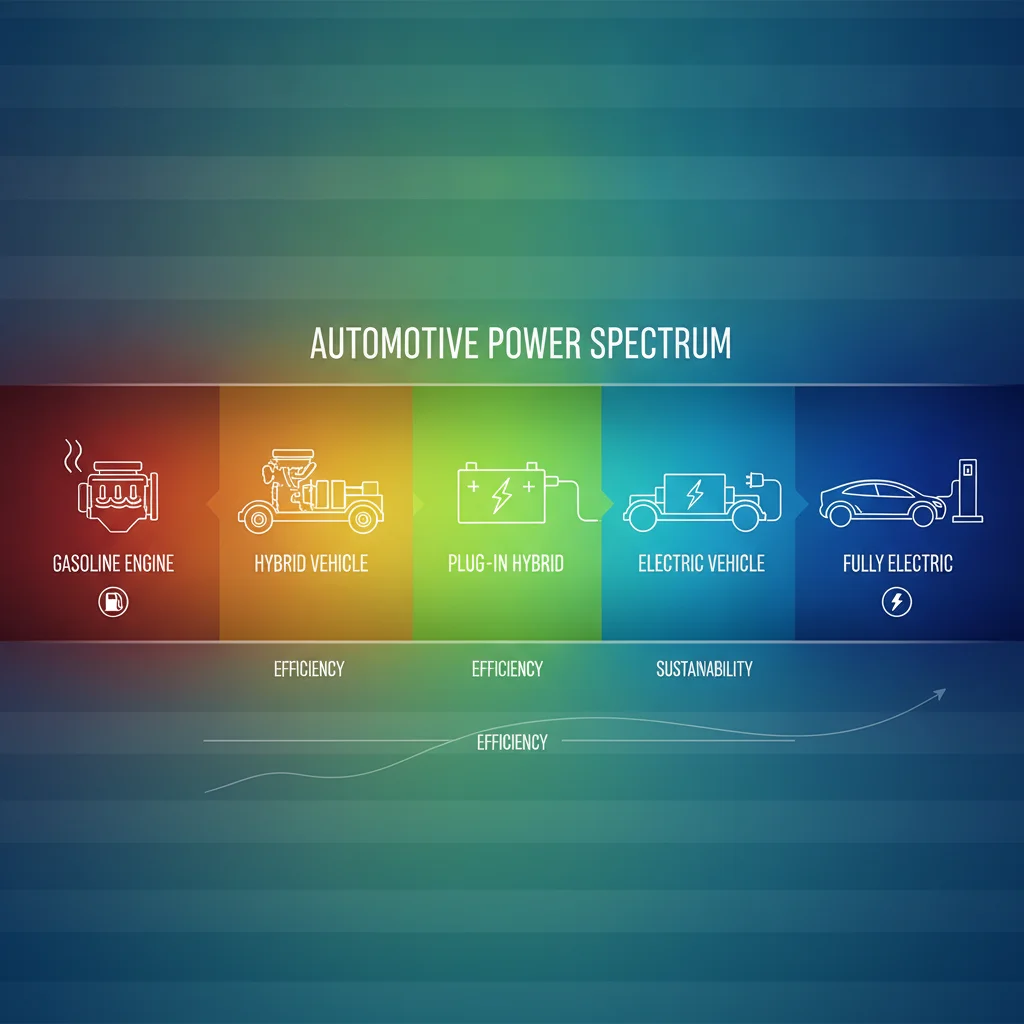
Automakers group their electrified vehicles — hybrids, plug-in hybrids, and fully electric models — into brand-specific naming families that can look very different from one manufacturer to the next. Terms like 'e-tron,' 'i,' 'Blue Oval Intelligence,' and 'e+' all refer to electrification, but they don't all mean the same thing. Understanding these conventions tells you exactly how much electric range a vehicle has, whether it needs plugging in, and what you're actually paying for.
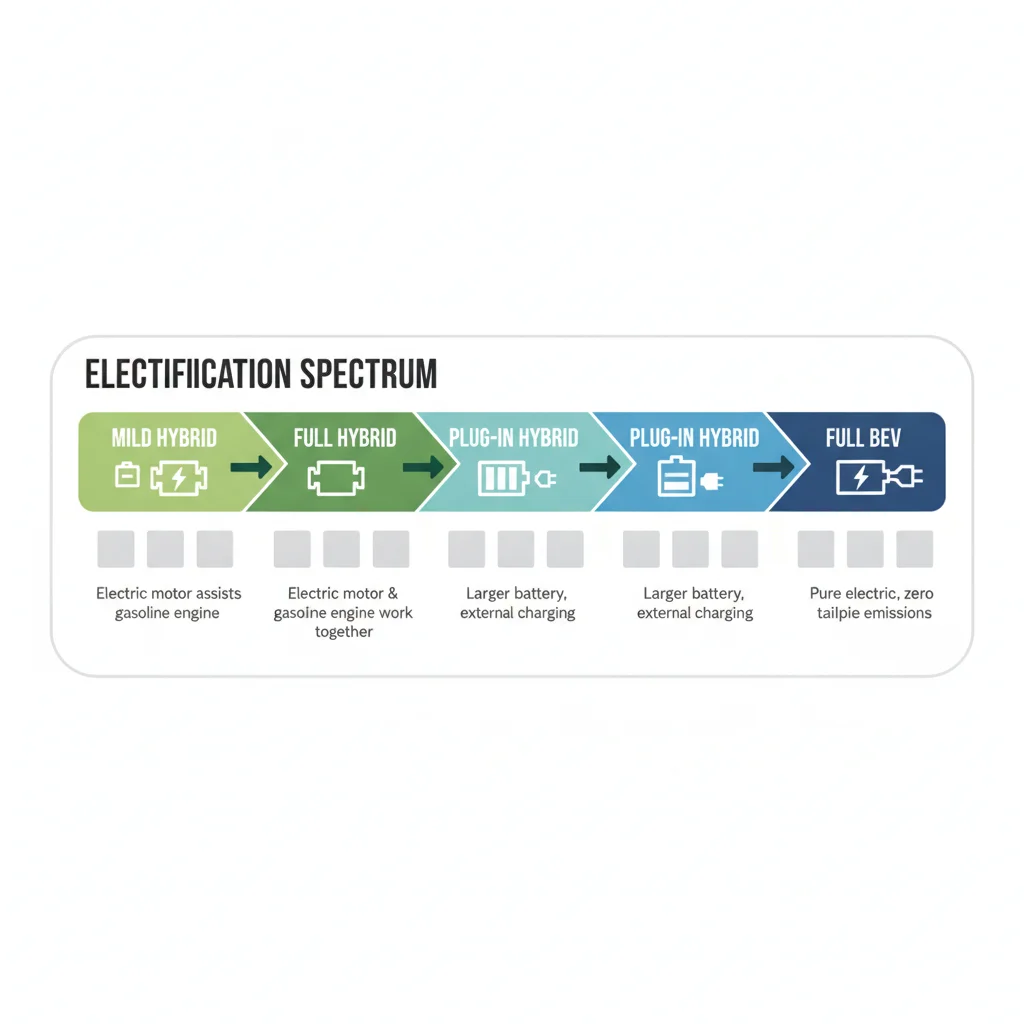
Industry-standard categories include MHEV (mild hybrid), HEV (full hybrid), PHEV (plug-in hybrid), BEV (battery electric), and FCEV (fuel cell electric). Automaker sub-brands layer on top of these classifications rather than replacing them.
Why Badge Names Don't Tell the Whole Story
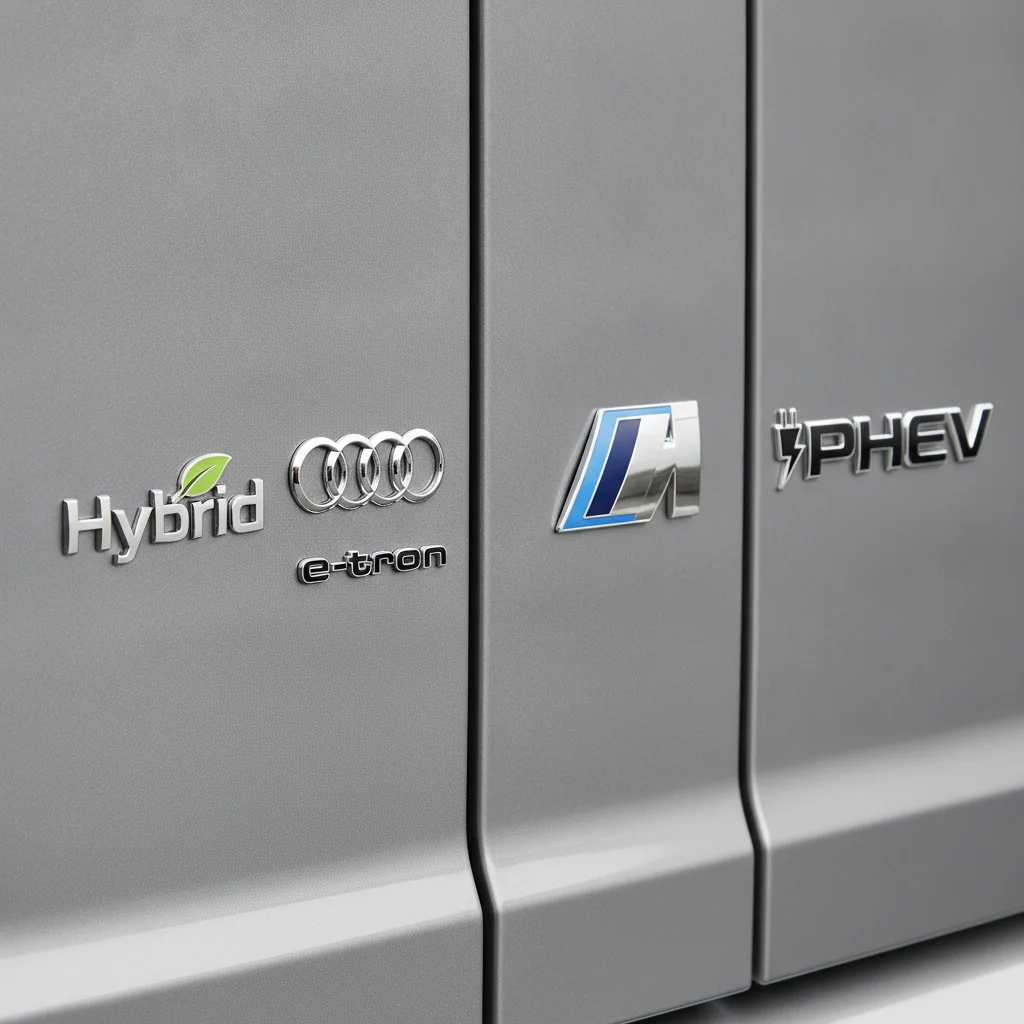
Walk through any large dealership today and you'll encounter an alphabet soup of electrification badges: e-tron on an Audi, xDrive45e on a BMW, EcoHybrid on a Kia, ePHEV on a Mitsubishi. Each badge signals some form of electrification — but the actual powertrain underneath can be wildly different. One badge might mean a car that never needs to be plugged in. Another might mean a vehicle that can drive 50 miles on electricity before the gas engine kicks in. A third might mean a battery so small it only assists the engine at low speeds.
This matters for several reasons. First, your purchase price and ongoing fuel costs depend heavily on the powertrain type. Second, federal and state tax incentives are tied to specific categories — a standard hybrid earns you zero federal credit, while a qualifying plug-in hybrid or BEV can save you up to $7,500. Third, insurance premiums, charging infrastructure needs, and long-term maintenance costs all differ based on what's actually powering the wheels.
The fix isn't to memorize every automaker's badge system — it's to understand the underlying categories, then use that framework to decode whatever badge you're looking at. For a full map of where each category sits on the electrification spectrum, see our guide to the electrified vehicle spectrum.
The Four Core Powertrain Categories You Actually Need to Know
Before we get into brand-specific naming conventions, ground yourself in the four categories that matter for your wallet:
- MHEV (Mild Hybrid Electric Vehicle): A small battery and electric motor assist the gas engine but can't propel the car on electricity alone. No plug required. Modest fuel savings, no tax credits. Examples: Ram 1500 eTorque, certain Mercedes-Benz EQ Boost models.
- HEV (Full Hybrid Electric Vehicle): A larger battery and electric motor can briefly drive the car at low speeds without gas. Still no plug — the battery charges from braking and the engine. Better fuel economy than MHEVs, but still no federal credit. Examples: Toyota Camry Hybrid, Honda CR-V Hybrid.
- PHEV (Plug-In Hybrid Electric Vehicle): A significantly larger battery that you can charge from an outlet. Most PHEVs deliver 20–50 miles of all-electric range before switching to hybrid mode. Qualifies for federal and some state credits. Examples: Ford Escape PHEV, Hyundai Tucson PHEV, Jeep Wrangler 4xe.
- BEV (Battery Electric Vehicle): No gas engine. Runs entirely on electricity stored in a large battery pack. Must be plugged in to refuel. Qualifies for the full federal Clean Vehicle Credit if it meets eligibility rules. Examples: Tesla Model 3, Chevy Equinox EV, Rivian R1T.
There's also a fifth category — FCEV (Fuel Cell Electric Vehicle) — but with only a handful of models available in limited U.S. markets (Toyota Mirai, Hyundai Nexo), it's niche enough to treat separately. If you want the physics behind why BEVs perform the way they do, this piece on instant torque explains the powertrain dynamics clearly.
$7,500
Max federal Clean Vehicle Credit (new BEV/PHEV)
Under the Inflation Reduction Act, qualifying new BEVs and PHEVs can earn up to $7,500; standard hybrids receive nothing.
40+
Distinct electrified sub-brand names in use
A 2023 automotive industry analysis counted more than 40 unique electrification naming conventions across global automakers selling in the U.S.
33%
Shoppers who can't distinguish PHEV from BEV
A 2023 Cox Automotive survey found roughly one-third of new car shoppers could not correctly identify the difference between a plug-in hybrid and a battery electric vehicle.
20–50 mi
Typical PHEV electric-only range
Most plug-in hybrids sold in the U.S. offer between 20 and 50 miles of EV range before the gas engine takes over, per EPA ratings data.
$3,750
Partial credit available to some PHEVs
PHEVs with smaller battery packs may qualify for only a partial federal credit of $3,750, depending on battery capacity and domestic content rules.
How Major Automakers Name Their Electrified Vehicles
Here's where it gets interesting — and confusing. Let's walk through the most common brand-specific naming systems and what they actually tell you.
BMW: 'i' vs. 'e' vs. 'iX'
BMW uses the letter 'i' as a prefix for its dedicated BEV lineup: the i4, i5, i7, iX. These are fully electric. The letter 'e' appears as a suffix in model names like X5 xDrive50e or 330e — those are PHEVs. Confusingly, the 'iX' is a BEV, not a PHEV, even though it follows a different naming pattern than the i4 or i5. The rule of thumb: if 'i' comes before the number, it's a BEV. If 'e' comes after, it's a PHEV.
Audi: e-tron as a Sub-Brand and a Suffix
Audi originally used e-tron as its dedicated BEV sub-brand (e-tron SUV, e-tron GT). More recently, Audi transitioned to the Q8 e-tron naming. However, models like the Q5 55 TFSI e are PHEVs — the lowercase 'e' suffix does the heavy lifting here. Same letter, very different powertrains.
Mercedes-Benz: EQ vs. EQ Boost
Mercedes separates its lineup into EQ (dedicated BEVs: EQS, EQE, EQB) and EQ Boost (mild hybrids found in many regular AMG models). The EQ family requires a plug; EQ Boost models never do. Mercedes also offers PHEVs badged as e — for example, the GLE 350 de uses diesel-electric plug-in technology for European markets.
Ford: Hybrid, PHEV, and Mustang Mach-E
Ford keeps its naming relatively transparent compared to European brands. Hybrid badges denote HEVs (Maverick Hybrid, Escape Hybrid). PHEV is spelled out explicitly (Escape PHEV, F-150 Lightning is actually a BEV). The Mustang Mach-E stands alone as Ford's dedicated BEV SUV. Ford's commercial vans use the E-Transit name for BEVs. Reasonably clear by industry standards.
Toyota: Hybrid, Plug-in Hybrid, and bZ
Toyota's Hybrid badge is ubiquitous across its lineup (Camry Hybrid, RAV4 Hybrid, Highlander Hybrid) — these are all HEVs. The Prime designation signals a PHEV (RAV4 Prime, Prius Prime). The bZ prefix marks Toyota's BEV lineup — the bZ4X is the main U.S. model. Clear and consistent, though bZ4X took time to gain market recognition.
Hyundai/Kia: Hybrid, PHEV, and Ioniq/EV6
Hyundai keeps standard models and adds Hybrid or Plug-in Hybrid to the nameplate (Tucson Hybrid, Tucson Plug-in Hybrid). For BEVs, Hyundai created the Ioniq sub-brand (Ioniq 5, Ioniq 6, Ioniq 9). Kia mirrors this with explicit Hybrid/PHEV suffixes and the EV6 and EV9 nameplates for BEVs. Both brands are among the clearest communicators in the industry.
General Motors: Ultium and the Chevy EV Strategy
GM uses Ultium as the platform name for its BEV architecture — but Ultium doesn't appear on window stickers or model names. Instead, GM badges BEVs with an 'EV' suffix (Chevy Equinox EV, Chevy Blazer EV, GMC Sierra EV). The Chevy Silverado EV and Cadillac LYRIQ are also BEVs. GM has largely exited the standard hybrid market, so if you see an 'EV' in the name, it's almost certainly a BEV.
FCEV: The Fifth Category Worth Knowing
Fuel cell electric vehicles (FCEVs) run on hydrogen, emit only water vapor, and are refueled at hydrogen stations rather than conventional chargers. The Toyota Mirai and Hyundai Nexo are the two models available in limited U.S. markets (primarily California). FCEVs are technically BEVs in that they use an electric motor, but the energy source is hydrogen rather than a plug-charged battery. They have their own incentive eligibility rules.
Window Sticker vs. Badge: Always Trust the Sticker
Federal law requires all new vehicles to display a Monroney label (window sticker) that clearly states the fuel type, powertrain technology, and fuel economy. If the badge and the sticker seem to conflict — or if a salesperson's description doesn't match what's on the sticker — the sticker is the legally mandated disclosure. Always ask to see it before signing anything.
Used Electrified Vehicles and the $4,000 Credit
The IRA also introduced a Used Clean Vehicle Credit of up to $4,000 for qualifying pre-owned BEVs and PHEVs purchased from a licensed dealer. The vehicle must be at least two model years old, priced at $25,000 or less, and the buyer must meet income limits. Standard used hybrids do not qualify. This makes the PHEV vs. HEV distinction just as important in the used market as it is when buying new.
“The proliferation of EV sub-brands and badges has created a marketing Tower of Babel. What consumers need isn't another catchy name — they need to know whether to look for a charging station or a gas pump.”
— Jessica Caldwell, Executive Director of Insights, Edmunds
The Incentive Trap: How Badge Confusion Can Cost You Thousands
Here's the real-world consequence of getting this wrong at the dealership. A buyer who mistakes a BMW 330e (PHEV) for a full BEV might assume they're getting the same federal tax credit as a BMW i4 buyer — but the credit amounts and eligibility rules differ. As of 2024, the federal Clean Vehicle Credit for new vehicles under the Inflation Reduction Act (IRA) applies to PHEVs and BEVs that meet domestic content, battery sourcing, and income/price thresholds. Critically, some PHEVs qualify for a partial credit rather than the full $7,500, depending on battery capacity.
Meanwhile, a standard hybrid — no matter how prestigious the badge — earns exactly zero federal credit. If a dealer presents you with an HEV and you assume the badge means BEV, you could be making a multi-thousand-dollar miscalculation before you've even negotiated the price.
The safest approach: before stepping into a dealership, confirm the powertrain category on fueleconomy.gov. The site shows the EPA classification, electric range (if applicable), and whether the vehicle has historically qualified for credits. Then cross-reference with the IRS's qualified vehicles list at irs.gov. Our breakdown of hybrids vs. electric cars walks through these distinctions in plain English if you want to go deeper before you shop.
Screenshot the IRS Qualified Vehicle List Before You Shop
The IRS updates its qualified vehicle list at irs.gov in real time as automakers certify new models. Pull it up on your phone before visiting a dealership and filter for the models you're considering. A vehicle on this list with a dollar amount next to it is confirmed eligible — no dealer claim can substitute for this verification.
Ask the Dealer for the EPA Range Figure, Not the Marketing Range
Automakers often advertise 'up to' range figures that reflect ideal conditions. Always ask for the EPA-rated electric range for PHEVs and the EPA-rated total range for BEVs. These numbers are the closest thing to a real-world benchmark and appear on the fuel economy label required on every new vehicle.
How to Decode Any Electrified Badge in Three Steps
You don't need to memorize every automaker's naming matrix. Use this quick framework whenever you encounter an unfamiliar electrified badge:
- Look for plug language. Does the model name or trim level include 'PHEV,' 'Plug-in,' 'Prime,' or a separate 'e' designation? That signals a plug-in capability. If there's no mention of plugging in, assume it's an HEV or MHEV.
- Check the fuel economy label. The Monroney sticker on every new car sold in the U.S. is required to state the fuel economy and powertrain type clearly. A BEV will show MPGe only. A PHEV will show both electric range (miles) and gas MPG. An HEV will show combined MPG without any electric range figure.
- Verify on fueleconomy.gov or the IRS qualified vehicles list. Both are free and updated regularly. If the vehicle appears on the IRS list with a credit amount, it qualifies — full stop. If it doesn't appear, it doesn't qualify, regardless of what the badge implies.
Understanding charging costs is the next step after confirming your powertrain type. Our glossary of EV charging terms covers kWh, MPGe, efficiency ratings, and what actually determines your monthly electricity bill as an EV or PHEV owner.
For a deeper look at how the electric drivetrain itself works — motors, inverters, battery management — our plain-language EV mechanics guide is the right next read. And if you're at the point where you're ready to insure an electrified vehicle, our EV insurance guide explains how premiums are calculated and where BEV and PHEV owners can expect to pay more or less than gas car owners.


All claims are backed by peer-reviewed research. Sources on request.