Key Takeaways
Extra Payments on an Auto Loan
Paying more than your required monthly minimum on an auto loan reduces the outstanding principal faster than your lender's original schedule. Because interest is calculated on the remaining balance, a lower principal means less interest accrues each month. Over time, even modest extra payments can shorten your loan by months — sometimes years — and save hundreds or thousands of dollars in total interest.
Most simple-interest auto loans calculate interest daily using the formula: Daily Interest = (Annual Rate ÷ 365) × Remaining Principal. Any amount applied to principal today immediately reduces tomorrow's interest accrual.
Why Every Dollar You Pay Early Is Worth More Than It Seems
Most people think of a car loan as a fixed expense: you borrow a set amount, pay the same amount every month, and eventually it's done. What that framing misses is that the total interest you owe is not fixed at all. It's a moving target — and you have more control over it than the lender wants you to realize.
Auto loans in the United States are almost always structured as simple-interest loans. That means interest accrues daily on whatever principal balance remains. Every time you make a payment, part of it covers accrued interest and the rest chips away at the balance. The smaller the balance, the less interest accumulates tomorrow. This creates a compounding effect in reverse: faster paydown → lower balance → less interest → faster paydown.
Extra payments exploit this mechanism directly. When you send money beyond your required minimum — and ensure it's applied to principal — you shrink the balance ahead of schedule. Every subsequent month, the lender calculates interest on that smaller number. The savings aren't dramatic on any single day, but they accumulate across months and years into real money.
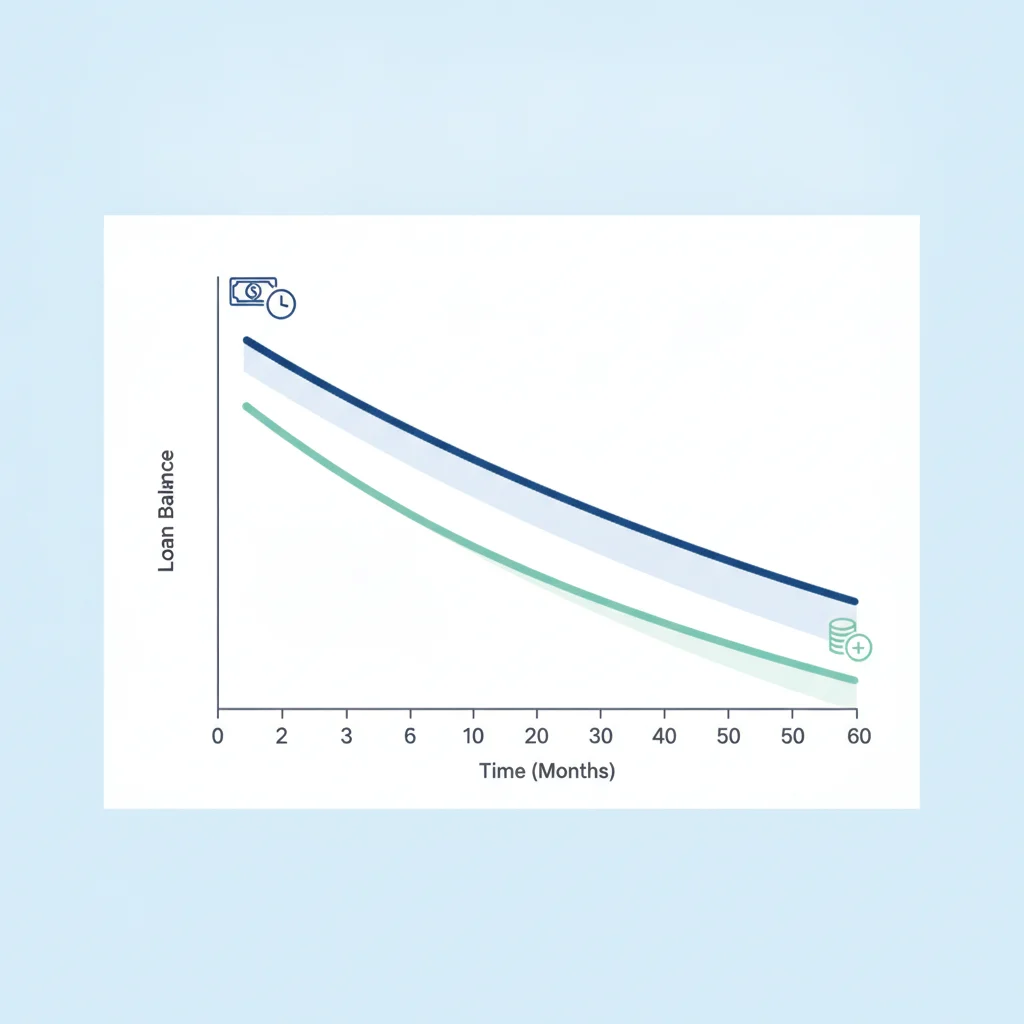
Understanding this dynamic is the starting point. The next step is putting real numbers behind it, because the math is more encouraging than most borrowers expect.
The Core Math: How Interest Accrues and Where Extra Payments Hit
Let's build the calculation from the ground up so the logic is clear, not abstract.
Step 1: How your required payment is split
On a $25,000 loan at 7% APR over 60 months, your fixed monthly payment is approximately $495.03. In month one, here's how that payment breaks down:
| Component | Amount |
|---|---|
| Interest charged (7% ÷ 12 × $25,000) | $145.83 |
| Principal repaid | $349.20 |
| Remaining balance after payment | $24,650.80 |
Notice that nearly 30% of your first payment goes to interest, not reducing what you owe. In month two, the interest portion drops slightly because the balance is a bit lower — but without extra payments, this process takes the full 60 months to unwind.
Step 2: What an extra $50/month actually does
If you add $50 to each monthly payment — bringing your total to $545.03 — that $50 goes entirely to principal (assuming your lender applies it correctly). Here's the cumulative impact:
| Scenario | Total Interest Paid | Loan Payoff |
|---|---|---|
| Standard payments only ($495/mo) | $4,701 | 60 months |
| Extra $50/month ($545/mo) | $4,243 | ~55 months |
| Extra $100/month ($595/mo) | $3,820 | ~51 months |
| Extra $200/month ($695/mo) | $3,083 | ~44 months |
Paying an extra $50 per month saves approximately $458 in interest and cuts five months off the loan. That's a net savings of $458 for an investment of $50 × 55 months = $2,750 in extra contributions — a roughly 17% guaranteed return on those extra dollars.
$458
Interest saved by $50/month extra
Based on a $25,000 auto loan at 7% APR over 60 months, adding $50 to each payment eliminates approximately $458 in total interest.
5 months
Loan shortened by $50/month extra
The same $25,000 / 7% APR loan is paid off in roughly 55 months instead of 60 when $50 is added to every payment.
~17%
Effective return on extra payments at 7% APR
Every extra dollar applied to principal generates roughly 17 cents in guaranteed interest savings over the remaining loan life — equivalent to a risk-free 7% return.
$660
Interest saved at 9% APR with $50/month extra
At a higher 9% rate, the same $50/month extra payment on a $25,000 60-month loan saves approximately $660 — illustrating how rate amplifies extra-payment value.
$1,100+
Savings from a $2,000 lump-sum payment
Applying a $2,000 windfall in month 9 of a $18,500, 7% APR loan can save over $1,100 in interest and shorten the loan by roughly 9 months.
Step 3: Why early extra payments beat late ones
If you send an extra $500 in month 3 versus month 48, the month-3 payment saves considerably more total interest. The reason: in month 3, the balance is still high, so reducing it creates 45+ months of compounded interest savings. In month 48, only 12 months remain and the balance is already low — there's less room for the effect to compound.
This is why financial advisors often say: the best time to make an extra payment was yesterday, and the second-best time is today.
Lump Sums vs. Small Monthly Additions: Which Saves More?
Both strategies work, but they work differently depending on the size of the extra money and when it arrives.
Simple Interest vs. Precomputed Interest Loans
The strategies in this article apply to simple-interest auto loans, which are the overwhelming majority of loans issued by banks, credit unions, and captive lenders in the United States. Precomputed-interest loans calculate total interest upfront and embed it into the payment schedule — extra payments on these loans may not reduce interest at all. Check your loan agreement or ask your lender which type you have before making extra payments.
Confirm Your Loan Has No Prepayment Penalty
While prepayment penalties are uncommon on auto loans — and banned on certain federally regulated loans — they do appear in some subprime and buy-here-pay-here contracts. A prepayment penalty charges you a fee for paying off the loan early, which can offset some or all of your interest savings. Review your loan documents or call your lender to verify before sending any extra money.
Monthly extra payments: consistent, predictable, budget-friendly
Adding a fixed amount to each monthly payment is the easiest strategy to maintain. You set it, possibly automate it, and the savings accumulate steadily. As shown in the table above, even $50 extra per month produces meaningful results over a 60-month loan.
This approach also fits naturally into rounding up your payment. If your payment is $312, paying $350 consistently produces real savings without requiring a separate decision each month.
Lump sums: high impact, concentrated savings
A one-time extra payment of $1,000 in month 6 of the example loan above would eliminate roughly $800–$900 in interest over the life of the loan — more than sending $50/month for 18 months would save. That's because the lump sum hits the principal all at once, immediately reducing the base from which daily interest is calculated for every remaining month.
Tax refunds, work bonuses, gifts, and legal settlements are all candidates for this strategy. See how to apply windfalls to your auto loan for a step-by-step guide on timing and directing those funds.
The hybrid approach
Many borrowers find the most effective strategy is to do both: add a modest amount to each monthly payment for steady principal reduction, then apply any windfalls as they come. This captures the compounding benefit of consistent small payments while taking full advantage of unexpected cash.
Whatever approach you choose, always confirm how your lender applies additional funds — this is the single most important practical step, and it's covered in detail below.
The Critical Catch: How Lenders Actually Apply Extra Money
The math above assumes extra payments reduce your principal immediately. But that assumption can be wrong — and it's a costly mistake to overlook.
Some lenders, when they receive more than your required payment, apply the overage as a credit toward your next scheduled payment rather than as a principal reduction. This means your loan doesn't shorten at all — the lender simply considers your next month's payment pre-paid. No interest savings, no faster payoff. Just your money sitting with the lender.
Always Specify 'Apply to Principal' in Writing
When making an extra payment, include a written note — via secure message, email, or the payment memo field — stating: 'Please apply this payment to principal balance only.' Keep a copy. Then verify on your next statement that the balance dropped by the full extra amount beyond the normal principal portion. If it didn't, contact your lender immediately to correct the application.
Check Your Balance Monthly, Not Just Your Payment Due
Because extra payments shorten your loan rather than reduce your monthly bill, progress is invisible if you only look at the payment amount. Log into your lender portal each month and note your remaining balance. Compare it to the original amortization schedule (your lender can provide one). A faster-falling balance is your confirmation that extra payments are working as intended.
Others apply extra funds correctly by default, reducing principal immediately. The only way to know which camp your lender falls into is to ask directly or check your loan agreement.
Before sending any extra payment, take these steps:
- Call or message your lender and explicitly request that any payment above the required minimum be applied to principal, effective immediately.
- Document the request — use email or your lender's secure message portal so you have a written record.
- Review your next statement to confirm the balance dropped by the full extra amount, not just the normal principal portion of a standard payment.
For a complete pre-payment checklist, see what to check before making extra car payments. It covers prepayment penalties, payoff quotes, and application instructions in detail.
Also understand the distinction between making extra payments and what actually changes in your loan account. What actually changes when you pay extra walks through the lender's side of the transaction, including how amortization schedules are recalculated.
Comparing Extra Payments to Other Ways of Reducing Interest
Extra payments are one tool among several for cutting the total cost of your auto loan. Understanding how they compare helps you prioritize the right strategy for your situation.
Extra payments vs. refinancing to a lower rate
Refinancing replaces your existing loan with a new one at a lower interest rate. If you can drop from 9% to 6% APR, the savings can be substantial — see how rate reductions translate to real savings for side-by-side numbers. Refinancing affects every remaining payment, whereas extra payments accelerate principal reduction within your current rate. If your rate is already competitive, extra payments are your primary lever. If your rate is high and your credit has improved, refinancing first — then making extra payments — delivers the best of both strategies.
Extra payments vs. a larger down payment
A larger down payment reduces the principal from day one, which means you benefit from a lower base amount for the entire loan. Extra payments catch up over time but start from a higher balance. If you're at the purchase stage and have cash available, putting more money down is typically more efficient than making post-purchase extra payments. If you're already in the loan, extra payments are your best path.
“The most powerful financial tool available to a borrower isn't a better interest rate — it's the discipline to send extra money to principal before it gets absorbed by everyday spending. The rate is set; the behavior is controllable.”
— Liz Weston, Certified Financial Planner and nationally syndicated personal finance columnist
Interest rate matters enormously
The higher your rate, the more each extra payment saves. At 3% APR, an extra $50/month on a $25,000 60-month loan saves roughly $140 in interest. At 9% APR, the same extra $50/month saves approximately $660. If you're carrying a high-rate loan, extra payments become dramatically more valuable — and so does the urgency of making them early.
For a deeper look at how rates interact with total cost across the interest and APR fundamentals, the hub covers everything from how APR is calculated to how it differs from your nominal rate.
Building a Practical Extra Payment Plan
Knowing the math is step one. Turning it into a habit is step two.
Start with what's realistic, not what's ideal
A $50 extra payment you actually make every month beats a $300 extra payment you commit to and skip. Look at your monthly cash flow and identify an amount that doesn't require sacrificing essentials. Even $25–$30 extra produces meaningful results over a 5-year loan.
Need help identifying where to find that extra money? Freeing up cash to pay off your car loan faster offers practical strategies — from subscription audits to tax refund planning — for finding room in a tight budget.
Use an amortization calculator
Before you commit, run your own numbers. Input your loan balance, interest rate, remaining term, and proposed extra payment into any free online amortization calculator. You'll see a month-by-month projection of your new payoff date and total interest — concrete numbers that make the decision feel real, not abstract.

Track the loan term, not just the monthly payment
Because extra payments typically shorten the loan rather than reduce monthly payments, the progress you're making won't be visible in your monthly bill. Track it by monitoring your loan balance each month and comparing it to the original amortization schedule. If your balance is falling faster than the original schedule projected, your extra payments are working.
Always Specify 'Apply to Principal' in Writing
When making an extra payment, include a written note — via secure message, email, or the payment memo field — stating: 'Please apply this payment to principal balance only.' Keep a copy. Then verify on your next statement that the balance dropped by the full extra amount beyond the normal principal portion. If it didn't, contact your lender immediately to correct the application.
Check Your Balance Monthly, Not Just Your Payment Due
Because extra payments shorten your loan rather than reduce your monthly bill, progress is invisible if you only look at the payment amount. Log into your lender portal each month and note your remaining balance. Compare it to the original amortization schedule (your lender can provide one). A faster-falling balance is your confirmation that extra payments are working as intended.
Don't sacrifice high-interest debt to pay down a low-rate car loan
If you're carrying credit card debt at 20% APR and your auto loan is at 5%, the mathematically correct choice is to pay off the credit card first. Extra car payments are most powerful when your auto loan is your highest-cost debt. Context matters — run the full picture before committing your extra cash.
Common Misconceptions About Extra Car Payments
Even motivated borrowers get tripped up by a few persistent myths. Let's clear them up.
"My monthly payment will go down if I pay extra."
For nearly all standard auto loans, this is false. Your required monthly payment stays fixed. Extra payments shorten the loan's duration. Some lenders offer reamortization — recalculating monthly payments based on the new lower balance — but this usually requires a formal request and may involve a fee. It's not the default behavior.
"It doesn't matter much if I start extra payments later."
It matters considerably. Interest savings are front-loaded in reverse — meaning the earlier you reduce principal, the more months of reduced interest you capture. Waiting until month 36 of a 60-month loan to start paying extra gives you only 24 months for the savings to compound. Starting in month 3 gives you 57.
"Any extra money I send goes to principal automatically."
As covered above, this is not guaranteed. Why your extra payment might not reduce your principal explains exactly how lenders can redirect your overage and what you need to do to prevent it.
Simple Interest vs. Precomputed Interest Loans
The strategies in this article apply to simple-interest auto loans, which are the overwhelming majority of loans issued by banks, credit unions, and captive lenders in the United States. Precomputed-interest loans calculate total interest upfront and embed it into the payment schedule — extra payments on these loans may not reduce interest at all. Check your loan agreement or ask your lender which type you have before making extra payments.
Confirm Your Loan Has No Prepayment Penalty
While prepayment penalties are uncommon on auto loans — and banned on certain federally regulated loans — they do appear in some subprime and buy-here-pay-here contracts. A prepayment penalty charges you a fee for paying off the loan early, which can offset some or all of your interest savings. Review your loan documents or call your lender to verify before sending any extra money.
"Paying off early hurts my credit score."
Closing a loan account in good standing does have a minor short-term effect on your score, primarily because it reduces your mix of open accounts. However, this effect is small and temporary. The financial benefit of eliminating interest charges almost always outweighs a brief credit score dip — particularly if you have other open accounts building your credit history.
Putting It All Together: What You Should Do Next
The math behind extra car payments isn't complicated once you see it laid out. A simple-interest loan penalizes you for carrying a high balance and rewards you for reducing it quickly. Every extra dollar you apply to principal today saves you more than a dollar in future interest — the exact amount depends on your rate, remaining term, and when you act.
Here's your action checklist:
- Find your remaining loan balance, interest rate, and months left — these are on your monthly statement or lender portal.
- Run the numbers using an amortization calculator with your actual figures. Input a few different extra-payment scenarios ($25, $50, $100) and see the payoff date and interest savings for each.
- Contact your lender to confirm how extra payments are applied. Request principal-only application in writing.
- Choose a realistic extra payment amount — one you can sustain, not just commit to in theory.
- Set up the payment either manually each month or via autopay if your lender allows a custom recurring amount.
- Monitor your balance monthly against your original amortization schedule to verify progress.
The biggest factor in how much you save is not how large your extra payments are — it's how consistently you make them and how early you start. A $50 habit begun in month 1 outperforms a $200 burst that starts in month 40.
Once you've got your extra payment strategy in place, consider whether understanding your loan terms more broadly might reveal other ways to reduce your total borrowing cost. And if your current rate is high, compare the value of extra payments against refinancing to a lower APR — in some cases, tackling the rate first multiplies the impact of every extra dollar you pay.

All claims are backed by peer-reviewed research. Sources on request.