Key Takeaways
Why Windfalls Are a Rare Chance to Beat the Lender
Auto loans are front-loaded with interest. In the early months of your loan, the majority of each monthly payment goes toward interest — not the principal balance you actually borrowed. That's how simple interest amortization works, and it's why paying extra early in the loan is so much more powerful than paying extra later.
A windfall — whether a year-end bonus, an inheritance gift, or a legal settlement — drops a lump sum into your lap at a moment you didn't expect. Most people treat that money as a bonus for spending. But if you have an auto loan, that lump sum is actually a tool for buying back months of your loan term and reclaiming hundreds or even thousands of dollars in future interest charges.
The key is knowing exactly how to direct those funds so they work as hard as possible. If you simply mail in extra money or make a payment through your lender's app without clear instructions, the money may be applied to future monthly payments instead of your principal — and you'll lose most of the benefit.
This guide walks you through the specific steps and strategies to make sure every dollar of a windfall does the maximum work on your loan. If you're new to how auto loan interest is calculated, see our introduction to early auto loan payoff before continuing.

How to Actually Apply a Lump Sum to Your Principal
This is where most borrowers make a costly mistake: they send in extra money without telling the lender how to apply it. Lenders are not legally required to apply overpayments to your principal. Many will simply mark your account as paid ahead — meaning your next regular payment is delayed, not your interest.
To apply a windfall correctly, follow these steps:
- Call your lender before sending money. Ask specifically: "If I send an extra payment, how do I ensure it's applied to the principal balance only?" Get the answer in writing via email confirmation or a reference number.
- Write "Apply to principal only" on your check if you're mailing a physical payment. Some lenders accept this notation; others require a separate cover letter or online form.
- Use the lender's online portal if available. Many lenders now have a dropdown or checkbox that lets you designate an extra payment as "principal only." Use it explicitly.
- Confirm afterward. Log in or call within 5 business days to verify the payment was applied as instructed. Check that your principal balance dropped by the amount you sent.
For a deeper look at the math behind what happens when you apply extra funds correctly, our companion piece on how extra car loan payments reduce total interest shows the numbers in detail.
Always designate extra payments as 'principal only' in writing before funds are sent.
Without a clear designation, lenders may apply your extra payment to future scheduled payments, which delays interest accrual rather than reducing your principal. This silent misapplication costs borrowers real money without them ever knowing it happened.
Apply the windfall as soon as possible after receiving it — don't let it sit.
Auto loan interest accrues daily on the outstanding principal balance. Every day you delay applying extra funds is another day of interest calculated on a higher balance. Two weeks of delay on a $3,000 payment at 8% APR costs roughly $13 in unnecessary interest — small but avoidable.
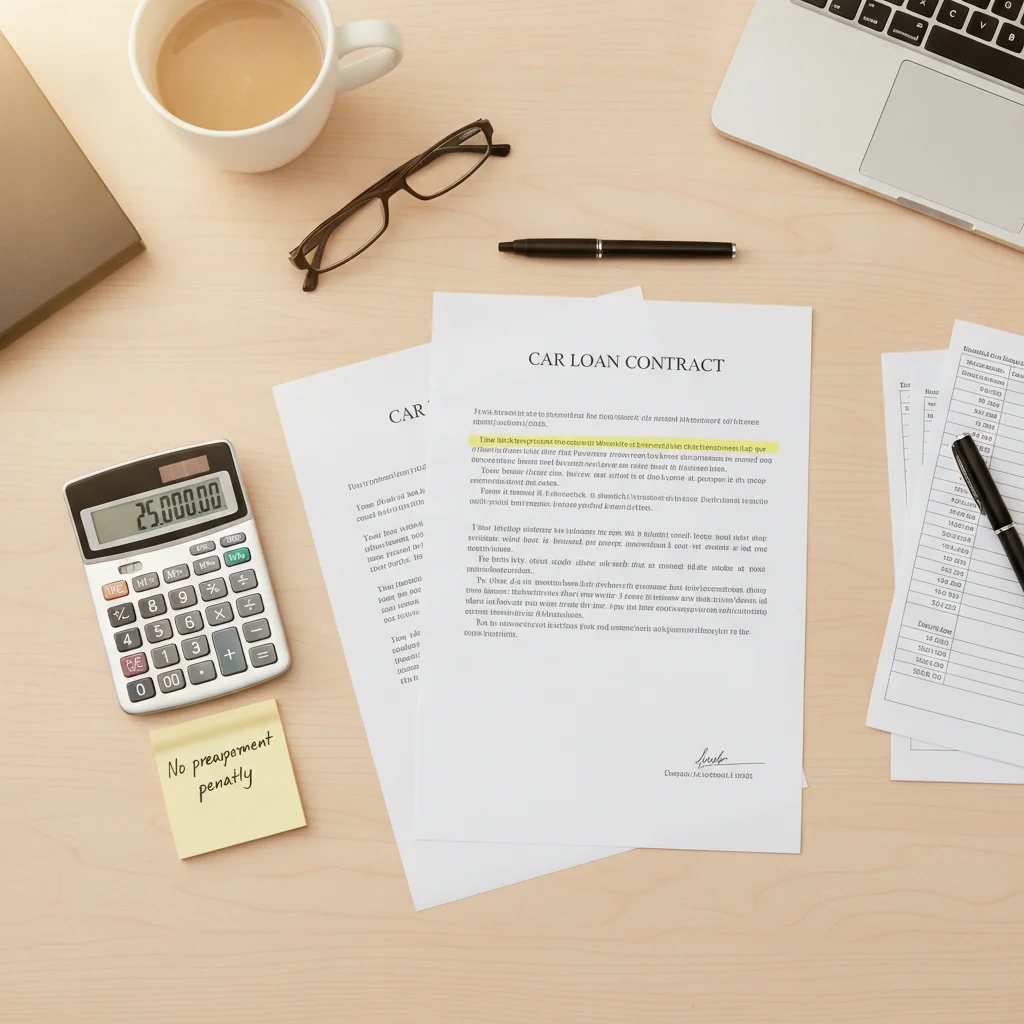
Check your loan contract for prepayment penalties before sending any lump sum.
While prepayment penalties are uncommon in modern U.S. auto loans, they still appear in some contracts — particularly those using the Rule of 78s calculation method. Paying off a large chunk without checking could trigger an unexpected fee that negates some or all of the interest savings.
Keep your monthly payment the same after a principal reduction — don't re-amortize.
When your principal drops, lenders may offer to recalculate (re-amortize) your loan so your monthly payment decreases. Accepting this offer keeps your term the same and reduces the interest savings. Maintaining your original payment means the loan simply ends sooner.
Fund or verify your emergency reserve before applying a windfall to any loan.
Applying your entire windfall to an auto loan and then facing a car repair or job disruption could force you into high-interest credit card debt — which costs far more than the auto loan interest you saved. A 3-month emergency fund is the prerequisite.
Request a written payoff quote from your lender before sending a full or near-full payoff amount.
Payoff balances include accrued daily interest not yet reflected in your statement balance. If you send your current balance amount without a payoff quote, you may underpay by a small amount, leaving a residual balance that continues to accrue interest — and potentially triggers a late fee.
Best Practices for Windfall Paydown Strategies
Applying a windfall isn't just about sending extra money — it's about timing it right, sizing it correctly, and knowing your loan contract's rules. The practices below represent the most reliable approaches for turning unexpected income into lasting interest savings.
The Tax Refund, Bonus, and Settlement: Each Source Is Slightly Different
Not all windfalls work exactly the same way when it comes to applying them to an auto loan. Here's how to think about each type:
Work Bonuses
Bonuses are the most straightforward. The money lands in your checking account and you own it outright. There are no documentation requirements from your lender. The main decisions are timing (apply it immediately vs. wait until your statement closes) and sizing (apply all of it or keep a portion in emergency savings).
Tax Refunds
A federal or state refund is functionally identical to a bonus from your lender's perspective — it's your money, no strings attached. The one strategic consideration: refunds often arrive in February or March. If your loan is less than 12 months old, you're still in the heaviest interest-accumulation window. Applying a refund then can be especially impactful.
Monetary Gifts
Gifts from family members — say, a holiday gift or an inheritance advance — are yours to use freely on an auto loan. However, if you used a gift as part of your original down payment, lenders may have asked for a gift letter at the time of origination. For a mid-loan paydown, no such letter is typically required. That said, if the amount is large (over $10,000), be aware of IRS gift tax reporting rules — though that's a tax issue, not a lender issue. See our related article on using gift funds for auto loan down payments for context on how lenders view gift money.
Legal Settlements
Settlement checks can sometimes trigger questions from lenders about the source of funds, particularly for very large amounts. In practice, most lenders have no interest in where your extra principal payment came from. But if you're paying off a large portion of a loan balance at once — say, more than 50% — it may trigger a payoff quote request. Contact your lender first to get an exact payoff figure, which accounts for any accrued daily interest not yet reflected in your balance.
When Lenders Request a Payoff Quote
If you're paying off 50% or more of your remaining balance in one payment, ask your lender for a formal payoff quote rather than relying on your last statement balance. Payoff quotes include all accrued daily interest up to the payment date and are typically valid for 10–30 days. This step prevents a situation where a small residual balance lingers on your account after you think the loan is resolved.
Gift Tax Rules Apply to Givers, Not Borrowers
If a family member gives you money to apply to your auto loan, you don't owe gift tax — that's the giver's responsibility, and only for amounts above the IRS annual exclusion ($18,000 per recipient in 2024). From your lender's perspective, the money is simply an extra payment. No gift documentation is required for mid-loan principal payments.
Inheritance or Estate Distributions
These are treated similarly to gifts. The amount and timing may vary unpredictably, but the application strategy is the same: confirm the correct designation with your lender, apply to principal, and verify afterward.
$1,200+
Potential interest saved on a 60-month loan
A $2,000 lump-sum principal payment applied in month 6 of a $25,000 loan at 8% APR can save over $1,200 in total interest and shorten the term by several months, based on standard amortization modeling.
8.7%
Average new car loan interest rate (2024)
According to Experian's State of the Automotive Finance Market Q4 2024, the average new vehicle loan interest rate reached 8.7%, making principal reduction especially valuable.
68 months
Average new car loan term in the U.S.
Experian data shows the average new car loan term now exceeds 68 months, meaning more borrowers spend more time in the interest-heavy early phase where windfalls have the greatest impact.
Should You Pay Down the Loan or Keep the Cash?
The right answer depends on your full financial picture. Paying down an auto loan is essentially a guaranteed return equal to your loan's interest rate — if your rate is 7%, every dollar applied to principal saves you 7 cents per year in guaranteed interest, risk-free.
Compare that to:
- Keeping cash in a high-yield savings account: If your savings rate exceeds your loan rate, holding the cash may pencil out — but only after considering tax on savings interest.
- Paying off higher-interest debt first: If you carry credit card balances at 18–24%, those should almost always be addressed before your auto loan.
- Emergency fund gaps: Never drain your emergency savings to pay down a car loan. A good rule is to keep 3–6 months of expenses liquid before applying any windfall to debt.
If your auto loan rate is above 6% and your emergency fund is fully funded, applying a windfall to the loan is almost always the right call from a pure math standpoint.
“The guaranteed return from paying down a fixed-rate loan is one of the few truly risk-free investments available to everyday consumers. You know exactly how much interest you're avoiding, and it happens immediately.”
— Greg McBride, Chief Financial Analyst, Bankrate
If you're weighing multiple uses for the money, our article on freeing up cash to pay off your car loan faster can help you think through the trade-offs systematically.
Checking for Prepayment Penalties Before You Act
Most auto loans in the United States do not include prepayment penalties. Federal law and most state consumer protection statutes limit or prohibit prepayment penalties on personal auto loans. But "most" is not "all."
Before applying any windfall, pull out your loan contract — the one you signed at the dealership or with your lender — and look for these terms:
- "Prepayment penalty"
- "Early termination fee"
- "Rule of 78s" or "Sum of Digits" method
The Rule of 78s is a specific interest calculation method that front-loads interest in a way that penalizes early payoff. It's now banned for most loan terms over 61 months in the U.S., but it may still appear in older contracts or certain lender types.
If you can't locate your original contract, call your lender directly and ask: "Is there a prepayment penalty or early payoff fee on my account?" Document the response.
Ask for a Prepayment Penalty Answer in Writing
If your lender verbally tells you there's no prepayment penalty, follow up with an email saying 'Just confirming our call: there is no prepayment penalty on loan #XXXXX.' A written confirmation protects you if a fee appears later. Most lenders will confirm this quickly and without issue.
Time Large Payments Around Statement Dates
If your loan statement closes on the 15th of each month, applying a windfall on the 13th means it will appear clearly on your next statement, making it easy to verify the balance drop. This isn't mandatory, but it simplifies your record-keeping and makes any discrepancies easier to spot.
If you're still in the car-buying phase and haven't taken a loan yet, this is also a negotiation point — you can ask that any prepayment penalty clause be struck from the contract before signing. Our hub on down payments and loan structure covers what else to watch for in loan terms.
Timing Your Windfall Payment for Maximum Effect
Timing matters more than most borrowers realize. Here's why:
Auto loans accrue daily interest on your outstanding principal balance. Every day you carry a higher balance, you pay more interest. This means that applying a windfall on Day 1 of receiving it is almost always better than waiting — even a two-week delay costs you two weeks of additional interest accrual.
There's one exception: if your payment statement closing date is a few days away, it may be worth waiting until the statement closes so the new balance is cleanly reflected. This is a minor timing optimization and shouldn't delay you by more than 3–5 days at most.
Also consider this strategic framing: if you receive a bonus in December and your loan is just 6 months old, applying it then — near the peak of your amortization curve's interest-heavy phase — will save more than applying the same amount in month 48 of a 60-month loan, when most of what remains is principal anyway.
For those still in the planning phase — perhaps expecting a bonus and wondering whether to use it as a down payment instead — see our resource on ways to increase your down payment before buying a car.

After the Payment: Track the Impact and Plan Ahead
Once you've applied your windfall correctly, verify the results and capture the benefit:
- Check your new amortization schedule. Many lenders will generate an updated schedule after a large principal payment. If yours doesn't offer this automatically, use an online auto loan amortization calculator with your new balance, remaining term, and interest rate to see how many months you've shaved off.
- Decide whether to reduce your monthly payment or shorten your term. Some lenders will offer to re-amortize the loan — spreading your new lower balance over the remaining term, which lowers your monthly payment. This is convenient, but it reduces the interest savings. If you can afford to keep your payment the same and just let the loan end earlier, do that.
- Document everything. Save the confirmation that your payment was applied to principal, save your updated balance statement, and note the new projected payoff date. This protects you if there's ever a dispute.
- Set an intention for the next windfall. If applying this payment felt good — and it will once you see your balance drop — plan to do it again. Even a modest $500 applied to principal each year makes a meaningful cumulative difference.
The goal isn't just to pay off one loan. It's to build the habit of treating unexpected money as a financial tool — not a spending event. That mindset change is worth more than any single bonus.

All claims are backed by peer-reviewed research. Sources on request.