Key Takeaways
Down Payment–Credit Score Interaction
When you apply for an auto loan, lenders weigh both how much money you put down upfront and how reliably you've repaid debt in the past. These two factors work together: a bigger down payment reduces the lender's financial exposure, which can partially compensate for a lower credit score and result in better loan terms than your credit history alone would earn you.
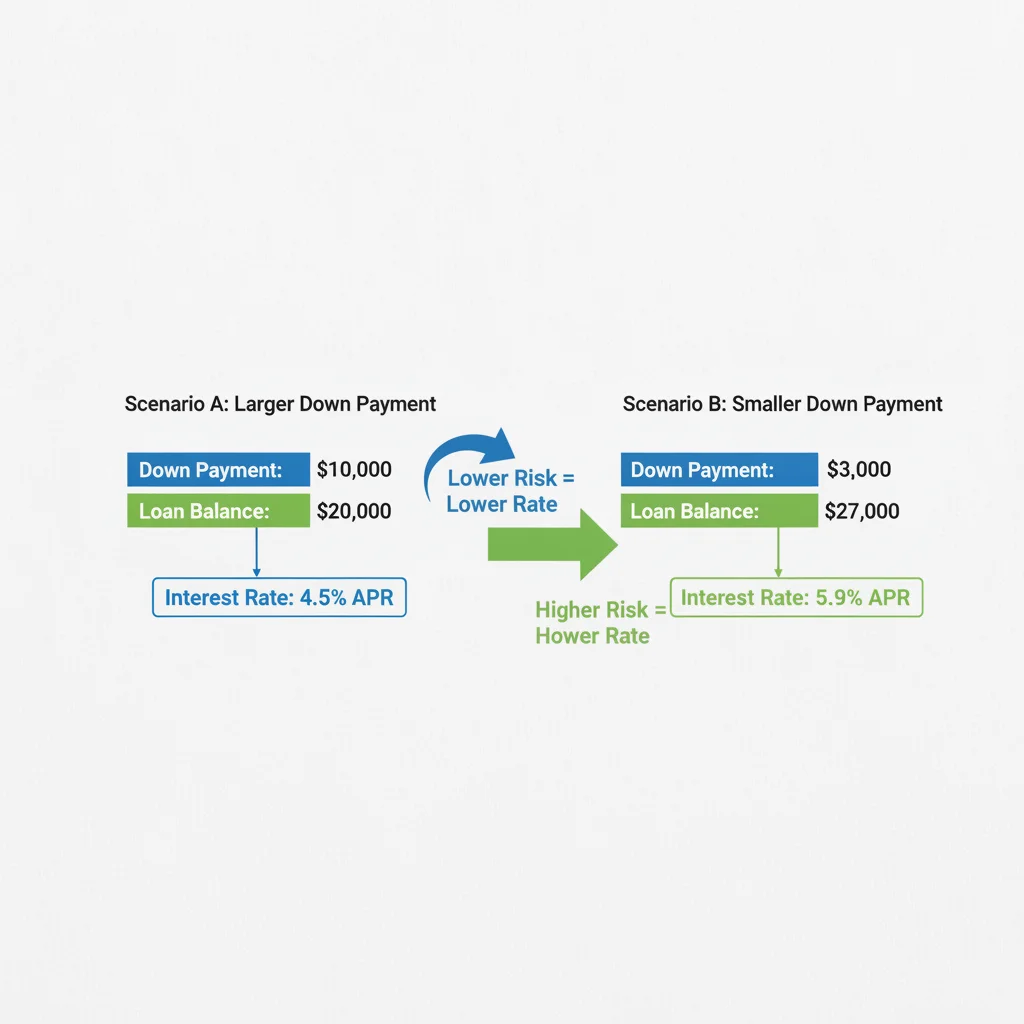
Lenders calculate loan-to-value (LTV) ratio by dividing the loan amount by the vehicle's value. A higher down payment lowers LTV, directly reducing default-loss risk — a key input in risk-based pricing models that set your interest rate.
Why Lenders Look at Both Numbers Together
Most car buyers think of their credit score and their down payment as two separate boxes on a loan application. Lenders don't see it that way. They view both as measurements of the same underlying question: how likely is this loan to cost us money?
Your credit score tells the lender how you've handled debt historically. Your down payment tells the lender how much skin you have in the game right now. Together, they form a risk picture that drives every term on your loan — approval, interest rate, loan length, and sometimes even the specific vehicles a lender will finance.
To see how intertwined these factors are, consider two borrowers buying the same $30,000 car:
| Borrower | Credit Score | Down Payment | Loan Amount | Likely Rate |
|---|---|---|---|---|
| Borrower A | 720 | $1,500 (5%) | $28,500 | ~6.5% |
| Borrower B | 620 | $6,000 (20%) | $24,000 | ~9.9% |
Borrower B has a credit score 100 points lower, but the bigger down payment shrinks the loan balance and the lender's exposure significantly. In many cases, Borrower B will actually get approved where a 5%-down version of that same borrower would be rejected outright. The down payment doesn't fix the credit score — it buys forgiveness for it.
Learn exactly how your upfront payment reshapes interest costs and lender risk before you decide how much to bring to the table.
Loan-to-Value Ratio: The Number That Connects Everything
The mechanism linking your down payment to your loan terms is a calculation called the loan-to-value ratio, or LTV. It's simple arithmetic:
LTV = Loan Amount ÷ Vehicle Value × 100
If you're buying a $30,000 car and putting $3,000 down, your loan amount is $27,000 and your LTV is 90%. If you put $6,000 down, your LTV drops to 80%. That 10-point difference matters more than most buyers realize.
Here's why: if you stop making payments and the lender repossesses the vehicle, they need to sell it to recover what you owe. Cars depreciate — often 15–20% in the first year alone. A lender sitting at 90% LTV on a car that just dropped 15% in value is already underwater. A lender at 70% LTV has a meaningful cushion. That cushion is what they're paying you for with a lower interest rate.
~15–20%
Typical first-year vehicle depreciation
According to Carfax and Edmunds data, most new vehicles lose 15–20% of their value within the first 12 months, which is why high-LTV loans quickly become underwater.
90%+
LTV on zero-down auto loans
Borrowers who put nothing down often start with LTV ratios above 90%, meaning any early depreciation immediately exceeds their equity position.
$5,800+
Extra interest cost on a $25,000 subprime loan
On a 60-month $25,000 loan, the difference between a 7% prime rate and a 15% subprime rate results in approximately $5,800 in additional interest paid over the loan term.
20%
Consumer credit reports with at least one error
A Federal Trade Commission study found that roughly one in five consumers had at least one error on a credit report that could affect their score — making it worth reviewing before applying.
1–3 pts
Rate reduction from lower LTV tier
Industry analysis from Experian and Bankrate data suggests borrowers who drop their LTV by 10–15 points can see rate reductions of 1–3 percentage points, depending on their credit band.
This is also why lenders use the vehicle's trade-in or book value — not the purchase price — when calculating LTV. If you overpay for a car, your effective LTV is higher than the simple math suggests. Recognize the warning signs that your upfront amount is insufficient given the vehicle's actual market value.
Dealer Financing vs. Direct Lender LTV Rules
Not all lenders apply LTV thresholds the same way. Credit unions often have more flexible LTV cutoffs for members with established relationships. Captive finance arms (manufacturer lenders like Ford Credit or Toyota Financial) may allow higher LTVs during promotional periods. Always compare at least three lenders before accepting terms, because the same LTV can produce very different rates depending on who's doing the math.
Trade-In Equity Counts as a Down Payment
If you're trading in a vehicle, the lender-recognized equity — the trade-in value minus any remaining loan balance — is added directly to your effective down payment. This can meaningfully reduce your LTV without requiring any cash outlay. However, if you owe more on your trade-in than it's worth (negative equity), that balance typically gets rolled into the new loan, making your LTV worse, not better.
How a Weak Credit Score Raises Your Costs — And What Down Payment Can Do About It
Credit scores directly feed into what's called risk-based pricing. Lenders use statistical models that assign higher interest rates to borrowers who look riskier on paper. A borrower with a 580 credit score might face a rate 8–12 percentage points higher than someone at 760 — on the exact same car, from the same lender.
That gap is enormous over a 60-month loan. On a $25,000 loan, the difference between 7% and 15% interest is roughly $5,800 in total interest paid. Bad credit is expensive.
A larger down payment attacks this problem in two ways:
- It lowers the loan amount — less principal means less interest accruing, even at the same rate.
- It may lower the rate itself — by reducing LTV, you move into a less-risky tier in the lender's pricing model, which can shave 1–3 percentage points off your rate.
Neither effect replaces a strong credit score. But together, they can move the needle enough to turn a denial into an approval, or a punishing rate into a manageable one.
“A down payment signals commitment. When a borrower has real money in the deal, the statistical likelihood of default drops — lenders know this and price accordingly. It's one of the few things a buyer with damaged credit can control before they walk through the door.”
— Melinda Greer, Consumer Auto Finance Analyst, cited in Bankrate's auto lending coverage
For borrowers at the lower end of the credit spectrum, see how much down payment is actually enough on a bad credit car loan — there is a point of diminishing returns worth understanding.

Real Numbers: What Different Down Payment Sizes Actually Buy You
Abstract explanations only go so far. Here's a concrete scenario comparing the same borrower — a 620 credit score, buying a $28,000 used SUV — with three different down payment amounts over a 60-month loan:
| Down Payment | Loan Amount | LTV | Estimated Rate | Monthly Payment | Total Interest Paid |
|---|---|---|---|---|---|
| $0 (0%) | $28,000 | 100% | 16.5% | $684 | $13,040 |
| $2,800 (10%) | $25,200 | 90% | 14.0% | $586 | $10,160 |
| $5,600 (20%) | $22,400 | 80% | 11.5% | $491 | $7,060 |
Moving from zero down to 20% down doesn't just cut the loan amount by $5,600 — it also drops the estimated rate by 5 full points, slashing another $3,100 in interest. The combined savings exceed $6,000 over the life of the loan.
See exactly how each extra dollar put down translates to lower monthly obligations over your loan term.
Calculate Total Interest, Not Just Monthly Payment
When comparing loan offers with different down payment amounts, always ask for — or calculate — the total interest paid over the full loan term. A lower monthly payment achieved through a longer loan term can actually cost you more in total than a higher payment on a shorter loan. Use a free auto loan calculator and enter the full loan amount, rate, and term for each scenario side by side.
Use a Credit Score Simulator Before You Apply
Many free credit monitoring services offer a simulator that shows you how specific actions — paying down a credit card, removing a collection — would affect your score. Run these simulations before deciding whether to apply now or wait. Even a 30-point score improvement can shift you into a pricing tier that saves more than the delay costs.
Where Credit Score Still Wins (And Can't Be Replaced)
A down payment is a powerful lever, but it has limits. There are situations where no amount of cash upfront will overcome a severely damaged credit profile:
- Active bankruptcies: Many lenders won't approve any loan while a Chapter 7 or Chapter 13 is open, regardless of down payment.
- Very recent repossessions: A repo in the last 12 months is often a hard denial trigger at prime lenders.
- No credit history at all: Without any payment history, lenders have no data to work with — a down payment helps but doesn't replace a track record.
- Extremely high debt-to-income ratio: If your existing monthly obligations already consume most of your income, lenders may decline even with 30% down.
Outside of these edge cases, a meaningful down payment genuinely moves the needle. The sweet spot for most subprime borrowers is somewhere between 15% and 25% — enough to drop the LTV into a better tier without liquidating savings you need for emergencies.
It's also worth remembering that improving your credit score before you apply — even by 30–40 points — can have an outsized effect on your rate. Paying down revolving balances, disputing errors, and avoiding new credit applications in the 90 days before you apply are all concrete steps. Understand how your credit score directly affects the loan rates lenders will offer so you know what you're working toward.

Preapproval, Dealers, and How They Weigh Your Down Payment
Getting preapproved before you walk into a dealership changes the dynamic entirely. When a bank or credit union preapproves you, they've already priced your credit score into the offer. If you then inform them of a larger down payment than assumed, you may be able to negotiate the rate down — or at least confirm the approval is solid.
Dealers see your down payment somewhat differently than lenders do. A dealer's finance office earns a portion of the interest rate spread — the gap between the rate a lender offers and what you actually sign. A large down payment shrinks the loan and can reduce their back-end profit. This doesn't mean dealers dislike down payments, but it explains why some finance managers may steer conversations toward monthly payment rather than total loan cost.
For the cleanest outcome: get preapproved from your own bank or credit union first, know your down payment amount before you arrive, and treat the monthly payment conversation as a distraction from what actually matters — total cost of the loan.
Understand how your down payment amount can change your preapproval and interest rate before you decide how much to put down.
Dealer Financing vs. Direct Lender LTV Rules
Not all lenders apply LTV thresholds the same way. Credit unions often have more flexible LTV cutoffs for members with established relationships. Captive finance arms (manufacturer lenders like Ford Credit or Toyota Financial) may allow higher LTVs during promotional periods. Always compare at least three lenders before accepting terms, because the same LTV can produce very different rates depending on who's doing the math.
Trade-In Equity Counts as a Down Payment
If you're trading in a vehicle, the lender-recognized equity — the trade-in value minus any remaining loan balance — is added directly to your effective down payment. This can meaningfully reduce your LTV without requiring any cash outlay. However, if you owe more on your trade-in than it's worth (negative equity), that balance typically gets rolled into the new loan, making your LTV worse, not better.
Building a Strategy: When to Down-Pay More vs. Fix Your Credit First
If you have time before you need a car, the most cost-effective move is almost always to work on both simultaneously — save for a larger down payment while taking steps to improve your credit score. Even a 60-day delay that lets you add $2,000 to your down payment and repair a credit error could save you thousands over the loan.
But time isn't always available. Here's a practical framework for deciding where to focus your energy:
- If your credit score is below 580
- Prioritize a significant down payment (aim for 20%+) because approval may depend on it. Simultaneously dispute any errors on your credit report — errors affect one in five reports.
- If your score is 580–650
- A 15–20% down payment will likely move you into an approval bracket and noticeably improve your rate. Also consider a co-signer if one is available.
- If your score is 650–700
- You're close to prime territory. A 10–15% down payment combined with a 60-day credit cleanup effort (reducing credit card balances especially) may push you over the line into meaningfully better rate tiers.
- If your score is above 700
- Your credit does most of the heavy lifting. A down payment of 10–15% protects you from going underwater on depreciation, but the rate benefit is smaller than for lower-score borrowers.
Calculate Total Interest, Not Just Monthly Payment
When comparing loan offers with different down payment amounts, always ask for — or calculate — the total interest paid over the full loan term. A lower monthly payment achieved through a longer loan term can actually cost you more in total than a higher payment on a shorter loan. Use a free auto loan calculator and enter the full loan amount, rate, and term for each scenario side by side.
Use a Credit Score Simulator Before You Apply
Many free credit monitoring services offer a simulator that shows you how specific actions — paying down a credit card, removing a collection — would affect your score. Run these simulations before deciding whether to apply now or wait. Even a 30-point score improvement can shift you into a pricing tier that saves more than the delay costs.
For a comprehensive view of how these mechanics fit together end to end, see our complete breakdown of auto loan down payment strategy — from loan math to lender expectations to common pitfalls.

All claims are backed by peer-reviewed research. Sources on request.