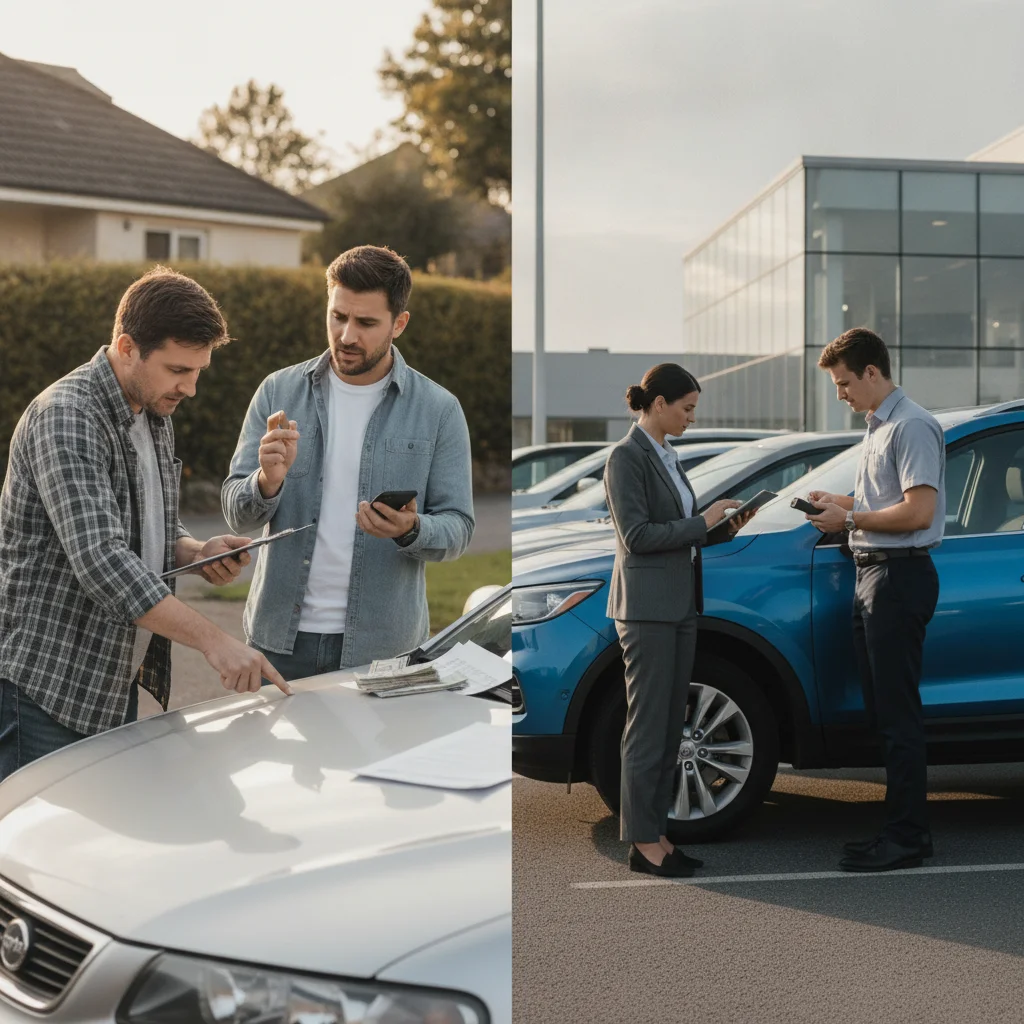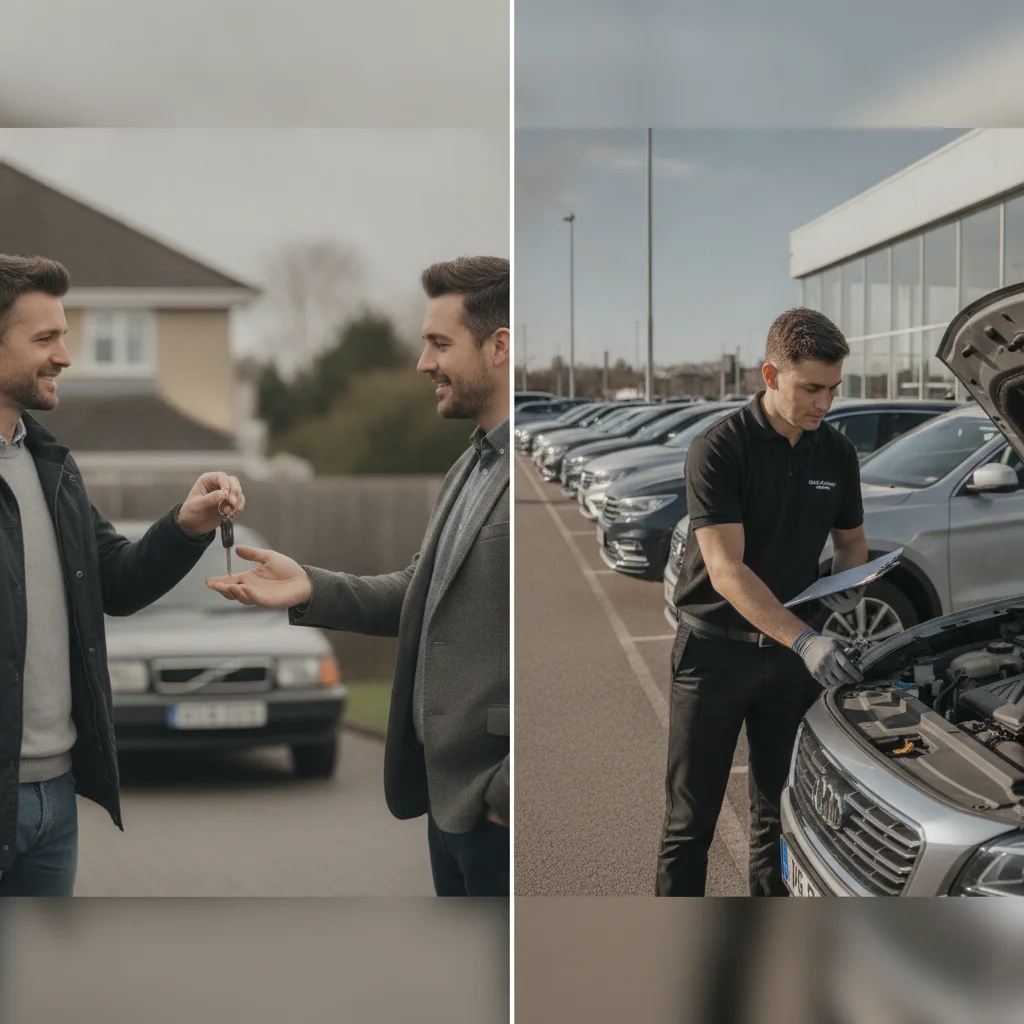
Key Takeaways
Option A
Dealer Trade-In
The fast, frictionless exit — at a price.
Best for: Sellers who prioritize speed and simplicity over squeezing every dollar from their vehicle.
Option B
Private Party Sale
The higher-yield option for sellers willing to do the legwork.
Best for: Sellers with time, a clean or desirable vehicle, and the patience to screen buyers and handle paperwork.
If you need to move fast and minimize hassle
Dealer Trade-In
A trade-in closes in hours, not weeks. If your next car purchase is time-sensitive or you simply can't manage buyer inquiries and test drives, the convenience premium is worth paying.
If maximizing net proceeds is your primary goal
Private Party Sale
Private buyers pay retail-adjacent prices. On a $20,000 vehicle, you could realistically net $1,500–$3,000 more than any dealer will offer — money that goes directly into your pocket or down payment.
If your car has significant mechanical issues or high mileage
Dealer Trade-In
Problem cars are hard private-party sells. Dealers have reconditioning infrastructure and auction channels for high-risk inventory — they're better positioned to absorb those cars than a private buyer who will demand a steep discount for uncertainty.
If you're buying your next car from a dealer in a high sales-tax state
Dealer Trade-In
In states that allow trade-in tax credits, a trade-in applied toward a new purchase reduces the taxable purchase price — a real dollar benefit that can narrow the private-sale advantage to just a few hundred dollars.
If you have a clean, in-demand car in a popular segment
Private Party Sale
Late-model trucks, SUVs, and fuel-efficient sedans with clean history reports attract competitive private offers quickly. That demand gives you pricing leverage that a dealer will never pass on to you.
The Core Financial Gap — And Why It Exists
Dealers don't trade in cars as a favor. They buy your vehicle at wholesale, recondition it, and sell it at retail — pocketing the spread. That spread typically runs 15–25% of the vehicle's retail value, and your trade-in offer reflects it. When a dealer hands you $14,000 on a car worth $18,000 at retail, they're not low-balling you out of spite; they're protecting their margin before they've spent a dollar on detailing, inspections, or lot fees.
Private buyers, by contrast, pay closer to retail because they're the end consumer. They're not planning to resell — they want to drive the car. That's the fundamental reason private party sales generate more cash. You're cutting out the middleman's margin and keeping it yourself.

The raw dollar gap varies by vehicle type, condition, and market timing. On a three-year-old mid-size SUV in good condition, the difference between a dealer trade-in offer and a realistic private sale price typically lands between $1,500 and $3,500. On a popular truck or a clean luxury vehicle, that spread can reach $5,000 or more. On a high-mileage economy car with deferred maintenance, it may shrink to a few hundred dollars — or disappear entirely if buyers price in the risk.
For a deeper look at how each channel interacts with depreciation curves, see how each selling channel exposes you to depreciation differently.
| Criterion | Dealer Trade-In | Private Party Sale |
|---|---|---|
| Typical net proceeds | Wholesale minus dealer margin | Near retail value |
| Dollar gap (typical) | $1,500–$3,500 less | $1,500–$3,500 more |
| Time to complete | Same day | 1–4 weeks average |
| Effort required | Low — dealer handles everything | High — listing, screening, paperwork |
| Sales tax benefit | Yes, in most states when buying from dealer | No direct tax benefit to seller |
| Works with loan payoff | Yes — dealer handles lien release | Complicated — buyer must navigate lender |
| Risk of scams/fraud | Very low | Moderate — requires vetting |
| Vehicles with issues | Accepted (at steep discount) | Hard sell — limited buyer pool |
| Negotiation leverage | Low without competing bids | High with multiple interested buyers |
| Best market timing | Any time — dealers always buy | Spring/summer — more private buyers active |
The Sales Tax Offset: When Trading In Actually Makes Financial Sense
Here's the trade-in argument that most private-sale advocates understate: in the majority of U.S. states, when you trade in a vehicle toward a new purchase, you only pay sales tax on the difference between the new car's price and your trade-in value. That tax credit can be worth real money.
$1,000–$3,500
Typical private sale premium over trade-in
Based on Kelley Blue Book and Edmunds data comparing trade-in and private party value estimates across popular vehicle segments.
41 states
States offering trade-in sales tax credits
According to the National Conference of State Legislatures, the majority of U.S. states reduce the taxable purchase price of a new vehicle by the trade-in value.
18–25%
Typical dealer reconditioning and profit margin on trade-ins
Industry estimates from NADA and dealer financial benchmarks indicate dealers target a 15–25% gross margin when retailing used vehicles acquired through trade-in.
21 days
Median days to sell a car privately
Marketplace data from platforms including Facebook Marketplace and AutoTrader suggests the median private party listing takes approximately three weeks to close.
Example: You're buying a $35,000 car in a state with 8% sales tax, and your trade-in is valued at $14,000. You pay tax on $21,000 — saving $1,120 compared to paying cash from a private sale. If the dealer's trade-in offer was $1,000 less than what you'd net privately, the tax credit more than compensates. The math shifts the decision significantly in high-tax states.
But this only applies when you're simultaneously purchasing from the same dealer. If you're not buying a car at all, or you're buying from a private seller, the trade-in tax credit is irrelevant — and the private sale wins cleanly on the numbers.
Sales Tax Rules Vary by State
Not all states offer a trade-in tax credit. States like California and Washington do not allow the credit to offset taxable purchase price — meaning the private-sale financial advantage is larger in those markets. Always verify your specific state's DMV rules or consult a tax professional before making this decision based on assumed tax savings. <a href="/maintenance-and-ownership/ownership-costs/registration-taxes/common-misconceptions-about-sales-tax-on-private-party-car-sales">Common misconceptions about sales tax on private party car sales</a> is a useful reference for understanding how tax applies in both transaction types.
Bottom line: run the tax math before assuming private always wins. Pull your state's sales tax rate, calculate the credit based on your expected trade value, and subtract it from the private-sale premium. The answer tells you the true financial gap — not the surface-level one.
Protecting Yourself From Lowball Trade-In Offers
If you've decided a trade-in is the right route — or you want a credible counter-offer in your back pocket — there are concrete steps to avoid leaving money on the table at the dealership. This is where most sellers get hurt: they walk in unprepared and accept the first number they hear.
Step 1: Get Competing Bids Before You Walk Into a Dealership
Spend 30 minutes generating offers from CarMax, Carvana, and one or two local independent dealers before you negotiate your trade-in at a franchised dealer. These offers are real and often transferable — CarMax written offers, for instance, are valid for seven days. Show that offer at the dealership. A salesperson who knows you have a $14,500 floor from CarMax has no leverage to offer you $13,000.
Step 2: Know Your Baseline Numbers
Look up your car's trade-in value on Kelley Blue Book and Edmunds. These tools use different methodologies and sometimes produce different numbers — knowing both gives you a range to reference. Don't anchor to just one source. Cross-reference with actual listings of similar vehicles in your zip code to understand what dealers are actually selling comparable cars for, which tells you what they can afford to pay you.
Step 3: Separate the Trade-In Negotiation From the Purchase Negotiation
Dealers love to bundle new car price and trade-in value into a single monthly payment conversation. Don't allow it. Negotiate your new car purchase price to an agreed number first. Then negotiate your trade-in as a completely separate transaction. When deals are combined, it's easy for a dealer to give you $500 more on your trade while adding $500 to the new car price — you feel like you won, but you didn't.
For more tactics on navigating this dynamic, our Trade-In Strategies hub covers the full playbook in detail.
Step 4: Use Condition Honestly — But Specifically
Dealers appraise your car with a profit-oriented eye. Every ding and stain they notice is justification for a lower number. Walk through the car yourself before the appraisal and document its actual condition: note recent repairs, new tires, fresh oil change receipts. Presenting maintenance records doesn't just signal the car is cared for — it removes objections the appraiser would use to discount your offer.
How to Run a Private Sale That Actually Closes
A private sale's financial edge only materializes if you execute it properly. Underpriced listings waste your effort; overpriced ones sit forever. Sloppy ads attract time-wasters; unclear paperwork creates legal exposure.
Price It to Sell — But Don't Leave Money Behind
Start with Kelley Blue Book's private party value and Edmunds' private market price for your exact trim, mileage, and condition. Then check active listings on Facebook Marketplace, Cars.com, and Craigslist in your market for direct comparables. Price your vehicle at the top of the realistic range, not above it — that leaves negotiation room without pricing yourself into irrelevance. On a car worth $16,000, listing at $16,900 gives you wiggle room to close at $16,000–$16,500 while still beating any dealer offer.
For a clear explanation of how private party value is calculated versus trade-in value, see what private party value actually means and why it differs from trade-in.
Build a Listing That Eliminates Doubt
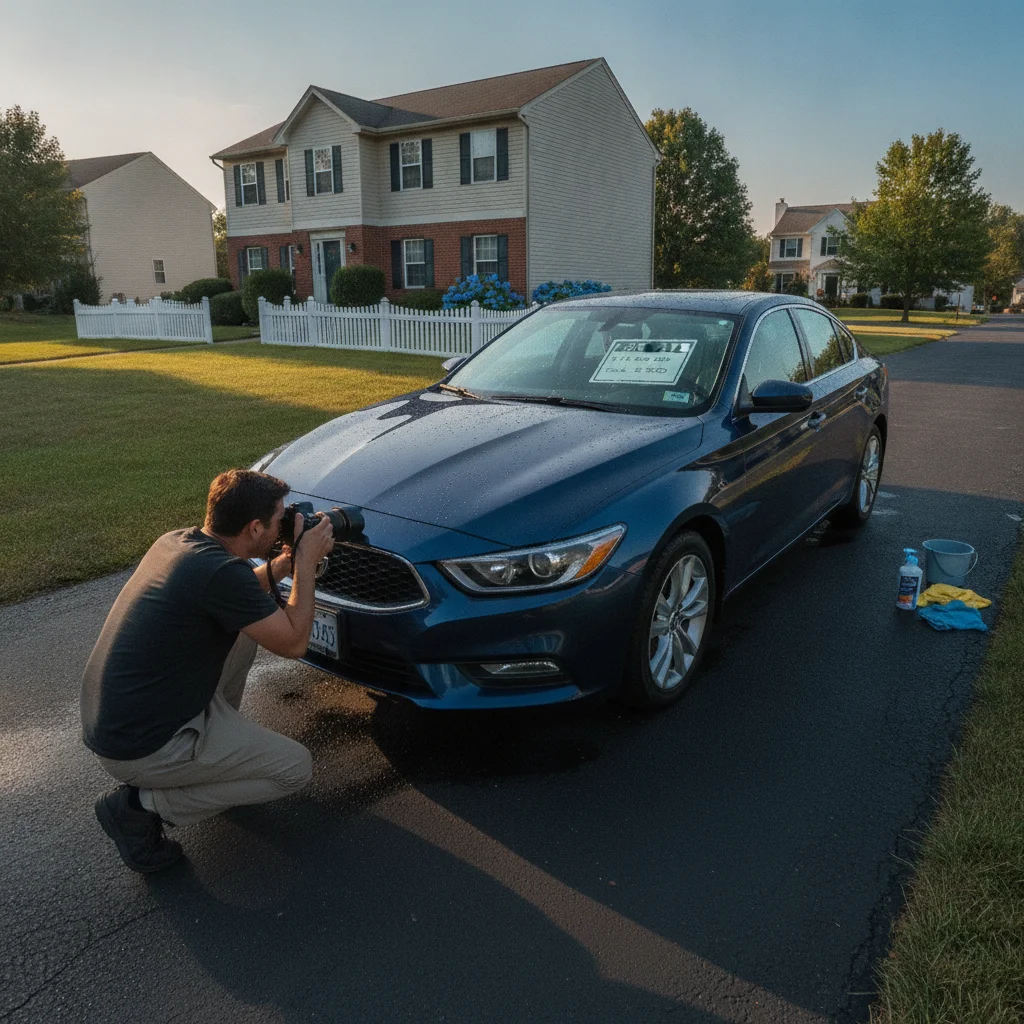
Serious buyers eliminate fear before they drive somewhere. Your listing should include: high-quality photos in natural daylight (exterior from all angles, interior, odometer, any known flaws), the VIN for buyers who want to pull a history report, maintenance records if you have them, and a factual description — year, trim, mileage, condition of tires and brakes, recent repairs, and any known issues. Concealing problems is a bad strategy; it surfaces during test drives and kills deals, or worse, creates post-sale disputes.
Screen Buyers and Stay Safe
Respond to inquiries via platform messaging initially. Confirm serious intent before giving out personal contact information or your address. Meet in a public place for a first look if possible. For test drives, ride along — don't hand keys to a stranger and wait on the curb. Require a valid driver's license before any test drive, and make a photo copy.
Handle the Paperwork Correctly
Every state has specific requirements for private party title transfers. At minimum: sign the title over to the buyer, complete a bill of sale (include sale price, VIN, date, both parties' names and signatures), and file a notice of release of liability with your state DMV immediately after the sale. That last step protects you if the buyer gets a ticket or has an accident before re-registering the car. Accept payment as a cashier's check from a verified bank, cash, or an immediately confirmed wire transfer — never personal checks or payment apps where funds can be reversed.
The Private Party Sales hub walks through how to list, negotiate, and close with private buyers from start to finish.
For an honest look at the full trade-offs involved, the pros and cons of selling without a middleman is worth reading before you commit to this path.
When the Trade-In Route Is the Right Call
Private sales aren't the right answer for every car or every seller. Be honest about which situations actually favor the trade-in route.
- Cars with outstanding loan balances: If you owe more than the car is worth, rolling negative equity into a dealer deal is often simpler than finding a private buyer willing to navigate a lienholder payoff. Most private buyers aren't equipped to handle that transaction.
- Vehicles with title problems: Salvage titles, missing titles, or probate situations are hard sells privately. Dealers and wholesalers have more tolerance for complicated title situations.
- Significant mechanical issues: Private buyers expect working vehicles or substantial price concessions for known problems. If your car needs $3,000 in repairs and you price it accordingly, you'll attract bargain hunters who'll offer $4,000 less — not the $2,000 adjustment you expected. Dealers who wholesale these cars have a more realistic model for absorbing mechanical risk.
- Time pressure: Relocating for work in two weeks? Divorcing and need to liquidate assets quickly? The trade-in's same-day close is genuinely valuable when time isn't on your side.
- High-mileage vehicles over 100,000 miles: Private buyer fear increases significantly past 100k miles. You'll spend more time convincing skittish buyers than you will on a lower-mileage car.
Also worth considering: some third-party instant-offer platforms (Carvana, CarMax, Vroom) sit between a traditional trade-in and a full private sale. They offer quick, no-negotiation bids that often beat franchised dealer trade-in offers by a meaningful margin, without the effort of managing private buyers. See when an instant offer makes more financial sense than a private sale for a side-by-side look at those numbers.
And if you're selling privately during the fall or year-end buying season, be aware that dealer incentives on new cars can pull buyers away from used private listings. Year-end clearance sales affect private sellers more than most people realize — timing your sale to avoid that window can make a meaningful difference in days on market.

Running the Numbers: A Real-World Comparison
Let's put concrete numbers to this decision using a realistic scenario: a 2021 Honda CR-V EX with 42,000 miles, clean title, no accidents, and average maintenance history in a mid-size U.S. market.
Trade-In Scenario
- Dealer trade-in offer: $21,500
- Applied toward new vehicle purchase price of $38,000
- Sales tax (7%) on $16,500 net purchase: $1,155
- Effective net from trade-in (offer + tax savings): $22,655
- Time invested: 1 afternoon at the dealership
Private Sale Scenario
- Private party listing price: $25,500
- Negotiated close price: $24,800
- Selling costs: $150 (detailing, listing fees)
- No sales tax offset (paying cash for next car from private seller)
- Net proceeds: $24,650
- Time invested: 3 weeks, ~8–10 hours total
True gap in this scenario: ~$2,000 in favor of the private sale. That's meaningful money — but it required three weeks and real effort. Whether that's worth it depends entirely on your time, your vehicle, and your situation. For many sellers with in-demand cars, the answer is clearly yes. For others juggling competing priorities, the trade-in's $2,000 implicit cost buys real convenience.
For more on how to think about where exactly that money goes in a trade-in transaction, trade-in value vs. private sale price breaks down the full picture. And if you're buying a new car specifically, trading in vs. selling privately when buying new addresses how that specific transaction context changes the calculus.

All claims are backed by peer-reviewed research. Sources on request.