
Key Takeaways
Option A
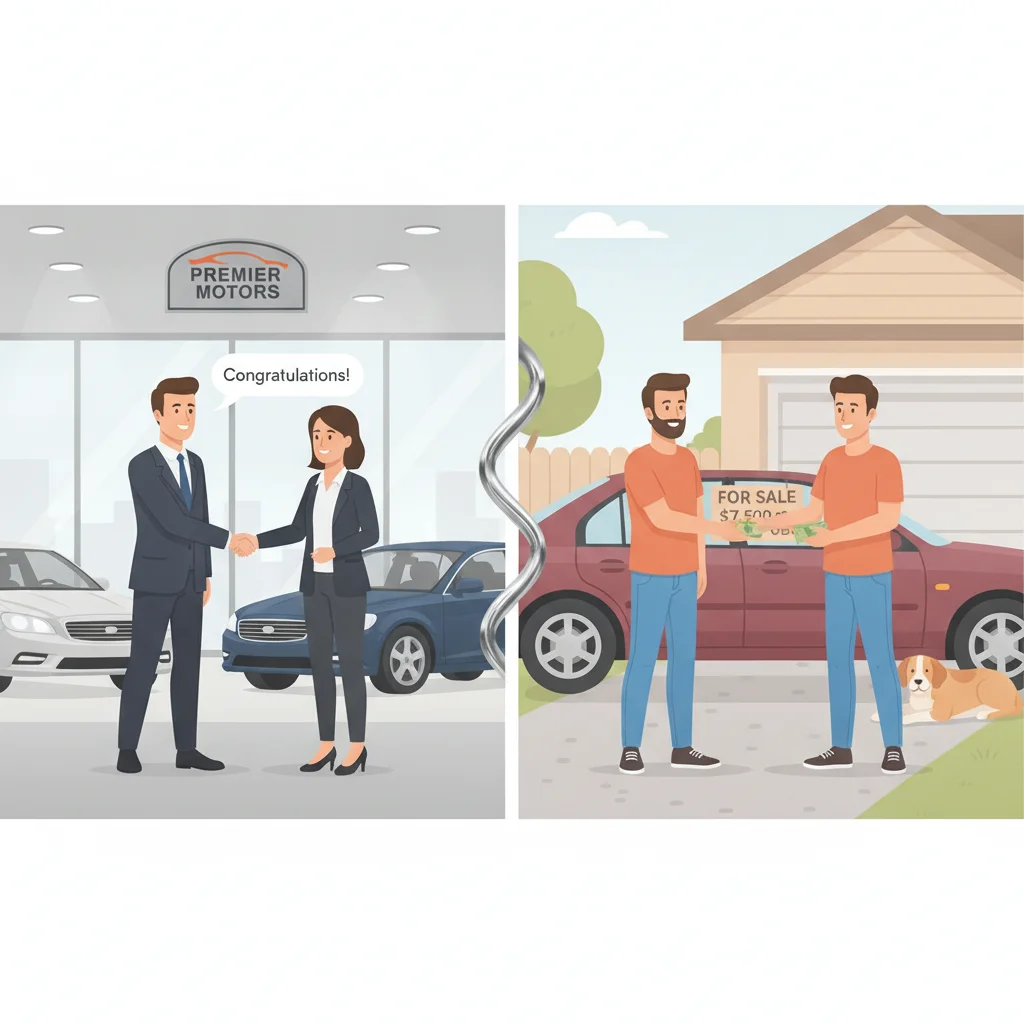
Dealer Trade-In
The fast, frictionless exit from your current car.
Best for: Buyers who want to roll everything into one transaction and skip the hassle of selling independently.
Option B
Private Sale
The higher-paying route that demands your time and effort.
Best for: Sellers willing to invest a few weeks of effort to walk away with meaningfully more cash.
If you need to close the deal this week
Dealer Trade-In
Trade-ins happen same-day with zero separate logistics. If your timeline is tight, the convenience is worth the price difference.
If your car is clean, popular, and fully paid off
Private Sale
A desirable, lien-free vehicle in good condition is the exact profile where private buyers pay close to retail — maximizing your net proceeds.
If you owe more than the car is worth
Dealer Trade-In
Dealers can often roll negative equity into your new deal. Coordinating a short sale privately is far more complicated and risky.
If the gap between trade-in and private offers exceeds $2,500
Private Sale
At that dollar difference, the hours spent listing and showing the car deliver a strong hourly return that most side gigs can't match.
If your car has significant mechanical issues or high mileage
Dealer Trade-In
Private buyers run inspections and walk away from problem cars. Dealers price in risk upfront and still take the vehicle off your hands.
The Core Question: Convenience or Cash?
Every time someone buys a new car with a vehicle to unload, they face the same fork in the road: hand the keys to the dealer and be done with it, or go through the work of selling privately and keep more money. Neither answer is universally right. The right move depends on your car, your timeline, your loan situation, and frankly, how much friction you're willing to tolerate.
What I've seen on the finance desk is that most buyers default to the trade-in out of habit — not because it's the best financial decision, but because it's the path of least resistance. That default costs them real money. The goal here is to walk you through exactly what each path delivers so you can make a deliberate choice instead of a lazy one.
For a deeper look at where the dollars actually go in each scenario, see Trade-In Value vs. Private Sale Price: Where the Money Really Goes.
| Criterion | Dealer Trade-In | Private Sale |
|---|---|---|
| Typical net proceeds | 10–20% below retail | Close to retail value |
| Time to complete | Same day | 2–6 weeks on average |
| Effort required | Minimal — dealer handles it | High — seller does all work |
| Sales tax benefit | Yes — reduces taxable amount | No tax offset on new car |
| Loan payoff handling | Dealer manages directly | Seller must coordinate |
| Works with negative equity | Yes, can roll into new loan | Very difficult to arrange |
| Buyer fraud risk | None | Real — requires vigilance |
| Best vehicle profile | Any condition, any mileage | Clean, popular, lien-free cars |
What a Dealer Trade-In Actually Involves
When you trade in at a dealership, their appraiser — or an algorithm backed by auction data — evaluates your vehicle in roughly 20 minutes. They check mileage, condition, CarFax, and what that model is currently selling for at wholesale auction. The number they hand you is designed to leave profit on the table for the dealer. That's not a cynical observation; it's just how the business model works.
The offer you receive is typically 10–20% below what a private buyer would pay for the same vehicle. On a car worth $20,000 at retail, that gap can easily be $2,000–$3,500. The dealer then either retails the car on their lot, wholesales it to auction, or sends it to a sister store. They need room to do that profitably.

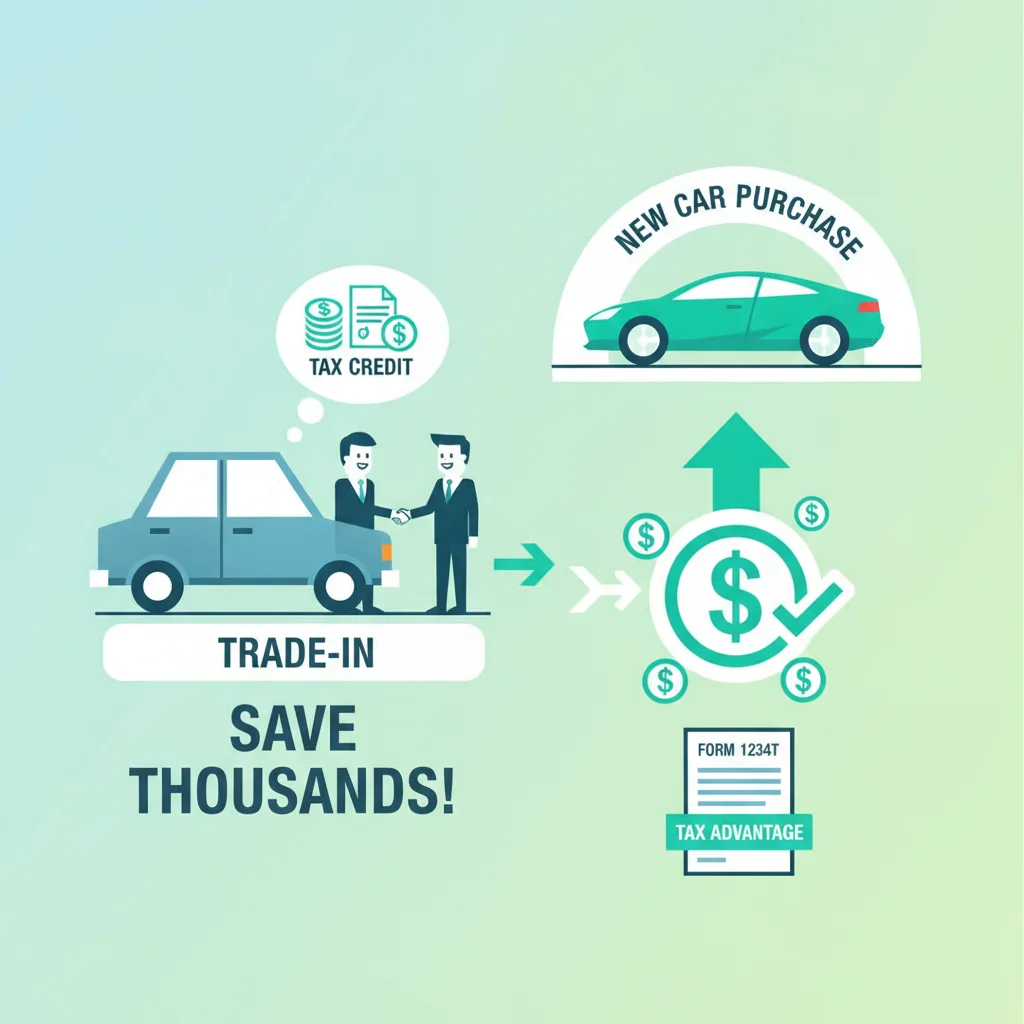
There's one meaningful financial offset that many buyers overlook: the sales tax credit. In most U.S. states, your trade-in value is subtracted from the purchase price of the new car before sales tax is calculated. On a $40,000 new vehicle with an $18,000 trade-in, you're only taxed on $22,000. At a 7% tax rate, that's a $1,260 savings compared to paying cash from a private sale. It doesn't erase the gap, but it narrows it. The Hidden Tax Advantage of Trading In Your Car walks through the exact math state by state.
The other things a trade-in handles for you: title transfer, any outstanding loan payoff, and the physical logistics of getting the car off your hands. If you owe money on the vehicle, the dealer calls your lender, pays it off, and either applies your equity to the new deal or rolls negative equity into your new loan. It's operationally clean — for you, at least.
Negotiating Trade-In and New Car Price Separately
One of the most common mistakes buyers make is letting the dealer bundle the trade-in value into the new car monthly payment discussion. Always negotiate the purchase price of the new car to a firm, written number before introducing your trade-in. Once the new car deal is locked, then reveal you have a vehicle to trade. This prevents the dealer from adjusting one number to offset the other and obscuring what you're actually getting on each side of the transaction.
For a full comparison of dealer trade-ins versus independent car-buying services like CarMax or Carvana, see Trading In at a Dealership vs. Selling to a Third-Party Buyer.
What a Private Sale Actually Involves
Selling privately means you are the dealer. You set the price, field the inquiries, schedule showings, negotiate, handle the paperwork, and coordinate the money transfer. Done right, it pays better. Done sloppily, it opens you up to scams, title headaches, and deals that fall apart at the last minute.
Here's a realistic timeline: list the vehicle on a Tuesday with good photos and a well-written description, and you're likely to field serious inquiries within a few days if you've priced it right. A clean, popular vehicle — a late-model Honda CR-V or Toyota Camry, for example — can close in under two weeks. An obscure trim or a high-mileage vehicle might sit for four to six weeks before you find a willing buyer at your number.
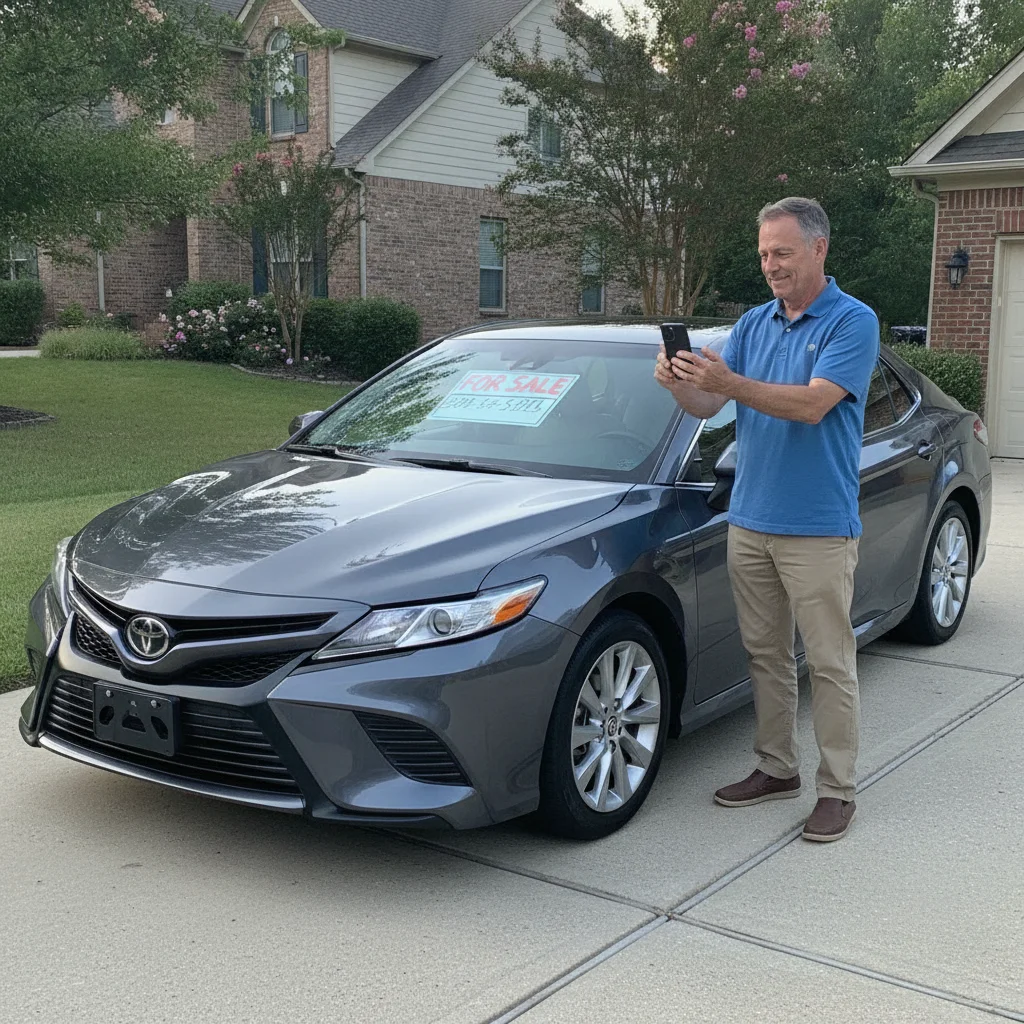
Pricing is the variable most sellers get wrong. Look at actual completed sales, not just asking prices. Platforms like Autotrader, CarGurus, and Facebook Marketplace show you what comparable cars are listed at, but that's not the same as what they sold for. Price 5–10% above what you'd accept, leaving room to negotiate. Buyers expect to negotiate; price with that in mind.
The complications arrive when your car has a lien on it. You can't hand a buyer a clean title if the bank still holds it. The standard workarounds include: closing at your bank or credit union (they handle the payoff and title release directly), using an escrow service, or — if the buyer is financing — having their lender pay yours off simultaneously. It's doable, but it requires coordination that most first-time private sellers don't anticipate.
Safety is also a real concern. Meet potential buyers in a public place for test drives. Bring a friend if possible. Accept payment only via bank wire or a verified cashier's check — personal checks and Zelle transfers for large amounts carry real fraud risk.
See The Pros and Cons of Selling Your Car Without a Middleman for a complete breakdown of what you take on when you cut out the intermediary.
The Real Numbers: How Big Is the Gap?
Let's anchor this in a concrete example. Say you're selling a 2021 Toyota RAV4 with 42,000 miles in good condition. Dealer trade-in offers are likely to range from $24,000 to $26,500 depending on the market and the dealership. Private sale price for the same vehicle in the same condition typically runs $27,500–$29,500. That's a realistic gap of $1,500 to $5,000 — call it $3,000 on average.
$1,000–$3,000
Typical private sale advantage over trade-in
Based on Edmunds and KBB analysis of private-party versus trade-in values across popular used vehicle segments in 2023–2024.
2–6 weeks
Average time to complete a private vehicle sale
Varies widely by vehicle type, condition, pricing accuracy, and local market demand according to CarGurus listing data.
Up to $1,500+
Sales tax savings from a trade-in credit
In states with 6–8% sales tax rates, trading in a $20,000+ vehicle can reduce your taxable purchase price and generate significant savings.
Now factor in the tax credit. If you're in a state with a 6% sales tax and the new car costs $38,000, a $25,000 trade-in saves you $1,500 in sales tax that a private-sale cash deposit won't. That narrows the effective advantage of selling privately to roughly $1,500–$3,500 on this example — still substantial, but not as dramatic as the headline number.
Then weigh your time. If the private sale takes three weeks and ten hours of your time (listing, responding to inquiries, showings, test drives, paperwork), and the net advantage is $2,000, you've effectively earned $200/hour for that effort. That's a strong return. If the advantage shrinks to $800 after accounting for detailing costs, a small repair you made to sell it, and a price reduction after two weeks of no offers, the math looks different.
Trading In vs. Selling Privately: Which Gets You More Money? provides a model for calculating your specific net advantage before you commit to either path.
One underrated strategy: get real offers from both channels before you decide. Request a written trade-in appraisal from two or three dealers. Simultaneously list the vehicle at your target private-sale price. If your car moves quickly at the private price, great — take it. If the listing stalls after two weeks, you already have dealer offers in hand and you haven't wasted time.
When the Trade-In Wins Despite the Lower Price
There are four situations where the trade-in is the smarter move even when the private-sale premium is real:
- You're underwater on the loan. If you owe $18,000 and the car is worth $14,000, a private buyer won't take on that shortfall — they'll just buy something else. A dealer can roll the $4,000 negative equity into your new loan (though this has its own costs and you should go in with eyes open).
- The car has known mechanical issues. Private buyers are increasingly savvy about getting pre-purchase inspections. A bad inspection report kills deals. Dealers price risk into their offer and still take the car. You avoid the liability exposure of selling a car with problems to a private party.
- Your new car deal is time-sensitive. End-of-month incentives, expiring lease deals, and limited-supply vehicles sometimes require same-day decisions. You can't run a three-week private sale on that timeline.
- The car is old, high-mileage, or niche. A 2009 Pontiac G6 with 130,000 miles is not going to attract a competitive private-sale price. The pool of buyers is small, and the ones who show up will lowball. The dealer at least gives you a clean exit, even if the number is modest.
For context on how depreciation interacts differently with each selling channel, see Private Sale vs. Dealer Sale: How Each Channel Exposes You to Depreciation Differently.
Making the Final Call
Here's a simple decision framework. Get a written dealer appraisal first — most dealers will give you one in 30 minutes with no obligation. Then look up the private-party value on Edmunds or KBB and compare it to actual active listings in your area. Calculate the gross gap. Subtract your state's estimated tax credit on the trade-in. Subtract any costs you'd incur to get the car ready for private sale (detailing, minor repairs, listing fees). What's left is your net private-sale advantage.
If that number is under $1,000, the trade-in probably isn't worth fighting. If it's over $2,500 and your car is in solid condition with a clean title, the private sale almost certainly is.
Also think about timing. Timing Your Sale Around a Trade-In vs. Private Listing Decision is worth reading before you pull the trigger — the season and the current used-car market conditions materially affect which path yields better results.
Finally, don't combine the negotiations if you trade in. Dealers sometimes bundle the new car price and the trade-in value into one monthly payment discussion, which makes it nearly impossible to tell whether you're getting a fair deal on either. Negotiate the new car price to your target first, lock it in writing, then bring up the trade-in. Keep the transactions separate on paper even if they close simultaneously. That discipline alone has saved buyers thousands.
For broader strategy on maximizing what the dealer pays for your current car, the Trade-In Strategies hub covers everything from timing your appraisal to countering lowball offers.
All claims are backed by peer-reviewed research. Sources on request.