Key Takeaways
Start here
What a Dealer Trade-In Actually Is
Understand the process
How Dealers Determine Your Trade-In Offer
Take action
Preparing Your Car Before the Appraisal
Do your homework
Researching Your Car's Value Before You Go
Negotiate smart
Negotiating the Trade-In Without Getting Rolled
Make your choice
Trade-In vs. Private Sale: Choosing the Right Path
What a Dealer Trade-In Actually Is
A dealer trade-in is a transaction where you sell your existing vehicle directly to a dealership, usually as part of buying another car from that same dealer. Instead of finding a private buyer, listing the car, and handling all the paperwork yourself, you hand the keys to the dealer and they apply whatever they offer you as a credit toward your next purchase.
Simple on the surface — but the mechanics underneath matter a lot to your wallet.
Here's what's actually happening: the dealer is buying your car at wholesale value, which is what they'd pay at an auction. They plan to recondition it and sell it on their used lot at retail, pocketing the difference. That spread is their profit. Your convenience is what you're trading for that lower number.
Wholesale value
The price a dealer would pay for a vehicle at auction — typically 10–20% less than the retail price they'd charge a consumer. This is the baseline for most trade-in offers.
Retail value
The price a dealer lists a used vehicle for on their lot after reconditioning. It's higher than wholesale because it includes refurbishment costs and dealer profit margin.
Negative equity
When you owe more on your car loan than the car is currently worth. If you trade in a car with negative equity, the remaining balance gets rolled into your new loan.
Appraisal
The dealer's formal evaluation of your vehicle's condition and market value, which determines the trade-in offer they'll make you.
Instant offer
A guaranteed purchase price from a company like CarMax or Carvana that is valid for a set period (usually 7 days). Unlike estimates, these are actual binding offers you can act on immediately.
Four-square worksheet
A sales tool some dealerships use that displays vehicle price, trade-in value, monthly payment, and down payment in four boxes simultaneously — making it easy to shift value between boxes in ways that obscure the true deal.
Understanding this profit motive upfront changes how you approach the whole conversation. The dealer isn't doing you a favor — they're buying inventory. And like any buyer, they'll start low. Your job is to come in prepared enough that starting low doesn't mean ending low.
If you're also buying a new vehicle at the same time, see our first-timer's guide to the new car buying cycle for context on how all the moving parts of that deal fit together.
How Dealers Determine Your Trade-In Offer
The appraisal process looks informal — a lot attendant takes your car for a quick drive, pokes around the interior, maybe runs it through a lane. But dealers use consistent, data-driven inputs to arrive at a number. Knowing those inputs helps you influence them.

The Four Factors That Move Your Number
- Market demand
- Trucks and SUVs typically command stronger trade-in values than sedans in most U.S. markets. Seasonal demand matters too — a convertible appraises better in March than in October. Timing your trade-in around market cycles can move the needle a few hundred dollars. Our market timing primer breaks this down for first-time sellers.
- Condition
- Appraisers use condition categories: Excellent, Good, Fair, and Poor. Most privately-owned vehicles land in Good or Fair. Visible damage, worn interior, check-engine lights, and mismatched paint all pull you toward Fair — and lower the offer materially.
- Mileage
- Average U.S. mileage is roughly 12,000–15,000 miles per year. Every 10,000 miles above average typically drops trade-in value by $500–$1,500 depending on the vehicle segment. High mileage on a luxury brand hurts more than on a workhorse truck.
- Vehicle history
- Dealers run a vehicle history report immediately. Accidents — especially frame damage — can cut trade-in value by 15–25% compared to a clean-title equivalent. You can pull your own Carfax or AutoCheck report before going in so there are no surprises.
Don't Reveal Your Trade-In Too Early
Walk into the dealership focused on the new car first. If you mention a trade-in at the start, some salespeople use it as a distraction — quoting a favorable trade-in number to anchor you emotionally before the new car price is even on the table. Introduce the trade-in only after you've established the new car's selling price.
Rolled-In Negative Equity Is a Debt Trap
If you're underwater on your current loan, rolling that balance into a new auto loan means you'll immediately owe more than your new car is worth — and you'll pay interest on that deficit for the life of the loan. Calculate your exact payoff amount before any dealer visit so you know precisely how much negative equity you're carrying.
The Wholesale Benchmark
Dealers typically use auction data from sources like Manheim to anchor their offer. Manheim publishes a Market Report, and while it's subscription-only for dealers, the public-facing tools from Kelley Blue Book and Edmunds pull from similar data sets. Their trade-in estimates (not private party or retail) are your best proxy for what a dealer will actually offer.
Preparing Your Car Before the Appraisal
You have more control over your appraisal outcome than most first-timers realize — but the leverage is almost entirely cosmetic, not mechanical. Here's how to spend your prep time and money wisely.
What's Worth Doing
- Professional detail ($150–$250): A clean car signals conscientious ownership. Appraisers are human — a grimy interior or foul smell creates an impression that colors the rest of their evaluation. A detail often returns more than it costs in avoided lowball adjustments.
- Fix obvious cheap cosmetics: Replace missing trim pieces, burned-out bulbs, or a cracked side mirror if the parts cost under $50. These items look like deferred maintenance.
- Gather service records: Oil change receipts, timing belt documentation, recent tire replacement — any paperwork that shows the car was maintained supports your position that the vehicle is in better condition than average.
- Clear the personal items: An empty, organized car appraises cleaner. Don't leave it looking like a storage unit.
What's Not Worth Doing
- Major mechanical repairs: If the transmission needs $2,000 of work, don't fix it hoping to recoup the cost in the trade-in. Dealers will price in the repair at their cost, not yours — and their shop rate is typically lower. Disclose the issue and let it adjust the offer naturally.
- New tires just for the trade-in: Unless they're genuinely dangerous, new tires rarely add their cost back to the offer.
- Repainting panels: Body shops charge retail. Dealers repaint at wholesale. You'll almost never break even.
OBD-II Scanner: A $30 Confidence Booster
Before your appraisal, plug a basic OBD-II scanner into your car's diagnostic port to read any stored fault codes. Auto parts stores like AutoZone will also read them for free. Knowing your warning lights in advance lets you disclose issues proactively and prevents the appraiser from using surprise findings to justify a lower number.
The Break-Even Test for Trade-In vs. Private Sale
Subtract your best trade-in offer from your best private-party estimate, then subtract the sales tax savings you'd get from the trade-in (trade-in value × your state's sales tax rate). If what's left is under $1,000, the trade-in is likely worth the convenience. If it's over $2,000, seriously consider selling privately.
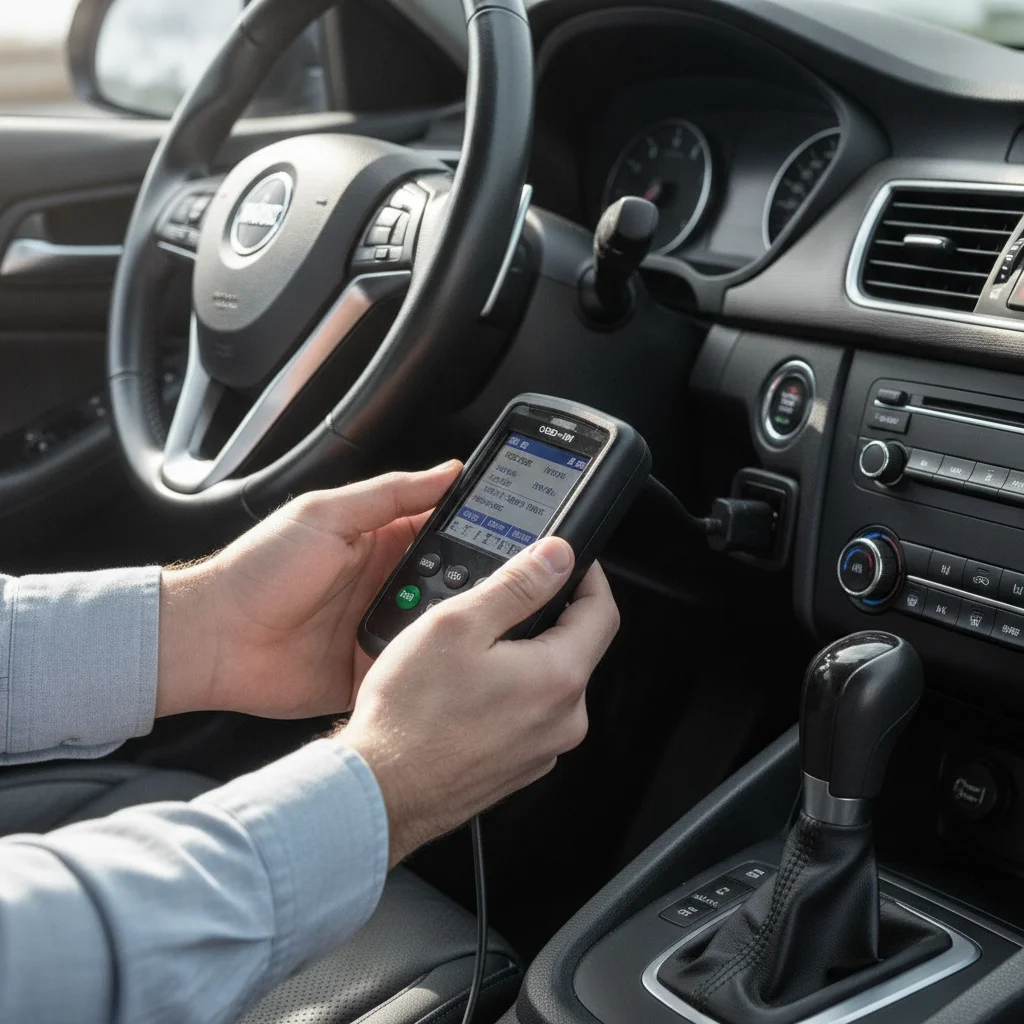
If your car has an active warning light, know what it is before you walk in. An OBD-II scanner (under $30 at any auto parts store) will tell you the fault code. You don't have to fix it, but you should be able to say "it's a P0420 catalytic converter code — common on this model at this mileage" rather than looking caught off guard. Knowledge projects confidence.
Researching Your Car's Value Before You Go
Walking into a dealership without knowing your car's value is the single most avoidable mistake first-time sellers make. Here's how to build a solid number in under an hour.
Run Three Estimates
- Kelley Blue Book (KBB) Trade-In Range: Go to kbb.com and enter your vehicle's year, make, model, trim, mileage, and condition honestly. KBB will give you a trade-in range — pay attention to the range, not just the midpoint. The low end is often close to what dealers open with.
- Edmunds True Market Value (TMV): Edmunds' appraisal tool often runs slightly higher than KBB's trade-in estimate. Use both and average them for a realistic floor to defend.
- Instant offers from online buyers: Get a real written offer from CarMax (online or in-store), Carvana, or Vroom. These are actual purchase offers valid for 7 days, not estimates. This number is your most powerful negotiating tool — it's what you can walk out and do today if the dealer won't budge.
Trade-In Tax Savings Vary by State
Most U.S. states allow you to subtract the trade-in value from the new vehicle's purchase price before calculating sales tax. However, a handful of states — including California — do not offer this benefit. Check your state's DMV or revenue agency website to confirm the rules before factoring tax savings into your trade-in math.
Factor In the Tax Advantage
In most states, trading in reduces the taxable purchase price of your new vehicle. If you're in a state with a 7% sales tax and trade in a car worth $8,000, you save $560 in tax compared to buying the new car outright and selling privately. This real-dollar benefit partially offsets the lower trade-in price — factor it into your break-even math.
For a deeper look at how trade-in tactics fit into the full negotiation strategy, see our step-by-step guide to negotiating trade-in value.
Kelley Blue Book Trade-In Value Tool
Enter your vehicle's details to get a trade-in value range based on current market data. Use the range — not just the midpoint — to set realistic expectations before your dealer visit.
Edmunds True Market Value Appraisal
Edmunds' appraisal tool provides an independent trade-in estimate that often differs slightly from KBB. Running both gives you a defensible floor for negotiation.
CarMax Instant Offer
Get a real, written purchase offer for your vehicle valid for 7 days — online or in-store. This is your most powerful negotiating chip when sitting across from a dealer.
Carfax Vehicle History Report
Pull your own vehicle history report before the dealer does. Knowing about any accidents, title issues, or service gaps in advance prevents surprises that dealers use to justify lowball offers.
Negotiating the Trade-In Without Getting Rolled
The dealership negotiation has a specific structure, and knowing it in advance keeps you from falling into traps that cost real money.
The Most Important Rule: Separate the Transactions
Dealers prefer to negotiate everything together — trade-in value, new car price, financing, and monthly payment — because blending the numbers makes it easier to give with one hand and take with the other. Your job is to keep these conversations completely separate.
Tell them upfront: "I'd like to settle the trade-in value before we discuss the new car price." Some dealers push back. Hold the line. If they won't separate the discussions, that's information too.
How to Use Your Competing Offers
When the dealer comes back with their appraisal, don't react emotionally — just present your homework calmly:
"I have a written offer from CarMax for $X. I'd prefer to do this here for the convenience, but I need you to get closer to that number to make it work."
This is not a bluff. You should genuinely be willing to walk to CarMax. Dealers know CarMax offers are real and current. A $200–$500 bump to keep the deal is a common response.
Tactics That Actually Work
- Let silence work for you. After you present your competing offer, stop talking. Silence is pressure. Let them respond.
- Ask what's dragging the number down. If their offer is significantly below your research, ask specifically: "What condition items are you pricing in?" This forces them to itemize, and you can push back on inflated deductions.
- Be willing to walk. This is not a negotiating tactic — it's a factual stance. If the numbers don't work, selling privately or through CarMax is a real option. Dealers read conviction accurately.
For a broader look at dealership dynamics, our guide on first-time dealership negotiation covers what to expect across the full transaction.
Don't Reveal Your Trade-In Too Early
Walk into the dealership focused on the new car first. If you mention a trade-in at the start, some salespeople use it as a distraction — quoting a favorable trade-in number to anchor you emotionally before the new car price is even on the table. Introduce the trade-in only after you've established the new car's selling price.
Rolled-In Negative Equity Is a Debt Trap
If you're underwater on your current loan, rolling that balance into a new auto loan means you'll immediately owe more than your new car is worth — and you'll pay interest on that deficit for the life of the loan. Calculate your exact payoff amount before any dealer visit so you know precisely how much negative equity you're carrying.
Watch for These Dealer Moves
- The monthly payment pivot: "We'll give you $500 more on the trade-in and just add $20/month to the payment." Run the actual math — $20/month over 60 months is $1,200, not $500.
- The inflated MSRP trick: They raise the new car price slightly to offset a better trade-in offer. This is why you negotiate the new car price separately and know its market value independently.
- The four-square worksheet: A classic tool for obscuring where money moves. If you see it, focus only on the out-of-pocket price per line — don't let them blend numbers.
Trade-In vs. Private Sale: Choosing the Right Path
There's no universally right answer here — only the right answer for your situation. Here's a clear-eyed comparison.
| Factor | Dealer Trade-In | Private Sale |
|---|---|---|
| Net proceeds | 10–20% below retail, but tax savings close the gap partially | Closest to full market value |
| Time and effort | Hours, done in one visit | Days to weeks of listing, showings, negotiations |
| Risk | Very low — dealer handles title transfer | Moderate — you manage payment security, title, and paperwork |
| Loan payoff | Dealer handles it directly | You manage lender payoff and title release |
| Best for | High-mileage vehicles, cars in fair condition, or when time is scarce | Low-mileage, clean-condition vehicles where the price gap is significant |
As a rough rule: if the gap between your best trade-in offer and your best private-sale estimate is under $1,000–$1,500, the trade-in convenience is probably worth it for most people. If the gap is $2,000 or more — especially on a clean, low-mileage vehicle — a private sale deserves serious consideration.
OBD-II Scanner: A $30 Confidence Booster
Before your appraisal, plug a basic OBD-II scanner into your car's diagnostic port to read any stored fault codes. Auto parts stores like AutoZone will also read them for free. Knowing your warning lights in advance lets you disclose issues proactively and prevents the appraiser from using surprise findings to justify a lower number.
The Break-Even Test for Trade-In vs. Private Sale
Subtract your best trade-in offer from your best private-party estimate, then subtract the sales tax savings you'd get from the trade-in (trade-in value × your state's sales tax rate). If what's left is under $1,000, the trade-in is likely worth the convenience. If it's over $2,000, seriously consider selling privately.
For a full walkthrough of the private sale process, see our guide on private car sales for first-time sellers. And if you're weighing an online car-buying platform as an alternative channel, online car buying for first-timers covers that landscape well.
Whatever path you choose, go in knowing your number. The difference between a seller who accepts the first offer and one who walks away with $1,500 more is almost always just preparation — not luck.
For more strategies on maximizing your trade-in, explore the Trade-In Strategies hub for additional guides on this topic.

All claims are backed by peer-reviewed research. Sources on request.