
Key Takeaways
Why Trade-In Negotiations Go Wrong
Most buyers walk into a dealership treating the trade-in as an afterthought — something to hand off while they focus on the new car. Dealers know this, and they're structured around it. The sales manager, the appraiser, and the finance office are a coordinated team. When you let them bundle your trade-in into a single monthly payment conversation, you lose visibility into every number that matters.
Here's what actually happens behind the scenes: the appraiser gives your car a rough wholesale figure, typically $1,500–$3,000 below what the dealer expects to retail it for. The sales manager then has a cushion. If you push hard on the new car price, they give a little there and recoup it on your trade-in allowance. If you push hard on the trade-in, they hold firmer on the new car. The numbers move in a shell game and you never see the full picture.
The only way to win both negotiations is to run them in strict sequence — trade-in value first, new car price second — and to bring market data that removes the dealer's information advantage. That's exactly what this guide walks you through.
For a broader look at how the entire dealer trade-in process works, see The Trade-In Playbook before you start. And if you want to go even deeper on the case for separating these two deals structurally, Separating the Trade-In from the New Car Deal breaks down exactly why bundling costs you money.

What You Need Before You Start
Preparation is where most of your negotiating power gets built. By the time you walk into a dealership, you should already know more about your car's market value than the appraiser pretends to. Here's what to gather:
What you will need
Kelley Blue Book (kbb.com)
Provides a benchmark trade-in value range by ZIP code, condition, and mileage — use the Instant Cash Offer feature for a dealer-redeemable quote.
Edmunds True Market Value
Cross-references KBB and often reflects actual transaction prices more closely, giving you a second data point to defend your position.
CarMax Instant Offer
Generates a real, redeemable written offer valid for seven days — your single strongest piece of leverage at any dealership.
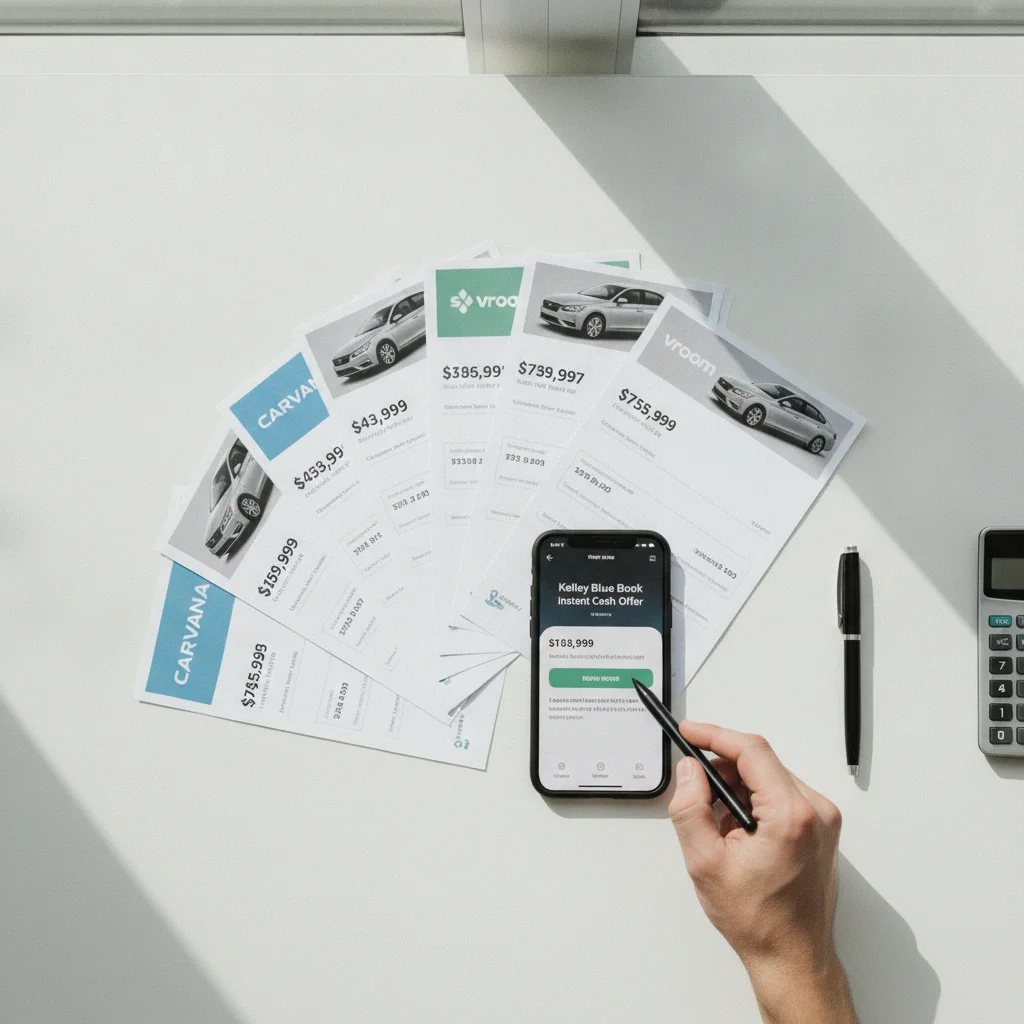
Carvana or Vroom Online Quote
Provides additional competing written offers to establish a credible floor and show the dealer you've done your homework.
Bank or Credit Union Preapproval Letter
Locks in an interest rate baseline so the finance office cannot pad your loan rate without you noticing.
Vehicle History Report (Carfax or AutoCheck)
Lets you proactively address any reported incidents before the appraiser uses them to justify a lower offer.
Pay special attention to the competing written offers. A printout or email confirmation from CarMax, Carvana, or a competing dealer showing a specific dollar amount is worth more than any printout of Kelley Blue Book ranges. It's a floor — a real number a real buyer will pay — and dealerships have a much harder time arguing against it than against a website estimate.
Step-by-Step: The Trade-In Negotiation Process
Follow these steps in order. Skipping ahead — especially jumping to the new car deal before locking in your trade-in value — is the single most common mistake buyers make.
Prepare and price your trade-in before contacting any dealer
Pull your vehicle's value on Kelley Blue Book and Edmunds using your actual mileage, condition, and ZIP code. Be honest about condition — appraisers are trained to downgrade vehicles from "good" to "fair" on the spot, so inflating your starting point only sets up a losing argument. Then get a CarMax Instant Cash Offer and at least one quote from Carvana or a competing dealer. Record each offer with the date, dollar amount, and expiration.
This step happens entirely before you step onto any lot. The data you collect here is your opening hand.
Handle minor prep work that moves the needle on appraisal
A professional detail — interior vacuum, exterior wash and light polish — costs $75–$150 and often recovers $300–$600 in appraisal value simply because the car presents better. Fix genuinely cheap items: replace burned-out bulbs, top off fluids, and address any dashboard warning lights that have inexpensive fixes. Do not spend money on cosmetic repairs that cost more than they'll recover.
Gather your service records and organize them chronologically. An appraiser who can see oil changes at regular intervals is less likely to assume deferred maintenance and apply a discount. For a full breakdown of prep tactics that actually move appraisal numbers, see the complete trade-in value maximization guide.
Get your new car's out-the-door price locked in writing first
Contact the dealership — by email or phone — and negotiate the new vehicle's price before you mention you have a trade-in. Use the dealer's internet sales department if available; they tend to work faster on pricing. Ask for a full out-the-door (OTD) quote that includes all fees, taxes, and dealer add-ons. Compare it against Edmunds TMV for that specific make, model, trim, and ZIP code.
Once the sales manager or internet department confirms the OTD price in writing — via email is sufficient — only then reveal that you also have a vehicle to trade. This sequencing prevents them from inflating the new car price while appearing generous on the trade.
Bring your vehicle in for appraisal — and present your competing offers immediately
Drive your vehicle to the dealership for the formal appraisal. The appraiser will take 15–20 minutes to inspect it, run the VIN, and check current auction data. While they do this, you wait — but you're not empty-handed. When the appraiser or sales manager returns with their first offer, respond by placing your CarMax offer and competing dealer quotes on the desk before you respond verbally.
Say something simple: "I have written offers for [your figure]. I'd prefer to trade here for convenience, but I need your offer to be in the same range to make that work." Let the numbers speak before you negotiate emotionally.
Counter the appraisal offer using market data, not emotion
When you counter, anchor to the highest credible competing offer you have, not to a round number you invented. For example: "CarMax offered me $18,400. I'd take $18,200 here to keep the deal simple." This is specific, defensible, and slightly compromising — which makes it harder for the manager to dismiss.
Expect the manager to come back with a second offer that closes some but not all of the gap. That's normal. Your goal is to get within $300–$500 of your best competing offer. Beyond that, the convenience premium of trading in vs. selling separately typically isn't worth it.
The dealer trade-in hub has additional context on how appraisers use auction data and what wholesale-to-retail margins typically look like if you want to pressure-test the numbers they give you.
Confirm both figures in a single written deal sheet before entering the finance office
Before anyone walks you to the finance office, ask for a deal sheet — sometimes called a worksheet — that shows the new car's OTD price, the trade-in allowance as a separate credit, and the net amount due or financed. Verify that:
- The new car OTD price matches what was confirmed in your earlier email or conversation.
- The trade-in allowance matches the figure the sales manager verbally committed to.
- There are no new fees or add-ons that weren't mentioned previously.
If any number has changed from what was agreed, stop the process and ask for an explanation before continuing. This is a common moment for "pencil mistakes" that happen to benefit the dealer.
Review and finalize in the finance office — don't let the gains slip here
The finance office is a second, often underestimated negotiation. The finance manager's job is to sell you add-on products — extended warranties, GAP insurance, paint protection, tire and wheel coverage — and to place your loan with a lender who pays the dealer a reserve on the interest rate. Your preapproval from a bank or credit union is your benchmark rate. If the dealer offers a lower rate, great. If not, use your preapproval.
On add-ons: every product is optional unless it's required by law. Dealers sometimes present GAP insurance or extended warranties as required for financing — they are not. Decline anything you don't want, and don't let the conversation revert to monthly payment framing to sneak in product costs.
Finally, re-verify the trade-in credit on the final contract. It should match the worksheet exactly. If it doesn't, point it out immediately — before you sign.
Timing Your Visit Can Work in Your Favor
Dealerships have monthly and quarterly sales targets. Visiting in the last three to five business days of the month — especially at quarter's end — puts subtle pressure on the sales team to close deals. Managers are often more willing to close the gap on trade-in value when they're chasing a volume bonus. It won't flip a bad deal into a great one, but at the margins it can be the difference between $200 and $500.
Consider Selling Privately if the Gap Is Too Large
If the best dealer trade-in offer is more than $1,500 below your highest competing written quote, the math often favors selling your car privately or to a direct-buyer service first. Yes, it's two separate transactions, but on a $20,000 vehicle, a $1,500 difference is 7.5% of the car's value — worth the extra few days of effort. Run the numbers before deciding convenience is worth it.
Never Lead with Your Monthly Payment Target
The moment you tell a dealer what monthly payment you can afford, you hand them a tool to structure a deal that works on paper but costs you thousands more. They can extend the loan term, reduce the trade-in credit, or adjust the new car price — all while hitting your target number. Negotiate every line item in dollars, not payments.
Beware of "Trade-In Value" vs. "Trade-In Allowance"
These two terms are not the same. Your vehicle's trade-in <em>value</em> is what the dealer believes your car is worth in the market. Your trade-in <em>allowance</em> is the credit they're giving you toward the new car — which can be inflated to make the deal look better while the new car price is simultaneously raised. Always verify both numbers independently on the deal sheet.
Once you've locked in a written trade-in figure and a separate out-the-door price on the new vehicle, run both numbers through the Trade-In Negotiation Checklist before signing anything. It's a fast gut-check that catches the most common last-minute sleights of hand.
Common Dealer Tactics — and How to Counter Them
Even with solid preparation, you'll encounter resistance. These are the most common dealer moves and the direct counters to each.
The "We Can Only Work in Monthly Payments" Redirect
When a finance manager insists on discussing only what your monthly payment will be, they're deliberately obscuring the trade-in value, interest rate, and purchase price as separate line items. Counter by stating clearly: "I need to see the out-of-pocket purchase price of the new vehicle and the trade-in allowance as separate line items before we discuss financing." Refuse to engage with a monthly payment number until those two figures are confirmed in writing.
The "We Gave You More on the Trade-In" Sleight of Hand
A dealer might offer you an inflated trade-in number while quietly adjusting the new car price upward or removing a promised incentive. This is why you lock in the new car's out-the-door price first, in writing, before bringing the trade-in offer back into the conversation. Any change to the new car price after the trade-in enters the room is a red flag.
The "That Competing Offer Doesn't Apply Here" Dismissal
Some dealers will claim your CarMax quote is for a different trim level, has undisclosed conditions, or simply doesn't reflect their market. Push back calmly: "CarMax will buy my car today at that price, unconditionally. I'd prefer to trade here for convenience, but the number needs to be competitive." If they can't match within a reasonable margin — typically $300–$500 — selling to CarMax and buying the new car separately is often the better financial decision.
The Financing Switcheroo
After you've agreed on trade-in value and new car price, the finance office can still erode your deal by burying points in the loan rate, adding unneeded add-ons, or quietly restating the trade-in allowance differently in the contract. Read every line of the purchase agreement before signing. Verify the trade-in credit matches exactly what was agreed, and confirm the interest rate matches your preapproval or the dealer's written quote.
Read the Full Purchase Agreement Before Signing
Verbal agreements made in the showroom are not binding. The only document that matters legally is the purchase agreement you sign in the finance office. Read every line, compare the trade-in credit and new car price against your worksheet, and don't let time pressure or a friendly demeanor rush you. Dealers are trained to create urgency — "another buyer is interested" or "this rate is only available today" — but a legitimate deal doesn't evaporate in the time it takes you to read a contract.
For situations where the dealer claims your trade-in negotiation is at a hard ceiling, Negotiating a Trade-In When the Dealer Says the Price Is Final gives you specific language and tactics to keep the conversation moving.

When to Walk Away — and What to Do Next
Walking away is not a failure. It's leverage made real. Dealers know that a buyer who has already invested three hours in a negotiation is statistically unlikely to leave — and they price their offers accordingly. Changing that dynamic is as simple as being genuinely willing to leave.
A clear signal that the deal is no longer working: when the gap between your competing offer and the dealer's trade-in appraisal is more than $500–$700 and the sales manager won't budge further after two rounds of counters. At that point, the math usually favors selling your current vehicle privately or to a direct-buy service, then purchasing the new car without a trade-in in the equation at all.
If you go that route, the new car negotiation actually gets simpler — no more shell game, just a single transaction. dealer negotiation tactics work more cleanly when there's only one number on the table.
Before finalizing any deal you do reach, walk through the Complete Playbook for Maximizing Your Car's Trade-In Value to confirm you've squeezed every dollar available. The difference between a well-prepared trade-in and a rushed one is routinely $1,000–$3,000 — sometimes more on higher-value vehicles.

All claims are backed by peer-reviewed research. Sources on request.