

Key Takeaways
Start here
How the New Car Buying Cycle Actually Works
Step 2
Setting a Realistic Budget Before You Shop
Step 3
Researching Models, Trims, and Dealer Inventory
Step 4
Financing: What Happens Before and at the Dealership
Step 5
Negotiating the Deal Without Leaving Money Behind
Final steps
The Finance Office and the Paperwork You'll Sign
How the New Car Buying Cycle Actually Works
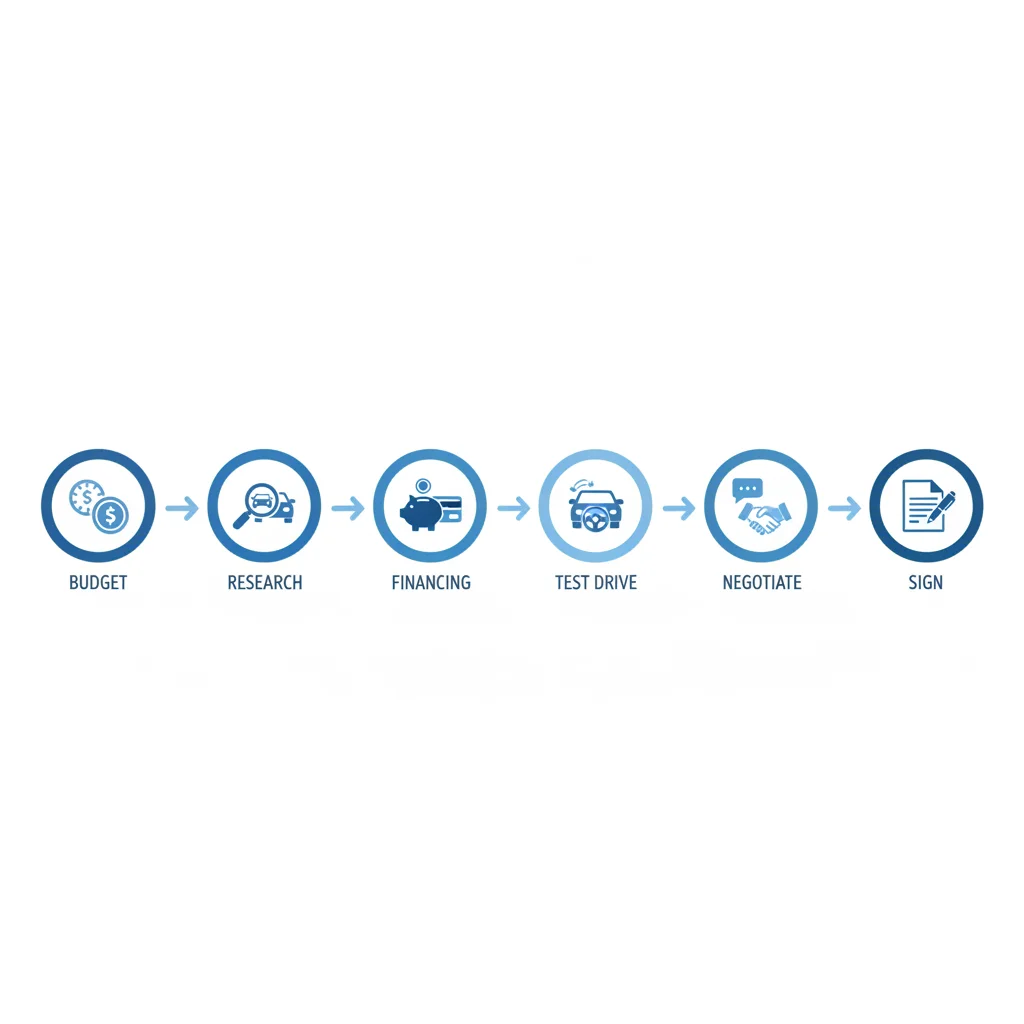
Most first-time buyers walk into a dealership thinking the process is simple: pick a car, agree on a price, hand over the keys to your old one, and drive away. In reality, buying a new car involves six overlapping stages, each with its own decisions and potential pitfalls. Understanding the full cycle before you start keeps you from getting pushed through it on someone else's timeline.
Here's the sequence:
- Budget and affordability check — Before you look at a single vehicle, establish what you can genuinely afford.
- Research and selection — Narrow down makes, models, trims, and feature priorities.
- Financing preparation — Get pre-approved before you set foot in a showroom.
- Test drive and vehicle selection — Confirm the vehicle on paper works for you in practice.
- Negotiation — Settle on the out-the-door price, trade-in value, and financing terms.
- Finance office and delivery — Sign the paperwork, decline or accept add-ons, and take ownership.
Each stage feeds the next. If you skip budgeting, you'll end up negotiating against a monthly payment the dealer controls. If you skip financing prep, the F&I manager controls your rate. The cycle is designed to move quickly — your job is to slow it down and make deliberate decisions at each stop.
If you're weighing whether new is even the right call for you, our comparison of buying a used car for the first time walks through a very different set of considerations.
Setting a Realistic Budget Before You Shop
The single biggest mistake first-time buyers make is starting with a vehicle and working backward to affordability. Start with your numbers, then find the car that fits them.
The Total Cost of Ownership, Not Just the Payment
A $35,000 car with a 72-month loan at 7% APR costs you roughly $41,900 by payoff — $6,900 in interest alone. Factor in:
- Down payment: Aim for at least 10–20% to avoid being immediately underwater on the loan.
- Monthly payment: Most financial advisors suggest keeping total vehicle costs (payment + insurance + fuel + maintenance) under 15–20% of take-home pay.
- Insurance: New cars, especially higher trim levels, carry significantly higher insurance premiums. Get quotes before you commit to a model.
- Registration and taxes: State sales tax on a $35,000 vehicle in a 7% sales tax state adds $2,450 upfront. Title and registration fees vary widely by state but commonly run $200–$600.
- Fuel costs: A truck getting 18 MPG vs. a sedan getting 32 MPG is a real monthly expense difference — run the math for your commute.
Set an Out-the-Door Number, Not a Monthly Payment Target
Dealers love buyers who anchor on monthly payments because it lets them adjust loan terms, interest rates, and add-on prices invisibly. A $600/month car could be a $28,000 vehicle on a 48-month loan at 5%, or a $38,000 vehicle on a 72-month loan at 7.5%. The second buyer pays $10,000 more for the same monthly number.
Never Negotiate on Monthly Payment Alone
If you tell a dealer your target is 'around $550 a month,' they have everything they need to structure a deal that hits that number while maximizing their profit — through longer loan terms, higher rates, or bundled add-ons. Always negotiate the out-the-door price first, then discuss financing separately.
Don't Sign in a Rush at the Finance Desk
F&I managers are skilled at creating urgency — suggesting the rate is only available today, or that the deal will fall apart if you don't sign now. These are pressure tactics. You have every right to read every document, ask for explanations, and take time before signing anything. A legitimate deal will still be there in 20 minutes.
Before moving on to research, decide on your maximum out-the-door (OTD) price — this includes the vehicle price, taxes, fees, and any dealer add-ons. That number is your ceiling in every conversation that follows.
Researching Models, Trims, and Dealer Inventory
Once you know what you can spend, research narrows down which vehicles fit the bill. This phase should happen entirely before you contact a dealer.
MSRP
Manufacturer's Suggested Retail Price — the price the automaker recommends dealers charge. It's a starting point for negotiation, not a fixed price.
Invoice Price
The price a dealer nominally pays the manufacturer for a vehicle. Dealers often receive additional payments called holdback that bring their real cost below invoice.
Out-the-Door Price (OTD)
The total amount you pay to drive home, including vehicle price, dealer fees, taxes, and registration. Always negotiate to this number, not the monthly payment.
APR (Annual Percentage Rate)
The yearly cost of borrowing money expressed as a percentage, including interest and certain fees. A lower APR means you pay less over the life of the loan.
Dealer Reserve
The markup a dealer adds on top of the lender's actual interest rate when arranging your financing. This is profit for the dealer paid by you in the form of higher interest costs.
Gap Insurance
Coverage that pays the difference between what you owe on your car loan and what your insurer pays out if the car is totaled. Useful when you finance most of the vehicle's value.
Trim Level
A specific configuration of a vehicle model that determines which features are included. Higher trims add features but increase cost significantly.
Holdback
A payment from the manufacturer to the dealer — typically 2–3% of MSRP — paid after the sale. It means a dealer's true cost is often below the invoice price they show you.
Where to Research
- Manufacturer websites: Build and price every trim level you're considering. Compare standard versus optional features at each price point.
- Third-party sites (Edmunds, Cars.com, Consumer Reports): Find MSRP, invoice prices, owner reviews, and reliability ratings. Edmunds publishes "True Market Value" (TMV) data showing what buyers in your area are actually paying — not just the sticker.
- Owner forums and communities: Real-world ownership experiences reveal problems that don't show up in press reviews — transmission quirks, software bugs, fuel economy gaps between EPA estimates and reality.
Trim Levels: Where Dealers Make Easy Money
Most automakers offer three to five trim levels on any given model. The base trim is heavily advertised at a low price; the one most buyers actually drive home is two or three levels up. Before you set foot in a showroom, decide which specific trim and which specific options you want. If you walk in undecided, you'll be upsold.
Key questions to answer during research:
- Which features are standard on which trim, and which require higher trims or option packages?
- Are there factory incentives (rebates, low APR offers) currently running on this model?
- What's the current inventory situation — are dealers marking up over MSRP, or discounting to move units?

Checking Dealer Inventory
Most dealers now list their live inventory online. Search by trim and color before you call. If a specific configuration isn't on a lot within a reasonable distance, you can order from the factory — though that adds 6–12 weeks of lead time. During high-demand periods, ordering from the factory has helped buyers avoid dealer markups on in-demand vehicles.
For a full step-by-step walkthrough of the entire purchase sequence, see The New Car Purchase Process, Start to Finish.
Financing: What Happens Before and at the Dealership
Financing is where more first-time buyers get hurt than anywhere else in the process. Here's how to approach it so the dealer's finance office doesn't have all the leverage.
Get Pre-Approved First
Visit your bank or credit union — ideally both — and apply for a pre-approval before you shop. You'll receive a loan offer with a specific rate, term, and maximum amount. This does two things: it tells you exactly what financing costs you on your own, and it signals to the dealer's F&I manager that you're not a captive customer who needs their help.
A credit union pre-approval at 6.5% APR on a $30,000 loan over 60 months costs about $586/month and $5,159 in total interest. If the dealer's manufacturer financing comes in at 4.9%, that's worth $1,350 in savings — take it. If the dealer tries to push 8.9%, you hand over your pre-approval letter and the conversation changes immediately.
Pre-Approval Is Your Best Negotiating Tool
Walk into any dealership with a written pre-approval from your own bank or credit union. It immediately signals that you understand financing and aren't dependent on the dealer's lending relationships. F&I managers adjust their approach — and often their offered rates — when they know you have an alternative.
Email Multiple Dealers for Competing Quotes
Send the same request to two or three dealers within driving distance: 'I'm looking for your best out-the-door price on a [Year] [Make] [Model] [Trim] in [Color].' Tell them you're comparing offers. You don't need to negotiate in person to start the process — and getting dealers to compete by email saves time and emotional energy.
How Your Credit Score Affects Your Rate
Auto loan rates are tiered by credit score. Here's a rough picture of what different score bands typically see from lenders:
| Credit Score Range | Typical New Car APR Range |
|---|---|
| 720 and above | 4.5% – 6.5% |
| 660 – 719 | 6.5% – 9.0% |
| 600 – 659 | 9.0% – 13.0% |
| Below 600 | 13.0% – 20%+ |
These ranges shift with market conditions, but the spread between excellent and fair credit is consistently wide — often 6–10 percentage points. On a $30,000 loan over 60 months, the difference between 5.5% and 12% APR is approximately $5,700 in additional interest paid. If your score is below 660, it may be worth waiting three to six months to improve it before buying.
Dealer Financing and the Interest Rate Markup
When dealers arrange financing through their lending partners, they often add a markup — typically 1–2 percentage points — on top of the rate the lender actually offers. This is called the dealer reserve. It's legal and common. Your pre-approval gives you a reference point to push back on it.
Manufacturer Financing Promotions Can Beat Outside Rates
Car manufacturers periodically run special financing promotions — sometimes 0% APR for qualified buyers — to move specific models or slow-selling inventory. These deals are real, but they typically require excellent credit (720+) and may restrict other rebates you could otherwise stack. Always calculate both options: the low-rate offer versus a higher rate plus a cash rebate.
Negotiating the Deal Without Leaving Money Behind
Negotiation at a new car dealership is not a single conversation — it's three separate negotiations that often get blurred together intentionally: the vehicle price, the trade-in value, and the financing terms. Keep them separate.
Start With the Out-the-Door Price
Open every conversation by asking for the out-the-door price in writing. This number includes vehicle price, all dealer fees, taxes, and title costs. Some dealers add hundreds or thousands in "documentation fees," "market adjustments," or "dealer-installed options" like nitrogen in the tires or window tinting you didn't ask for. Getting OTD in writing surfaces these additions immediately.
Research tells you what similar buyers are paying. If Edmunds TMV shows buyers in your market paying $1,200 below MSRP on this trim, that's your opening anchor. Offer $1,500 below MSRP and negotiate up. If the dealer is marking up over MSRP due to demand, you need to decide whether the vehicle is worth the premium or whether you wait for inventory to normalize.
Get Competing Quotes
Email at least two dealers asking for their best OTD price on the exact same trim and color. Tell each dealer you're getting quotes from multiple sources. This costs you 30 minutes and routinely saves $500–$2,000. Dealers know when they're competing for a sale and adjust accordingly.
Pre-Approval Is Your Best Negotiating Tool
Walk into any dealership with a written pre-approval from your own bank or credit union. It immediately signals that you understand financing and aren't dependent on the dealer's lending relationships. F&I managers adjust their approach — and often their offered rates — when they know you have an alternative.
Email Multiple Dealers for Competing Quotes
Send the same request to two or three dealers within driving distance: 'I'm looking for your best out-the-door price on a [Year] [Make] [Model] [Trim] in [Color].' Tell them you're comparing offers. You don't need to negotiate in person to start the process — and getting dealers to compete by email saves time and emotional energy.
Keep the Trade-In Separate
Dealers prefer to bundle your trade-in into the overall deal because it gives them more variables to play with. Get trade-in offers from CarMax, Carvana, or KBB Instant Cash Offer before your visit. These are real, time-limited offers you can bring to the dealer. If the dealer's trade-in offer beats them, great. If not, sell your car separately and walk in with clean buying power.
Our guide on dealer trade-ins for first-time sellers walks through what to expect during that part of the process.
For a deeper dive into the negotiation itself, what to expect negotiating at a dealership for the first time covers tactics, common dealer scripts, and how to respond to each.
The Finance Office and the Paperwork You'll Sign
You've agreed on a price. Now you're handed off to the finance and insurance (F&I) manager. This is where many buyers who negotiated well on the car price give back their savings. F&I managers are typically among the highest-paid people in a dealership — and their income depends heavily on what they sell you in this room.
Documents You Will Sign
- Retail Installment Sales Contract (RISC): The primary loan agreement. Verify the APR, loan term, monthly payment, and total amount financed match exactly what was agreed upon. Do not sign if the numbers differ from what you discussed.
- Buyer's Order: The itemized breakdown of the vehicle price, fees, trade-in credit, rebates, and down payment. Review every line.
- Odometer Disclosure: Federal requirement disclosing current mileage.
- Title and registration paperwork: State-specific forms transferring ownership.
For a full breakdown of what each document means, see the Paperwork & Contracts hub.
What the F&I Manager Will Try to Sell You
Expect a presentation of additional products after you've settled into the finance chair. Common offerings include:
- Extended warranty (Vehicle Service Contract)
- Can have genuine value — but the dealer's price is often 200–400% of what you'd pay from a third-party provider or directly through the manufacturer after purchase. Never buy on the spot; prices are negotiable and available elsewhere.
- Gap insurance
- Worth having if you're financing more than 80% of the vehicle's value. Your auto insurer typically offers gap coverage for $20–$40/year — far less than the $500–$1,000 the dealer often charges.
- Paint and fabric protection
- Rarely worth the price. Quality paint sealant can be purchased and applied independently for a fraction of dealer pricing.
- Credit life and disability insurance
- Almost universally overpriced. Term life insurance through a separate policy delivers far better value.
Never Negotiate on Monthly Payment Alone
If you tell a dealer your target is 'around $550 a month,' they have everything they need to structure a deal that hits that number while maximizing their profit — through longer loan terms, higher rates, or bundled add-ons. Always negotiate the out-the-door price first, then discuss financing separately.
Don't Sign in a Rush at the Finance Desk
F&I managers are skilled at creating urgency — suggesting the rate is only available today, or that the deal will fall apart if you don't sign now. These are pressure tactics. You have every right to read every document, ask for explanations, and take time before signing anything. A legitimate deal will still be there in 20 minutes.

If you prefer to skip the dealership experience entirely, online car buying for first-timers covers how the process shifts when you buy through a digital retailer.
After You Drive Off the Lot
Ownership doesn't end at the signature — it begins there. A few steps in the first 30 days protect both your investment and your legal standing.
Insurance Confirmation
Your lender requires comprehensive and collision coverage for the life of the loan. Confirm with your insurer that your new vehicle is active on your policy before you drive home — most insurers extend temporary coverage when you notify them of a purchase, but you need to call and make the switch official. Add gap insurance to your auto policy if you didn't get it through the dealer.
Review Your First Statement
When your first loan statement arrives, verify the payment amount, due date, and total balance owed match the retail installment contract you signed. Errors are rare but not unheard of. Set up autopay to avoid late fees that can damage your credit score.
Manufacturer Registration and Warranty Activation
Register your vehicle with the manufacturer through their owner portal or app. This activates your warranty, allows for recall notifications, and often unlocks connected services. Keep your window sticker (Monroney label) and all signed documents in a safe place — you may need them for warranty claims or future trade-in negotiations.
Scheduled Maintenance
Read the owner's manual section on the maintenance schedule. New cars require an oil change at specific mileage intervals — often around 5,000–10,000 miles depending on the model and oil type. Missing early scheduled maintenance can complicate warranty claims if a mechanical issue arises.
Edmunds True Market Value (TMV)
Shows what buyers in your local market are actually paying for a specific trim — not just the sticker price. Use it to anchor your negotiation before you contact any dealer.
MyFICO Auto Loan Calculator
Lets you model monthly payments and total interest across different loan amounts, APRs, and term lengths — critical for comparing dealer financing against your pre-approval.
KBB Instant Cash Offer
Get a real, time-limited offer on your trade-in before you visit a dealer. Use it as a floor — any dealer offer below this number means you're better off selling separately.
CFPB Auto Loan Toolkit
The Consumer Financial Protection Bureau's plain-language guide to auto financing, covering your rights, how to compare offers, and what to watch for in loan documents.
The New Car Purchase Process, Start to Finish
A detailed stage-by-stage walkthrough of every step from setting a budget to signing the final paperwork — pairs directly with this beginner's guide.
If you want a broader look at how new car buying compares to other paths — private sales, online retailers, or used vehicles — the complete roadmap to buying a used car is a useful contrast to what you've just learned.
All claims are backed by peer-reviewed research. Sources on request.