


Key Takeaways
Start here
How the Dealership Is Set Up to Work Against You
Prepare
Do This Before You Set Foot on the Lot
At the table
The Negotiation Playbook: What They'll Say and What You Should Say Back
Watch out
The Finance Office: Where Dealers Make Their Real Money
If you're trading in
Trade-Ins: Keep It Separate from the Purchase Price
Final move
When to Walk Away — and Why It Works
How the Dealership Is Set Up to Work Against You
I spent seven years in dealership finance offices. The first thing I'll tell you is that dealerships are not designed for your comfort — they're designed to maximize per-vehicle profit. Understanding the structure is the first step to fighting back.
A typical dealership negotiation involves at least two separate people working as a coordinated team: the salesperson and the finance manager (also called the F&I manager). The salesperson handles the test drive, the emotional sell, and the initial price negotiation. The finance manager handles the loan, the paperwork, and — most importantly — a second round of add-on selling that many buyers don't even recognize as negotiation.
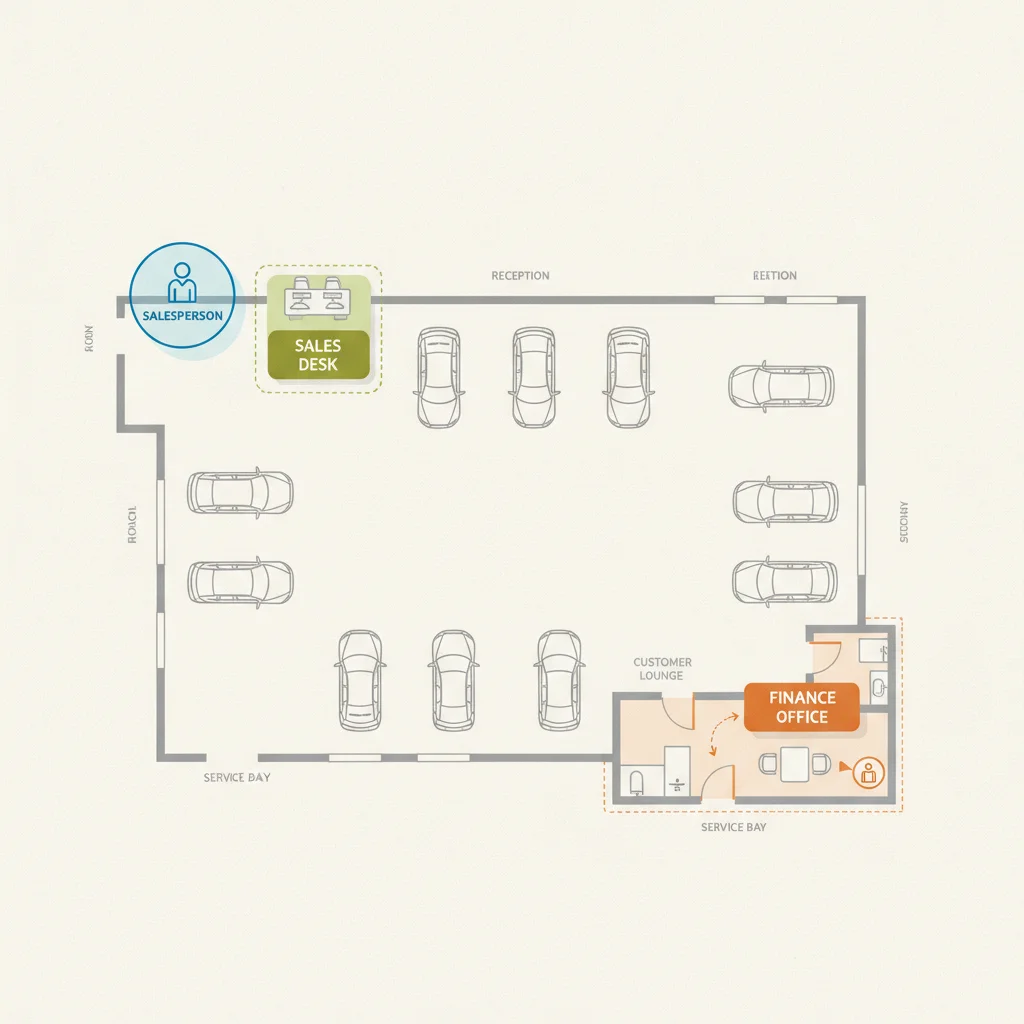
The dealership's profit comes from several buckets simultaneously:
- Front-end profit: The markup between invoice price and what you pay for the vehicle.
- Back-end profit: Financing markup, extended warranties, paint protection, and other add-ons sold in the finance office.
- Holdback: A rebate the manufacturer pays the dealer after the sale — typically 1–3% of MSRP — meaning even a deal at invoice still earns the dealer money.
- Manufacturer incentives: Bonus cash paid to dealers who hit volume targets, which gives them room to cut deals at month-end.
When a salesperson says "I'm losing money on this deal," they almost certainly aren't. They're referring to front-end profit only, and the back-end can easily make up the difference. This is why negotiating just the sticker price isn't enough — you have to manage every part of the transaction.
MSRP
Manufacturer's Suggested Retail Price — the sticker price set by the automaker. It's the starting point for negotiation, not the fair price.
Invoice Price
The amount the dealer paid the manufacturer for the vehicle. This is your negotiation anchor — aim to pay as close to this as possible.
Out-the-Door Price
The total you actually pay, including the vehicle price, taxes, title, registration, and dealer fees. Always negotiate this number, not the monthly payment.
Dealer Reserve
The difference between the loan rate a lender approves you for and the higher rate the dealer quotes you. The dealer keeps the difference as profit.
Holdback
A quarterly rebate manufacturers pay dealers — typically 1–3% of MSRP — after a vehicle sells. It means dealers still profit even on deals at invoice price.
F&I Manager
The Finance and Insurance manager who handles your loan paperwork and sells add-on products. Their compensation is tied to how many products they sell you.
GAP Insurance
Covers the gap between what you owe on your loan and what your car is worth if it's totaled. Useful on high loan-to-value deals, but often cheaper through your own insurer.
Pre-approval
A loan offer from your own bank or credit union, issued before you shop. It gives you a rate benchmark and negotiating leverage in the finance office.
If you want to explore an alternative approach that sidesteps some of this pressure entirely, online car buying for first-timers walks through how the remote purchase process works and where it differs from the showroom experience.
Do This Before You Set Foot on the Lot
The single biggest mistake first-time buyers make is walking into a dealership before they've done any research. Preparation isn't optional — it's where most of your negotiating power comes from.
Know the Numbers That Matter
Before you visit any lot, you need three figures:
- MSRP (Manufacturer's Suggested Retail Price): The sticker price. This is the ceiling, not the target.
- Invoice price: What the dealer paid the manufacturer for the car. Sites like Edmunds and KBB publish this. It's your starting reference point for negotiation.
- Market price / recent transaction data: What people in your area are actually paying. Edmunds' "True Market Value" and similar tools aggregate real transaction data. This tells you whether inventory is tight (prices run high) or if the model is sitting on lots (you have leverage).
Email Dealers Before You Visit
Contact the internet sales department of three to five dealers via email or their website. Request an out-the-door price quote for a specific make, model, trim, and color. Dealers who know you're shopping multiple lots tend to sharpen their numbers quickly. This also gives you written quotes to bring to in-person negotiations.
Get Competing Trade-In Offers First
Before visiting any dealership, get your trade-in appraised by CarMax, Carvana, or a similar service. These appraisals take 20–30 minutes and give you a firm, no-obligation offer that's valid for several days. Use it as a floor — any dealer who won't match it loses the trade-in business.
Get Pre-Approved for a Loan
Walk in with a loan offer in hand from your bank or credit union. This does two things: it tells you exactly what interest rate you actually qualify for, and it gives you a benchmark to compare against whatever the dealer's finance office offers. If the dealer can beat your rate, great — let them. If they can't, you already have your financing locked.
Pre-approval also signals to the dealer that you're a serious, informed buyer, which tends to produce more straightforward negotiations. For a deeper look at how dealer financing stacks up, see negotiating a new car price without feeling outmatched.
Know Your Credit Score
Check your credit report before the dealer does. If there are errors, dispute them. If your score is lower than you expected, understand what rate tier you'll likely fall into — and don't accept a rate that's worse than your tier warrants. Dealers are legally allowed to mark up interest rates (called a "dealer reserve"), and they will if they think you don't know your number.
Set a Hard Budget — Including All Costs
Decide your maximum out-the-door number before you go in. Include estimated taxes, registration, and a reasonable dealer doc fee. In most states, doc fees range from $100–$500, though some states cap them. If you're unsure what taxes and fees look like in your state, use an online auto loan calculator to build your estimate.
The Negotiation Playbook: What They'll Say and What You Should Say Back
Dealership salespeople aren't villains — they're trained professionals doing a job. Knowing their scripts in advance removes the psychological pressure and lets you respond from a position of knowledge.

"What monthly payment are you looking for?"
Why they ask it: Monthly payment framing lets them obscure the total cost of the vehicle. They can stretch a loan term to 84 months, keep your payment where you want it, and still make thousands more profit.
What to say: "I'm focused on the out-the-door price, not the monthly payment. What's the best price you can do on this vehicle?" Repeat this every time the conversation drifts back to payments.
"This deal is only good today."
Why they say it: Artificial urgency is a classic pressure tactic. Most "today only" deals are available tomorrow unless the vehicle genuinely sells.
What to say: "I understand. I'm not ready to make a decision today, but I want to make sure I have your best number in writing so I can compare." Good deals don't evaporate; pressure tactics do when you don't react to them.
"Let me go check with my manager."
Why they do it: This gives the sales team time to regroup, lets the manager play good cop later, and wears down your patience. Long waits are intentional.
What to say: Stay relaxed. Bring something to read. When they return, ask: "Did you get authorization to accept my offer?" Keep the focus on your number, not theirs.
"We're already losing money at this price."
Why they say it: They're almost certainly not. See the holdback and back-end profit explanation above.
What to say: "I appreciate that, but my research shows invoice on this trim is around . I'm offering above invoice, which is a fair deal. Can you make that work?" Specific numbers beat vague claims every time.
Don't Sign Anything You Haven't Read
Finance offices move fast — intentionally. Stacks of paper, rapid explanations, and a casual "just sign here" rhythm are designed to get you through the process before you notice what you've agreed to. Slow down. Read every line. Ask what every charge is for. If they add urgency, that's a red flag, not a reason to hurry.
For a complete walkthrough of how negotiations unfold from the first email through final signature, car dealer negotiation from first contact to final signature goes stage by stage with tactics for every step.
The Finance Office: Where Dealers Make Their Real Money
You survived the showroom floor. You agreed on a price. Now the salesperson walks you back to a small office with a desk, a computer screen, and a very friendly person in a button-down shirt. This is the finance office — and it's where first-time buyers lose the most money they never knew they were losing.
The F&I manager's job is to sell you financing and add-on products. Their commission depends on it. The products themselves aren't all bad — some are legitimate — but the markup is almost always enormous, and the presentation is designed to make everything sound cheap and necessary.
Common Add-Ons and How to Evaluate Them
| Product | Typical Dealer Price | Reality Check |
|---|---|---|
| Extended warranty | $1,500–$4,000 | Heavily marked up. If you want one, buy from a third-party provider or negotiate the price hard. |
| GAP insurance | $400–$900 | Useful if you're financing over 80% of the car's value, but your own insurer often sells it for $20–$40/year. |
| Paint/fabric protection | $200–$800 | Usually already applied; you're paying for something you didn't ask for. |
| VIN etching | $100–$300 | You can buy a DIY kit for $25. Decline or demand it at cost. |
| Tire and wheel protection | $300–$700 | Has legitimate uses, but read the exclusions carefully — many claims are denied. |
The Rate Markup You Don't See
When the dealer arranges your financing, the lender gives the dealer a "buy rate" — the base rate you actually qualify for. The dealer is then allowed to mark that rate up and keep the difference as profit. On a $30,000 loan over 60 months, a 1% rate markup costs you roughly $780 over the life of the loan. Two percent costs you $1,550.
This is exactly why you want your pre-approval in hand. When you have a competing offer, the dealer must beat it — or lose the financing business entirely.
Rate Markups Are Legal — But Negotiable
Dealers are legally permitted to mark up the interest rate on your loan and keep the difference. This practice, called dealer reserve, was the subject of regulatory scrutiny but remains widespread. The only reliable defense is knowing your actual qualifying rate before you walk in. If the dealer's rate is higher than your pre-approval, ask them to beat it or use your own financing.
You Can Leave the Finance Office and Come Back
You are not legally obligated to complete the finance office visit in a single sitting. If you feel overwhelmed or pressured, it's acceptable to say you'd like to review the add-on pricing at home and return the next day. The car will still be there. Any dealer who claims otherwise is using pressure tactics.
The bottom line: go into the finance office with a list of what you want (if anything) and a polite but firm "no" ready for everything else. Don't let the friendly atmosphere and rapid paperwork pressure you into agreeing to products you haven't had time to evaluate.
Trade-Ins: Keep It Separate from the Purchase Price
If you're trading in a vehicle, this is one of the most important rules you'll read: negotiate the purchase price of the new car first, completely separate from any discussion of your trade-in.
Dealers love to bundle these two transactions because it gives them enormous flexibility to obscure where the profit is coming from. They might offer you $2,000 more for your trade-in while quietly raising the new car price by $2,500. On paper it looks like a good deal on the trade; in reality you've paid more overall.
How to Separate the Transactions
- Negotiate the new car's out-the-door price to a number you're satisfied with. Get it in writing.
- Only then bring up your trade-in. Say: "Now, separately, I have a vehicle I'd like to trade in. What will you offer for it?"
- Compare the trade-in offer to independent appraisals you've already gotten from CarMax, Carvana, or similar services. These offers are often valid for 7 days and serve as concrete competing bids.
Email Dealers Before You Visit
Contact the internet sales department of three to five dealers via email or their website. Request an out-the-door price quote for a specific make, model, trim, and color. Dealers who know you're shopping multiple lots tend to sharpen their numbers quickly. This also gives you written quotes to bring to in-person negotiations.
Get Competing Trade-In Offers First
Before visiting any dealership, get your trade-in appraised by CarMax, Carvana, or a similar service. These appraisals take 20–30 minutes and give you a firm, no-obligation offer that's valid for several days. Use it as a floor — any dealer who won't match it loses the trade-in business.
If the dealer's trade-in offer doesn't come close to your competing offers, you can sell your vehicle privately or to a third-party buyer separately. Yes, it takes more effort — but on a $15,000 trade, a $1,500 difference in offer price is real money.
For a thorough look at how trade-in appraisals work and how to negotiate them effectively, dealer trade-ins for a first-time seller covers the full process. You can also explore the broader dealer trade-ins hub for comparisons and strategy guides.
When to Walk Away — and Why It Works
The single most powerful move you have in a dealership negotiation costs you nothing: standing up, thanking the salesperson for their time, and walking toward the door.
Walking away works for two reasons. First, dealerships have a high cost structure — floor plan financing, salaries, utilities — and every day a car sits on the lot costs them money. A bird-in-hand buyer who walks is a real loss. Second, most salespeople would rather take a thinner deal than watch a customer leave for a competitor.
When Walking Away Is the Right Move
- The dealer won't get close to your researched target price after two or three counters.
- They're adding fees or add-ons that weren't part of the agreed deal.
- The finance office is pressuring you to decide on add-ons before you've had time to think.
- The numbers presented in the finance office don't match the numbers agreed on the floor.
- You feel rushed, confused, or manipulated.
How to Walk Away Without Burning the Bridge
Keep it professional. Say: "I appreciate your time, but the numbers aren't where I need them to be. I'm going to continue my search. If anything changes, here's my number." Leave your contact info. In my experience, roughly half of customers who walk receive a follow-up call within 24–48 hours with a better offer.
Rate Markups Are Legal — But Negotiable
Dealers are legally permitted to mark up the interest rate on your loan and keep the difference. This practice, called dealer reserve, was the subject of regulatory scrutiny but remains widespread. The only reliable defense is knowing your actual qualifying rate before you walk in. If the dealer's rate is higher than your pre-approval, ask them to beat it or use your own financing.
You Can Leave the Finance Office and Come Back
You are not legally obligated to complete the finance office visit in a single sitting. If you feel overwhelmed or pressured, it's acceptable to say you'd like to review the add-on pricing at home and return the next day. The car will still be there. Any dealer who claims otherwise is using pressure tactics.
If walking feels too high-stakes, remember that you're dealing with a business transaction. The salesperson will negotiate again in an hour with another customer. Your job is to get the best deal for yourself, not to make the dealership's quota easier to hit.
For buyers who want to manage more of this process from home before ever visiting in person, what to know when buying new cars and the broader full negotiation walkthrough are worth bookmarking before your visit.
Edmunds True Market Value
Aggregates real transaction data to show what buyers in your area are actually paying for a specific make, model, and trim. Use it to set your target price before negotiating.
CarMax Instant Offer
Get a firm, no-obligation trade-in appraisal online or in-store in under 30 minutes. Use this offer as a floor when negotiating your trade-in value at a dealership.
Negotiating a New Car Price Without Feeling Outmatched
A companion article covering advanced price negotiation tactics for new car buyers, including how to handle counter-offers and when to stop pushing.
Car Dealer Negotiation from First Contact to Final Signature
A full-length walkthrough of every stage of the dealer negotiation process — from the first email inquiry through signing the final paperwork.
Annual Credit Report (AnnualCreditReport.com)
The only federally mandated free credit report source. Check all three bureaus before applying for any auto loan to catch errors that could raise your rate.
Online Car Buying for First-Timers
If the showroom experience feels like too much pressure, this guide walks through buying a car entirely online — from search to home delivery.
All claims are backed by peer-reviewed research. Sources on request.